
How to Tell if Furnace Has Pilot Light or Hot Surface Igniter
Key Takeaways
- A standing pilot light is a small flame that burns all the time. It usually means an older furnace.
- An intermittent pilot clicks, lights a small flame, and shuts that flame off after the heat cycle.
- A hot surface igniter is silent. You see an orange glow, then the main burners light.
- An igniter is not the same thing as a pilot light. Both start the burners, but they work differently.
- If you smell gas, leave the house first. Call from outside.
- Igniter repairs are routine on newer furnaces. Repeated failures on an old unit point toward replacement.
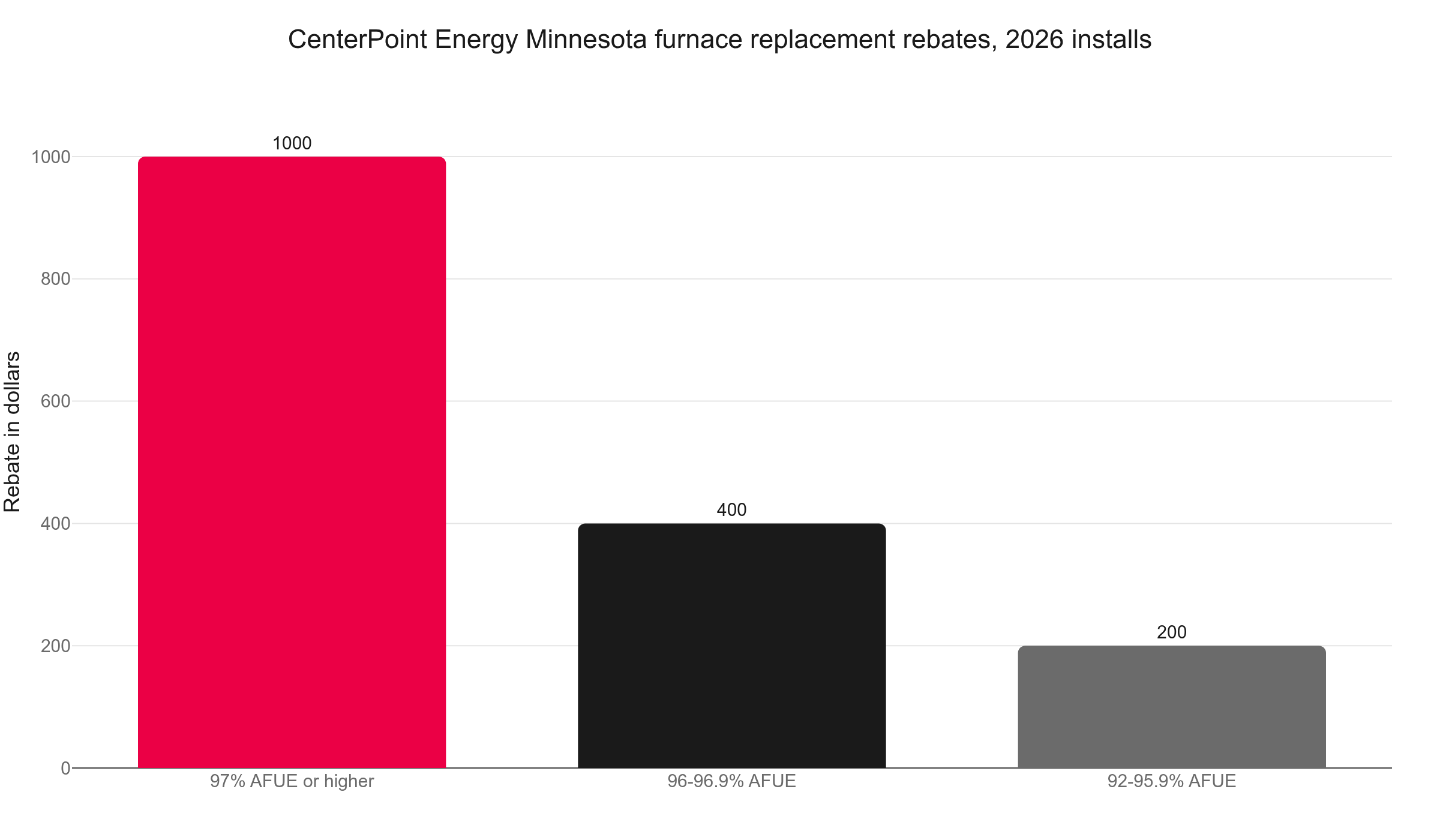
- CenterPoint Energy Minnesota offers rebates up to $1,000 for qualifying furnaces installed in 2026.
The Short Answer: Look, Listen, and Watch the Burners
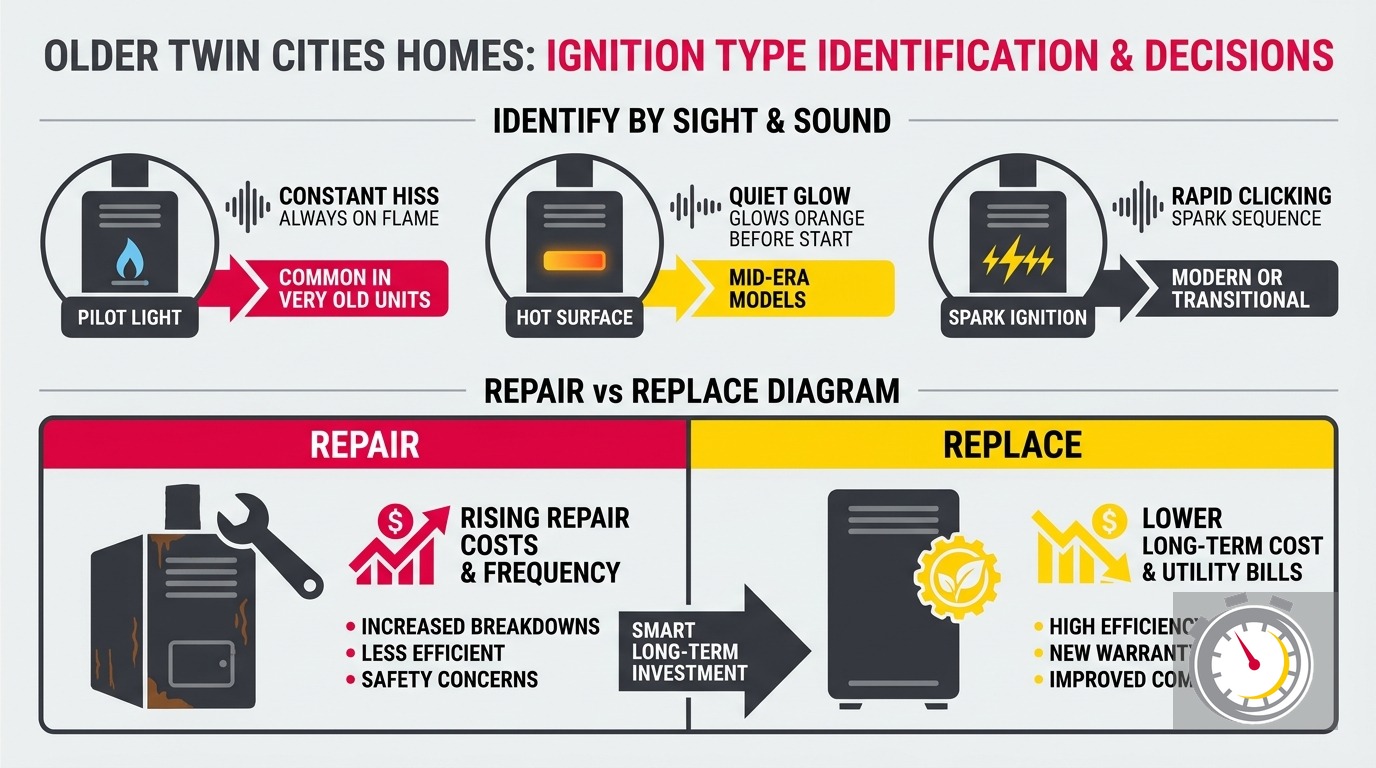
You can tell your furnace ignition type in about two minutes. Look through the burner window as the furnace starts, and listen closely. A small flame that burns all the time is a standing pilot light. Clicking, then a small flame, means an intermittent pilot. A quiet orange glow with no flame beforehand is a hot surface igniter.
The ignition type hints at the furnace’s age. It points to the most likely cause of a no-heat morning. It also shapes the repair-or-replace decision.
We are Northern One Hour, a locally owned and operated Twin Cities heating and cooling company. Many homes we visit have a furnace tucked in a basement corner or utility closet, and homeowners often cannot tell what they have. The steps below will help you work it out.
What Are the Three Ignition Types in a Gas Furnace?
A gas furnace lights its burners one of three ways: a standing pilot light, an intermittent pilot, or a hot surface igniter. Each starts the flame differently, and each gives off sights and sounds you can spot yourself.
Standing pilot. A tiny flame burns day and night. When the thermostat calls for heat, the gas valve opens. The main burners catch fire from that pilot flame. This is the oldest design.
Intermittent pilot. A spark lights a small pilot flame only when heat is needed. A sensor confirms the flame. Then the gas valve opens and the main burners light, according to one contractor’s explanation of how these systems work. When the cycle ends, the pilot goes out.
Hot surface igniter. A small electric element heats until it glows. It lights the gas directly. There is no pilot flame at any point. This is the most common design in modern furnaces.
One more type exists: the direct spark igniter. It makes a loud clicking noise, while a hot surface igniter runs quietly. You rarely need to tell the two apart. Both are electronic, and neither keeps a flame burning all the time.
How Can You Tell Which Ignition Type You Have?
Open the furnace’s front panel only if the owner’s manual says it is safe. Most furnaces have a small viewing window near the burners. Watch through it as the furnace starts. You are looking for three clues: a flame already burning, clicking, or a glow.
Here is the sight and sound test. Start with the thermostat set below room temperature, so the furnace is idle.
- Look first. Check the burner window before the furnace starts. Do you see a small, steady flame?
- Raise the thermostat. Set it a few degrees above room temperature. Then stand near the furnace.
- Listen. Do you hear rapid clicking, or nothing at all?
- Watch the window. Look for a glow, a small flame, or both.
- Watch the end of the cycle. When the furnace shuts off, does a small flame stay on?
Now match what you saw to this list.
- Small flame before the call for heat, and still lit after: standing pilot light.
- Clicking, then a small flame that disappears after the cycle: intermittent pilot.
- No flame before heat, a quiet orange glow, then the main burners: hot surface igniter.
- Loud, steady clicking, then burners: direct spark igniter.
A few more clues help. A small knob labeled PILOT, ON, and OFF on the gas valve points to a standing pilot. A thin, dark, curved element near the burners is often a hot surface igniter. The data plate gives the model number and age. Our guide on finding your HVAC system’s age shows how to read it.
Never put your hand or a tool near the burners while the furnace runs. Look and listen only.
Is an Igniter the Same as a Pilot Light?
No. A pilot light is a small flame that exists to light the main burners. An igniter is an electric part that creates a spark or a glowing hot surface. Both start the burners, but an igniter has no flame of its own and uses no gas while idle.
People say “the pilot” for any ignition trouble, and that causes confusion on the phone. Tell a technician “my pilot is out” when you have a hot surface igniter, and they start in the wrong place.
Here is the practical difference:
- Pilot light: a flame you can see. If it goes out, you may be able to relight it.
- Igniter: an electric part you cannot relight. If it fails, a technician replaces it.
ENERGY STAR notes that electronic ignition eliminates the need to have the pilot light burning all the time. That page covers boilers, but the efficiency principle applies to gas furnaces too. A flame that burns around the clock uses gas all year, including summer.
If your furnace has an igniter and the heat stops, there is nothing to relight. Check the basics: power, thermostat, filter, and error codes. Our furnace error code guide explains the blinking light on the control board.
How Can You Tell if the Furnace Pilot Light Is Out?
If you have a standing pilot, look through the burner window. A lit pilot shows a small, steady flame. No flame means the pilot is out. You will usually have no heat too, and the burners will not light when the thermostat calls for warmth.
A few other clues point the same way:
- The furnace is silent when the thermostat calls for heat.
- The gas valve knob sits in the PILOT position, but no flame shows.
- Other gas appliances, like the water heater, work fine.
Drafts, a dirty pilot tube, a weak thermocouple, or a gas supply problem can all blow a pilot out. A thermocouple is a small safety sensor that shuts off gas when the pilot flame dies.
The furnace label shows the relighting steps. Follow them in order, and do not skip the waiting period it lists. That wait lets any unburned gas clear out.
Stop if you smell gas, if the pilot will not stay lit, or if you feel unsure. Our guide on a pilot light that keeps going out covers the causes in more depth.
If you have an intermittent pilot or igniter, you will not see a flame waiting at idle. That is normal. A missing flame at rest is not a sign of trouble in those systems.
What Should You Do if You Smell Gas or See a Yellow Flame?
These are safety problems that need a professional. If you smell gas, leave the house right away. Do not flip switches or use a phone inside. Call your gas utility and 911 from outside. A yellow or orange burner flame can signal poor combustion and needs a technician.
Here is the safety script for older homes:
- Smell gas? Walk out. Take everyone, including pets. Call from a neighbor’s house or your driveway.
- Alarm sounding? A carbon monoxide alarm is a signal to get fresh air and call for help. Read our post on a CO alarm going off near the furnace to see what to do next.
- Flame looks yellow or orange? Burner flames should be mostly blue. See our post on yellow versus blue furnace flames for details.
- Pilot keeps going out? Do not keep relighting it. Call a technician.
Our post on what to do if you smell gas has more detail. Keep working carbon monoxide alarms on each level of the house. Older homes need them most.
Do not attempt repairs to gas valves, burners, or pilot safety controls on your own. Those parts need a trained professional. A wrong repair can create a leak you cannot see.
Why Won’t My Furnace Make Heat During the First Cold Snap?
A furnace that sat idle all summer gets its first real test in the first cold snap. Common causes include a dirty or worn ignition part, a clogged filter, a tripped switch, or a dirty flame sensor. A standing pilot may also have gone out over the summer.
Think about what changed. Nobody touched the furnace for months, and dust settled on the parts. Then the first cold morning arrives, and every home on the street turns on its heat at once.
Check these items in order:
- Thermostat. Set it to heat, and raise the setting a few degrees above the room temperature.
- Power. Look for a tripped breaker and the furnace switch near the unit. It often looks like a light switch.
- Filter. A clogged filter can shut a furnace down. Replace it if it looks gray and packed.
- Pilot. If you have a standing pilot, look for a flame in the window.
- Igniter. If you have a hot surface igniter, watch for the orange glow. No glow may mean a failed part.
A hot surface igniter is fragile. It can crack with age, and a crack may show up only when the furnace first runs hard. Our post on furnaces that will not ignite on a cold morning covers the full list of causes. Our igniter failure guide shows the warning signs.
A no-heat call in January can be urgent. After-hours service adds $180 to $270 per hour on top of standard rates. A fall tune-up helps you avoid that. Our fall startup checklist shows what to do before the cold arrives.
Can a Furnace Be Repaired if It Keeps Shutting Off Unexpectedly?
Usually yes. A furnace that starts and then quits is often showing you a safety part at work. The cause can be a dirty flame sensor, a weak igniter, a clogged filter, or a blocked vent. A technician finds it by testing the ignition sequence step by step.
Most of these repairs are modest. A flame sensor confirms that the burner flame is lit. When it is coated in residue, it cannot see the flame, and the furnace shuts the gas off for safety. Cleaning or replacing it often fixes the problem. Flame sensor or igniter service typically runs $95 to $325 in the Twin Cities.
Watch the pattern when it happens:
- Burners light, then go out in a few seconds: often a flame sensor issue.
- No glow at all from the igniter: the igniter or its wiring may have failed.
- Furnace tries a few times, then stops: the control board may have locked out.
- Runs a few minutes, then shuts off: look at the filter, vent, and limit switch.
Technicians test an igniter with a meter. A worn element may read high resistance before it fails completely. That is one reason a tune-up can catch a weak part early.
If the furnace locks out and will not reset, read our guide on ignition lockout. Do not press reset again and again. Repeated attempts can build up unburned gas.
For repair help, see our furnace repair service.
Repair or Replace: What Each Ignition Type Tells You
Ignition type is a clue to a furnace’s likely age and efficiency. Repair history, safety, and cost fill in the rest. Here is a simple framework we use with Twin Cities homeowners.
Standing pilot light.
This usually means a very old, low-efficiency furnace. One contractor source notes these units waste gas by burning a pilot all year. If the furnace also has other problems, replacement is often the better move. A single cheap fix on a pilot-light furnace may still buy you a season. But you are spending money on a unit near the end of its life.
Intermittent pilot.
This sits in the middle. These furnaces are newer than standing-pilot models but older than most igniter furnaces. Check the age and repair history before deciding.
Hot surface igniter.
A failed igniter on a newer furnace is a routine, inexpensive repair. Fix it and move on. The rest of the furnace is probably in good shape.
Repeated igniter failures on an old unit.
If the igniter has failed more than once, look at the whole picture. Something else may be stressing the part. A furnace past 15 years with repeated repairs deserves a replacement quote. Our guide on how long furnaces last in Minnesota helps you judge. Our post on repairing or replacing a system adds a decision checklist.
A good rule of thumb is to ask three questions.
- Is the furnace old, or has it failed before?
- Is the repair small compared to a new furnace?
- Are there any safety concerns, such as a cracked heat exchanger or CO?
Two or three “yes” answers lean toward replacement. Safety concerns always lean toward replacement or immediate repair.
What Does Furnace Replacement Cost, and What Rebates Apply?
In the Twin Cities, a furnace replacement typically runs $3,900 to $7,800 installed. Efficiency drives the price. An 80% AFUE furnace starts around $4,950. A 95-96% unit starts around $6,500. A 97-98% unit starts around $9,100. Our furnace replacement cost guide breaks down the factors.
Rebates can offset part of the price. CenterPoint Energy Minnesota lists these amounts for forced-air furnaces installed January 1 to December 31, 2026:
- $1,000 at 97% AFUE or higher
- $400 at 96 to 96.9% AFUE
- $200 at 92 to 95.9% AFUE
The same page lists the rules. Submit your application in the same calendar year as the installation. The equipment must be AFUE-verified on the AHRI or ENERGY STAR site. The invoice must come from a licensed heating dealer. Self-installation does not qualify. Allow up to 10 weeks for processing.
Timing matters this year. It is mid-November. If you plan to replace a furnace in 2026, the application must also go in during 2026.
Our post on Xcel and CenterPoint HVAC rebates covers the wider picture. Larger jobs may also qualify for financing. See our overview of HVAC financing options to compare choices before you decide.
Rules and amounts can change, so confirm them with CenterPoint before you buy.
Older Twin Cities Homes: What to Check in the Basement or Utility Closet
Older homes often hide the furnace in a tight space. It may sit in a basement corner, a utility closet, or behind a water heater. That makes the burner window hard to see, and it makes the furnace easy to ignore until winter.
Here is a quick walk-through for your own home:
- Light the area. Use a flashlight. Check the window, the gas valve, and the data plate.
- Clear the space. Boxes and paint cans near a furnace are a fire risk. Our post on furnace clearance and storage explains the rules of thumb.
- Check the vent pipe. Look for rust, loose joints, or stains.
- Check the air supply. Furnaces in closed closets need combustion air. Our guide on combustion air in a hot furnace room shows why.
- Note the age. A date on the data plate helps you plan.
Older Twin Cities houses also tend to be leakier and harder to heat. Our post on why older homes struggle with winter comfort explains the reasons. A furnace that runs hard all winter wears its ignition parts faster.
If you are buying or selling an older home, note the ignition type. A standing pilot light tells a buyer to expect a replacement soon. Our home-buying HVAC checklist lists what else to ask.
Call Northern One Hour for Ignition Problems
Not sure what you have? Send us a photo or describe what you see and hear. Our technicians identify ignition types every week. We can tell you if a quick repair makes sense or if a new furnace is the smarter move.
Our promise is simple. “Always On Time… Or You Don’t Pay a Dime!(R)” We arrive within the time window you select. If the technician does not show up on time, you do not pay for the service.
We are locally owned and operated. Our neighbors in Ramsey, Blaine, Maple Grove, Plymouth, Brooklyn Park, Woodbury, and Bloomington call us when the heat goes out.
Pick the next step that fits:
- Furnace not heating now: see our furnace repair page.
- Furnace is old and failing: see our furnace replacement options.
- Want to avoid surprises: book a furnace tune-up before the next cold snap.
Call (763) 260-6662 or book online to schedule fast. If you smell gas, leave first, then call.
Frequently Asked Questions
Can I relight a standing pilot light myself? +
Does a hot surface igniter wear out? +
Why does my newer furnace make no flame before the burners light? +
Need a technician now?