
Furnace Closet Needs Ventilation Louvers? Check This First
Key Takeaways
- Find your furnace type first. Open-combustion furnaces need air from the room. Sealed-combustion furnaces do not.
- Minnesota amends the national fuel gas code. It deletes the two-opening method and uses one opening plus a table and worksheet.
- Net free area is what counts, not the size of the louver frame. Slats and screens block part of the opening.
- Air sealing, finishing a basement, and swapping a louvered door for a solid one can starve a furnace of air.
- Backdrafting can put carbon monoxide in your home. Keep a working alarm.
- Your installer sizes the opening from your furnace’s input rating and the Minnesota table. Do not guess.
- Twin Cities cities require a mechanical permit for furnace replacement.
The Short Answer: Check Your Furnace Type First
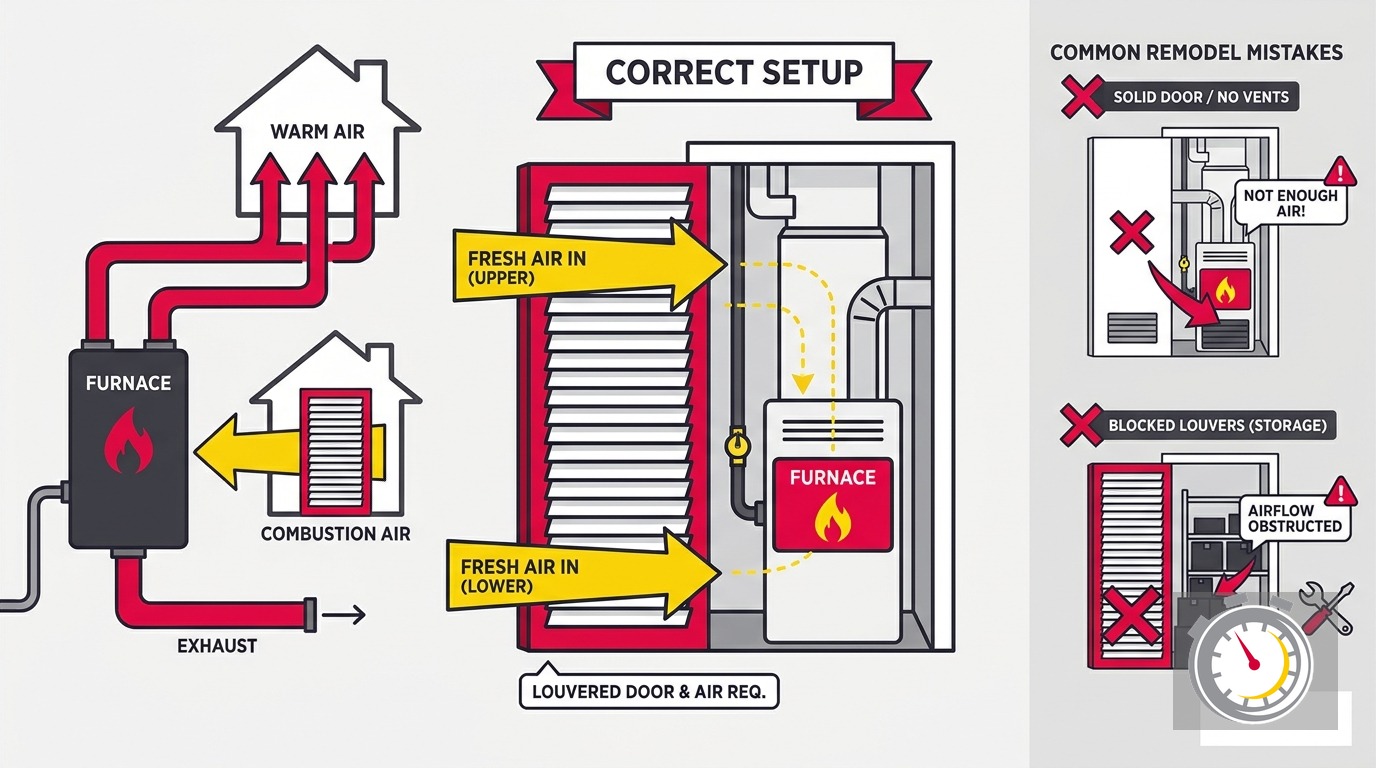
Your furnace closet needs louvers only if of how your furnace gets its air. Some furnaces pull combustion air from the room. Others pull it through a sealed pipe from outside.
If your furnace uses room air, the closet needs a way to supply it. That means permanent openings or a louvered door sized for the job. If your furnace is sealed, the rules change.
We are a locally owned and operated Twin Cities HVAC company. We see closet and utility room mistakes every heating season. Most start with a remodel, a new door, or a “cleaner look” project.
Why Does a Furnace Need Air at All?
A gas furnace burns fuel, and fire needs oxygen. The furnace also needs air to carry exhaust up the flue. If the room cannot supply enough air, exhaust can spill back into your living space. That is called backdrafting.
Think of your furnace as a big breathing machine. Air comes in, fuel burns, and exhaust goes out. Block the air, and the whole process struggles.
An air-starved furnace can burn poorly. It can make soot and carbon monoxide, a colorless, odorless gas. It can also trip safety switches and shut down on the coldest night of the year.
Minnesota homes make this harder. We build tight on purpose. Winters are long, so we seal and insulate to keep heat in. That helps your energy bills. It can hurt combustion air if no one plans for it.
Which Type of Furnace Do You Own?
Start here. Your furnace type decides almost everything else.
Open-combustion furnaces draw air from the room around them. They include older atmospheric units and many 80% efficiency models. The Building America Solution Center, a DOE-funded resource, says Category 1 appliances draw air from the combustion appliance zone. It also says they are “susceptible to backdrafting.”
Sealed-combustion (direct-vent) furnaces use two pipes. One brings in outside air. The other sends exhaust out. The same source says that with direct-vent equipment, “the risk of backdrafting is eliminated.”
Here is how the efficiency ranges line up, per that page:
- Condensing direct-vent units: 90% to 98% AFUE
- Atmospheric units: 60% to 78% AFUE
- Induced-draft Category 1 units: 78% to 83% AFUE
AFUE is the share of fuel that becomes heat. For more, read our guide to 80% versus 96% furnace efficiency.
How to tell which one you have
You can usually spot the difference in a minute:
- White PVC pipes running to an outside wall or the roof often mean a sealed, condensing furnace. Two pipes mean sealed combustion.
- A metal flue pipe that runs up into a chimney or a metal vent usually means an open-combustion unit.
- The model label lists the efficiency rating. If it says 80%, expect room-air combustion.
Not sure? A technician can tell you in minutes. Do this before you buy a door, build a closet, or finish a basement.
Does My Furnace Room Need a Vent?
It depends on your furnace type and the room. An open-combustion furnace in a closet or tight utility room needs a permanent supply of combustion air. A sealed-combustion furnace does not. Either type may still need return air and clearance, so check before you close anything in.
“Vent” can mean three different things, and homeowners mix them up all the time:
- Combustion air openings. These feed the burner and carry exhaust up the flue.
- Return air paths. These let house air flow back to the furnace to be heated again.
- Flue or vent pipes. These carry exhaust out of the home.
A louvered closet door can sometimes do the first or second job. It cannot do the third. Mixing up these roles causes most closet problems.
A big open basement often has enough air for an open-combustion furnace. A small closet or sealed utility room often does not. The smaller and tighter the space, the more likely you need planned openings.
Keep the space clear, too. Boxes and shelves block airflow and create fire risk. Our post on furnace clearance and utility room storage covers what to keep out.
What Does Minnesota Code Change?
Minnesota amends the national fuel gas code. It deletes the standard two-permanent-openings method and uses a one-opening method with a table and worksheet. Generic national advice about two louvers, one high and one low, does not match Minnesota rules.
This is where most online advice goes wrong. Many articles recite the national two-opening rule. Minnesota does something different.
The state’s fuel gas amendments say, “IFGC section 304.6.1, Two-permanent-openings method, is deleted in its entirety.” You can read that in Minnesota Rule 1346.5304.
The same rule describes what replaces it:
- One permanent opening that starts within 12 inches of the bottom of the enclosure
- For appliances that are not natural draft, the opening starts within 12 inches of the top
- A table, Table 304.1, that lists required free area for combined inputs up to 400,000 Btu/hr
- A rule to “use next largest listed input” when your input falls between listed capacities
- Worksheet E-1 for residential dwellings
The rule also covers ducts. Combustion air ducts “shall not terminate in an attic space.” Intake openings must be at least 12 inches above adjoining grade. In Minnesota, that last point matters, because snow drifts can bury a low intake fast.
A separate sizing rule in the mechanical code
The state mechanical code has its own outdoor-air opening section. Under Minnesota Rule 1346.0703, one permanent opening needs a free area of “1 inch2/3,000 Btu/hr (700 mm2/kW/hr) of the total input rating of all equipment located in the enclosure.”
That rule also covers the two-opening layout for the mechanical code. One opening goes within 1 foot of the ceiling and one within 1 foot of the floor. Horizontal ducts need 1 square inch per 2,000 Btu/h. Vertical ducts need 1 square inch per 4,000 Btu/h.
Which rule applies depends on your equipment and layout. That is why we do not give one universal number. Your installer should size the opening from your furnace’s input rating and the Minnesota table.
This post is not a code reference. Codes get amended, and local inspectors apply them. Use it to learn the right questions to ask.
How Do You Size Louvers the Right Way?
Size louvers by net free area, which is the open space air can actually pass through. It is not the size of the frame. Slats, screens, and fins block part of the opening, so a louver can be much smaller in free area than it looks.
Here is the trap. You measure a 16-by-20-inch louvered door insert and assume you have 320 square inches of opening. You do not.
Slats and bars take up room. A fine mesh screen takes even more. The usable opening is the net free area. The mechanical code points to IMC Chapter 709 for how to calculate it.
What does that mean for you?
- Check the product label or spec sheet for net free area. Good louvers list it.
- Do not buy a decorative vent just because it fits the hole.
- Do not add a fine screen to a louver unless the free area accounts for it.
- Do not paint or caulk over slats. Paint and dust can clog them.
- Keep furniture, boxes, and storage away from the opening.
We do not give a single “right” louver size here. It depends on your furnace’s input rating, your layout, and the Minnesota table. A technician reads the rating plate and does the math in minutes.
Can I Vent an 80% Furnace Through a Wall?
Generally, no. A standard 80% furnace is an open-combustion, Category 1 unit. It typically vents up a flue or chimney. Sidewall venting is the norm for sealed, condensing furnaces with PVC pipe. Your installer must confirm what your unit and local code allow.
This question comes up when homeowners want to move a furnace or remodel a utility space. The answer is usually no, and here is why.
An 80% furnace makes hot exhaust. That exhaust rises on its own through a vertical flue. A long horizontal run through a wall fights that natural lift, and exhaust can spill back into the room.
A 90%-plus furnace works differently. It pulls more heat from the exhaust, so the gas comes out cooler. A fan pushes it through sealed PVC pipe. That setup can exit through a sidewall, and a second pipe can bring in outside air.
So if you want a sidewall exit, you usually need a different furnace. In many cases the fix is a sealed, condensing model. Our furnace replacement service covers those options.
Why this matters for closets
A sealed-combustion upgrade often solves the closet air problem too. The furnace no longer competes with your house for air. You also no longer need to size combustion air louvers for that unit.
Watch other gas appliances. A water heater in the same space may still draw room air. If you replace the furnace but keep an older vented water heater, the room’s air needs change. Have a technician check the whole space together.
For more on vent concerns, see our post on high-efficiency furnace PVC vent pipe problems.
What Remodel Mistakes Cause Backdrafting?
The most common mistakes are air sealing or finishing a basement around an open-combustion furnace, replacing a louvered door with a solid one, adding powerful exhaust fans, and boxing in a furnace with walls and storage. Each one cuts the air the furnace needs.
The Building America Solution Center notes that air sealing and insulating rooms with Category 1 appliances “will impact how much air is available to the appliance for combustion.” Its backdrafting guide uses finishing a previously unfinished basement as an example of a change that can affect drafting. You can read it at this DOE-funded guide.
Here are the mistakes we see most in Twin Cities homes.
Mistake 1: Finishing the basement around the furnace
A contractor frames and drywalls the basement. The old leaky space becomes a tight, insulated room. The furnace used to get air from gaps and open space. Now it does not.
Plan combustion air before the walls go up. Tell your remodeler that an open-combustion furnace is in the space. If you are planning a basement project, our guide to heating and cooling a finished basement can help.
Mistake 2: Boxing the furnace into a closet
A furnace in the open basement looks ugly, so someone builds a small closet around it. Now the furnace sits in a tiny room with no air supply.
If the closet holds an open-combustion furnace, it needs sized combustion air openings. It also needs clearance for service. A closet built for looks alone often fails both tests.
Mistake 3: Swapping a louvered door for a solid one
The louvered door looks dated, and a solid door looks cleaner. But the louvers may have been doing real work.
Two things can go wrong. An open-combustion furnace may lose its air supply. The furnace may also lose its return air. Without a return path, it can overheat and trip its high-limit switch.
Mistake 4: Adding exhaust fans and range hoods
A powerful kitchen hood or bath fan pulls air out of the house. In a tight house, that air has to come from somewhere. It can come down the furnace flue, which pulls exhaust into your home.
Our posts on exhaust fans and furnace backdrafting and range hood makeup air explain this in detail.
Mistake 5: Spray foam and heavy air sealing
Spray foam and tight air sealing save energy. They also remove accidental air leaks. If your furnace relied on those leaks, you now have a problem. Read about spray foam and combustion air before you insulate.
Mistake 6: Blocking the louvers
Some homeowners stuff louvers with towels, cover them with cardboard, or stack boxes against them. They want to stop a draft. They also stop the furnace from breathing.
Leave the openings clear. If the closet is drafty, call us. We can fix the draft without starving the furnace.
Can a Louvered Closet Door Serve as Return Air?
Sometimes. A louvered closet door can act as a return air path if the closet is in conditioned space, the furnace is direct-vent, and the louver has enough net free area. Verify the details against Minnesota’s adopted code before relying on it.
Return air is the air that flows back to the furnace. Your furnace needs a path for it, and many closet furnaces use the louvered door.
A code summary from J.A. Inspector paraphrases IRC 2018 M1602.2. It says a louvered closet door can serve as return air only if the closet is in conditioned space, not a garage. It also requires a direct-vent furnace and adequate net free area. The page warns that swapping to a solid door with no return duct can trip the high-limit switch.
That page says its code text is paraphrased, so we treat it as a secondary source. Your local inspector and the Minnesota-adopted code decide what counts.
A louvered door can do real work. Do not remove it without a plan.
If your rooms feel stuffy or the furnace runs hot, return air may be the cause. Our post on return air problems explains the symptoms. It also helps to know that closing vents in unused rooms can add to pressure and airflow trouble.
How Do You Spot Backdrafting Before It Gets Dangerous?
Look for soot or discoloration near the burner tubes, flame rollout, a flickering flame when fans run, and a warm or sooty draft hood. Any of these signs means you should stop and call a technician. Do not ignore them.
The DOE-funded backdrafting guide lists soot and discoloration near the burner tubes and flame rollout as warning signs. Flame rollout means flames escape the burner area instead of staying inside.
You may also notice:
- A burning or exhaust smell near the furnace
- Moisture on windows or near the flue
- A furnace that shuts off on its own, often from a tripped safety switch
- Headaches or nausea when the heat runs, which can signal carbon monoxide
Our guide to furnace rollout switch trips explains one common safety shutdown. Do not bypass or repeatedly reset safety switches. They trip for a reason.
What the carbon monoxide numbers mean
The same guide gives carbon monoxide readings you can use as a rule of thumb:
- Properly operating gas appliances may show up to 5 ppm.
- At 30 ppm or higher, leave the home and call an HVAC technician.
- The guide also cites a federal evacuation standard of 35 ppm.
- It says any reading above 10 ppm warrants investigation.
The page gives two sets of thresholds, so do not treat one number as a magic line. If an alarm sounds or you feel sick, leave first and call for help. Our post on what to do when a CO alarm goes off walks through the steps.
For placement tips, see our guide to carbon monoxide detector placement. A home with a furnace and water heater in the basement needs an alarm. Put one near sleeping areas and on each level.
Do You Need a Permit to Change Your Furnace Closet?
Usually, yes, if the work involves replacing a furnace or changing ducts. Twin Cities cities require a mechanical permit for furnace replacement, and gas work must be done by a licensed contractor. Check with your city before you start.
Maplewood states it plainly: “A mechanical permit (PDF) is required for the replacement of a furnace and/or air conditioner.” Duct changes also need a permit. The city adds that “All gas work must be done by a contractor who is licensed.” See the Maplewood heating and air conditioning page.
Rules vary by city. Our guides on when an HVAC permit is required and what permits cost cover the basics.
An inspector may look at combustion air, clearance, and venting. A closet that looks fine can still fail. Fixing it after the fact costs more than planning it first.
What Does It Cost to Fix a Furnace Closet Problem?
Costs range widely. A louver or opening fix can be a small job. Upgrading to a sealed-combustion furnace is a bigger project. A high-efficiency furnace in the Twin Cities typically starts around $6,500 installed, and full replacement ranges from $3,900 to $7,800 or more.
Here is how the options compare:
- Add or resize a combustion air opening. This is often the lowest-cost fix. Your technician will quote it after a site visit.
- Move or open a closet. This can be simple carpentry. It may need a permit.
- Replace with a sealed-combustion furnace. A 95-96% furnace starts at about $6,500 installed. Higher-efficiency 97-98% models start higher, at about $9,100.
- Replace an 80% furnace with another 80% furnace. An 80% model starts around $4,950. You keep the same combustion air needs.
An upgrade can solve several problems at once. You gain efficiency and remove the backdraft risk. You may also free up the closet.
We offer financing for larger jobs like furnace replacement. Our post on HVAC financing options explains what to know. Also see our guide to furnace replacement cost in the Twin Cities.
Not Sure Where You Stand? Start With a Quick Check
You can do a simple walk-through before you call anyone:
- Find the model label on your furnace. Note the efficiency rating and input.
- Count the pipes. Two white PVC pipes mean sealed combustion.
- Look at the closet or room. Is there a louvered door or grille? Is it clear?
- Look for signs of change. Did anyone finish the basement, add a door, or seal the house?
- Check for soot, rust, or discoloration near the burners and flue.
- Test your carbon monoxide alarms.
If anything looks off, do not wait for winter. Call before the first deep freeze. Our post on furnace inspection explains what a checkup covers.
Thinking about a bigger change? Our guide to heat pumps in Minnesota covers fit and tradeoffs. A heat pump has no combustion, so it avoids the combustion air question altogether. Many Twin Cities homes pair one with a gas furnace as a backup.
Why Call Northern One Hour
We are a locally owned and operated Twin Cities company, backed by the national One Hour Heating & Air Conditioning franchise. We know our winters, our older basements, and the remodels that change how a furnace breathes.
When you book with us, we arrive within the time window you select. We stand behind it with our promise: “Always On Time… Or You Don’t Pay a Dime!(R)” If the technician does not show up on time, you do not pay for the service. We also back our work with a 100% satisfaction guarantee and honest, transparent pricing.
A technician will identify your furnace type and check combustion air and return air. They will also look for backdraft signs and explain what they find in plain English. If your closet needs a fix, we will say so. If it does not, we will tell you that too.
Do not guess with combustion air. A little checking now costs far less than a lockout on a January night, or worse. Call (763) 260-6662 or book online to schedule fast.
For related help, see our furnace repair and furnace tune-up services.
Frequently Asked Questions
Do I need a carbon monoxide alarm in the basement if the furnace and water heater are down there? +
Can I just remove the louvered door and put in a solid one? +
Does a high-efficiency furnace need a louvered closet door? +
How do I know if my furnace is backdrafting? +
Who sizes the louvers or openings? +
Need a technician now?