
Furnace Rollout Switch Tripped? Why It's a Safety Issue
Key Takeaways
- A tripped rollout switch means flame or heat escaped the burner area. That is a safety event.
- Never reset it and walk away. A trip always has an underlying cause.
- Never bypass, jumper, or tape over the switch. It is the last line of protection.
- If anyone feels sick, or a CO alarm sounds, get outside and call 911.
- Minnesota law requires a working CO alarm within 10 feet of every sleeping room.
- Winter ice and snow on a high-efficiency furnace vent can trigger a trip.
- A technician should find the cause, fix it, and test the furnace before it runs again.
A Tripped Rollout Switch Is a Warning, Not a Glitch
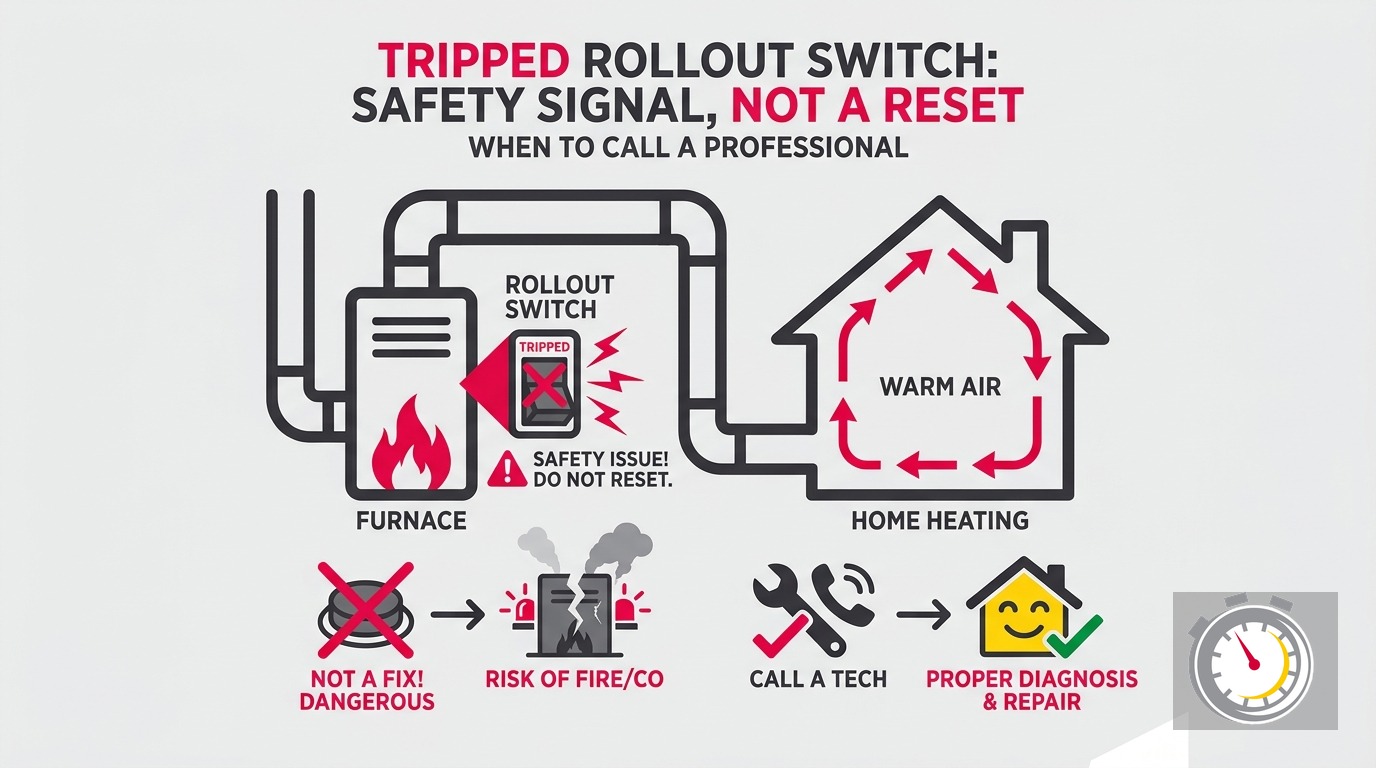
When a furnace rollout switch trips, your furnace has seen flames or heat where they should not be. It shut itself down to protect your home. Resetting the button may bring the heat back, but it does not fix the cause. Treat the trip as a safety warning and call a technician.
We are Northern One Hour, a locally owned and operated Twin Cities HVAC company. We see this problem every winter. Below you’ll find what the switch does, what trips it, which signs mean “leave now,” and what to do next.
What Does a Rollout Switch Actually Do?
A rollout switch is a heat-sensing safety device mounted near the burners. If flames roll out of the burner compartment, the switch senses the heat and cuts power to the gas valve. The furnace stops making heat.
Think of a circuit breaker for fire. A breaker trips when wiring runs too hot. A rollout switch trips when flame goes where it does not belong.
Some switches have a small red reset button. Others are one-time thermal fuses that must be replaced after a trip. Both do the same job.
The location matters. Burners should send flame up into the heat exchanger, the metal chamber that warms your air. Hot exhaust then leaves through the flue or vent pipe.
If flame spills back out toward the front of the furnace, something has gone wrong. The cause may be a blocked exhaust path, a cracked or failing heat exchanger, or a problem with airflow or gas pressure.
The switch cannot tell you which one. It only tells you the furnace is no longer burning safely.
What Causes a Rollout Switch to Go Bad?
Most of the time the switch is not bad. It is doing its job. The usual causes of a trip are a blocked vent, a failing heat exchanger, dirty burners, weak draft, or a gas pressure problem. True switch failure is rare.
Each cause points to a different repair.
Blocked or restricted venting
Exhaust gases need a clear path outside. If the flue or vent pipe is blocked, those gases back up. Flame can then push out of the burner area.
Minnesota Commerce lists blocked or undersized chimney or vents among the causes of CO buildup. It also lists damaged or separated vents. The EPA says flue problems make CO worse when a flue is improperly sized, blocked, disconnected, or leaking.
Birds, nests, and debris can block a vent. So can snow and ice, which we cover below.
A cracked or failing heat exchanger
A crack in the heat exchanger changes how air and flame move inside the furnace. The blower pushes air across the cracked metal. That air can disturb the flame and push it out toward the switch.
Minnesota Commerce notes that CO buildup may involve “a cracked furnace heat exchanger.” This is the most serious cause on the list. Our guide to cracked heat exchanger signs explains what technicians look for.
Dirty or misadjusted burners
Soot, rust, and debris on the burners disturb the flame pattern. A lazy, uneven flame can lick outward instead of burning cleanly upward.
CenterPoint Energy points to two warning signs. One is soot or water near a burner or vent. The other is a yellow or orange flame instead of a clear blue one. Either one calls for a professional.
Weak draft or a failing inducer motor
A high-efficiency furnace uses an inducer motor to pull exhaust through the heat exchanger and out the vent. If that motor weakens, exhaust moves slowly. Flame can then drift the wrong way.
Draft inducer motor replacement typically runs $375-$900. Brand-specific parts can raise that to $500-$1,650. Our furnace draft inducer motor guide covers the symptoms.
Combustion air and house pressure problems
A furnace needs enough air to burn fuel. Tight homes, strong exhaust fans, and fireplaces can starve it of air. They can even pull exhaust backward.
Minnesota Commerce lists insufficient combustion air supply as a cause of poor venting. The EPA also names back-drafting among its furnace-related CO sources.
The switch itself
Rarely, a switch wears out or fails from age and repeated heat cycles. A technician can test it with a meter. Don’t assume this is the answer. Rule out every other cause first.
Which Signs Mean You Should Leave the House Now?
Leave immediately if anyone has headaches, dizziness, nausea, or confusion, or if a CO alarm sounds. These signs can point to carbon monoxide, which you cannot see or smell. Get outside to fresh air, then call 911.
CO is dangerous because it hides. The EPA says health effects range from fatigue and chest pain at low levels to impaired vision, headaches, dizziness, confusion, and nausea at higher levels. It also says CO is “fatal at very high concentrations.”
Watch for these signs along with a tripped switch:
- A CO alarm that is sounding or has sounded
- Headaches, dizziness, or nausea that ease when you leave the house
- Flu-like symptoms without a fever
- Several people or pets in the home feeling sick at once
- Soot or scorch marks around the furnace
- A yellow or orange burner flame
- Water pooling near the burner or vent
- A burning smell or visible smoke near the furnace
Minnesota Commerce says early CO symptoms resemble the flu but occur “without a fever.” If everyone in a household has symptoms, CO may be the cause.
Smell gas? That is a separate emergency. Leave first and call 911. Then read our guide on what to do if you smell gas near your furnace.
What Should You Do If You Suspect Carbon Monoxide?
Get everyone outside right away, including pets. Then call 911 from outside. Do not go back in until the source is found and fixed. Open windows and turn off the furnace only if you can do so quickly on your way out.
The Consumer Product Safety Commission and CenterPoint give the same core advice. The CPSC says, “If you suspect CO poisoning, get outside to fresh air immediately, and then call 911.”
CenterPoint adds detail. It says to evacuate the building immediately and call 911. Open windows and turn off the furnace if you can. Evacuate everyone, pets included, if anyone has symptoms. Do not re-enter until the source is found and fixed.
Follow these steps in order:
- Move everyone outside to fresh air.
- Count heads, including children and pets.
- Call 911 from outside.
- Stay out until emergency crews say the home is safe.
- Keep the furnace off until a technician finds and fixes the cause.
- Get medical care for anyone who had symptoms.
Do not stop to troubleshoot. Do not go back for a phone, a coat, or a pet. Minutes matter more than belongings.
The CPSC reports that more than 200 people in the United States die every year from accidental, non-fire CO poisoning tied to consumer products. That is why we take a tripped switch seriously.
If your alarm went off but everyone feels fine, our article on CO alarms going off with no emergency explains the next steps.
Can You Reset a Tripped Rollout Switch?
A homeowner should not reset it and walk away. Resetting without finding the cause lets the furnace fire again under the same unsafe conditions. If the switch trips once, shut the furnace off and call a technician. If it trips again, do not run the furnace at all.
Here is a simple decision path.
The switch tripped once and you feel fine
- Turn the thermostat to “off.”
- Check that no one has symptoms and no alarm is sounding.
- Look for obvious causes from the outside: snow or ice on the exhaust and intake pipes.
- Do not open the burner compartment or touch the switch.
- Call a technician the same day.
Why not press the button once? You cannot see inside the burner area. You cannot know whether the heat exchanger is cracked or the vent is blocked. A single reset could fire the furnace into an unsafe condition.
The switch trips again, or keeps tripping
Leave the furnace off. Repeat trips mean the problem is active, not a fluke. Use another heat source safely and call us. Our guide to what to do when your furnace is out tonight covers safe stopgaps.
Do not use a gas oven, grill, or fuel-burning heater indoors to warm the house. Those add CO risk. See our article on portable generator and combustion air risks for related hazards.
Anyone has symptoms, or an alarm is sounding
Skip the decision path. Go outside and call 911, as covered above.
How Do You Stop a Furnace From Short Cycling?
Short cycling means the furnace starts, runs briefly, and shuts down. First check the filter, vents, and thermostat. If a rollout switch is involved, stop troubleshooting and call a pro. A trip-driven shutdown is a safety problem, not a comfort problem.
Short cycling has many causes. A clogged filter, an oversized furnace, a bad flame sensor, or an overheating limit switch can each trigger it. Most are less urgent than a rollout trip.
Start with the simple checks:
- Replace a dirty air filter.
- Make sure supply and return vents are open and unblocked.
- Confirm the thermostat has fresh batteries and sits away from drafts.
- Look at the outdoor vent pipes for snow, ice, or debris.
Our full guide on furnace short cycling causes and fixes walks through each one. A dirty sensor is also a frequent culprit. See how to clean a furnace flame sensor and when to stop.
The two shutdown types differ. A flame sensor shutdown is a nuisance: the furnace lights, then quits after a few seconds. A rollout trip is a protective lockout. The furnace may not light at all until the switch is reset.
If your furnace short cycles and you find a tripped rollout switch, treat the switch as the bigger problem. Fixing the cycling will not matter if the burner area is unsafe.
A flame sensor or igniter service usually runs $95-$325. That is small next to a safety event. Do not let a cheap fix hide a serious one.
Can You Bypass a Furnace Pressure Switch or Rollout Switch?
No. Bypassing or jumpering a safety switch removes protection against flame escape, fire, and CO. Never do it, even as a temporary fix in a cold snap. A technician can restore heat safely, often the same visit.
People search for ways to bypass these switches because the furnace will not run and the house is cold. We understand. A Minnesota January night is no time to be without heat.
Still, the safety switch is not the problem. It is the messenger. Cut it out of the circuit and the furnace keeps burning with a fault nobody can see.
The two switches guard against different things. A pressure switch confirms the inducer is moving exhaust before the burners light. A rollout switch reacts if flame escapes anyway. You want both working.
For the pressure switch side, read our guide on furnace pressure switch failure symptoms. It explains what a failed one looks like and why it should be tested, not jumped.
Bypassing risks:
- Fire in the burner compartment or nearby wiring
- Exhaust and CO entering living spaces
- Damage to the furnace that costs far more to repair
- A voided warranty and possible insurance trouble
Our rule: if a safety switch is open, we find out why. We do not remove it from the picture.
Why Do Twin Cities Winters Trip Rollout Switches?
Cold, snow, and ice can block the vent and intake pipes on high-efficiency furnaces. Blocked pipes disrupt exhaust flow and combustion air. That can lead to flame disturbance and a tripped switch. Clearing the terminations safely may be part of the fix.
High-efficiency furnaces vent through PVC pipes that exit the side of the house. Those pipes sit low. After a heavy snowfall or a drift, they can end up buried. Frost can also build up around the exhaust opening in deep cold.
CenterPoint tells customers to keep furnace and dryer exhaust vents and flues clear of snow, ice, and debris. That advice fits Minnesota well.
After each storm:
- Walk outside and find the furnace vent and intake pipes.
- Clear snow gently by hand or with a soft broom.
- Break up loose ice only if you can do so without cracking the pipe.
- Check that nothing, such as a shovel or a bag, rests against the opening.
- Look for heavy frost or ice growing around the exhaust opening.
Do not chip hard at frozen pipes. PVC cracks in the cold, and a damaged vent leaks exhaust. If ice keeps forming, call us. The cause may be a drain, a slope, or a termination problem.
Our article on high-efficiency furnace exhaust vents blocked by snow and ice goes deeper. Clearing a vent may let the furnace run again, but you should still have it checked. A trip means something needed to be fixed.
Other winter causes are also common in our area:
- Animals nesting in vent pipes
- Frozen condensate drains backing up into the burner area
- Cold snaps that strain older heat exchangers
- Closed-up homes with less fresh air for combustion
Give each a quick look before the next storm.
What Does a Technician Check, and What Might It Cost?
A technician finds the reason for the trip before restoring heat. That means inspecting the vent, burners, heat exchanger, inducer, and gas pressure, then testing the furnace. Cost depends on the cause. Many fixes are modest, while a failed heat exchanger can change the repair-or-replace choice.
We do not guess. We work through a checklist.
- Vent and intake: We look for blockage, separation, and damage.
- Burners: We inspect flame color, shape, and cleanliness.
- Heat exchanger: We look for cracks, rust, and signs of flame disturbance.
- Inducer and draft: We confirm that exhaust moves as designed.
- Gas pressure: We check that fuel supply matches the furnace rating.
- Combustion air: We check whether the home is starving the furnace.
- CO readings: We test the air around the furnace and in the vent.
- The switch: We test it last, and replace it only if it failed.
Our gas furnace combustion analysis guide explains how that testing works.
Rough costs for common causes, installed with parts and labor:
- Flame sensor or igniter service: $95-$325
- Draft inducer motor: $375-$900, and $500-$1,650 for some brands
- Control board: about $750
- Furnace replacement: $3,900-$7,800
Your price depends on the furnace and the fault. We quote before we start work.
A cracked heat exchanger is different. It is usually not a small repair. The choice often comes down to repair versus replacement, based on furnace age and cost. Our guide to heat exchanger replacement versus a new furnace lays out the math.
If replacement makes sense, ask about financing. We can walk you through payment options so a safety repair does not stall for months.
What Does Minnesota Law Say About CO Alarms?
Minnesota requires at least one working CO alarm within 10 feet of every room used for sleeping. Removing batteries or otherwise disabling a required alarm is prohibited. A first violation brings a safety warning, and later violations are petty misdemeanors.
The statute covers single-family dwellings and multifamily units. Under Minnesota Statutes section 299F.51, alarms must sit within ten feet of each lawful sleeping room. Disabling a required alarm is not allowed.
Minnesota Commerce repeats the rule. It says homes need at least one working alarm within 10 feet of every room used for sleeping.
The CPSC goes further. It advises alarms on every level of the home and outside sleeping areas. Interconnected alarms are best, because when one sounds, they all do.
Check your alarms today:
- Press the test button on every alarm.
- Replace batteries on schedule.
- Check the expiration date printed on each unit.
- Add alarms on each level if you are short.
- Put one near the bedrooms and one near the furnace area.
Our guide to CO detector placement near furnaces and boilers shows where to put them. Alarms do not replace a safe furnace. They are your backup when something slips past.
How Do You Prevent a Rollout Switch Trip?
Annual professional maintenance is the best prevention. A yearly tune-up catches dirty burners, weak inducers, early heat exchanger wear, and venting problems before they trip a safety switch. Keep vents clear of snow and test your CO alarms.
The EPA and Minnesota Commerce agree. The EPA says to have a trained professional inspect, clean and tune up the central heating system annually. That includes furnaces, flues, and chimneys. Minnesota Commerce says vented fuel-burning appliances should be checked by a qualified heating contractor every year.
CenterPoint also recommends an annual inspection before heating season. Fall is the ideal time.
A single tune-up visit often costs $95-$250. An annual maintenance plan runs $195-$390. Compare that to a no-heat call in January. Our piece on whether a maintenance plan is worth it breaks down the value.
Between visits, build a few habits:
- Change your filter on schedule.
- Keep the area around the furnace clear of boxes and chemicals.
- Clear snow from vent terminations after storms.
- Test CO alarms monthly.
- Call us if you notice soot, odd smells, or a flame color change.
Call Northern One Hour When a Rollout Switch Trips
If your rollout switch tripped, shut the furnace off and call us. We will find the cause, fix it, and test the furnace before it runs again. As a locally owned and operated Twin Cities company, we know what Minnesota winters do to furnaces.
Our promise: “Always On Time… Or You Don’t Pay a Dime!(R)” We arrive within the time window you select. If our technician does not show up on time, you do not pay for the service.
Here is how to get help:
- Call (763) 260-6662 to reach our team.
- Book online to schedule fast.
- Call 911 first if anyone has symptoms or an alarm is sounding.
Learn more about our furnace repair service and what to expect on a visit.
A tripped switch is your furnace asking for help. Don’t reset it and hope.
Frequently Asked Questions
Is a tripped rollout switch an emergency? +
Should I replace the rollout switch myself? +
How often should a furnace be inspected? +
Need a technician now?