
Furnace Turns On and Off Every Few Minutes: Fix Guide
Key Takeaways
- A furnace that turns on and off every few minutes is short cycling. It is not heating the way it should.
- Three causes cover most Twin Cities cases: thermostat placement, restricted airflow, and a limit switch that trips on overheating.
- You can tell them apart by watching what the blower does after the burner shuts off.
- Cold snaps make every one of these causes worse. Frozen vent pipes and loaded filters are common in Minnesota.
- Gas smell, a carbon monoxide alarm, or a repeating lockout means stop and call right away.
- Most fixes are small. A filter, a sensor, or a thermostat move often solves it.
Why does my furnace run, stop, and run again?
Your furnace starts, runs a few minutes, and shuts off before the house warms up. Then it starts again. That pattern is short cycling. Something tells the furnace to quit early: the thermostat, a safety switch, or a flame problem.
It is like a car that stalls at every stoplight. The engine may be fine. Something is shutting it down too soon.
We are a locally owned and operated Twin Cities company, and we get this call every winter, usually on the coldest morning. You can narrow down the cause yourself in about 20 minutes.
Start at the top of the order below and work down. Stop when you find the answer.
How many times should a furnace come on in an hour?
There is no single magic number. A healthy furnace runs long, steady cycles, and the count per hour drops as the weather gets colder. In a deep freeze, it may run almost nonstop.
Don’t count cycles. Watch for a repeated run of very short ones, only a few minutes each, while the house stays cold.
Here is what normal looks like:
- In mild fall weather, the furnace runs, shuts off, and rests for a good while.
- In a hard cold snap, it runs longer and rests less. That is the furnace keeping up, not failing.
- In either case, the house reaches the set temperature.
Here is what a problem looks like:
- The burner lights, runs a few minutes, and shuts off.
- The house never reaches the set temperature.
- This repeats over and over.
If your furnace runs hard but the house still lags, read our guide on what to do when your furnace can’t reach the setpoint in extreme cold. That is a related but different problem.
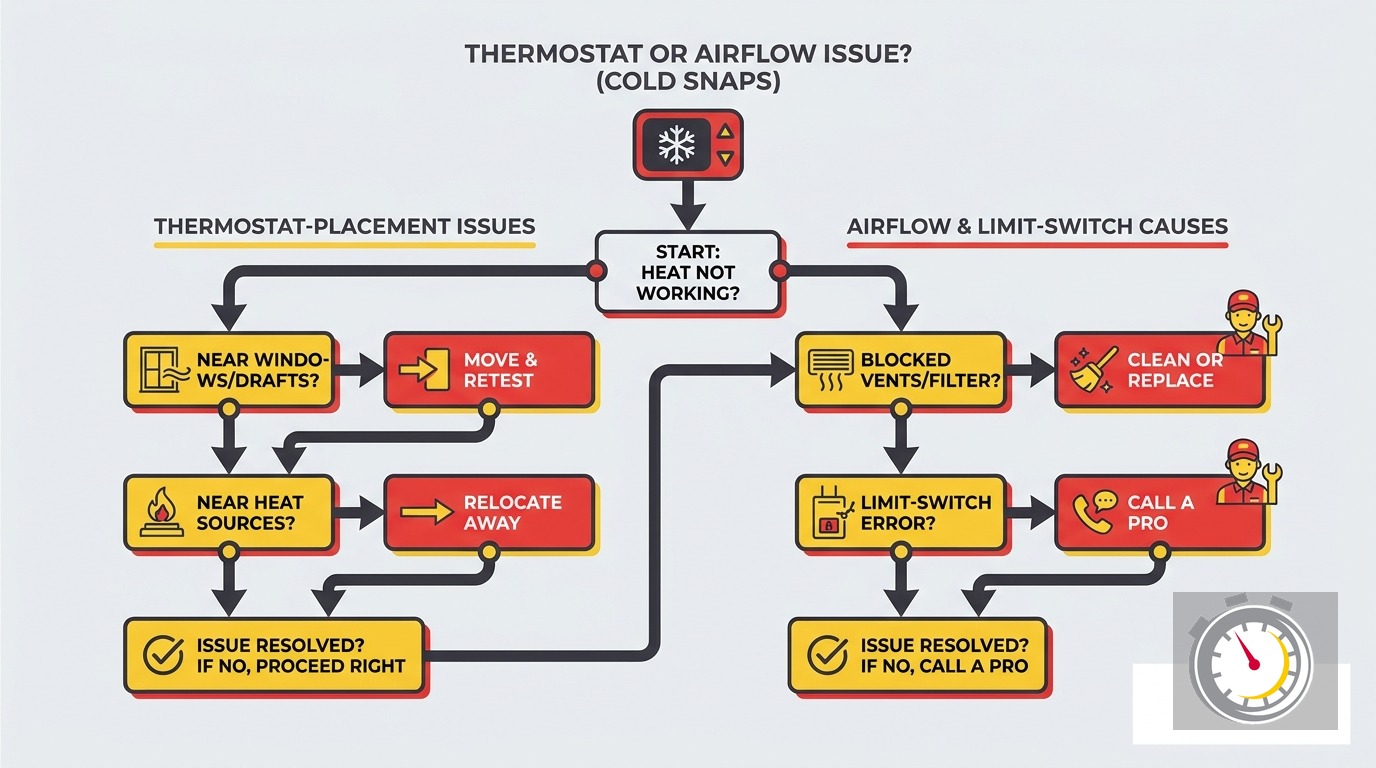
The flowchart: work through these steps in order
Each step is cheaper and safer than the one after it.
- Check the filter. Is it gray, matted, or the wrong size? If yes, replace it and watch one full cycle.
- Watch the blower. When the burner shuts off, does the blower keep running? If yes, suspect a limit switch trip from overheating.
- Check the thermostat. Does cycling follow the sun, a nearby register, or a drafty wall? If yes, suspect placement.
- Check the outdoor vent pipes. Are they blocked by snow, ice, or frost? If yes, clear them safely and watch again.
- Check for error codes. Look at the blinking light on the furnace control board through the viewing window.
- Call for service. If none of the above explains it, a technician should test the flame sensor, limit switch, and heat exchanger.
The sections below explain each test. Skip to the ones that match your symptoms.
How do I test whether my thermostat placement is the problem?
Compare your thermostat reading to a separate thermometer on the same wall. If they differ by more than a couple of degrees, or if cycling follows sunshine, a register, or a draft, placement is likely causing the early shutoffs.
A thermostat only knows the air around itself. If that air is not typical of the house, the furnace gets bad information.
You can run this test in one afternoon:
- Tape a basic thermometer on the wall about six inches from your thermostat.
- Wait 15 minutes without touching either one.
- Compare the two readings.
- Note the time of day when the furnace starts cycling short.
Now look for patterns:
- Cycling starts when sun hits the wall. Direct sun warms the thermostat, so it thinks the house is warm. It shuts the heat off while the rest of the house is cold.
- Cycling starts when a register blows near the thermostat. Warm air hits the sensor fast, and the thermostat quits early.
- Cycling happens on windy nights. A drafty wall or a leaky outlet box behind the thermostat can feed it cold air. It may also confuse the reading.
- A lamp or TV sits near the thermostat. Heat from appliances fools the sensor.
Manufacturers generally advise installing a thermostat in a central location, away from vents and heat-producing appliances. That matters in Minnesota homes with big south-facing windows.
If your test shows a mismatch, read our guide on thermostat location and placement accuracy. It covers where a thermostat belongs and when to move one.
Check the basics too. A thermostat with weak batteries can act strangely. Our thermostat troubleshooting guide walks through those fixes.
One more clue: if the furnace stops when the thermostat says the house is warm, but the house feels cold, suspect the thermostat. The furnace is doing what it was told.
How do I know if restricted airflow is the problem?
Restricted airflow means the furnace cannot move enough air across its heat exchanger. Signs include weak airflow from vents, a loaded filter, closed or blocked registers, and a furnace that gets very hot. The furnace then shuts down to protect itself.
Air carries heat away from the burners. When air cannot flow, heat builds up inside the cabinet. A safety switch sees that heat and shuts off the burners.
Common airflow culprits in Twin Cities homes:
- A dirty or clogged filter. This is the most common cause by far.
- The wrong filter. A very dense filter can choke airflow, even when it is clean. See our post on high-restriction filters like MERV 13 and why they can cause trouble.
- Wrong size or a missing slot cover. A filter that doesn’t fit leaves gaps. Dust then loads the blower wheel instead.
- Closed or blocked registers. Sofas, rugs, and drapes can block vents. Closing many vents raises pressure in the ducts.
- A dirty blower wheel. Dust packs the blower fins, so the wheel moves less air.
- Return air problems. A return grille blocked by furniture starves the system.
Start with the filter. It takes two minutes. Pull it out and hold it up to a light. If you cannot see light through it, replace it.
Our post on how often to change your HVAC filter in Minnesota explains timing for different homes. Filters load faster when the furnace runs more, and winter is when it runs most.
Then walk the house:
- Go through every room.
- Make sure each supply register is open and clear.
- Hold your hand over each one. Does the air feel strong?
- Check that return grilles are clear too.
If airflow feels weak everywhere, the problem is likely at the furnace. A dirty blower wheel or failing blower motor could be the cause. A blower motor replacement runs $1,100 for a standard PSC motor and $2,200 for a variable-speed ECM motor, installed. Our guide to blower motor failure signs and costs covers it in detail.
How do I tell a limit switch trip from a dirty filter?
Watch the blower after the burner shuts off. If the blower keeps running, the limit switch likely tripped on heat. Then check whether cycles get shorter as the filter loads up. If so, the cause is airflow. If the filter is clean and it still happens, the switch itself may be failing.
The limit switch is a safety device. It watches the temperature inside the furnace. If the furnace overheats, the switch shuts off the burners, and the blower keeps running to cool things down.
You can see and hear that behavior yourself. Here is how to read it:
- Burners shut off, blower keeps running for a few minutes. The limit switch likely tripped because the furnace got too hot.
- Burners shut off, blower stops quickly. That points to the thermostat, a flame problem, or a pressure switch.
- Cycles start longer and get shorter over days. Airflow is likely restricted and getting worse. This often tracks a filter loading up.
- A fresh filter makes cycles longer right away. The filter was the cause.
- A fresh filter changes nothing, and the blower runs on after shutoff. Either airflow is blocked somewhere else, or the switch is bad.
A bad limit switch can trip too early even when the furnace is not overheating. That failure is real but less common than a simple airflow problem. Rule out airflow first.
Do not bypass or jumper a limit switch. It protects your home. Our guide on furnace limit switch failure symptoms and reset steps explains what a technician checks.
A cracked heat exchanger can also cause overheating and shutdowns, and it is a serious safety issue. Learn the signs of a cracked heat exchanger and call us if you see them.
Why do cold snaps make short cycling worse?
Cold snaps push your furnace harder. Filters load faster, vent pipes can freeze over, and gas supply can dip. Any weak spot shows up first in the deepest cold. A system that worked fine in October may start short cycling at minus ten.
Here is what changes when the temperature drops:
- The furnace runs far more. More run time means the filter collects dust faster. A filter that was fine last month can now restrict airflow.
- High-efficiency vent pipes can freeze. A 90%-plus furnace vents through plastic pipe. Snow, ice, or frost can block the intake or exhaust, and the furnace shuts down for safety.
- Condensate drains can freeze. High-efficiency furnaces make water as they run. A frozen drain can trigger a shutdown.
- Wind can push exhaust back. Gusts across a sidewall vent can disrupt the draft.
- Gas pressure can dip. Extreme demand sometimes affects supply to the furnace.
Walk outside and look at the intake and exhaust pipes on the side of your house. Are they clear? Is there a drift against them? Is frost building a thick collar?
If you see a blockage, clear it gently by hand. Do not chip at plastic pipe with tools. Never use open flame to melt ice.
Our guides cover each of these:
- High-efficiency furnace exhaust vent blocked by snow or ice
- Furnace vent termination frost buildup on sidewalls
- Frozen condensate drain on a high-efficiency furnace
- Natural gas pressure in a cold snap
Cycling can look odd on the coldest days even when nothing is wrong. A furnace that runs nearly nonstop is working. A furnace that fires and quits is not.
What about an oversized furnace or a flame problem?
If you checked the thermostat, filter, and vents and still have short cycles, look at two more causes. One is a furnace that is too big for the house. The other is a flame sensor that cannot confirm the burner is lit.
An oversized furnace heats the house too fast. It hits the setpoint, shuts off, and restarts soon after. This often shows up where the furnace was sized by rule of thumb. It can also appear after insulation or window upgrades. Our post on oversized furnace problems and short cycling explains the pattern. Proper sizing uses a load calculation. See our guide to right-sizing with Manual J.
A dirty flame sensor is a small rod that confirms the burner is lit. When residue coats it, it cannot sense the flame. The control board then shuts the gas off after a few seconds. The burner lights, then quits, and the pattern repeats.
Flame sensor or igniter service typically runs $95 to $325. It is one of the cheapest fixes here. Read more in our guide to cleaning a dirty flame sensor.
A technician will also check these:
- A failing pressure switch or draft inducer
- A control board fault (about $750 installed, on average)
- A gas valve problem
- A condensate pump or drain problem
The blinking light on your control board often stores an error code. Our furnace error code guide helps you read it. Write the code down before you call. It saves time.
How do I stop my furnace from short cycling?
Fix the cause. Replace a clogged filter, clear blocked vents and registers, move or shield a misplaced thermostat, and book a tune-up to clean the flame sensor and check the limit switch. If those fail, a technician must find the fault.
Here is a short list you can work through today:
- Replace the filter. Use the correct size and a filter your furnace can handle.
- Open and clear every register and return.
- Clear snow and ice from outdoor vent pipes. Use your hands only.
- Shade the thermostat, or test it with a second thermometer.
- Replace thermostat batteries if your model uses them.
- Reset power once at the switch near the furnace after fixing an obvious cause.
- Watch two full cycles. Note how long each one runs.
For more background, see our overview of furnace short cycling causes and fixes.
A yearly tune-up prevents most of these shutoffs. A single tune-up visit runs $95 to $250. An annual maintenance plan runs $195 to $390. Our post on what a furnace tune-up includes shows what you get.
Our furnace tune-up service covers the flame sensor, blower, filter fit, and safety switches. Those parts cause most cold-weather cycling.
When should I stop and call right away?
Some symptoms are not a DIY job. If any of these happen, stop and call. Do not wait for the next cycle.
- You smell gas. Leave the house first. Then call from outside. See our guide on what to do about a gas smell near your furnace.
- A carbon monoxide alarm sounds. Get everyone outside and call 911. Our post on CO alarms and furnaces explains next steps.
- The furnace locks out again and again. Repeated lockouts mean a safety system keeps stopping a real problem.
- You see soot, scorch marks, or a yellow flame.
- You hear a loud boom on startup.
- The furnace cabinet feels hot or smells like burning.
Do not clear a lockout repeatedly or bypass a safety switch. Those protections keep your family safe.
If the furnace is out entirely on a freezing night, our emergency steps for a furnace that quits can help you stay safe until we arrive. For a true emergency, ask about our after-hours service. After-hours work adds $180 to $270 per hour on top of standard rates.
What does it cost to repair a short-cycling furnace?
Costs depend on the cause. Many fixes are small, and a few are not. These are typical installed prices in the Twin Cities, including parts and labor.
- Flame sensor or igniter service: $95 to $325
- Draft inducer motor: $375 to $900, and brand-specific models run $500 to $1,650
- Blower motor: $1,100 for a standard motor, $2,200 for a variable-speed motor
- Control board: about $750
- Single tune-up visit: $95 to $250
A filter swap or thermostat move costs little or nothing. That is why we start there.
If the repair is large and the furnace is old, replacement may make more sense. Full furnace replacement in the Twin Cities typically runs $3,900 to $7,800 installed. Higher-efficiency models cost more. Our guide to repair versus replace decisions helps you weigh it. You can also read how long furnaces last in Minnesota.
Our furnace repair team diagnoses first and quotes before we start. Pricing is honest and transparent.
Is a new furnace worth it before the year ends?
If your old furnace keeps short cycling and repairs are piling up, a replacement may qualify for a utility rebate. CenterPoint Energy offers rebates to natural gas customers in Minnesota, but equipment must be installed by Dec. 31, 2026.
Today is early November. That window is closing, so timing matters if you are thinking about replacing.
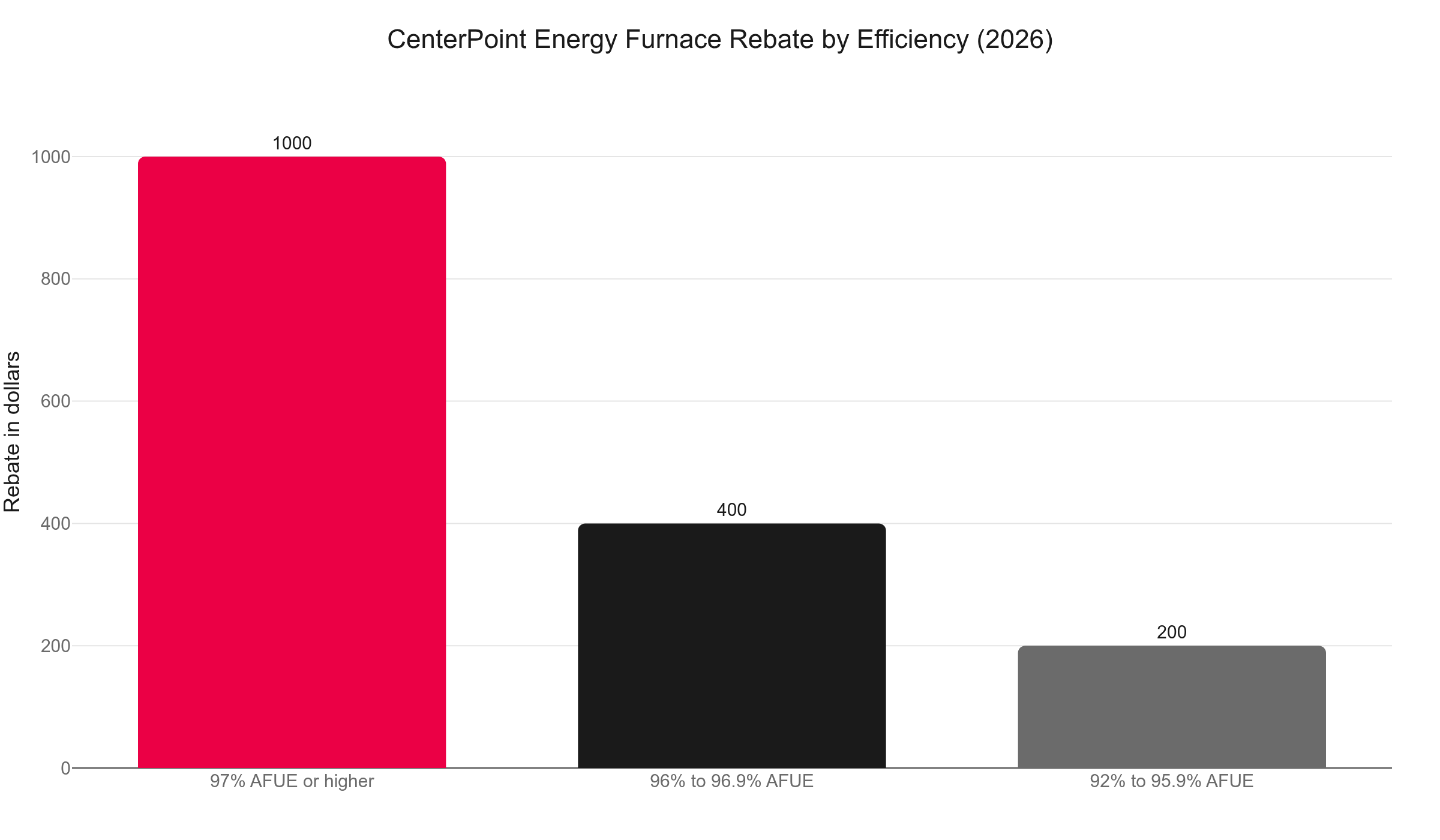
CenterPoint’s rebate for a replacement furnace depends on efficiency. According to CenterPoint Energy’s Minnesota heating rebate page, the amounts are:
- $1,000 for a furnace at 97% AFUE or higher
- $400 for a furnace at 96% to 96.9% AFUE
- $200 for a furnace at 92% to 95.9% AFUE
The same page lists the rules. Equipment must be installed between Jan. 1 and Dec. 31, 2026. It must be listed and AFUE-verified on the AHRI or ENERGY STAR site. The invoice must come from a licensed heating dealer. Self-installation does not qualify.
The utility pays the rebate, not us. Check the program page for the latest terms before you buy. Our guide to stacking Xcel and CenterPoint rebates shows how these programs fit together.
Not ready to replace? That is fine. Many short-cycling furnaces just need a repair, and we will tell you honestly which one you need.
If you do replace, ask about financing. We offer financing options for larger jobs, so a big install does not have to hit your budget all at once. Our furnace replacement service page has details.
Thinking about a different fuel? Our post on switching from gas to a heat pump in Minnesota lays out the tradeoffs for Twin Cities homes.
What should I tell the technician before they arrive?
Good notes cut diagnosis time. You do not need technical language. Plain observations work best.
Write down:
- When it started. Did it begin during a cold snap, after a filter change, or after a storm?
- How long each cycle lasts. Time two or three of them.
- What the blower does after the burners shut off.
- Any blinking code on the control board.
- When you last changed the filter, and what size it is.
- Whether the outdoor pipes were clear or frosted.
- Whether cycling follows sun, wind, or time of day.
Take a photo of the filter and the control board light. Send them if you can.
These details let your technician bring the right parts on the first trip, which keeps your repair fast.
The on-time promise and your next step
Heat trouble in a Minnesota winter cannot wait. We live here too. We are locally owned and operated, and we back every visit with a promise: “Always On Time… Or You Don’t Pay a Dime!(R)”
We arrive within the time window you select. If your technician does not show up on time, you do not pay for the service.
You also get a 100% satisfaction guarantee. Our technicians explain what they find in plain language, and you approve the price before any work starts.
If your furnace turns on and off every few minutes, start with the flowchart above. Check the filter, the blower, the thermostat, and the vents. Many homeowners solve it in one afternoon.
If the problem is still there, don’t wait for a worse night. Call (763) 260-6662 or book online. We serve Minneapolis, St. Paul, Ramsey, Blaine, Maple Grove, Plymouth, Brooklyn Park, Woodbury, Bloomington, and nearby Twin Cities communities.
For more on winter comfort, read our guide on preventing winter breakdowns. You can also explore our full heating repair services.
Frequently Asked Questions
Can a furnace be repaired if it keeps shutting off unexpectedly? +
Is a furnace that cycles every few minutes dangerous? +
Should I reset my furnace when it keeps cycling? +
Need a technician now?