
Furnace Short Cycling After Changing Filter: Why It Happens
Key Takeaways
- A new filter does not always cause short cycling. Sometimes the timing is a coincidence, and a dirty flame sensor is the real culprit.
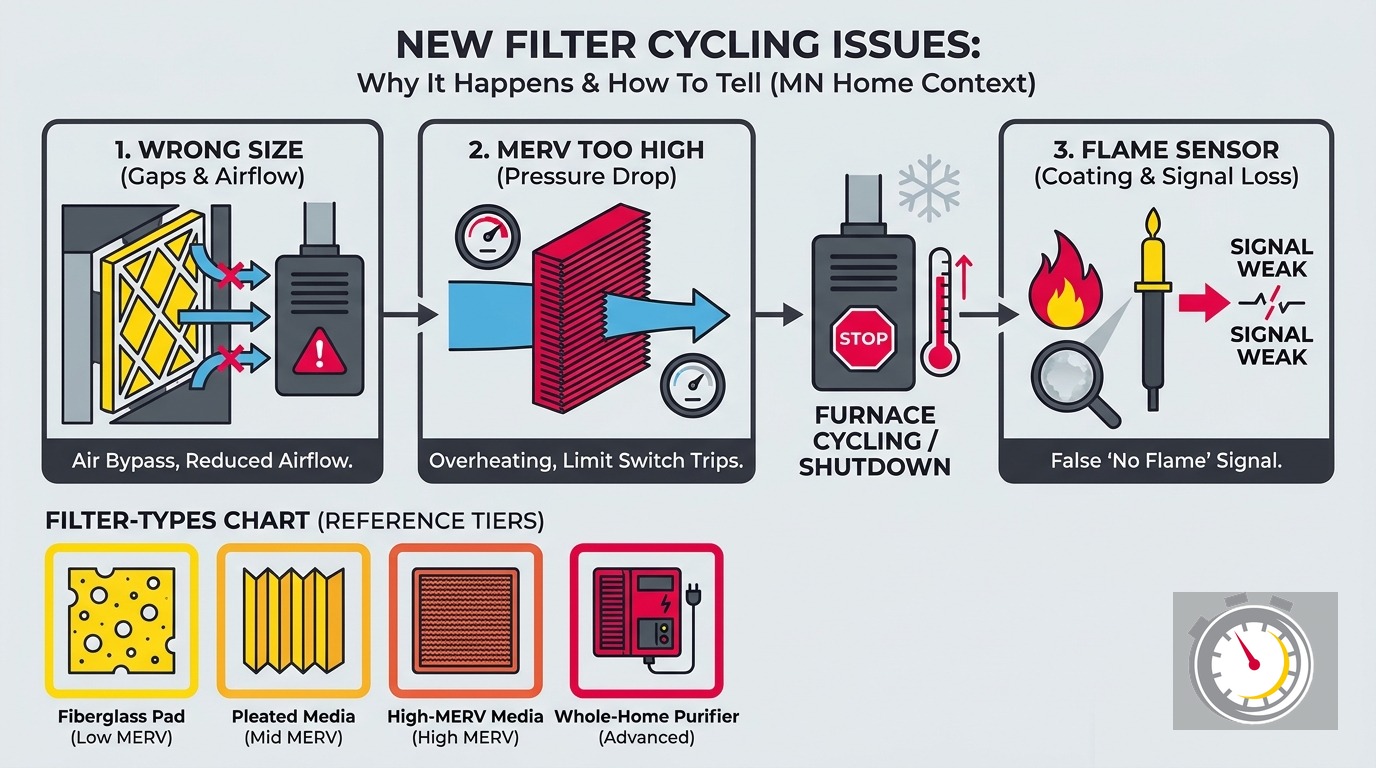
- Three common causes fit this situation: a flame sensor problem, a filter that restricts airflow, or a filter that is the wrong size and lets air leak around it.
- When the shutoff happens tells you a lot. Seconds after ignition points to the flame sensor. A few minutes in, with a hot blower, points to airflow.
- A high MERV rating does not automatically mean high resistance. Filter depth and surface area matter as much as the rating.
- Excess pressure drop can overheat a furnace and wear out the blower motor, so do not ignore repeat cycling.
- Our timing pattern is a practical guide, not a diagnosis. A technician should confirm the cause before you replace parts.
- Call Northern One Hour at (763) 260-6662 or book online if the problem continues after a basic check.
Why does a furnace short cycle right after a filter change?
A furnace can short cycle after a filter change for three main reasons. The new filter may restrict airflow, it may be the wrong size or seated poorly, or the timing may be a coincidence and a dirty flame sensor is shutting the burners off. Each cause leaves a different pattern.
You swapped the filter to fix a problem. Now the furnace starts, runs briefly, and quits. That feels like bad luck, and sometimes it is.
Most online guides assume your filter was dirty. They tell you to replace it and move on. You already did that, and the cycling is still there, or it started right after.
Below, you’ll find how to tell the three causes apart in a Minnesota home, where the furnace works hard for roughly half the year.
We are Northern One Hour Heating & Air Conditioning, a locally owned and operated company serving the Twin Cities. We get this call often in the first cold weeks of fall.
What does it mean when a furnace short cycles?
Short cycling means the furnace turns on, runs for a very short time, shuts off, and starts again before the house reaches the set temperature. A normal heating cycle runs several minutes or longer. Repeated starts that end early signal a safety shutdown or a control problem.
It’s like a car that stalls every time you pull out of the driveway. The engine runs, but something stops it.
Your furnace has several safety controls. Each one can end a cycle early:
- The flame sensor confirms the burners are lit. If it cannot sense a flame, it shuts the gas off.
- The high-limit switch watches the temperature inside the furnace. If the heat exchanger gets too hot, it shuts the burners down.
- The thermostat tells the furnace when to stop. A misplaced or faulty thermostat can end cycles early.
Trane’s troubleshooting guide lists restricted airflow and a faulty limit switch among the causes of short cycling. That fits a filter problem. A restricted filter can heat the furnace until the limit switch trips.
For causes unrelated to filters, see our guide to furnace short cycling causes and fixes.
How do I tell which cause I have?
Watch when the furnace shuts off. Seconds after the burners light usually points to the flame sensor. A few minutes in, with hot air blowing, usually points to restricted airflow. A filter that is the wrong size causes a different pattern. A technician should confirm any of these.
This timing check is a practical way to sort the causes. It is not a diagnosis. Furnaces differ, and some problems overlap. Use it to give your technician better information.
Stand near the furnace during a heating call and note what happens. Use your phone’s stopwatch. Write down:
- How long after the burners light does the furnace shut off?
- Does the blower keep running after the burners stop?
- Is the air from the vents hot, or barely warm?
- Does the furnace restart on its own, or does it stay off?
Now compare your notes to the three patterns below.
Pattern one: shuts off seconds after ignition
If the burners light and then go out within a few seconds, suspect the flame sensor. It is a thin metal rod in the burner flame. It tells the control board the flame is lit.
Over time, the rod builds up a film. When the film gets thick, the sensor cannot read the flame. The board shuts the gas off as a safety step.
Bryant’s guide notes that a faulty flame sensor can shut the burners down shortly after ignition.
The filter change likely did not cause this. You probably changed the filter, then turned the furnace on after a long summer off. The sensor was already dirty. The timing made the filter look guilty.
Our guide on cleaning a dirty flame sensor and what it costs explains the repair in detail. In our experience, a flame sensor or igniter service typically runs $95 to $325, depending on the furnace and what the technician finds.
Pattern two: shuts off a few minutes in, blower running hot
If the furnace runs a few minutes, then shuts the burners off while the blower keeps going, suspect restricted airflow. The air from the vents may feel very hot.
The blower pulls air through the filter and pushes it across the heat exchanger. If too little air moves, the heat exchanger gets hotter than it should. The high-limit switch trips and shuts the burners off. The blower keeps running to cool things down.
Then the furnace cools, resets, and tries again. That is a short cycle.
A filter that is too restrictive for your system can cause this. So can a filter with a very high MERV rating in a thin 1-inch slot. We cover that next.
Pattern three: wrong size or a gap around the filter
A filter that is too small, too thin, or poorly seated does not restrict airflow. Air goes around the filter instead. This is called bypass.
Bypass does not usually overheat the furnace, because air moves freely. The symptoms differ. You may see dust building on the blower, hear a whistling sound, or notice a filter that never seems to load up. Unfiltered air also carries dust into the system.
Because the symptoms differ, this one is harder to spot from timing alone. A technician should check the fit. Our guide to filter bypass and air leaking around the filter shows what to look for.
If your furnace short cycles and your filter has visible gaps, fix the fit first. Then watch whether the cycling changes.
Can a filter that’s too restrictive damage my furnace?
Yes, over time it can. A filter that restricts airflow too much can overheat the furnace and strain the blower motor. According to the Pacific Northwest National Laboratory, excessive pressure drop can overheat furnaces, freeze AC condensing coils, and burn out blower motors. Repeated short cycling is an early warning.
The Building America Solution Center is a DOE-backed resource. It explains how filters affect the whole system.
Your furnace has an airflow budget. The blower can only push so hard against resistance. That resistance is called static pressure. Every part of the duct system uses some of it: the ducts, the coil, the registers, and the filter.
The same page says a filter typically accounts for 20% to 50% of total system pressure drop. It also notes that most residential systems run efficiently with total static pressure at or below 0.4 or 0.5 inches of water column.
That leaves little room. The page gives an example: a filter with a 0.25 inch water column pressure drop in a PSC air handler would use half the system’s available static pressure.
A PSC motor is the older, simpler type of blower motor. It does not adjust well to extra resistance. A newer variable-speed motor can compensate more. Neither likes a filter that blocks too much.
What does damage look like?
- Overheating. The heat exchanger runs hotter than designed. The limit switch trips often.
- Blower strain. The motor works harder to move less air. Heat and wear shorten its life.
- Frozen coils. In summer, low airflow can ice the AC coil.
We cover this in more detail in our guide to high static pressure symptoms and fixes.
If you suspect your filter is the issue, do not keep running the furnace for weeks. Cycling the limit switch over and over stresses parts. Check the filter, and call us if the problem continues.
Does a higher MERV rating always restrict airflow?
No. A higher MERV rating does not automatically mean higher pressure drop. Filter depth and surface area matter too. A deeper filter with more pleats can have a higher rating and lower resistance than a thin one. The problem is usually a high-MERV filter squeezed into a slot that is too thin.
MERV stands for minimum efficiency reporting value. It rates how well a filter captures particles. Higher numbers capture smaller particles.
The Building America page lays out the standards. ENERGY STAR requires MERV 6 or higher. DOE’s Zero Energy Ready Home program and EPA’s Indoor AirPlus require MERV 8 or higher. MERV 13 or higher is recommended for controlling viruses.
Those are good goals, but the same page shows why depth matters. A 4-inch-deep pleat gives twice the surface area of a 2-inch pleat. In its MERV 7 example at 300 feet per minute, a 1-inch filter drops 0.20 inches of water column. A 4-inch filter drops 0.12.
That is a real difference for the same MERV rating. The deeper filter leaves more of your airflow budget for the rest of the system.
The page also gives airflow guidance. It lists 500 feet per minute as the maximum desired residential velocity. It says 200 to 400 feet per minute is preferred.
What does this mean for you?
- If your furnace has a thin 1-inch slot, a high-MERV filter may be too restrictive.
- If you have a 4-inch or 5-inch media cabinet, you can often use a higher MERV with less penalty.
- If you recently upgraded your MERV rating and the cycling started, that upgrade is a prime suspect.
No single MERV number is safe for every home. It depends on your furnace, your ductwork, and your filter slot. A technician can measure the pressure to be sure.
Our guide to whether a MERV 13 filter restricts furnace airflow goes deeper. If you are choosing a new filter, see our MERV rating guide for Minnesota homes.
How do I tell if my air filter is backwards?
Look for the airflow arrow printed on the filter frame. It should point toward the furnace, in the direction air travels. If the arrow points away from the furnace, the filter is backwards. A backwards filter can load up unevenly and may let debris through.
Most filters have an arrow on the cardboard edge. It shows the direction of airflow.
Here is how to check:
- Turn the furnace off at the thermostat.
- Find the filter slot. It is usually at the furnace itself or at a return air grille.
- Slide the filter out and read the arrow.
- The arrow should point toward the furnace blower, away from the room or return duct.
- Slide the filter back in so it sits flat.
If you are not sure which way air moves, remember the path. Air flows from your living space, through the return duct, through the filter, and into the furnace. The arrow points the way the air is going.
A backwards filter is less likely to cause short cycling by itself. The bigger risk is a poor fit. Check that the filter sits snug in the slot with no gaps at the corners. Also check that the slot cover closes fully.
How do you restart a furnace after changing the filter?
Most furnaces restart on their own once the filter is in and the access panel is closed. Make sure the panel is fully latched, because many furnaces have a door switch that stops the blower. Then set the thermostat above room temperature and wait a few minutes.
Here is a simple restart routine:
- Confirm the new filter sits flat and the arrow points toward the furnace.
- Close the filter cover and the blower access door firmly.
- Check that the furnace power switch, which looks like a light switch, is on.
- Set the thermostat to heat, and raise it a few degrees above room temperature.
- Wait for the furnace to begin its startup sequence.
The sequence takes a minute or two. You will hear the inducer fan start. Then the burners light. Then the blower comes on after a short delay.
If nothing happens, check the door switch first. A panel that is not seated can keep the furnace from running. We cover that in our guide to a blower door switch that won’t run.
If the furnace still will not start, or it starts and quits, do not keep resetting it. Repeat attempts can lock out the ignition system. Call a technician instead.
Do not open any gas-related parts yourself. If you smell gas, leave the house and call your gas utility from outside.
What should Minnesota homeowners know about filters and cycling?
Minnesota furnaces face a long, hard heating season. That makes airflow problems show up fast. Heavy run time means a restricted filter overheats the furnace sooner, and a dirty flame sensor causes more lockouts. Regular filter checks and a yearly tune-up catch both problems early.
The Minnesota Center for Energy and Environment, known as MNCEE, says about 55% of the energy used by Minnesota homes goes to heating and cooling. That is a big load for one system.
MNCEE also says that “replacing your filter every three months is a good start.” The right timing depends on your heating system, filter type, and pets. In a Minnesota winter with a furnace running most of the day, check your filter monthly.
We see these Minnesota-specific points often:
- The first cold snap. The furnace has sat idle all summer. Dust has settled on the flame sensor. The first run of the season is when sensor problems appear.
- Heavy winter run time. A filter that is fine in October may be loaded by January.
- Dry, dusty air. Low winter humidity can mean more dust moving through the system.
- Pets and fall leaves. Hair and debris load filters faster.
Our guide on how often to change your HVAC filter in Minnesota gives a schedule that fits our climate.
A possible rebate for the tune-up
Some Minnesota homeowners can offset part of a tune-up. Minnesota Energy Resources offers a $35 rebate for a furnace tune-up. Rules apply:
- It is limited to existing homes.
- It allows one tune-up per household every two years.
- A licensed HVAC dealer must do the work.
- The application must arrive within 60 days of service.
Minnesota Energy Resources serves only part of the state, and the rebate applies to its customers. Check which utility serves your address before you count on it. Xcel Energy and CenterPoint run their own programs, so ask your utility what is available.
The rebate page also says the tune-up includes a carbon monoxide test, a check of the pilot or igniter and flame sensor controls, and a check of the furnace air filter’s condition.
A good tune-up looks at the exact parts that cause short cycling after a filter change. Learn more about our furnace tune-up service.
What can I check myself before calling a technician?
You can safely check the filter, the filter slot, the return vents, and the thermostat. Do not open gas controls or burner parts. These checks take about fifteen minutes. They often find the cause or give your technician useful clues.
Work through this list in order.
1. Check the filter size. Read the size printed on the old filter’s frame. The new filter should match it. Do not trust the nominal size alone. A filter labeled 16x25x1 is slightly smaller than 16 by 25 inches, but it should still fit the slot snugly.
2. Check the fit. Look for gaps at the edges. The filter should slide in without bending. Make sure the slot cover closes fully.
3. Check the MERV rating and depth. Did you change brands or ratings? If you went from a basic filter to a high-MERV filter in a 1-inch slot, that is a likely suspect. Try a lower-MERV filter of the same size as a test.
4. Check the direction. Confirm the arrow points toward the furnace.
5. Check the return vents. Make sure furniture, rugs, or closed doors are not blocking return air. Trane’s guide lists blocked return vents among the airflow problems. Our article on return air problems explains why.
6. Check the vent pipe outside. For a high-efficiency furnace, look at the exhaust and intake pipes outside. Snow, ice, or nests can block them. Clear what you can reach safely.
7. Run the timing test. Use the stopwatch method from earlier. Write down when the furnace shuts off.
A simple swap test
If you changed to a higher-MERV filter, try a different filter as a test. Use one that is the same size but a lower rating, or a thicker one if your slot allows it.
If the cycling stops, the filter was likely too restrictive. If it continues, the filter is probably not the cause. Either result helps.
Do not leave the furnace running through repeated trips while you experiment. If it cycles more than a few times with no change, stop and call.
When should I call a technician?
Call a technician if the furnace keeps short cycling after you correct the filter, if you see signs of overheating, or if you are unsure about any step. Also call if you smell gas, burning, or exhaust fumes. Safety problems are never a do-it-yourself job.
Call us if you notice any of these:
- The furnace cycles on and off more than a few times in an hour after a filter fix.
- The vents blow very hot air, or the cabinet feels hot to the touch.
- You hear banging, squealing, or a loud blower.
- The furnace locks out and will not restart.
- You smell gas, burning, or exhaust.
- A carbon monoxide alarm goes off.
For a gas smell or an alarm, leave the home and call from outside. Do not wait for an appointment.
A technician can do things you cannot safely do yourself:
- Clean and test the flame sensor and check the flame signal.
- Measure the supply and return static pressure. The Building America page says to add the two readings to check a system after an upgrade.
- Test the high-limit switch.
- Check the temperature rise across the furnace.
- Confirm the filter fit and recommend a filter that suits your system.
We measure instead of guessing. Then we can tell you whether your system handles a high-MERV filter, or whether a deeper media cabinet would fix the problem.
Our furnace repair team handles these calls across the Twin Cities. For the full range of causes beyond filters, our article on furnaces cycling on and off every few minutes compares filter and thermostat problems.
What does the fix usually cost?
Costs depend on the cause. A filter swap costs very little. A flame sensor or igniter service typically runs $95 to $325. A single tune-up visit typically runs $95 to $250. Larger repairs, such as a blower motor or control board, cost more.
Here is how the causes line up.
Wrong filter or poor fit. This is the cheapest fix. You buy the right size and seat it properly. If you need a deeper filter cabinet, that is a larger job. We can quote it after we measure.
Restrictive MERV rating. Often you switch to a lower rating, or a deeper filter. If a thin slot cannot handle the filtration you want, we can discuss options.
Dirty flame sensor. A cleaning or replacement is a short visit. Our typical range is $95 to $325 for flame sensor or igniter service.
Overheated parts. If repeated limit trips have worn a blower motor or other part, the repair costs more. That is why we urge you not to ignore the cycling.
If a repair starts to look expensive on an older furnace, we will tell you honestly. Our guide to furnace repair costs helps you compare. For larger jobs, ask us about financing options.
We price transparently. You see the number before we start work.
Why choose a local team for furnace problems?
A local team knows how Twin Cities homes and winters behave. We are locally owned and operated, and we are backed by the national One Hour Heating & Air Conditioning name. We keep our promise simple: we show up when we say we will.
Short cycling in January cannot wait. Your home gets cold fast.
That is why we stand behind “Always On Time… Or You Don’t Pay a Dime!(R)” We arrive within the time window you select. If the technician does not show up on time, you do not pay for the service.
We also offer a 100% satisfaction guarantee and honest, transparent pricing. We explain what we find in plain language. We show you the filter, the sensor, and the readings.
Read more about why on-time service matters for Twin Cities homes.
Get your furnace running right
A new filter should help your furnace, not hurt it. If your furnace started short cycling after a filter change, timing can narrow down the cause:
- Shutoff within seconds of ignition points to the flame sensor.
- Shutoff after a few minutes with a hot blower points to restricted airflow.
- A loose or wrong-size filter points to bypass.
Start with the free checks. Confirm the size, the fit, the direction, and the MERV rating. Try a swap test if you recently upgraded. Then call a professional if the cycling continues.
Do not let a short cycling furnace run for weeks. Repeated overheating wears out parts and can leave you without heat in a Minnesota cold snap.
Call Northern One Hour at (763) 260-6662 or book online. We will find the real cause, explain it plainly, and get your heat steady again.
Frequently Asked Questions
Should I put my old filter back in if the furnace starts short cycling? +
Is it normal for a furnace to cycle more on very cold Minnesota nights? +
How often should I change my furnace filter in Minnesota? +
Can I clean a flame sensor myself? +
Need a technician now?