
Smart Thermostat Recovery Mode Explained for Minnesota Homes
Key Takeaways
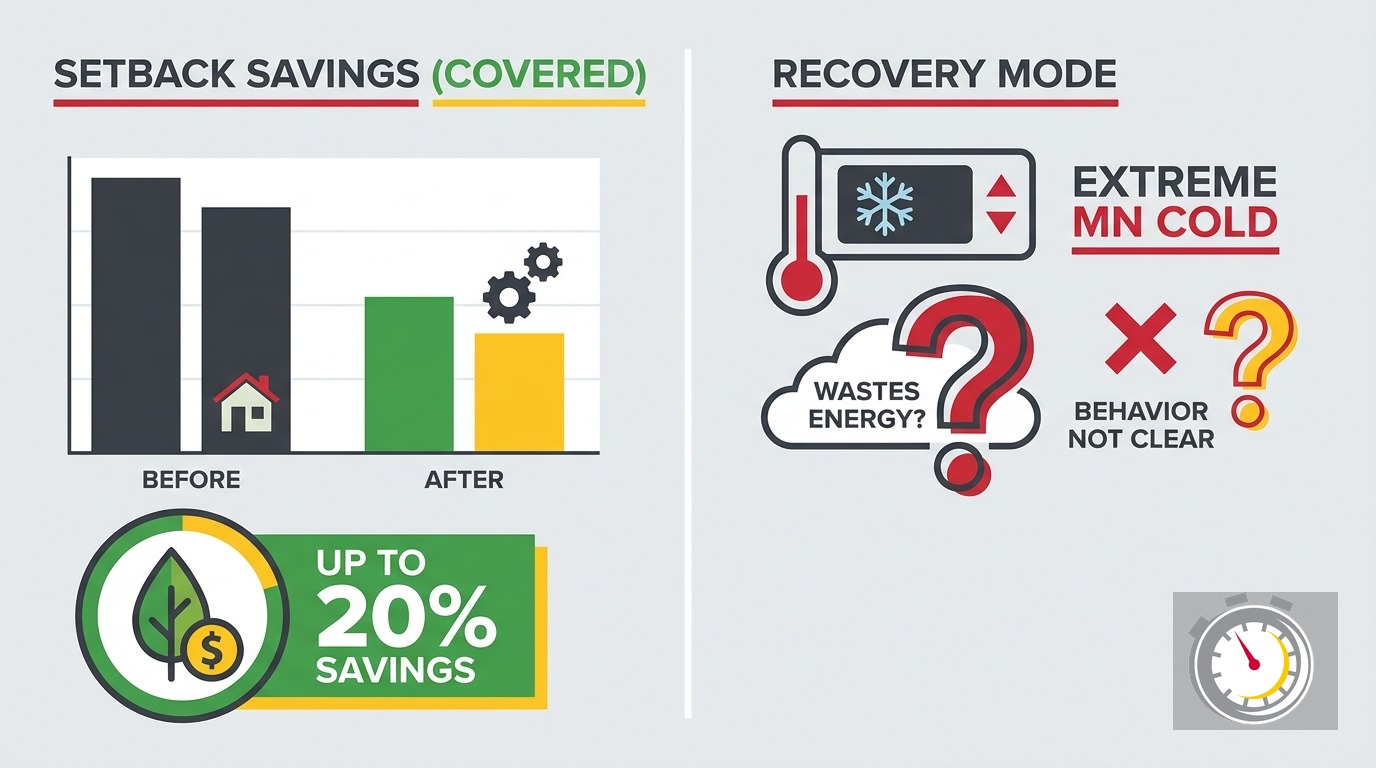
- Recovery mode is a feature, not an error. Your thermostat is working exactly as designed.
- Gas furnace owners can save on annual heating costs with a temperature setback, according to the U.S. Department of Energy.
- Heat pump owners should cap setbacks at 2°F. Larger setbacks can trigger electric resistance auxiliary heat, which NREL research found fully erases setback savings in some homes.
- Normal recovery runs 15 to 60 minutes. Anything consistently past 90 minutes without reaching the setpoint is a warning sign worth investigating.
- Minnesota homeowners on Xcel Energy or CenterPoint can collect up to $175 in year-one rebates on a qualifying smart thermostat.
What Does It Mean When My Thermostat Is in Recovery Mode?
Recovery mode means your thermostat started the heating or cooling cycle early. It detected an upcoming scheduled temperature and began working ahead of time. The goal is to reach the target temperature at the exact moment you programmed, not 30 or 40 minutes after.
The word “recovery” describes your home recovering from a setback temperature back to the comfort setpoint you set. Nothing is broken. Recovery mode is a feature, not an error.
The label varies by brand. “Smart Recovery,” “Adaptive Intelligent Recovery,” and “Early Start” all describe the same behavior. The display is telling you the system is in its planned warm-up window.
How Does Thermostat Recovery Mode Work?
The thermostat tracks how long your system takes to move from setback temperature to comfort setpoint, then uses that history to start early. Modern smart thermostats adapt the estimate based on outdoor temperature and recent performance. Older programmable models use a fixed window of 30 to 60 minutes.
What your thermostat is learning
Every morning, a smart thermostat logs how the recovery went. It adjusts the next day’s start time based on outdoor temperature data and how the home performed. On a -10°F morning, it starts earlier than on a 30°F morning. Over weeks, it builds a model specific to your home’s insulation, your system’s capacity, and your local climate.
That learning is why smart thermostats consistently out-save older programmable ones. An ENERGY STAR certified smart thermostat can reduce heating and cooling bills and save money each year on average. Homes that are unoccupied much of the day can save approximately $100 a year, according to ENERGY STAR.
Why a gradual ramp beats a hard start
A slow ramp from 65°F to 70°F avoids the brief, intense demand spike of a cold-start call. The system runs at a lower stage for longer rather than firing at full capacity for a short burst. This is easier on the equipment and smoother on your energy use.
Whether that actually saves energy for your home depends on your system type. That distinction matters a great deal in Minnesota.
How Long Should a Thermostat Be in Recovery Mode?
Normal recovery runs 15 to 60 minutes. Homes with large setbacks, extreme outdoor temperatures, or aging equipment may run up to two hours. Recovery consistently exceeding 90 minutes without reaching the setpoint is a warning sign of a possible system problem, according to Lennox.
Several factors stretch recovery time:
- Setback size: A 10°F overnight drop takes longer to close than a 4°F drop.
- Outdoor temperature: At -15°F, your system works harder than at 25°F.
- System age and condition: Aging equipment loses capacity. A recovery that took 20 minutes at installation may now take 45.
- Home insulation: A leaky older home loses heat faster than the system can produce it.
Lennox recommends a 4-5°F setback gap as a practical target for keeping recovery short and efficient. If your home is still in recovery mode when the morning is half over, a smaller setback will serve you better than a longer runtime.
Recovery Mode and Heat Pumps: What Minnesota Homeowners Need to Know
This is the part every mainstream guide skips. Every article ranking for this topic was written as if the reader has a gas furnace in a mild climate. If you have a heat pump in the Twin Cities, that assumption changes the advice materially.
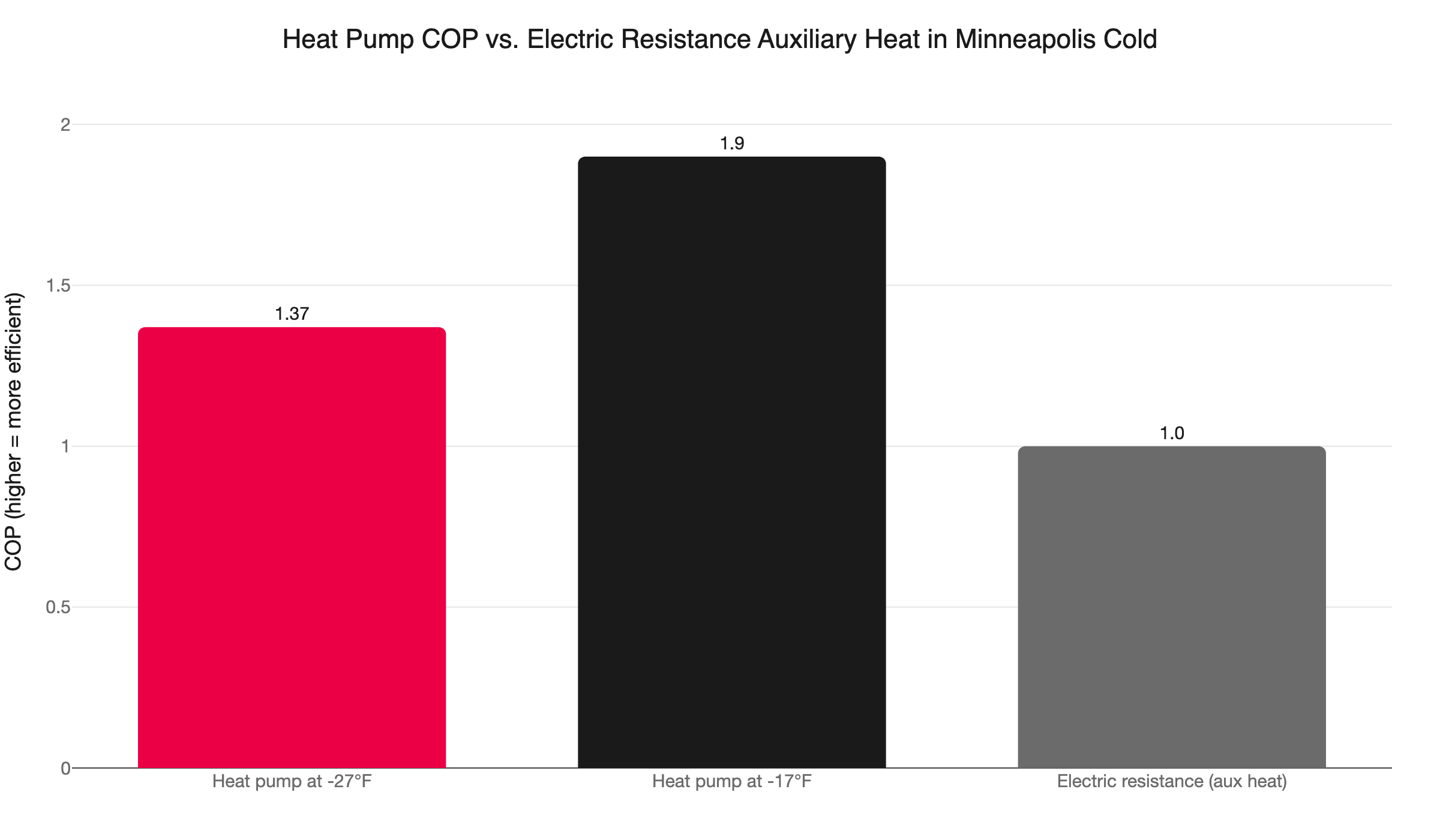
Here is the core issue. When a heat pump needs to recover from a deep setback, the temperature gap may be too large for the heat pump to close quickly on its own. The thermostat calls for supplemental heat, and the electric resistance strips activate. Those strips have a coefficient of performance (COP) of 1.0 by definition: one unit of electricity in, one unit of heat out.
Your heat pump does better than that, even in Minnesota cold. Field data from a Fujitsu mini-split in Minneapolis at -17°F shows a COP of nearly 2: roughly twice the heat output per unit of electricity compared to resistance strips. At -27°F, the same unit measured a COP of 1.37. Aux heat at COP 1.0 is the least efficient mode your system has. (Source: Energy Vanguard)
A September 2025 NREL report studied thermostat setbacks in heat pump homes and found that setbacks of 3°F or greater increased electricity demand for heating at the peak demand hour by around 35%. The same report found that the energy penalty from electric supplemental heat during morning warm-up negated the setback energy savings entirely.
Minneapolis has a 99% design temperature of -16°F. Our winters are not a mild-climate edge case. They are precisely where the aux-heat recovery penalty is largest and most expensive.
The Right Setback for Your System Type
The ideal setback is not the same number for every home. Your heat source changes the calculation.
Gas furnace: use the standard guidance
A 7-10°F setback overnight or during unoccupied hours is the well-supported sweet spot. The U.S. Department of Energy estimates savings on annual heating and cooling costs for a setback of that size held 8 hours a day.
Recovery mode with a gas furnace is low-risk. Gas heat recovers quickly. A gradual ramp avoids a demand spike. Recovery typically finishes in 30-45 minutes on a well-maintained furnace.
Heat pump: cap your setback at 2°F
The September 2025 NREL research recommends a maximum 2°F unoccupied setback for heat pump systems to avoid supplemental heating demand spikes. That is far smaller than what furnace owners use.
A small, consistent setback still saves energy. The heat pump runs at a slight deficit throughout the unoccupied period rather than cycling off and demanding a hard recovery. You save less per degree of setback than a furnace owner does, but you avoid the aux-heat penalty that erases those gains.
If you are not sure whether your home has a heat pump or a gas furnace, check the thermostat wiring. An “O” or “B” terminal wire signals a heat pump. A separate “W2” or “AUX” terminal means electric resistance strips are present. Our technicians confirm system type on every service visit.
Recovery Mode Is Not the Same as Vacation Mode
Many homeowners conflate these two concepts. They are different, and the distinction matters for heat pump owners especially.
- Recovery mode is the warm-up or cool-down phase before a scheduled occupied period. It is temporary and ends when the thermostat reaches the setpoint.
- Setback mode is the reduced-temperature period during unoccupied hours. The thermostat holds, say, 62°F while you are at work.
- Vacation mode is a manual, extended setback you program for multi-day absences.
Vacation mode is where the heat pump penalty is most pronounced. A drop to 60°F from a normal 68°F setpoint is an 8°F gap. That gap will almost certainly trigger aux heat on recovery. The electricity cost during the recovery can exceed what you saved during the setback itself.
For heat pump owners planning a long weekend away in January: keep the setback to 2°F or less. If you want the house comfortable when you return, leave the setpoint where it is and let the thermostat manage the schedule normally. The heat pump will cycle efficiently in the background rather than hitting a hard recovery call on your return.
Should You Disable Recovery Mode?
It depends on your system.
Leave it on with a gas furnace. Recovery mode delivers the right temperature at the right time without demanding a hard, sudden call. There is no meaningful downside.
Leave it on with a heat pump and a 2°F setback. A modest setback with smart recovery gives the heat pump a few extra minutes of lead time. That is the right combination.
Fix the setback before disabling recovery on a heat pump. Turning off recovery mode on a large setback does not solve the problem. The system still needs to close that temperature gap. Without the early start, it begins late and may still call for aux heat to catch up. Reduce the setback to 2°F or less first. That is the actual fix.
To find the recovery mode setting on common thermostats:
- Ecobee: Thermostat Settings > Preferences > Smart Recovery
- Nest: Settings > Thermostat temperature settings, or in the schedule editor
- Honeywell / Resideo: Smart Response under Comfort Settings
- Emerson/White-Rodgers: Early Start under Scheduling
Why a C-Wire Matters for Reliable Recovery
Recovery mode and smart scheduling both depend on the thermostat having stable, continuous power. A thermostat running on batteries alone may lose its programmed schedule during a power fluctuation, or produce erratic recovery behavior as the batteries weaken.
A C-wire (common wire) provides constant 24-volt power from the furnace or air handler control board. It is what allows modern smart thermostats to run a backlit display, hold a Wi-Fi connection, and log weather data without draining batteries. If your thermostat loses its schedule unexpectedly, or recovers at odd times that do not match your programming, check the C-wire first.
Our guide to C-wire compatibility and installation options for Minnesota homes covers both the DIY wiring check and when a technician needs to pull a new wire through the wall.
Minnesota Rebates for Smart Thermostats
Getting recovery mode configured correctly matters most when the thermostat is modern and calibrated well. If you are running an older programmable or dial thermostat, the rebates available in Minnesota make upgrading easy to justify.
Xcel Energy (residential electric or natural gas customers):
- $50 rebate for an ENERGY STAR certified smart thermostat
- $100 bill credit at enrollment in AC Rewards
- $25 annual bill credit for minor demand-response adjustments
- Year-one total: $175
Source: Xcel Energy AC Rewards, Minnesota
CenterPoint Energy (Minnesota natural gas residential customers):
- $50 rebate for a smart or Wi-Fi enabled programmable thermostat
- One rebate per address; program runs January 1 through December 31, 2026
Source: CenterPoint Energy smart thermostat rebate
One note: the federal 25C tax credit for smart thermostats expired December 31, 2025. It does not apply to 2026 purchases. The utility rebates above are still active.
Before upgrading, it is worth knowing how much life your existing system has. A new thermostat on a furnace that is two years from retirement is a different investment than one paired with a recent install. Our guide to HVAC system lifespan in the Twin Cities covers furnace, heat pump, and AC life expectancy for Minnesota conditions. If you decide to move forward with a full system upgrade, here is what installation day actually looks like so you know what to expect before the technician arrives.
When Recovery Mode Becomes a Warning Sign
Recovery mode is a feature, not a fault. But patterns during recovery can reveal a real problem.
Watch for:
- Recovery consistently running past 90 minutes without reaching the setpoint. This is the clearest sign of a system issue, not just cold weather.
- Recovery getting longer week over week. A building restriction, such as a filter loading up, a coil fouling, or refrigerant slowly dropping, shows up exactly this way.
- Auxiliary heat firing during heat pump recovery on mild days. Some aux use below 25°F is normal in Minnesota. On a 40°F morning, aux heat during recovery suggests a system fault.
- The thermostat never exits recovery mode. If the display shows recovery for two or three hours and the home temperature barely moves, the system is not producing enough heat.
These patterns are easier and cheaper to address during a scheduled tune-up than during an emergency on a January night. Northern One Hour is locally owned and operated in Ramsey, MN. When you schedule a visit, our technician arrives within the window you select. That is the promise behind “Always On Time… Or You Don’t Pay a Dime!(R)”: if our technician does not show up on time, you do not pay for the service.
Ready to Get Your Thermostat Working Right?
If recovery mode is running too long, your setbacks may need adjusting for your system type. If your thermostat is outdated, the rebates above make upgrading a straightforward call.
Our team serves Minneapolis, St. Paul, Ramsey, Blaine, Maple Grove, Plymouth, Brooklyn Park, Woodbury, Bloomington, and the surrounding Twin Cities metro. Call us at (763) 260-6662 or schedule your thermostat service online.
Frequently Asked Questions
How do I get my thermostat out of recovery mode? +
Need a technician now?