
Need a Smaller Furnace After Insulation and Windows? MN
Key Takeaways
- Insulation and window upgrades cut your home’s heat loss. If your furnace was already oversized before the work, that mismatch just got wider.
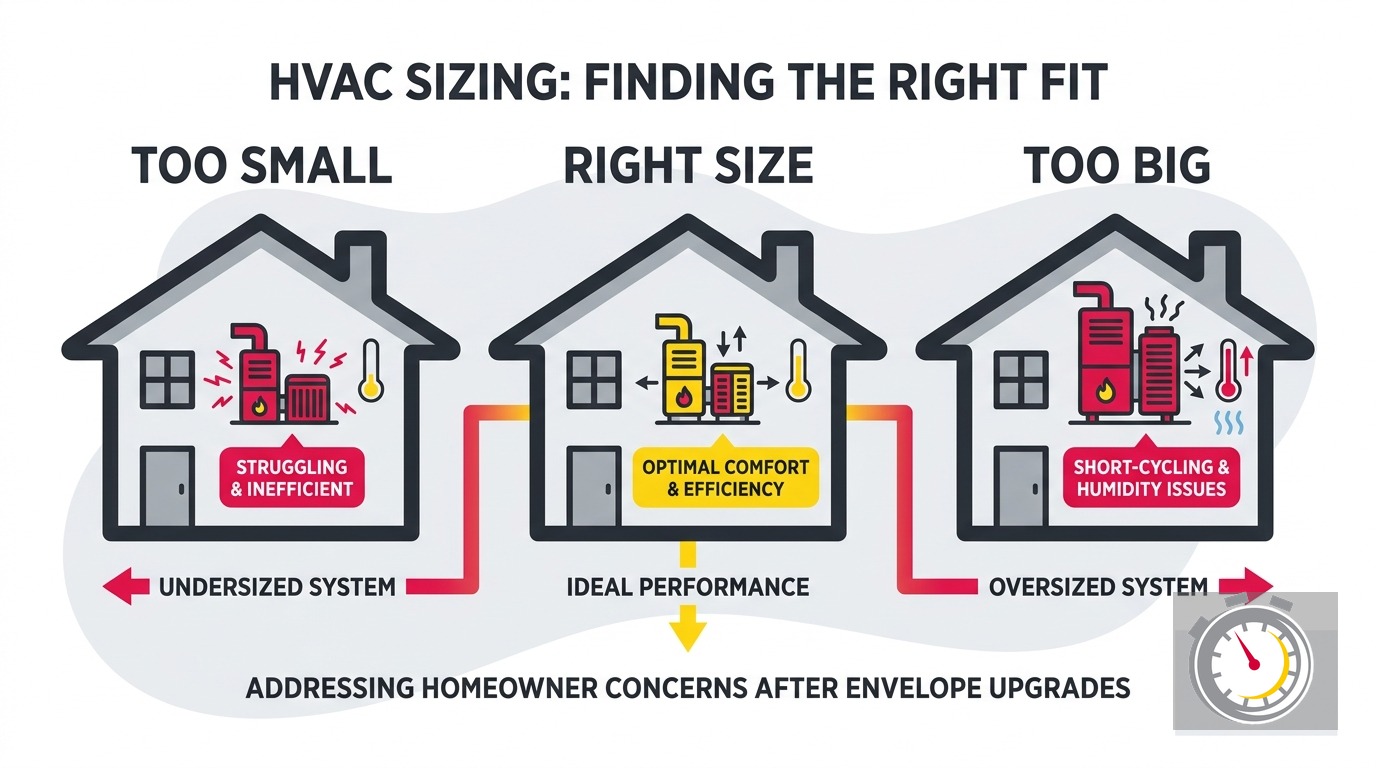
- The primary symptom: short-cycling, where the furnace fires for 3-7 minutes, overshoots the thermostat, shuts off, and repeats all day.
- The correct ACCA 99% design temperature for the Twin Cities is -11°F, not the old -20°F figure still in many contractor spreadsheets.
- A fuel-bill load check using your gas utility history takes about 15 minutes and costs nothing. Run it before you call anyone.
- A Manual J calculation is the only proper basis for a sizing conversation. It accounts for your new insulation levels, window U-values, and air infiltration rate.
- A CenterPoint natural gas customer replacing with a qualifying 95%+ furnace can stack a $1,000 utility rebate with a $600 federal 25C tax credit in the same transaction.
You spent the money on new insulation and triple-pane windows. Now you are wondering: do I need a smaller furnace after adding insulation and new windows in Minnesota? Here is the honest answer, and a free way to check before you call anyone.
Do I Need a Smaller Furnace After Adding Insulation and New Windows in Minnesota?
Possibly, yes. Insulation and window upgrades reduce your home’s heat loss, which shrinks its design load. If your furnace was already oversized before the upgrade, the gap is now wider. The clearest signs are short-cycling, uneven temperatures, and a heating bill that dropped while comfort did not improve.
Most articles about furnace sizing assume you are looking at a sales quote and deciding what to buy. This post is for a different situation. You have already improved the envelope, you have a running furnace, and you want to know whether the system is now a mismatch worth addressing.
Here is the scenario our technicians see regularly. A Twin Cities homeowner invests in new triple-pane windows and added attic insulation. The heating bill drops 15-20% that first winter. But the house still runs too warm in short stretches, then drifts cold within an hour. The thermostat never holds steady. That is not a thermostat problem. That is an oversized furnace problem the envelope upgrade just made more visible.
Research by GreenBuildingAdvisor shows that oversizing by 3x is the norm rather than the exception in residential HVAC replacements. ASHRAE recommends sizing heating equipment at no more than 1.4x the design heat load. The gap between that standard and what most homes actually have is wide. Your insulation project did not create the oversizing problem. It exposed it.
How Do I Know If My Furnace Is Now Too Big?
The most reliable sign is short-cycling: the furnace fires, the house heats fast, the system shuts off before finishing a proper run, and then it fires again a few minutes later. Run times of 3-7 minutes with repeated restarts throughout the day are the oversize signature.
Watch for these patterns after your envelope upgrade:
- Short on/off cycles. A correctly sized furnace runs 15-20 minutes in moderate cold. Three-to-five-minute cycles are a red flag.
- Temperature swings. The furnace blasts on, overshoots the thermostat target, shuts down, and the house drifts cold quickly. No stable temperature is held.
- Uneven rooms. Short cycles do not push heat evenly through ductwork. Far rooms fall short while rooms near the furnace run too warm.
- Humidity problems in winter. Short cycles degrade humidity management: the unit does not run long enough for the whole-house humidifier to complete its cycle.
- Bills fell but comfort did not improve. The envelope investment reduced the load, but the system cannot modulate down to match it.
There is a less obvious failure mode worth knowing about. An oversized furnace runs hotter than its design target and can trip its own overheat safety on the coldest days - the exact moment you need reliable heat the most. The unit shuts itself down in self-protection mode. You are calling for emergency service at -20°F not because something broke, but because the furnace was too large for the house it is serving.
Can I Check My Own Heating Load Before Calling Anyone?
Yes, and it takes about 15 minutes. The fuel-bill load method uses your actual gas utility history to estimate your home’s real design heat load. No contractor, no tools, no fee.
Here is how to do it:
Step 1. Pull your gas bills for the three coldest months of the past one to two heating seasons. You need monthly therms used and the billing-period dates.
Step 2. Find heating degree-days for each billing period. Your utility often prints this on the bill. If not, it is available by zip code through most weather data services.
Step 3. Subtract your baseline non-heating gas use. For a typical Twin Cities home with a gas range and water heater, this is roughly 10-15 therms per month.
Step 4. Convert remaining therms to BTUs (multiply by 100,000) and divide by billing-period hours. This gives you average hourly heat output for that month.
Step 5. Scale to your design temperature. If your coldest billing period averaged 10°F and your design temperature is -11°F, your worst-case load is proportionally higher.
GreenBuildingAdvisor’s guide walks through this math step by step. The goal is not to replace a Manual J. The goal is a sanity check: if your calculation suggests a peak load of roughly 55,000 BTU/hr and your furnace is rated at 100,000 BTU/hr, you have close to a 2x oversize situation before even accounting for the load reduction from your new insulation and windows.
Do this before you invite anyone to give you a quote. It puts you in a much stronger position in that conversation.
What Is the Correct Design Temperature for Twin Cities Furnace Sizing?
The current ACCA 99% design temperature for the Twin Cities metro is -11°F. A properly sized furnace runs near-continuously on a -11°F night and falls slightly short only on the rare days below that threshold. That is the intended design behavior, not a failure.
The -20°F figure that still appears in many contractor estimates is outdated. Structure Tech’s research on oversizing flags this directly: the -20°F benchmark does not reflect current ACCA methodology for most of the Twin Cities metro, but it persists in older estimating tools and has not been corrected in many contractor workflows.
The practical consequence is meaningful. A furnace sized for -20°F instead of -11°F carries roughly 25-30% more capacity than the design load requires, before any other margin is added. Stack that on top of a like-for-like replacement that ignores the load calculation, then add the load reduction from your new insulation and windows, and the total mismatch can reach 2x to 3x the actual need.
A furnace operating at 30-40% of its rated capacity during a typical January morning is not running well. It is cycling more, wearing components faster, and delivering less comfort than a correctly sized unit would at the same or lower fuel cost.
What Should a Contractor Do When You Ask About Right-Sizing?
They should run a Manual J calculation, not a square-footage rule of thumb. A real Manual J accounts for your current insulation R-values, window U-values, air infiltration rate, home orientation, ceiling height, duct losses, and the local design temperature. If a contractor’s proposal does not mention Manual J, ask directly why not.
Many Minnesota contractors skip Manual J entirely and replace like-for-like, installing the same BTU/hr as the old unit without calculating what the house now needs. For a house whose envelope has not changed, that is already a problem. For a house that just had insulation and windows upgraded, a like-for-like replacement locks in the mismatch for another 15-20 years.
Ask the contractor these specific questions before accepting any proposal:
- “Will you run a Manual J based on my current insulation R-values and window U-values?”
- “What design temperature are you using for the Twin Cities?”
- “What run ratio are you targeting at 0°F outdoor temperature?”
Vague answers are informative. A contractor who will run a proper Manual J calculation is taking the problem seriously. One who quotes from a table tied to square footage is not.
A note on modulating furnaces: some contractors will propose a modulating unit as a partial response to the sizing question. A modulating furnace can ramp its output down to 40-60% of rated capacity in mild weather. That softens the oversize comfort penalty and is a legitimate engineering response when the Manual J shows mild oversizing. It is not a substitute for right-sizing, but it is a useful tool when the numbers are close and replacement timing is uncertain.
The Permit You Cannot Skip
Every furnace replacement in Minnesota requires a mechanical permit under Minnesota Statutes Chapter 326B. The permit is pulled by the contractor. The work must be performed by a DLI-licensed technician. Typical Twin Cities permit cost is $150-$450.
The inspection matters beyond compliance. It creates a paper trail that protects you at resale: buyers’ home inspectors flag unpermitted HVAC work, and title companies increasingly request documentation that major mechanical systems were installed to code. If you paid for insulation and window upgrades and kept those receipts for the 25C tax credit, you already have a model for the kind of documentation that protects an investment. The furnace permit and inspection is the HVAC version of that.
An unpermitted system can also complicate a homeowner’s insurance claim if a fire or carbon monoxide incident is later tied to the equipment. Any contractor who suggests the permit is optional is a red flag. Verify contractor license status at dli.mn.gov.
Can I Stack Rebates and Tax Credits If I Right-Size?
Yes, and the combination is worth understanding before you get to the contract stage. A CenterPoint natural gas customer who replaces with a qualifying 95%+ AFUE furnace can combine a $1,000 utility rebate with a $600 federal 25C tax credit. If you already claimed the insulation credit in a prior year, that was a separate annual limit. The furnace credit is its own category.
CenterPoint Energy (natural gas customers): Up to $1,000 rebate on a high-efficiency furnace replacement, for equipment installed January 1 through December 31, 2026. Equipment must be AHRI-verified. Full program details at CenterPoint Energy’s Minnesota Heating Rebates page.
Federal 25C tax credit: The IRS Energy Efficient Home Improvement Credit allows up to $600 per year for a qualifying 95%+ AFUE natural gas furnace. This is a separate category from the up to $1,200 credit for insulation and air sealing materials. These are per-category annual limits, not a single lifetime cap. Banking the insulation credit in one tax year does not reduce what you can claim for HVAC equipment in another year.
Xcel Energy: Xcel offers HVAC rebates on qualifying high-efficiency equipment, plus a $600 bonus rebate for customers who install qualifying insulation and air sealing and then a qualifying heat pump within two years. If your envelope upgrade was recent, that two-year window is already open. Check current amounts at Xcel’s heat pump rebate page.
For a full walkthrough of how these programs interact, including income-qualified bonus tiers, see our guide to IRA tax credits for high-efficiency HVAC in Minnesota.
What a Right-Sized Replacement Costs in the Twin Cities
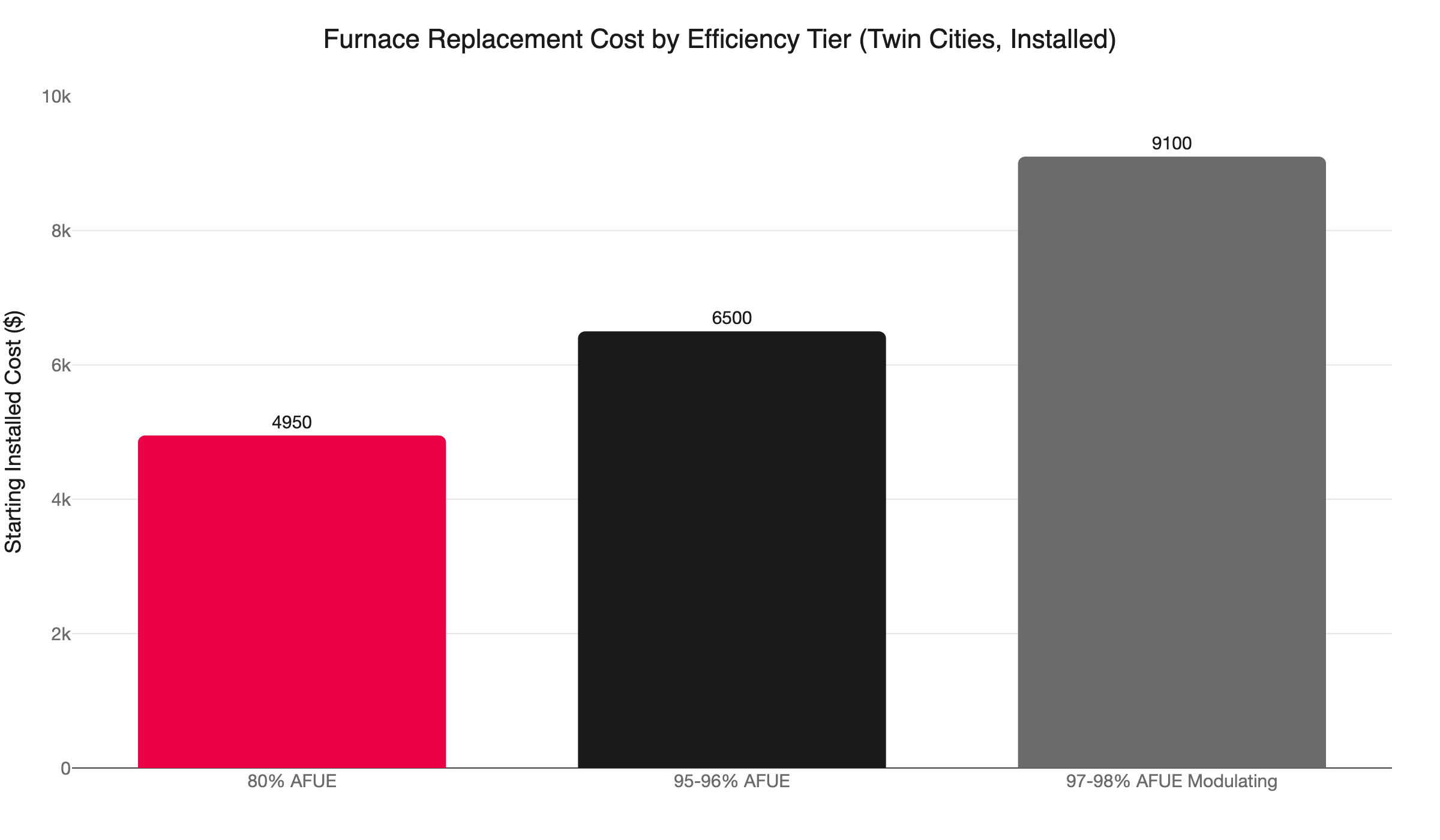
If Manual J confirms your house now needs a smaller, more efficient furnace, installed starting prices in the Twin Cities run as follows. An 80% AFUE unit starts around $4,950. A qualifying 95-96% AFUE furnace, the tier that earns CenterPoint rebates and the federal 25C credit, starts around $6,500. A top-tier 97-98% AFUE modulating furnace starts around $9,100.
For most post-upgrade Twin Cities homes, the 95-96% AFUE tier is the practical choice. The efficiency gain over an 80% unit translates to real savings at Minnesota natural gas rates over a 15-20 year lifespan. A mechanical permit adds $150-$450 to the project total. If the contractor recommends duct modifications to match the new equipment footprint, budget separately for that work; smaller equipment can change static pressure across the duct system.
For a detailed breakdown of what drives furnace replacement pricing, including brand comparisons and financing options, see our furnace replacement cost guide for the Twin Cities.
When to Act Now vs. Wait It Out
You do not need to replace a running furnace the week after your insulation contractor finishes. Here is how to frame the decision.
Consider replacing now if:
- The furnace is 15 years old or older. The average lifespan in Minnesota is 15-20 years. A furnace already showing short-cycling symptoms and approaching end of life is near its natural replacement window.
- Short-cycling has gotten noticeably worse since the envelope upgrade. The mismatch is accelerating wear on the ignitor, heat exchanger, and blower. Those are the components most stressed by oversize-driven cycling.
- Your heating bills did not drop as much as the insulation and window contractor projected. That gap is money leaving the house every month through operating inefficiency.
- You are already spending on repairs. Continued investment in an oversized, aging furnace rarely makes financial sense when a replacement qualifies for rebates.
Hold off if:
- The furnace is under 8-10 years old and otherwise running well. If the fuel-bill check and a Manual J confirm only mild oversizing, wait for a natural trigger: a repair that crosses the half-the-replacement-cost threshold, or the next pre-season service visit.
- Short-cycling is intermittent and has not been confirmed by a contractor. Get the diagnosis before committing to a decision.
- Budget is already committed to other priorities this season. An oversized furnace is a problem, but it is not an emergency the day after the insulation crew packs up.
The decision is not always binary. If the Manual J confirms moderate oversizing on a younger furnace, a two-stage or modulating unit can reduce the comfort penalty while the furnace completes its useful life. Ask about that option in the same conversation as the sizing calculation.
Ready to Get a Proper Sizing Answer?
Our team serves the Twin Cities from Ramsey, MN. We are locally owned and operated, and we run actual Manual J calculations rather than quoting from a square-footage table. We use the current ACCA design temperature, we factor in what you have already done to the envelope, and we give you a straight answer on what your house actually needs now.
Every appointment is backed by the promise we have kept since day one: “Always On Time… Or You Don’t Pay a Dime!(R)”
Call (763) 260-6662 or book online. If a right-sized replacement makes sense, we will walk you through the CenterPoint rebate application and the 25C credit documentation in the same visit. Financing is available on qualifying jobs.
Frequently Asked Questions
How do I know if my furnace is oversized after adding insulation and new windows? +
What is the correct design temperature for furnace sizing in the Twin Cities? +
Can I stack utility rebates and the federal tax credit when I replace my furnace? +
Is a permit required to replace a furnace in Minnesota? +
Need a technician now?