
New Furnace Some Rooms Still Cold? Fix the Ducts Next
Key Takeaways
- A new furnace heats the air. Ducts and returns decide where that air goes.
- Older Twin Cities homes often have leaky, undersized, or poorly balanced ducts.
- ENERGY STAR says leaky ducts can cut efficiency by as much as 20 percent.
- Cold air from a new furnace has a short list of causes. Most are quick to diagnose.
- Real duct work means testing leakage, measuring pressure, checking room loads, and balancing.
- Minnesota Energy Resources offers a duct sealing rebate for qualifying work. Funding can end at any time.
- Replacing gas or mechanical equipment in Minnesota generally requires a permit.
- Closing vents in cold rooms does not fix the problem.
The Short Answer: A New Furnace Cannot Fix the Ducts
If some rooms are still cold after a new furnace, the furnace is rarely the cause. The furnace makes heat. Your ducts, returns, and room-by-room airflow deliver it. In many older Twin Cities homes, we replace the furnace but the duct system stays as it was built decades ago.
That old duct system may have leaks, long runs, and too little return air. A new furnace does not cure those problems. Sometimes it makes them easier to notice. The fix is to measure the duct system, repair what is wrong, and balance the airflow.
Why Are Some Rooms in My House Warmer Than Others?
Uneven rooms usually mean uneven airflow. Some rooms get too little warm air because of leaks, long duct runs, weak returns, or poor balance. Others sit over a garage, under an attic, or at the end of a trunk line. The furnace itself is often fine.
Think of your duct system as a plumbing network for air. Every room needs the right share. When the system is built or altered badly, some rooms get more than their share and others get less.
These are the common patterns we see in older homes:
- Long runs. A bedroom at the far end of the house gets weaker airflow than the room by the furnace.
- Additions. A family room added in the 1980s may hang off a duct that was never sized for it.
- Rooms over garages. Cold floors and exposed walls pull heat out faster than the duct can supply it. Our post on bonus rooms over garages covers this in more depth.
- Ducts in cold spaces. Runs through attics and unheated basements lose heat before the air reaches the register.
- Too little return air. Rooms can’t push air back to the furnace, so supply airflow suffers.
Minnesota winters are long and deep-cold. A small airflow gap you’d never notice in October becomes a cold bedroom in January. That’s why comfort complaints spike once the real cold arrives.
ENERGY STAR notes that sealing and insulating ducts can help with common comfort problems, including rooms that run too hot or too cold. That matches what we find in the field.
Why Can a New Furnace Make Duct Problems Show Up?
A new furnace does not create duct problems. It can expose problems the old furnace hid. A different blower, a different airflow rate, and a different heat output all change how the duct system behaves.
Older furnaces often ran in long, slow cycles. Over time, the house settled into that pattern. People got used to the cold back bedroom and never connected it to the equipment.
A new, higher-efficiency furnace behaves differently. Here is what can change:
- Airflow demand. A modern blower may move air at a different rate than the old one. Restricted ducts push back harder.
- Heat output. More capacity does not mean more airflow reaches the far rooms.
- Cycle length. A furnace that satisfies the thermostat quickly may shut off before the weak rooms catch up.
- Noise. Whistling registers and rumbling trunk lines often start after a swap, because the duct was always tight.
Sizing matters too. A furnace that is too big for the home can short cycle, and that makes uneven heating worse. We explain that in our oversized furnace post. Our Manual J sizing guide shows how a load calculation prevents it.
So look at the whole system at the same visit you replace the furnace. Otherwise you pay for new equipment and keep the old comfort problem.
Why Does Heat Feel Cold Coming Out of Vents?
Air from a vent can feel cool for several reasons. A furnace needs a short warm-up at the start of each cycle. A leaky duct can cool the air before it arrives. Air can also feel cool when it moves slowly across your skin. A heat pump delivers cooler air than a gas furnace by design.
The causes break down like this:
- Normal start-up. The burners light first. The blower waits until the heat exchanger warms up. In the first moments, air can feel lukewarm.
- Duct heat loss. Ducts that run through an attic or an unheated basement lose heat on the way. The air arrives cooler than it left.
- Duct leaks. Warm air escapes into wall cavities and attics before it reaches the room.
- Low airflow. A weak, slow stream feels cooler than a strong one, even at the same temperature.
- Heat pump comparison. Heat pump air is warm, but not as hot as gas furnace air. Our post on why heat pump air does not feel warm explains the physics.
The U.S. Department of Energy says that about 20%-30% of the air that moves through the duct system is lost due to leaks, holes, and poorly connected ducts. That’s a lot of warm air heating your attic instead of your bedroom.
If the air feels cool for the whole cycle, not just the start, call us. A technician can measure the temperature rise across the furnace and find where the heat goes.
Why Is My New Furnace Blowing Cold Air?
A new furnace that blows cold air for a full cycle has a problem. The burners may not be staying lit, a safety switch may be shutting the heat off, or the fan may be set to run constantly. Some causes are simple to check. Others need a technician.
Start with the easy checks:
- Thermostat fan setting. If the fan is set to “On,” it runs between heating cycles and blows unheated air. Set it to “Auto.”
- Thermostat settings. Confirm the system is on heat and the setpoint is above room temperature.
- Air filter. A clogged filter can choke airflow. Replace it if it is dirty.
- Blocked supply vents. Open any registers that are closed or covered.
If those check out, the cause is likely one of these:
- No ignition or flame loss. The burners light, then shut off. The blower keeps running.
- High-limit trip. The furnace overheats from poor airflow and shuts the burners down for safety. Restricted ducts can cause this.
- Venting or condensate trouble. High-efficiency furnaces shut down if the vent or the drain is blocked. Snow and ice can do it in Minnesota. See our snow-blocked vent guide for details.
- Gas supply. The gas valve or supply may be off or restricted.
We cover a wider checklist in our guide to a furnace blowing cold air instead of heat.
Do not keep resetting a furnace that keeps shutting down. Repeated lockouts signal a real fault. If you smell gas, leave the house and call your gas utility and 911.
If the installer’s work is recent, the unit may still be under warranty. We can help you sort out whether the problem is the equipment or the ducts.
What Duct Work Finishes the Job After a Furnace Replacement?
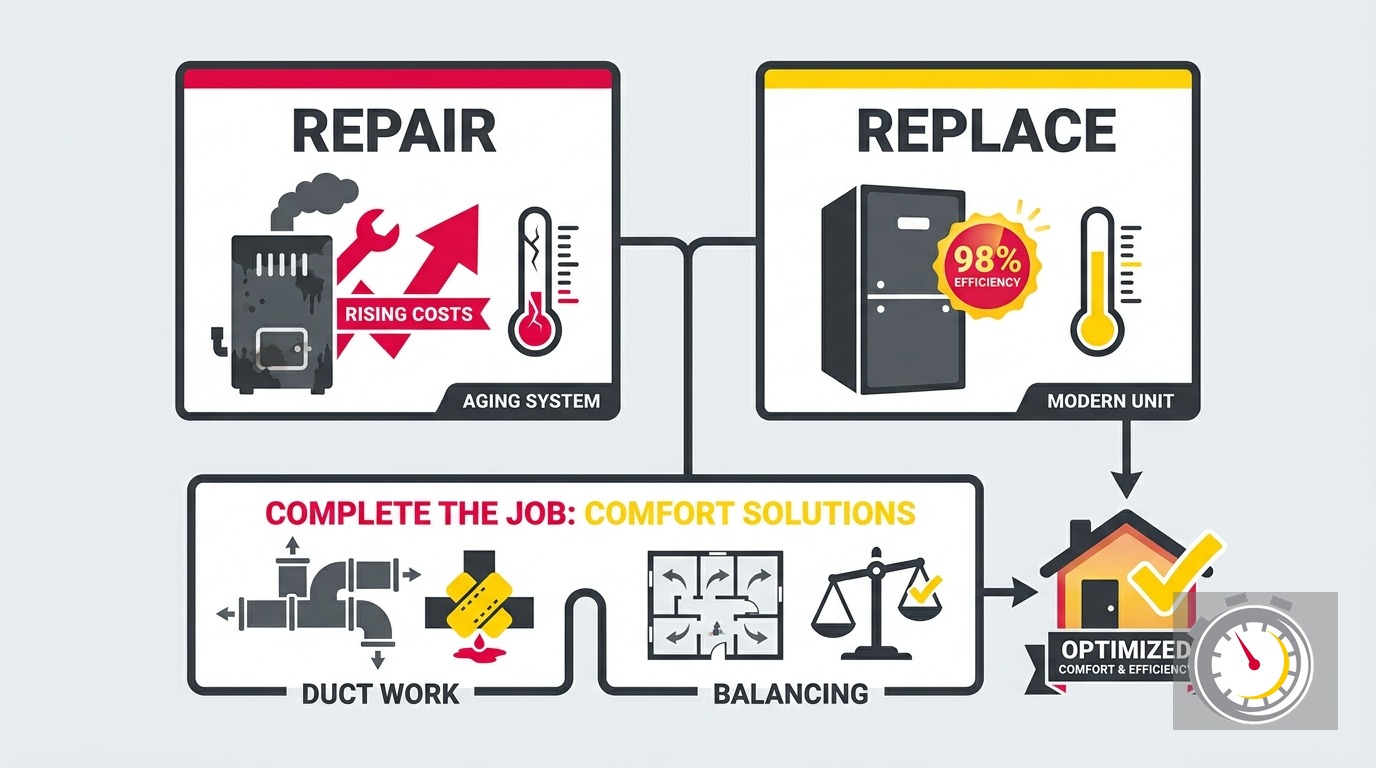
A complete job measures the duct system before changing it, then fixes what the measurements show. In our experience, the work follows a clear order: test leakage, measure static pressure, calculate room loads, fix returns, seal and insulate, then balance and verify.
Here is the process we recommend:
- Measure duct leakage. Testing shows how much conditioned air escapes. You can’t fix what you haven’t measured.
- Measure static pressure. This tells us how hard the blower works to push air through the ducts. High pressure points to restrictions. Our guide to high static pressure symptoms explains what we look for.
- Calculate room-by-room loads. Load and duct design calculations show how much heat each room needs and how much airflow each duct should carry.
- Check and improve return air. Many older homes have too few returns, or returns that are too small. Our post on return air problems shows the signs.
- Seal and insulate. Fix leaks at joints and connections. Insulate runs in attics and unheated spaces.
- Balance and verify. Adjust airflow to each room, then confirm the results with measurements.
Some homes also need a trunk line resized, a branch run replaced, or a new run added to a cold room. Our duct sealing guide covers the sealing step in depth.
Sealing has a safety side too. ENERGY STAR says leaky ductwork may cause “backdrafting,” which pulls combustion gases back into living spaces. That matters in a home with a gas furnace. Good duct work protects comfort and safety together.
What Does Air Balancing Involve?
Balancing adjusts how much air each room receives so the whole house heats evenly. A technician measures airflow at each register, then adjusts dampers and other controls to match what each room needs. Balancing works best after leaks and returns are fixed.
Balancing follows measurements, not feel. A good balancing visit includes:
- Baseline readings. We record airflow and temperatures at each register before touching anything.
- Damper adjustment. We open dampers on starved runs and close them slightly on over-served runs.
- Re-measurement. We check the results and refine until the rooms line up with their design airflow.
- Final verification. We confirm that the furnace still runs within its safe airflow range.
Balancing cannot fix a duct that leaks half its air into the attic. It also cannot fix a return that is far too small. That’s why we do the repairs first and the balancing last.
You can try basic register adjustments yourself. Our guide to balancing HVAC registers shows how. For a full job with instruments, see our post on what air balancing costs after an install.
Should I Close Vents in the Cold Rooms to Push Air Elsewhere?
No. Closing vents does not send more air to cold rooms. It raises pressure in the duct system and can increase leakage. It can also strain the blower. Cold rooms need more airflow through repairs and balancing, not less airflow elsewhere.
Many homeowners hear this tip from neighbors, and it sounds logical. In practice, closing vents makes a duct system work harder against itself.
Closed vents can lead to:
- Higher static pressure and more noise
- More leakage at weak duct joints
- A blower working outside its best range
- A furnace that overheats and trips its high-limit switch
Our post on the closed vents myth goes into the details. Keep your vents open and fix the root cause.
What Does Duct Work Cost, and Are There Rebates?
Costs depend on how much work your ducts need. In the Twin Cities, duct sealing typically runs around $1,300. A full duct replacement runs $6,500 to $13,000. A furnace replacement runs $3,900 to $7,800. We quote each job after we inspect your system.
Many homes need something in between. A new return, a resized trunk, or one rebuilt run costs less than a full replacement. We price each piece so you pay for what the measurements call for.
Our ductwork replacement cost guide breaks down what drives the price. For larger jobs, ask about financing. Monthly payments can make a furnace and duct project easier to afford.
Minnesota Energy Resources duct sealing rebate
Minnesota Energy Resources offers an aerosol duct sealing rebate of $2.50 per CFM reduction up to $500. CFM is a measure of airflow. The rebate cannot exceed the cost of the work.
Key conditions from the program page:
- Duct leakage must drop by at least 50%.
- A licensed HVAC contractor must install and measure the work.
- Only ducted furnaces qualify.
- Mastic tape sealing does not qualify.
- Homes built in the past two years are not eligible.
- You must apply within 60 days of service.
- Funding is first-come, first-served and can change or end at any time.
Confirm current availability before you schedule. The program may not cover your address or your type of sealing.
Other programs
Xcel Energy has offered air sealing and insulation rebates in Minnesota. We could not confirm current amounts. Check Xcel’s current rebate page before you plan around any figure. Our Xcel and CenterPoint rebate guide is a good starting point.
Income-qualified households may also have options through state weatherization programs. Ask your utility or county about eligibility.
Does Replacing a Furnace Need a Permit in Minnesota?
Generally yes. Minnesota Rule 1300.0120 requires an application to the building official and a permit before an owner or agent can replace any gas, mechanical equipment. The exemption covers replacing a minor part that does not alter the equipment’s approval or safety.
A permit means a local inspector checks the work, which protects you. Your city or county building department enforces it, and permit fees vary by city.
Ask any contractor who bids your job how permits are handled. If a contractor skips the permit, you hold the risk. That can cause trouble with insurance or a future home sale.
What Should You Ask Before Your Next Furnace Replacement?
Ask what the contractor will measure and fix besides the furnace. A bid that covers only equipment leaves the duct system untouched. A complete bid describes testing, repairs, balancing, and permit handling in writing.
Use this checklist:
- Will you test duct leakage before and after?
- Will you measure static pressure?
- Will you calculate loads for each room?
- Do my returns need to be larger or added?
- Will ducts in attics and unheated spaces be sealed and insulated?
- Will you balance and verify airflow?
- Who pulls the permit?
- Does the quote itemize equipment and duct work separately?
Compare bids on scope, not just price. Our bid comparison guide walks through what to look for. If your cold rooms began after a recent swap, asking for a second look at the duct system is a fair request.
Why Twin Cities Homeowners Call Northern One Hour
Northern One Hour Heating & Air Conditioning is locally owned and operated in Ramsey, Minnesota. We serve homeowners across the Twin Cities, from Blaine and Maple Grove to Woodbury and Bloomington. We know our older homes, our attics, our unheated basements, and our long winters.
We treat the furnace and the duct system as one job. We look at airflow, returns, leaks, and balance, then explain what we find in plain language.
We also respect your time. We arrive within the time window you select. If the technician does not show up on time, you do not pay for the service. That is our promise: “Always On Time… Or You Don’t Pay a Dime!(R)”
If your new furnace left some rooms cold, don’t wait for the next cold snap. Call (763) 260-6662 or book online. We’ll find out where your heat is going and show you the fix.
Frequently Asked Questions
How do I reset my furnace blower? +
Will a bigger furnace fix cold rooms? +
Can I fix a cold room myself? +
Need a technician now?