
Why Does Heat Pump Air Not Feel Warm? The Physics Explained
Key Takeaways
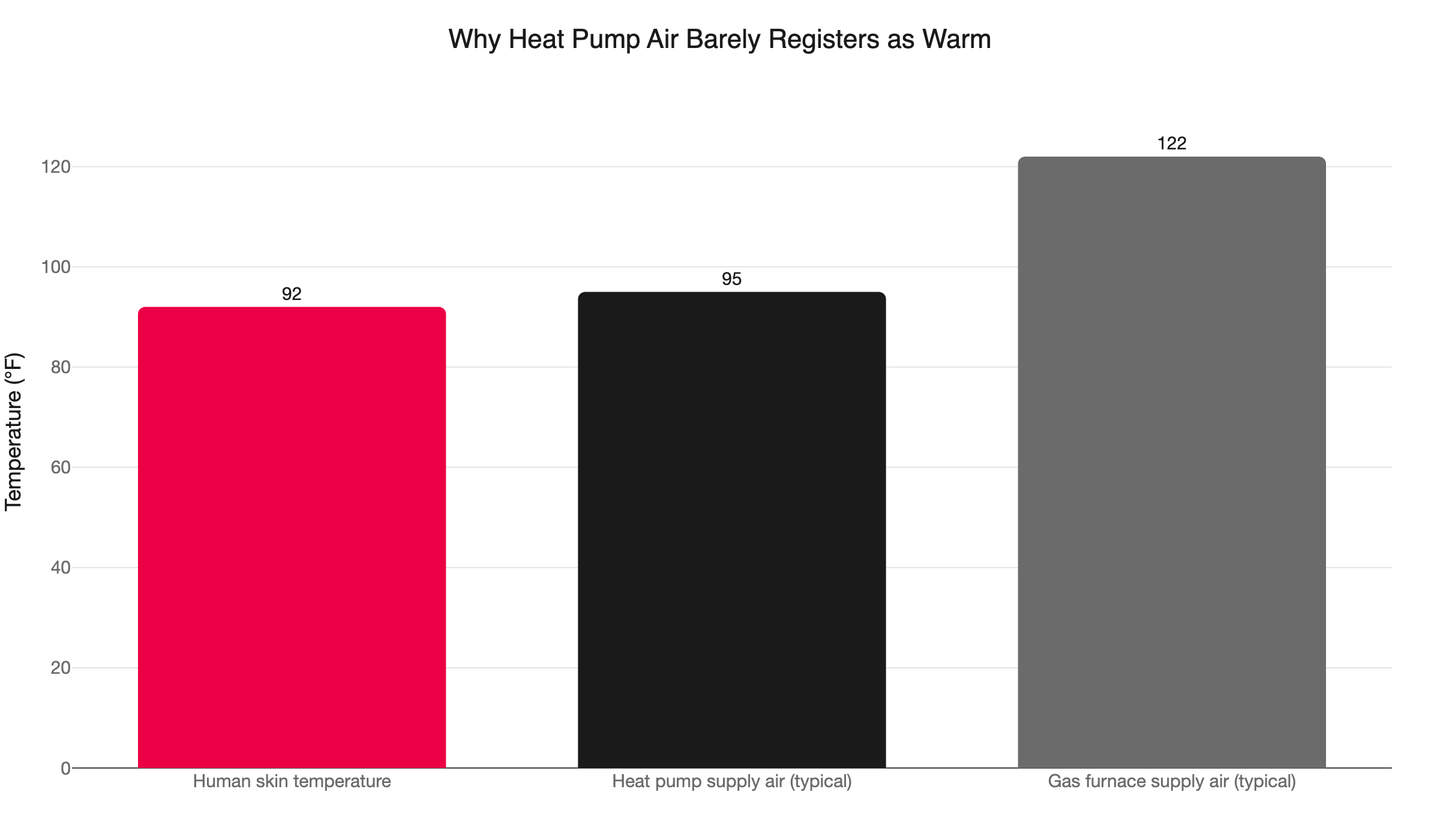
- Heat pump supply air runs 85-105°F. Gas furnace supply air runs 105-140°F or higher. That gap is intentional - it is the mechanism that makes heat pumps efficient.
- Your skin temperature is roughly 92°F. Air at 90-95°F is only a few degrees above that threshold. It cannot feel obviously warm to the touch, even when it is heating the room effectively.
- A heat pump heats in long, steady cycles. A furnace heats in short, hot blasts. Both deliver the same BTUs to the room. One just feels more dramatic.
- The one-number test: hold a thermometer near the supply vent. Above 85°F and your thermostat is climbing toward setpoint? The system is correct.
- Supply air consistently below 80°F, a house that will not reach setpoint on a mild day, or heavy ice on the outdoor unit that is not clearing are signs something is actually wrong.
- Minnesota homeowners on Xcel Energy may qualify for up to $2,600 in rebates on a qualifying cold-climate heat pump upgrade.
Why Does Heat Pump Air Not Feel Warm?
Heat pump supply air runs between 85 and 105°F. Human skin temperature is roughly 92°F. Air at or near your skin temperature cannot trigger a warmth sensation, even when it is actively raising your home’s temperature. That gap between sensation and reality is physics, not a malfunction.
You put your hand over the supply vent in January. The air drifts out - barely warm, maybe lukewarm, possibly like it is doing nothing. Meanwhile, the thermostat climbs from 67°F to 70°F over the next hour. The room is getting warmer. Your hand just cannot feel it.
This is the most common concern we hear from new heat pump owners across the Twin Cities. It catches almost everyone off guard, especially homeowners who spent years with a gas furnace. Furnace air feels hot. Heat pump air does not. Both heat the room. Here is why the sensation is so different, and the one number you can check right now to confirm your system is working correctly.
How Warm Should the Air Be Coming Out of My Heat Pump?
In heating mode, expect supply air between 85 and 105°F. The exact temperature depends on outdoor conditions, your thermostat setting, and whether auxiliary heat is running. A temperature differential of 20 to 35 degrees between return air and supply air is the normal operating range.
Here is a practical benchmark by outdoor temperature:
| Outdoor Temperature | Expected Heat Pump Supply Air |
|---|---|
| 40°F and above | 95-105°F |
| 20-40°F | 88-95°F |
| 0-20°F | 82-90°F |
| Below 0°F | Below 85°F, aux heat often active |
These ranges vary by system size, duct layout, and equipment model. The more useful indicator is whether your home is reaching setpoint. Checking the temperature difference between your return air and supply air confirms whether your heating system is operating correctly. If the house is climbing steadily toward your thermostat target, the system is working - regardless of how the vent air feels on your hand.
Supply temperature naturally dips toward the lower end of that range as outdoor temperatures drop. That is not a system degrading. That is a system responding to conditions - working harder against a larger indoor-to-outdoor temperature difference. When auxiliary heat engages, supply temperatures climb again.
Why Heat Pump Delivery Feels Different From a Furnace
A gas furnace fires in short, intense bursts. The burner ignites, heats air to 120-140°F or higher, and the blower pushes that hot air through your ductwork. The cycle runs 10-15 minutes, then shuts off. You feel the blast. The room warms in stages, with pauses between.
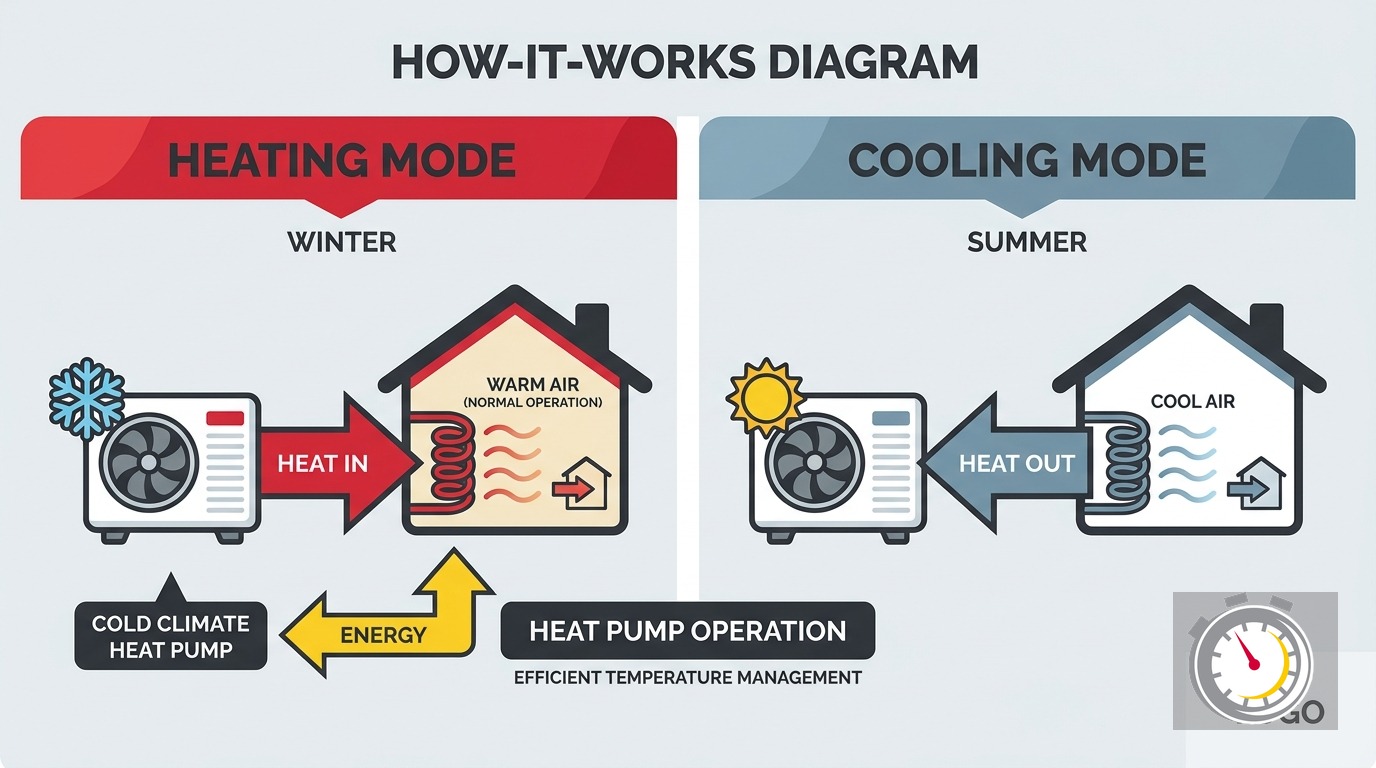
A heat pump works in the opposite pattern. It runs in long, steady cycles at lower temperatures. Instead of short and hot, it goes long and warm. The supply air stays in the 85-105°F range, but the system runs continuously for longer stretches. The room reaches the same temperature. The delivery is just quieter.
Think of two ways to fill a bathtub. A furnace is a bucket: big dump, pause, repeat. A heat pump is a steady faucet: slower, continuous, constant. The tub fills either way.
The sensation gap comes down to skin temperature. Your body registers warmth when something transfers heat to your skin. Air at 130°F does that easily - it is obviously hot to the touch. Air at 90°F is only a few degrees above skin temperature, so almost no heat transfers to your hand. That tiny margin barely registers as warmth, even as the heat pump moves thousands of BTUs per hour into your home.
This is not a design compromise. It is the core mechanism. Modern air-source heat pumps can reduce electricity use by 50% compared to furnaces and baseboard heaters precisely because they move heat at lower temperatures rather than generating it at high ones. A heat pump with a coefficient of performance (COP) of 3 delivers three units of heat for every one unit of electricity it uses. Electric resistance heat, which produces the hot-feeling supply air homeowners sometimes expect, has a COP of exactly 1.
Variable-speed and inverter-driven heat pumps carry this further. They modulate output to match your home’s heat load in real time instead of cycling on and off. The delivery is even more subtle - lower-temperature air running almost constantly. It is the most efficient operating mode. It is also the one most likely to feel like “the system is barely doing anything” to a homeowner used to a gas furnace. That feeling is the efficiency working as designed.
Why Isn’t My Heat Pump Blowing Warm Air?
Nine times out of ten, a heat pump that is “not blowing warm air” is blowing air at 85-95°F. That is normal operation. The system is working. The air just does not feel warm because it is close to skin temperature. Check your thermostat first - if the temperature is climbing toward setpoint, no service is needed.
That said, there are real scenarios where a heat pump is not heating properly:
The outdoor temperature is below the system’s operating range. Conventional heat pumps start losing meaningful capacity below 35-40°F. A cold-climate heat pump rated to -13°F will continue running efficiently well below zero. But a standard unit may struggle on the coldest nights in Minnesota. If you are in a genuine no-heat situation during a cold snap, our post on what to do when your heat pump stops heating in a Minnesota winter covers what to do while you wait for a technician.
The reversing valve is stuck. A reversing valve failure can cause the system to blow cool or cold air even when set to heat mode. If vent air is clearly cold (below 65°F at the vent) and the outdoor temperature is not extreme, this is a repair scenario worth a call.
Low refrigerant. A refrigerant leak reduces the heat pump’s ability to transfer heat. Supply air will be cooler than normal, and the house will not reach setpoint. This requires a technician.
A clogged filter. A severely restricted filter cuts airflow, drops supply temperature, and strains the system. Check the filter before calling anyone. It takes two minutes and is the most common self-fixable cause of reduced output.
Why Is My Heat Pump Blowing Lukewarm Air?
“Lukewarm” air in the 85-95°F range is correct operation. If your home is reaching setpoint, nothing is wrong. If supply air is consistently below 80°F and your house is not reaching setpoint on a mild day, that is a real performance problem - low refrigerant, a dirty evaporator coil, or an undersized system are the common causes worth investigating.
The word “lukewarm” is almost a perfect description of a working heat pump in cold weather. The air is meaningfully above room temperature. It is just well below the threshold where skin perceives it as obviously warm.
Where it becomes a problem is when the house cannot keep up with demand. If the outdoor temperature is 15°F and your thermostat reads 65°F at 8 a.m. with a setpoint of 70°F, something is off. Either the system is running without transferring meaningful heat, it is undersized for your home’s heating load, or a ductwork restriction is limiting delivery.
For a clear breakdown of what lukewarm supply air in heat mode actually signals versus what normal low-temperature delivery looks like, our post on when a heat pump blows cool air in heating mode covers each scenario step by step.
The One-Number Test You Can Do Right Now
This takes two minutes and a basic thermometer. It will tell you whether your heat pump is working or not.
Step 1. Find a supply register near the air handler. The closest vent to the indoor unit gives the clearest reading.
Step 2. Hold the thermometer about six inches from the vent - not directly in the airstream, which reads artificially high.
Step 3. Wait two to three minutes while the system is actively running.
Step 4. Read the temperature and interpret it:
- Above 85°F: The system is delivering heat. If the thermostat is climbing toward setpoint, you are done. Normal operation.
- 75-85°F: Borderline. Watch whether the house reaches setpoint on a mild day above 30°F. If it does not, a tune-up is worth scheduling.
- Below 75°F: The system is not heating effectively. Call for service.
You can pair the vent reading with a return air reading at the filter or return grille. A 20-35°F differential between return and supply confirms normal operating range. Return air at 68°F and supply air at 92°F means the system is doing its job. The room will reach setpoint even if your hand barely registers the warmth.
Why Does My House Feel Cold With a Heat Pump?
A heat pump runs longer at lower temperatures rather than delivering hot blasts. If the room is reaching your thermostat setpoint, the system is doing its job, even if it never produced the burst of warm air a furnace would. A house that “feels cold” at 70°F is often a radiant comfort problem, not an HVAC problem.
There are two distinct versions of this experience worth separating:
The room is at setpoint but still feels cold. This is a perception issue. Cold floors, drafty windows, and low insulation reduce the mean radiant temperature of the room. That makes you feel cold even when air temperature is correct. The heat pump is not the cause. Air sealing and insulation will address this more effectively than any HVAC adjustment.
The room is actually below setpoint. This warrants investigation. On the coldest days in Minnesota, a heat pump will call for auxiliary heat to maintain setpoint. That is normal behavior. How heat pump staging works in Minnesota explains when auxiliary heat is expected and when it signals a problem with the primary heat pump stage.
A useful diagnostic: check your thermostat display. If it shows “Aux Heat” or “Emergency Heat” running when outdoor temperatures are above 20-25°F, the primary stage may not be performing correctly.
What Should I Check Before Calling for Service?
Before calling, check four things: your air filter (replace if dirty), your thermostat settings (confirm heat mode, not cool or fan-only), the supply vent temperature (above 85°F is normal operation), and the outdoor unit (light frost during operation is expected; a solid block of ice that is not clearing is not).
Here is the quick checklist:
Filter. A severely restricted filter drops both airflow and supply temperature. If the filter is gray and dense, replace it and recheck the vent. This solves the problem more often than most homeowners expect.
Thermostat mode. Confirm the system is set to heat. After a mild shoulder-season day when cooling was running, a mode setting is easy to miss.
Outdoor unit. Some frost on the outdoor coil during operation is normal. The system runs a defrost cycle every 30-90 minutes to clear it. A solid block of ice that has not cleared after an hour or more suggests low refrigerant or a defrost control failure. Our post on heat pump outdoor units covered in ice explains what is normal defrost behavior and what is not.
Breaker. Check that neither the indoor nor outdoor unit circuit breaker has tripped. A partial power loss can leave the air handler running without the outdoor unit, which produces room-temperature air from the vents.
If all four check out and the house is still not reaching setpoint on a day above 10°F, that is the right point to call for service.
What Cold Climate Really Means in Minnesota
Minneapolis-Saint Paul logs some of the highest annual heating degree day totals of any major U.S. metro, making cold-climate heating performance especially important. The national average is roughly 4,500 HDD. Minnesota sits in IECC Climate Zone 6A (Cold-Humid). The ASHRAE 99% heating design temperature for Minneapolis is approximately -16°F. The metro sees roughly 200-400 hours per year below 0°F.
That context shapes every heat pump recommendation we make. A standard heat pump is tested and rated at 47°F. A cold-climate heat pump carries performance ratings at 5°F and 17°F, and is designed to operate down to -13°F without relying on supplemental electric resistance heat. ENERGY STAR cold-climate qualification requires a COP of at least 1.75 at 5°F and a heating capacity at 5°F that is at least 70% of the rated capacity at 47°F. That is the minimum specification for a responsible Twin Cities installation.
DOE and NREL field testing across 12 cold-climate sites found an average seasonal COP of 2.5, with individual sites ranging as low as 1.7. Even at outdoor temperatures below 0°F, cold-climate heat pumps maintained meaningful heat output. The coldest test month still showed 40% energy savings over the baseline.
For comparison, electric resistance heat has a COP of exactly 1 - one unit of electricity becomes one unit of heat, no more. A cold-climate heat pump operating at a COP of 2.5 delivers two and a half units of heat for every unit of electricity consumed. That efficiency advantage is why the supply air feels lukewarm instead of hot - and why your heating bills are lower.
Cold-climate certification is not an upgrade tier for Minnesota homeowners. It is the baseline specification. Any heat pump recommended for a Twin Cities home should meet or exceed the ENERGY STAR cold-climate threshold.
Xcel Energy Rebates on Cold-Climate Heat Pump Upgrades
If your current system is struggling in cold weather and an upgrade is on the table, Minnesota homeowners on Xcel Energy may qualify for significant rebates. The current program offers $2,000 for gas-plus-electric or gas-only customers switching to a qualifying cold-climate heat pump. An additional $600 bonus is available when pairing the installation with qualifying insulation and air sealing work. The potential total Xcel rebate reaches $2,600.
To qualify, equipment must have a COP of at least 1.75 at 5°F and a heating capacity at 5°F that is at least 70% of the rated capacity at 47°F - the same cold-climate threshold that matters for Minnesota performance.
Note that the federal heat pump tax credits available under the IRA expired on December 31, 2025. State and utility programs remain active. For a full picture of what programs can be stacked for a Minnesota installation, our guide to Minnesota heat pump rebates and tax credits has current program details.
Heat pump installation costs vary by system type, home size, and ductwork condition. We offer financing options for larger projects - ask about them when you call or book. Our locally owned and operated team in Ramsey has installed cold-climate heat pumps across the Twin Cities and knows which equipment holds up in a Minnesota winter.
When to Call Northern One Hour
If your heat pump supply air is consistently below 80°F, your home is not reaching setpoint on days above 10°F, or you have ice on the outdoor unit that is not clearing after a defrost cycle, those are the right signals to call.
We are locally owned and operated in Ramsey, MN, and we serve homeowners across the Twin Cities - Minneapolis, St. Paul, Blaine, Maple Grove, Plymouth, Brooklyn Park, Woodbury, and Bloomington. Our technicians know cold-climate heat pump performance from direct field experience, not just spec sheets.
Schedule at our heat pump service page or call (763) 260-6662. We back every appointment with the on-time promise: “Always On Time… Or You Don’t Pay a Dime!(R)” Your time matters, and we will be there when we say we will.
Frequently Asked Questions
Should I switch to emergency heat if my heat pump air does not feel warm? +
What is a normal temperature rise from return air to supply air on a heat pump? +
Do I need a cold-climate rated heat pump for a Minnesota home? +
Need a technician now?