
HVAC Air Balancing After Installation: Minnesota Cost Guide
Key Takeaways
- HVAC air balancing measures airflow at every register after installation and adjusts the system until each room receives its designed share of conditioned air.
- Minnesota Mechanical Code Section 309.2 requires ventilation systems to deliver airflow within ±10% of design capacity. This is a code requirement tied to your mechanical permit, not optional maintenance.
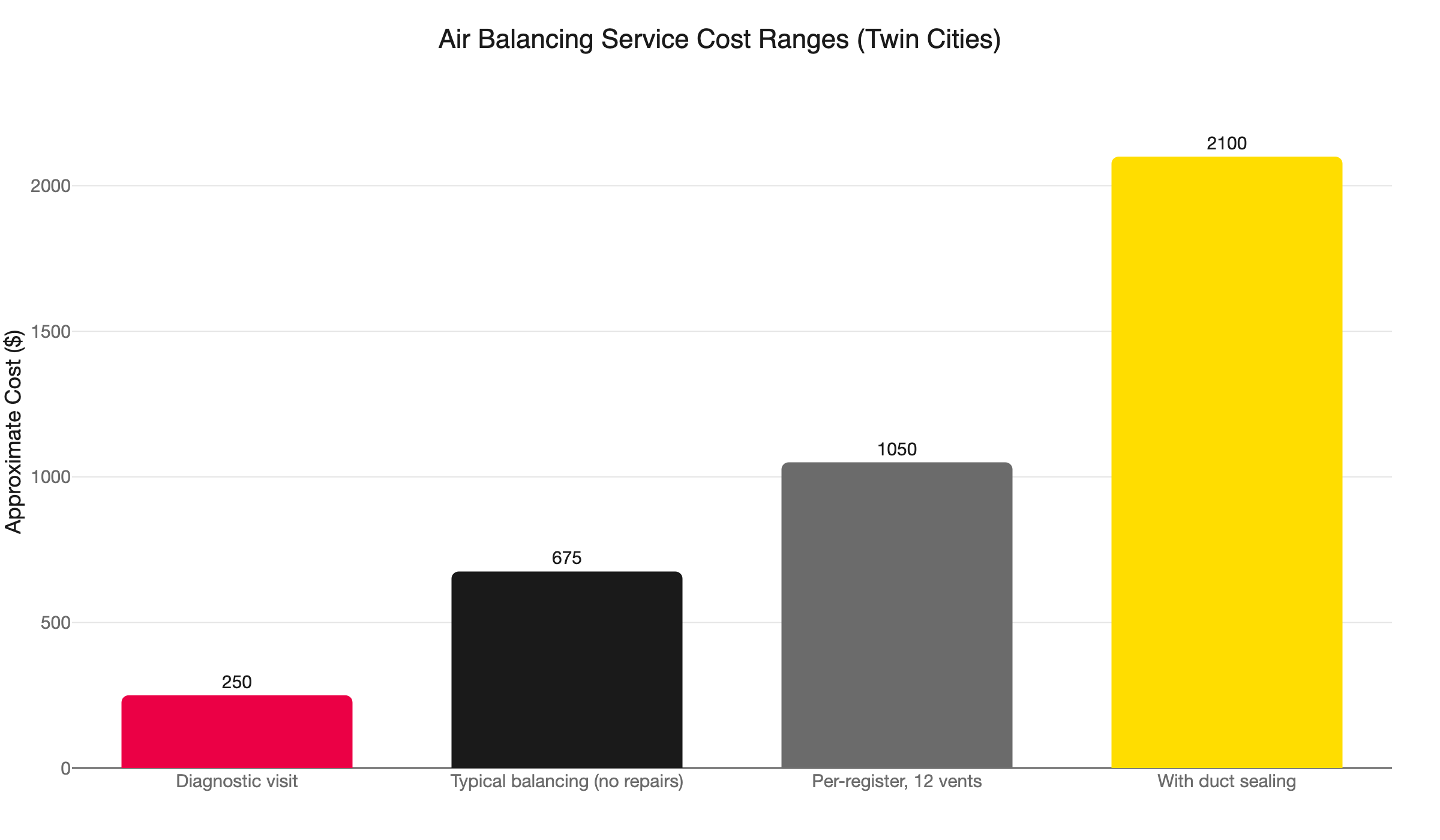
- Most Twin Cities single-family homes pay $450-$900 for professional balancing with no major repairs needed, per industry cost data.
- Four events call for balancing: a new install, a renovation that changed square footage or windows, added ductwork, and persistent comfort complaints after equipment tests fine.
- DOE research shows the typical home loses 20-30% of conditioned air through duct leaks and imbalance.
- Ask for a written balancing report at the end of the visit. Keep it with your mechanical permit and equipment warranty paperwork.
What Is HVAC Air Balancing After Installation?
Most homeowners think the job is done once the new furnace or AC fires up and the house heats or cools. That is step one. Step two is confirming the air actually reaches every room in the proportions the system was designed to deliver. That is what air balancing does.
A certified technician uses a balometer - also called an airflow capture hood - to measure airflow at each register. The unit measures in CFM, or cubic feet per minute. Those readings are compared to the original Manual J load calculations that determined how much airflow each room needs. Rooms with too much flow are noted alongside rooms with too little. The technician then adjusts dampers, fan speed, and register positions until the whole system is within the required tolerance.
The process ends with a written report showing before-and-after measurements at every register. That document matters for permit sign-off and for any equipment warranty claim you might need later.
Minnesota asks more of residential HVAC than most states. Your system has to push a furnace from 60% capacity on a mild fall day to 100% during a -20°F polar vortex, then pivot four months later to cool the same house through 90-degree summer humidity. A system that is 20% out of balance in October is 20% out of balance in January, when you notice it most. Getting the balance right at installation means the system performs correctly across the full range of Minnesota weather.
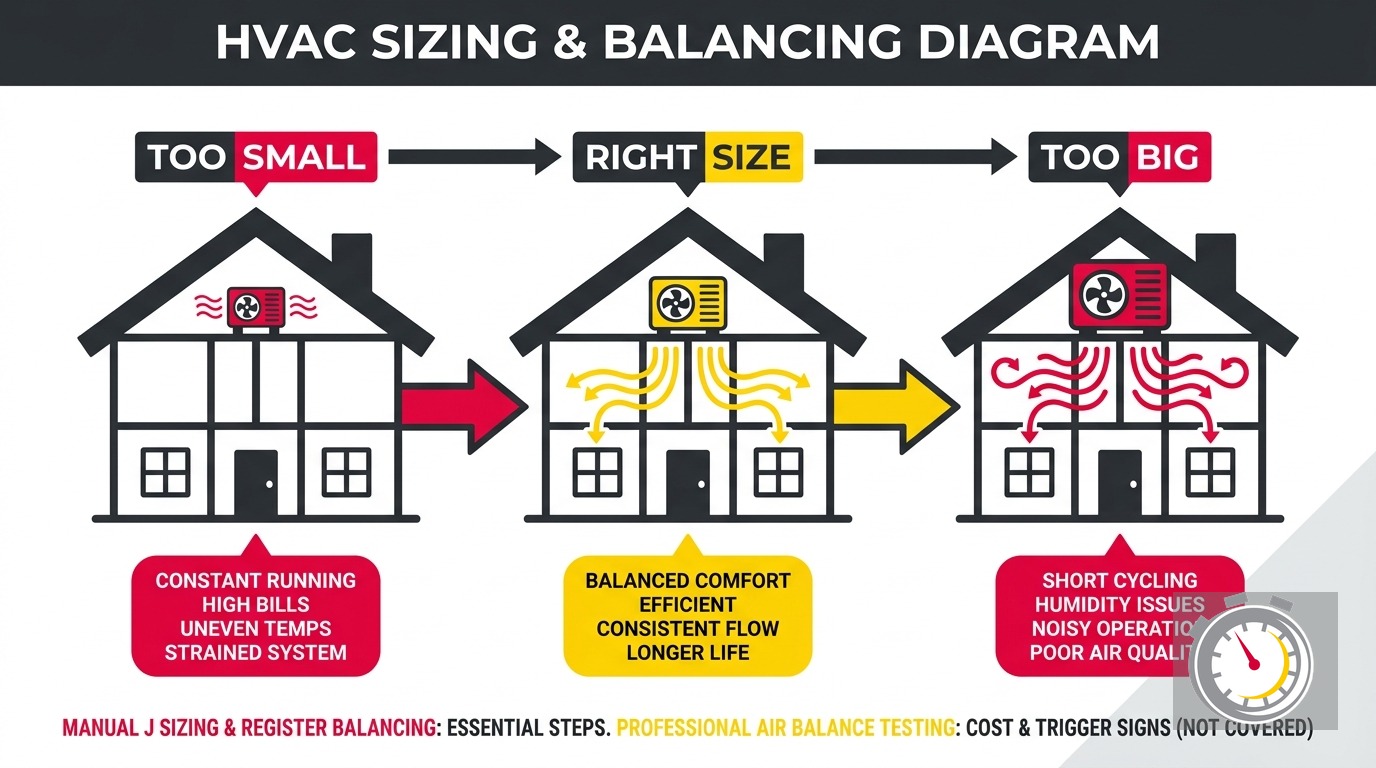
One point worth clarifying: partially closing registers in warm rooms is not the same as balancing. Restricting a register raises static pressure throughout the system. Over time, higher static pressure stresses the blower motor. It can also crack the heat exchanger on a furnace. The right fix is a damper adjustment that redirects air at the source.
Is Air Balancing Required by Minnesota Law?
Yes, for all mechanical ventilation systems. Minnesota Mechanical Code Section 309.2 requires every ventilation system to deliver airflow within ±10% of design capacity. Fan speed must be adjusted to meet those design conditions. A system that cannot meet this standard does not comply with the permit.
This requirement is tied to the mechanical permit on your installation. A permit inspector can ask for documentation that the system was commissioned to design spec. If your contractor did not include a balancing step in the installation scope, ask about it before the permit closes.
The Minnesota energy code also caps new duct leakage at 4 CFM25 per 100 square feet of conditioned area. New construction requires a blower door test at or below 3.0 ACH50. Balancing is part of this commissioning package.
If you want to understand what a permit inspection covers and what final sign-off looks like in the Twin Cities, our post on HVAC permit costs in Minnesota walks through the details.
What Are the Signs Your System Needs Balancing?
You usually feel an unbalanced system before you measure it. Inconsistent room temperatures are the most common sign. If one bedroom runs warm all winter while another stays cold despite the same thermostat setting, duct distribution is the likely cause.
Here are the most reliable indicators:
- Rooms that are consistently too hot or cold, regardless of the thermostat setting. One bedroom warm all winter. A corner room cold through summer.
- Weak airflow at specific vents. Hold your hand over a supply register while the system runs. If you barely feel air moving, that register is being starved.
- Doors that move or slam when the system kicks on. This is a pressure imbalance between rooms. Too much supply air, not enough return.
- Humidity varying noticeably room to room. In a Twin Cities summer, a room with poor airflow will feel more humid than the rest of the house.
- Utility bills rising without a change in usage. Your system runs longer to compensate for uneven distribution.
- Short cycling. The system starts and stops without reaching the setpoint because the thermostat’s room heats or cools quickly while other rooms lag behind.
The single most important question is whether the problem is consistent. A room that is too hot on one extreme weather day might just be at the edge of the system’s design capacity. A room that is consistently 5 degrees off target, day after day, under normal operating conditions, is a distribution problem.
Minnesota’s climate makes these symptoms hard to ignore. Sub-zero winters expose any room not getting its share of heated air. Humid summer days make every under-conditioned room feel worse. Two-story and split-level homes across the Twin Cities suburbs see these complaints most often, because thermal stratification works against any room relying on ductwork running through unconditioned space.
What enters your living space through an unbalanced duct system also affects air quality. For more on what poor air distribution means for what you breathe, read what is really in your air after a Minnesota winter.
When Should You Schedule It?
Schedule balancing before you close the mechanical permit, or within the first 30 days of running the system under real seasonal load. The technician needs the system operating under actual conditions to get accurate readings. An install in October? Schedule balancing before mid-November. An install in April? Wait until the AC has run through a few warm days in late May.
There is also a practical reason for the 30-day window: duct systems settle. Dampers can shift slightly after initial install. A new branch run may behave differently under sustained load than it did on the first test. Waiting a few weeks gives the system time to reveal any settling issues before the balancing report is finalized.
Four events should trigger a balancing appointment:
- Any new HVAC installation. Full system replacement, furnace-only or AC-only swap, or a heat pump retrofit.
- Renovation that changed the home’s thermal envelope. A finished basement, an added room, new windows across a large wall section, or significant added insulation all change the load the duct system was originally sized for. Read more about HVAC resizing after home improvements.
- New or extended ductwork. Adding a branch run changes static pressure throughout the system. Every register is now receiving slightly different pressure than it was designed for.
- Persistent comfort complaints after the equipment tests fine. If a technician has confirmed the furnace, AC, or heat pump is functioning correctly but rooms are still inconsistent, the duct system is the next place to look.
How Much Does HVAC Air Balancing Cost in Minnesota?
For most single-family homes in the Twin Cities, budget $450-$900 for a professional balancing visit with no major repairs. Here is how the pricing typically breaks down, per industry data from e320 Air:
- Diagnostic visit only: $150-$350. The technician measures airflow at every register, identifies the problems, and delivers a written report. Many contractors credit this fee toward the full balancing job if you proceed.
- Full balancing by register count: $75-$100 per register. A home with 12 registers runs $900-$1,200 before any duct or damper repairs.
- Duct sealing, if found: $200-$4,000 depending on scope and access. This is a common add-on when measurement finds significant leakage.
A few factors push cost higher in Minnesota specifically. Older homes with flex duct and complex branching take longer to test and adjust. Homes with zone damper systems require each zone to be tested independently. After-hours balancing carries a premium of $180-$270 per hour above the standard service rate.
On rebates: Neither Xcel Energy nor CenterPoint Energy currently offers a rebate specifically for HVAC duct balancing. CenterPoint’s air sealing rebate ($750-$3,000) covers attic envelope sealing, not duct register balancing. For a full look at what utility rebates are available for heating and cooling upgrades, see our guide to Xcel Energy and CenterPoint HVAC rebates in Minnesota.
What Does a Professional Balancing Visit Look Like?
The technician measures every register, compares readings to design specs, makes adjustments, re-measures, and issues a written report. Here is the sequence on a standard Twin Cities home:
Step 1: Pre-check. The technician confirms the equipment is running correctly. Filter clean, registers open, return grilles unobstructed, no error codes. Any problems found here are corrected before airflow measurements begin.
Step 2: Baseline measurements. Using a balometer at each supply and return opening, the technician logs actual CFM. Every opening gets a number.
Step 3: Comparison. Actual CFM readings are compared to the design values from the original Manual J load calculation. The technician notes which rooms are over-supplied and which are under-supplied.
Step 4: Adjustment. Inline duct dampers are adjusted. On a variable-speed or multi-stage system, fan speed may be changed. On systems with zone dampers, each zone is balanced and tested independently.
Step 5: Re-measurement. After every adjustment, the technician re-measures. The goal is to bring each opening within ±10% of its design value, as required by Minnesota Mechanical Code.
Step 6: Written report. You receive a document showing before-and-after readings for every register. File it with your permit paperwork and equipment warranty registration.
On a standard single-family home, this process takes two to four hours. Larger homes, multi-zone systems, and homes with ductwork in difficult spaces take longer. If the technician finds significant duct leakage, sealing is typically scheduled as a separate job.
What Is the 2-Foot Rule in HVAC?
The 2-foot rule says supply registers should be located within 2 feet of an exterior wall or window. Exterior walls and windows are where heat gain and heat loss are highest. Placing a supply near the perimeter directs conditioned air toward the most demanding zone in the room, letting it sweep inward toward the return and provide even coverage.
This rule shows up most often as a problem in finished basements and bonus rooms. A finished basement may have had ductwork roughed in before the walls were framed, with register locations placed without accounting for the final wall layout. Bonus rooms above garages - a common Twin Cities configuration - are especially prone to problems because they have exterior exposure on three or more sides. The duct design often treats them as standard interior rooms.
When registers are placed too far from exterior surfaces, you get a room that is comfortable on one side and not on the other. Air balancing can adjust how much total airflow reaches that room. But it cannot fix a register that is pointing at an interior wall instead of the perimeter.
If the 2-foot rule was violated in your duct layout, the real fix involves moving the register or adding a second supply point near the window. A balancing report will identify this clearly and give you the documentation to support a ductwork modification later.
Why Skipping Air Balancing Is a Real Risk in Minnesota
Energy loss is the most direct cost. DOE research shows the typical home loses 20-30% of conditioned air through duct leaks and imbalance. For homes with attics or crawl spaces carrying the ductwork, that figure climbs to 25-40%. Many Twin Cities suburban builds fall into that category. A separate DOE Building America study found air distribution efficiency in many homes at 60-75% or less. The cause: insufficient duct insulation and leaks.
If your system is losing 25% of its output before it reaches the registers, duct sealing and balancing together typically deliver faster payback than any equipment upgrade.
Two other risks are worth naming.
Equipment wear. An unbalanced system short-cycles and runs longer to compensate for uneven distribution. That adds cycles to the compressor, blower motor, and heat exchanger - all components with finite service lives. Fixing the balance after installation is one of the lowest-cost ways to protect the equipment you just paid for.
Warranty and permit. Most equipment warranties require documented commissioning. If a compressor fails three years in and the manufacturer asks for start-up documentation, a written balancing report is what you need. Without it, coverage can be disputed. On the permit side, a mechanical permit left open because the system was never commissioned to code can surface as a problem at home sale. Buyers and their inspectors ask about open permits.
For a deeper look at what leaky ductwork does to heating and cooling efficiency year-round, read our post on duct sealing and energy loss.
How to Find a Certified Balancing Technician in the Twin Cities
The three credential bodies for professional HVAC air balancing are TABB (Testing, Adjusting and Balancing Bureau), NEBB (National Environmental Balancing Bureau), and AABC (Associated Air Balance Council). All three require formal training and field testing before certification is awarded. A TABB-certified firm operating in Minnesota is Test and Balance Solutions Inc..
Before you hire, ask these four questions:
- Will I receive a written balancing report? A verbal “looks good” is not documentation.
- Are you calibrated to the Minnesota Mechanical Code ±10% tolerance? Any credentialed technician should confirm yes without hesitation.
- Do you have experience with my system type? Multi-zone, variable-speed, and modulating systems require different procedures than single-stage equipment.
- Can you coordinate with the permit inspector if needed? If your permit is still open, you want a technician who can produce the documentation the inspector requires.
Your HVAC contractor can often perform or arrange balancing as part of the installation scope. Ask during the bid process, not after the job is done. A contractor who mentions commissioning and balancing in their written proposal is building to code, not just to the lowest line item. If it is not in the proposal, ask for it to be added. The cost is far less than a revisit after comfort problems surface.
Northern One Hour is locally owned and operated in Ramsey, MN. Our team serves Ramsey, Blaine, Maple Grove, Plymouth, Brooklyn Park, Woodbury, Bloomington, and across the Twin Cities metro. We back every visit with our on-time commitment: “Always On Time… Or You Don’t Pay a Dime!(R).” That means we arrive within your selected time window, and if we do not, you do not pay for the service.
Schedule Your Air Balancing Visit
A new HVAC installation is a significant investment. Air balancing is what confirms that investment is performing as designed. It satisfies the Minnesota code requirement, gives you documentation to protect your equipment warranty, and ensures every room in your home receives the conditioning it was sized for.
Most Twin Cities homeowners pay $450-$900 for the service with no repairs needed. That is a fraction of the cost of an early equipment repair caused by a system running harder and longer than it was designed to.
Call Northern One Hour at (763) 260-6662 or book your appointment online. Our team arrives on time, every time. And if we are not there when we said we would be, you do not pay for the service.
Frequently Asked Questions
How do I balance my HVAC airflow? +
Need a technician now?