
Furnace Filter Dirty After One Month? What It Means
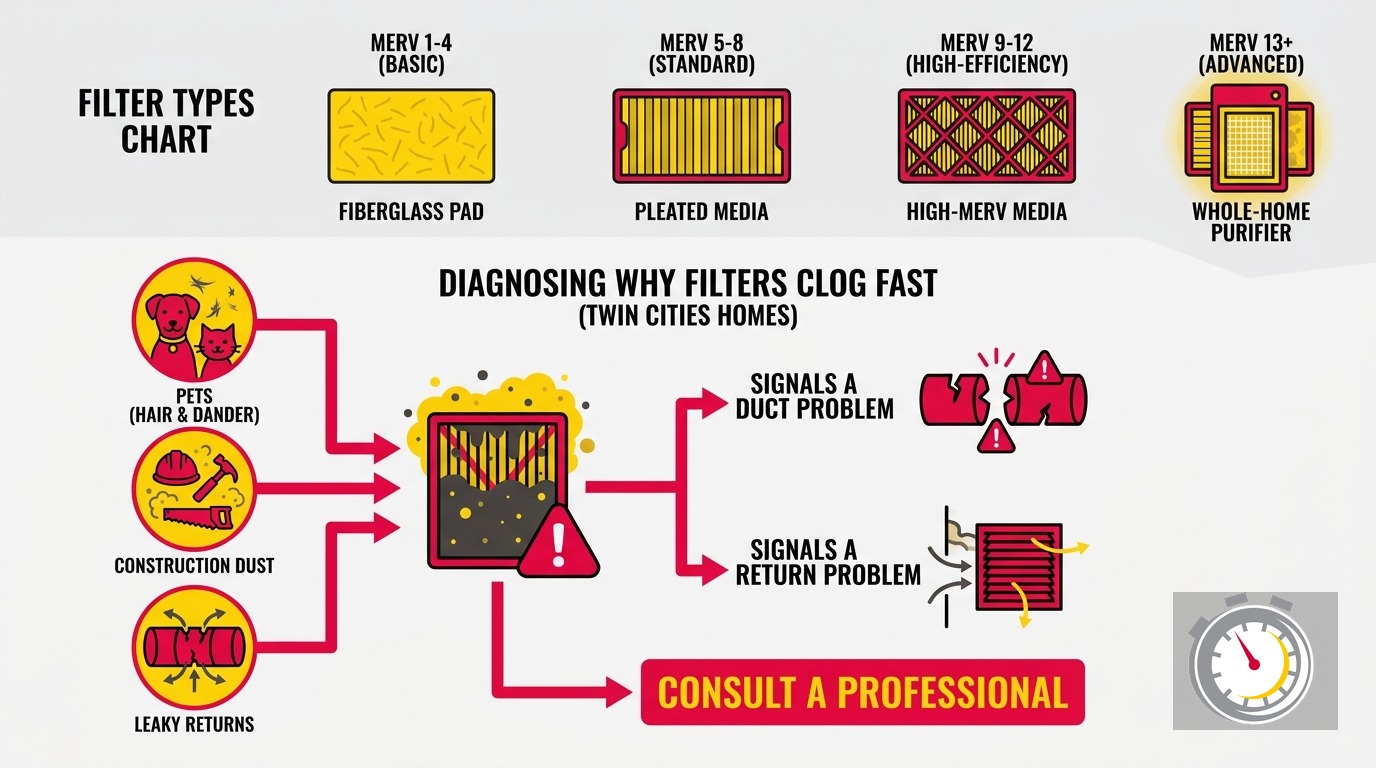
Key Takeaways
- A gray, lightly dusty filter after one month is common during a Minnesota heating season.
- A filter that looks packed solid in two or three weeks deserves a closer look.
- Check the easy things first: filter size, fit, thickness, and the slot cover.
- Pets, construction dust, and heavy household dust all load filters faster.
- Leaky returns can pull in air that never passed through the filter.
- Dark dust streaks at duct joints, uneven rooms, and a quickly dirty filter together point to a duct problem.
- A dirty filter can dramatically reduce air flow and add wear to your furnace.
- Call (763) 260-6662 or book online when the easy fixes do not solve it.
Is a Furnace Filter Dirty After One Month Normal?
Often, yes. A standard 1-inch filter can look gray and fuzzy after a month of Minnesota heating. That is the filter doing its job. The warning sign is a filter that looks packed solid within a few weeks, or one that loads faster than it used to.
A fast-clogging filter can tell you something about your home. Pets, dust, and a tight fit can all explain it. So can a duct or return problem you cannot see.
We are Northern One Hour Heating & Air Conditioning, locally owned and operated, serving homes across the Twin Cities. Below, the causes run from the ones you can check yourself to the ones that need a technician.
What Does a Normal Dirty Furnace Filter Look Like?
A normal dirty filter has an even, light gray or tan coat across the face. You can still see the pleats and some white media. Dust, lint, and a few hairs are expected. The coat should look the same from edge to edge.
Try a quick test. Hold the filter up to a bright light. If light still shines through in places, it has life left. If it looks like a solid gray mat, replace it.
Here is what separates normal from worrying:
- Normal: An even gray coat, visible pleats, and light passing through.
- Heavy but explainable: A thick mat with lots of pet hair, or a fine pale layer after a remodel.
- Worrying: Uneven loading, with one edge caked dark while the rest looks clean.
- Worrying: Dark, sooty streaks that suggest air is entering somewhere it should not.
Uneven loading matters because air takes the easiest path. If one corner is dark, air may be squeezing past a gap or flowing hard through one section. That is worth a look.
Check the back of the filter too. The side facing the furnace shows what the blower actually saw. If you want help with orientation, our guide to which way the filter arrow should point covers it.
How Often Should I Change My Furnace Filter?
Most homes should check the filter monthly and replace it on a schedule that fits the filter type. A thin 1-inch filter usually needs replacing more often than a deep media filter. Pets, remodeling, and long run times shorten the interval. The U.S. Department of Energy says filters should be replaced or cleaned frequently.
The best habit is simple. Pull the filter on the first of each month and look at it. Replace it if it looks loaded. If it still looks fine, put it back and check next month.
Your filter type changes the answer:
- Thin 1-inch pleated filters: Check monthly. Plan to replace them often in winter.
- Deeper media filters: These hold more dust and usually last longer between changes.
- High-MERV filters: These catch finer particles and can load faster in dusty homes.
We go deeper on schedules in our Minnesota guide to changing your air filter, which breaks down timing by season and filter type.
One tip: write the install date on the filter frame with a marker. Then you never have to guess how long it has been in there.
Why Do Filters Clog So Fast in Twin Cities Homes?
Long heating seasons mean long blower run hours. The more your system runs, the more air passes through the filter, and the more dust it catches. A Twin Cities winter keeps the blower working for months, so a filter can load faster here than in a mild climate.
We will not put a number on that. Run time depends on your home, your thermostat, and the weather. But a filter that sees a few hours of air each day in April sees far more in January.
Our climate adds a few other factors:
- Dry winter air. Low humidity lifts more dust and lint into the air.
- Closed-up homes. We seal windows for months, so dust has nowhere to go.
- Mudroom grit. Salt, sand, and dirt ride in on boots and coats.
- Fall leaf and pollen swings. Seasonal particles get pulled into the return.
A dirty filter after a cold month is no surprise. A filter that is dramatically worse than last winter is the clue to chase.
Start With the Easy Checks: Size, Fit, and Thickness
Before you blame your ducts, check the filter itself. This is the cheapest fix and the most common one. Take the old filter out and read the size printed on the frame. Compare it to the slot.
Run through this list:
- Size. The printed size should match the slot. A filter that is too small leaves gaps.
- Thickness. A 1-inch filter in a 4-inch slot lets air slip around it.
- Slot cover. Make sure the door or cover closes tight and sits flat.
- Direction. The arrow should point toward the furnace blower.
- Condition. Look for bent frames, torn media, or crushed corners.
Gaps cause trouble in two ways. Air that goes around the filter is never cleaned, so that dust ends up in your blower and ducts. A wrong-size filter can also load unevenly, since air funnels through one section.
Two other posts cover fit. One explains how a wrong-size filter hurts airflow. The other covers a missing slot cover that lets air bypass the filter. If your filter does not fit snugly, start there.
If you have a media cabinet or a thicker filter rack, confirm the filter seats fully. A crooked filter can leave a hidden gap along one edge.
Do Pets and Household Dust Clog Filters Faster?
Yes. Pets are one of the biggest reasons a filter fills quickly. Dogs and cats shed hair and dander all year, and the blower pulls it into the return and onto the filter. A home with two shedding dogs can load a filter far faster than a quiet home with none.
Household habits add dust too:
- Carpet and area rugs, especially in high-traffic rooms.
- Fabric furniture, bedding, and heavy drapes.
- Open shelving and clutter near return grilles.
- Running the fan on the “on” setting, which keeps air moving all day.
- Fireplaces, candles, and cooking that put fine particles in the air.
Pet owners can brush pets outdoors when possible. Vacuum with a sealed-system or HEPA vacuum. Wash bedding often. Keep return grilles clear of fur.
For more detail, see our post on HVAC filters and pet hair and dander. It explains how to match a filter to a pet household without choking your airflow.
Here is a useful test. If the filter is covered mostly in hair and lint, pets and fabric are likely the cause. If it is covered in a fine, pale powder, think drywall or construction dust.
Can Construction Dust Ruin a Filter in Weeks?
Yes. Drywall sanding, demolition, and flooring work throw fine dust into the air. Your system pulls it into the return and onto the filter fast. A remodel can load a filter in days, not months. That is normal during the project.
Fine dust hides in a house long after the crew leaves. It settles on shelves, in vents, and inside ducts. Each time the blower starts, it stirs some of it back up.
If you are remodeling, follow these steps:
- Seal off return grilles and supply registers in the work area.
- Change the filter more often while work is underway.
- Run the system as little as you can during heavy dust work.
- Replace the filter again once the project wraps.
- Ask a pro to check the ducts if dust keeps showing up.
We wrote a full walk-through on this. Read our Twin Cities guide to filters after construction dust for timing and tips. If your ducts took a hit, our post on duct cleaning after a renovation explains what helps.
No remodel under way? Cross this one off and move on.
Can Leaky Returns Make a Filter Dirty Faster?
Yes, and most homeowners miss this cause. A leaky return duct can pull in air from an attic, crawlspace, or wall cavity. That air may carry dust, insulation fibers, and debris, and some of it never passes through the filter. The U.S. Department of Energy notes that poorly sealed return ducts in unconditioned spaces can draw in contaminated air.
Think of the return side as the system’s intake. The blower creates suction. Wherever the return has a gap, the blower pulls air through it. That gap can be a loose seam, a bad joint, or an open wall cavity used as a return path.
A leak can show up in two ways:
- Dirtier filter. Extra dusty air that does reach the filter loads it faster.
- Dirty system. Air that skips the filter coats your blower, coil, and ducts.
The second one is easy to miss. A filter can look surprisingly clean while the system gets dirty, because bypass air leaves no trace on the filter.
Return leaks tend to hide in these spots:
- Return ducts running through an attic or crawlspace.
- Panned joist cavities used as returns in older homes.
- Joints and seams near the furnace cabinet.
- The gap around the filter slot or cabinet door.
- Poorly sealed boots where a return duct meets the wall or floor.
Older Twin Cities homes often have these features. Our post on return air problems explains the common ones. Our guide to air leaking around the filter covers the slot itself.
Sealing helps beyond the filter. The Department of Energy says a sealed duct system can reduce utility bills by up to 20%. Your results depend on how leaky your ducts are today. For the energy side, read our post on duct sealing and energy loss.
What Are the Signs of a Duct or Return Problem?
No single sign proves a leak. A pattern does. If your filter loads fast and you see one or more of the signs below, a duct or return problem becomes more likely.
Watch for these clues:
- A dirty filter within a few weeks. This holds true even after you fix size and fit.
- Dark dust streaks at duct joints. Dust lines near seams can mark where air leaks in or out.
- Uneven room temperatures. One room stays cold while another runs hot.
- Dust returning right after cleaning. Surfaces get dusty again in a day or two.
- Whistling or rushing sounds. A strong hiss near a return can mean a gap.
- Dusty registers. Supply vents blow visible debris.
- Rising energy bills. Your heating costs climb with no change in use.
You can do a basic visual check yourself. With a flashlight, look at exposed ducts in the basement. Check the seams, joints, and the area around the furnace cabinet. Look for gaps, loose connections, and dark dust lines.
Do not crawl into tight attic or crawlspace areas. Do not open the furnace cabinet. Those jobs belong to a trained technician.
The Department of Energy names specific sealing materials. Seams wider than 1/8 inch call for fiberglass mesh tape, and sealing calls for UL-approved mastic. Standard cloth duct tape is the wrong choice. A pro knows the right materials and where to apply them.
If your rooms feel uneven, see also why upstairs rooms run cold in winter. Airflow problems and duct problems often overlap.
Can a Dirty Filter Cause a Furnace to Short Cycle?
Yes. A clogged filter restricts airflow. The furnace can overheat and shut the burners off on a safety limit. Then it cools, restarts, and repeats. That pattern is short cycling. A fresh filter is the first thing to try.
A dirty filter is not the only cause. A bad thermostat, an oversized furnace, or a blocked vent can do the same thing. But the filter is the free test.
Try this sequence:
- Turn the thermostat down so the furnace stops.
- Replace the filter with a clean one of the correct size.
- Restore the thermostat setting.
- Watch the next few cycles.
If the cycling stops, the filter was the problem. If it continues, call a technician. Repeated limit trips put stress on the heat exchanger, and that is a repair you want to avoid.
We cover the full list of causes in our guide to furnace short cycling and its fixes. Our post on furnace cycling on and off every few minutes helps you tell a filter problem from a thermostat problem.
The link to this topic is direct. A filter that clogs fast can set off short cycling again and again. Fixing the root cause stops both problems.
Can a Filter That’s Too Restrictive Damage My Furnace?
Yes. A filter with too much resistance can starve the blower of air, even when it is new. That adds heat and strain. The Department of Energy says a clogged filter increases furnace run time, wear on the motor, and energy consumption.
Many homeowners buy the highest-rated filter on the shelf. That can backfire. Higher ratings catch smaller particles, but they also resist airflow, and not every furnace is built to handle that.
The Department of Energy ties filters rated MERV 6 and above to trapping pollutants such as pollen and mold spores. That is a useful starting point for many homes. Going far above what your system needs may cost you airflow.
Signs your filter may be too restrictive:
- The filter loads very fast even in a clean home.
- Airflow from the vents feels weak.
- The furnace runs longer than it used to.
- The blower sounds strained.
- The system trips on its high-limit switch.
The fix is often simple. Use a filter that matches the furnace and the filter slot. A deeper media filter can give you fine filtration with less resistance, because it has more surface area.
Our posts can help you choose. See how to pick a MERV rating for a Minnesota home. Also read about why a MERV 13 filter can restrict airflow. If symptoms persist, a technician can measure your system’s static pressure and tell you what filter it can handle.
When Should You Call a Pro?
Call a pro when the easy fixes fail or the signs point to ducts. You do not need to wait for a breakdown. A short visit can find a leaking return or a restrictive setup before it damages your equipment.
Call us if any of these apply:
- Your filter is packed dark within two or three weeks, even after you checked size and fit.
- You see dark dust streaks at duct joints or around the furnace cabinet.
- Some rooms stay too hot or too cold.
- The furnace short cycles after a filter change.
- Your energy bills rise with no clear reason.
- You smell something musty or burnt when the furnace runs.
- You have had work done on your ducts or return paths.
Some signs need fast action. A burning smell, a repeated shutdown, or any hint of carbon monoxide means you should stop and call. Our guide on warning signs that need emergency furnace repair lists them.
A technician can inspect the return side, check static pressure, and test for leaks. They can also tell you whether sealing or a duct repair makes sense. If the ductwork is beyond repair, we will explain your options plainly. For major work, such as ductwork replacement or a new furnace, we can talk through financing too.
Read our post on what it costs to replace ductwork to plan ahead. A basic sealing job costs far less than replacement. Duct sealing starts around $1,300, though your price depends on how big and how leaky your system is.
What Happens During a Northern One Hour Visit?
We start with your question, not a sales script. First, we look at the filter and the slot. Then we check the return side, the blower, and airflow. We explain what we find in plain language and show you where it is. You decide what to do next.
A visit often covers:
- A look at the filter, slot, and cabinet for gaps.
- A check of visible return ducts and joints.
- Airflow and static pressure readings where they apply.
- A check of the blower and the furnace’s safety limits.
- A clear recommendation, with options and pricing up front.
A furnace tune-up is a good time to ask about filter loading. We can tune the system and check your airflow in one trip.
In a Minnesota winter, showing up when we say we will counts for a lot. Our promise is “Always On Time… Or You Don’t Pay a Dime!(R)” We arrive within the time window you select. If our technician does not show up on time, you do not pay for the service.
We are locally owned and operated, and our team lives in the same cold and snow you do. We also back every job with a 100% satisfaction guarantee. Learn more in our post on why on-time service matters for your Twin Cities home.
What Should You Do Next?
Start with the filter in your hand. Check the size and thickness. Look for gaps at the slot. Replace it with a clean filter of the correct type, then watch how fast it loads over the next few weeks.
Use this simple plan:
- Read the size on the filter frame and match it to the slot.
- Confirm the slot cover closes tight.
- Install a new filter with the arrow pointing toward the blower.
- Write the date on the frame.
- Check it again in two to four weeks.
- Note pets, remodeling, or other dust sources in your home.
- Call us if the filter still loads fast or you see duct warning signs.
A filter that looks dirty after a month is usually just working. One that clogs far faster than it should is a clue. Pets, dust, and fit explain most cases. Leaky returns and duct problems explain the rest.
A quick inspection can protect your blower, lower your bills, and clean up the air in your home.
Call Northern One Hour at (763) 260-6662 or book online. We serve Minneapolis, St. Paul, Ramsey, Blaine, Maple Grove, Plymouth, Brooklyn Park, Woodbury, Bloomington, and the surrounding Twin Cities.
Frequently Asked Questions
Should I clean and reuse a disposable furnace filter? +
Does a dirty filter raise my heating bill? +
Can a thicker filter go longer between changes? +
Need a technician now?