
Air Duct Cleaning After Renovation Drywall Dust in Minnesota
Key Takeaways
- Drywall compound contains crystalline silica. The Minnesota Department of Health classifies it as more toxic than ordinary household dust. The risk is permanent lung damage over time, not seasonal allergy irritation.
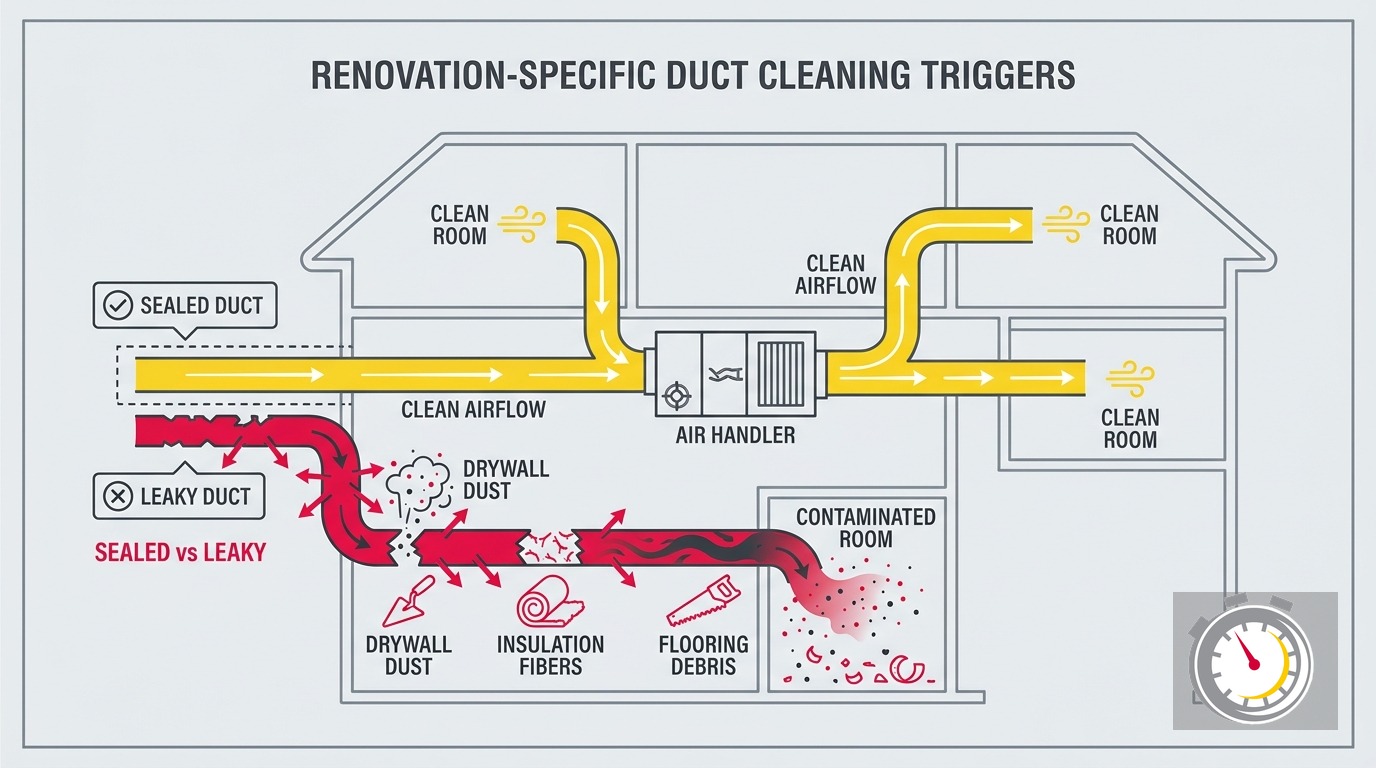
- The EPA says to seal supply and return registers before dusty renovation work begins. Most contractors skip this step.
- Drywall particles are slightly adhesive. They stick to duct walls and do not self-clear with normal HVAC operation.
- Twin Cities homes run forced-air heat from October through April. A fall renovation means contaminated ducts cycling dust through a sealed home for the entire heating season.
- Professional duct cleaning should meet NADCA ACR 2021, which sets a post-cleaning threshold of 0.75 mg per 100 cm² of surface area.
- Homes built before 1980 may contain asbestos in joint compound or duct insulation. Confirm asbestos status before scheduling any duct work.
- MERV filters do not remove contamination already on duct walls, and they do nothing for VOC off-gassing from new flooring.
Does Renovation Dust End Up in Your Ducts?
Yes, and in larger quantities than most homeowners expect. If the HVAC system ran at any point during dusty renovation work, particles from drywall, joint compound, insulation, or flooring entered through open registers. Even with the system off, open vents act as settling points for airborne material.
What is inside the duct system stays there until it is mechanically removed. The contamination does not thin out with normal operation. Drywall particles are slightly adhesive and build up with each heating or cooling cycle. Running the system longer does not help. It makes the distribution worse.
This post covers what renovation dust actually is, why drywall dust is a distinct health concern, and what a proper post-renovation cleaning looks like for Twin Cities homes.
Not All Construction Dust Is the Same
Most articles on post-renovation air quality treat construction dust as a single, uniform category. It is not. What ended up in your duct system depends entirely on what your contractor cut, sanded, and installed. Different materials leave chemically distinct contaminants, and each type calls for a different response.
Drywall, joint compound, and patching products contain crystalline silica. This is not a common allergen. The Minnesota Department of Health classifies crystalline silica as “more toxic to human health” than amorphous silica. Long-term exposure causes permanent lung tissue damage, damage that does not reverse the way seasonal allergy symptoms can.
Blown-in and batt insulation releases mineral or glass fibers when disturbed. These fibers can lodge in duct liner rather than passing through the system. Heavy contamination may require liner inspection and possible replacement, not just a cleaning pass.
Laminate and engineered wood flooring introduces a different class of contaminant: volatile organic compounds, including formaldehyde. Off-gassing peaks at installation and continues at declining levels for up to 12 months. Heat accelerates emissions, so flooring installed in fall can produce elevated VOC levels again when the home first runs cooling the following summer. Our post on VOC off-gassing and indoor air quality after a Minnesota renovation covers the flooring piece in more detail.
When you call to schedule post-renovation duct cleaning, telling the contractor what materials were used is the single most useful piece of information you can provide. It determines the cleaning method, the scope, and whether secondary concerns like liner inspection or VOC filtration belong in the conversation.
What Makes Drywall Dust Especially Dangerous in Your HVAC System?
Drywall particles are slightly adhesive. They stick to duct walls on contact rather than passing through the airstream. Each heating or cooling cycle lifts some particles back into suspension and deposits them further into the system. The contamination grows and does not self-correct without mechanical cleaning under negative pressure.
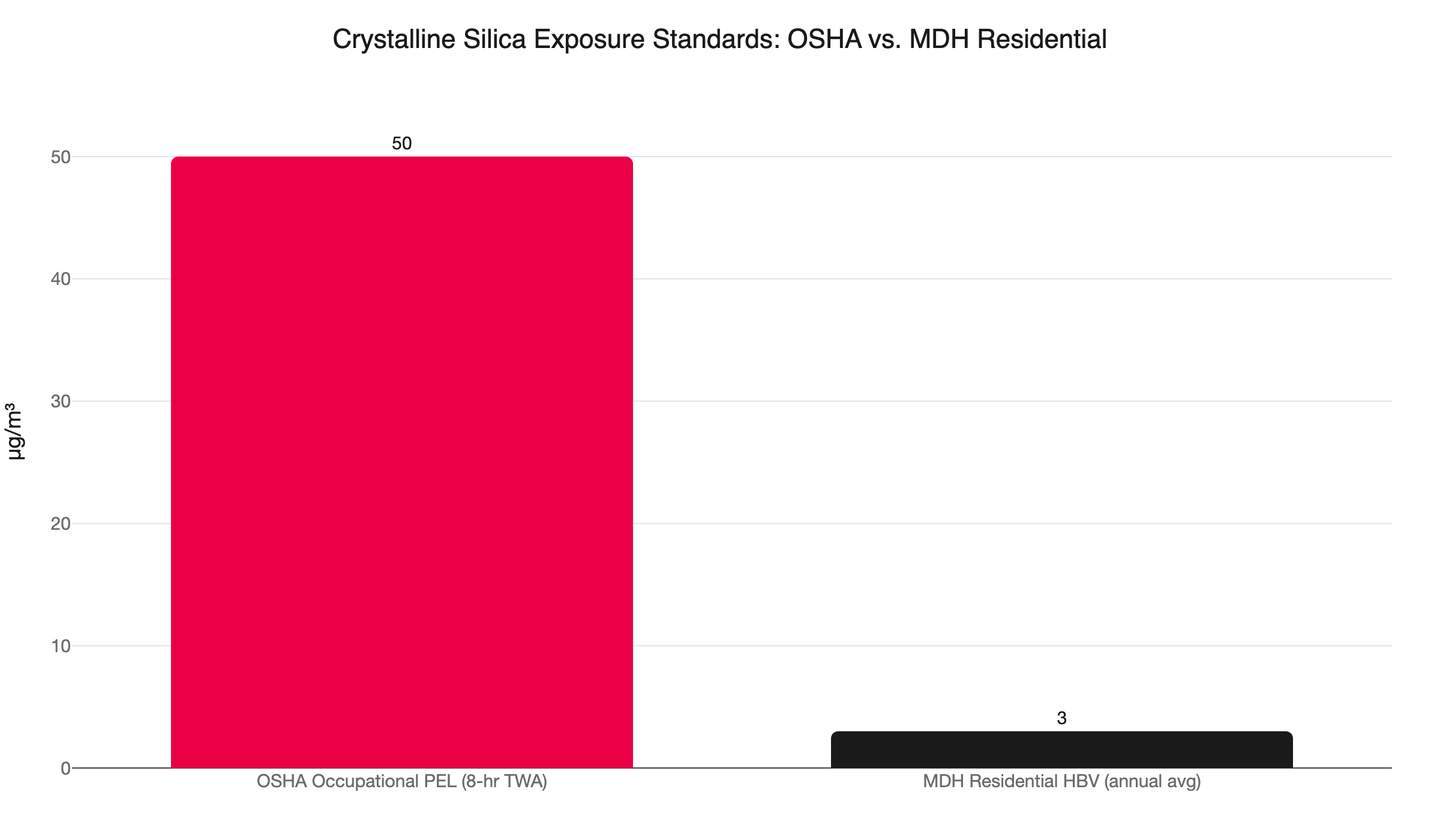
The deeper concern is the chemistry. The MDH residential health-based value for crystalline silica is 3 micrograms per cubic meter (µg/m³) as a yearly average. OSHA’s occupational permissible exposure limit is 50 µg/m³, set for workers during an 8-hour workday. The MDH residential standard is approximately 17 times more protective. That gap reflects the difference between an 8-hour shift and living in a space full-time for years.
Every furnace cycle moves air over contaminated duct surfaces. Fine crystalline silica particles lift off, enter the airstream, and are inhaled. Unlike ordinary household dust, which the respiratory system largely clears, crystalline silica triggers an immune response in lung tissue. The result is progressive scarring that accumulates over years of repeated exposure. This risk is not limited to people with pre-existing respiratory conditions.
No filter upgrade removes the contamination at the source. The source is on the duct walls.
The Step Most Renovation Contractors Skip
EPA guidance on duct cleaning is explicit: seal off supply and return registers before dust-producing renovation work begins, and “do not operate the heating and cooling system until the dust is cleaned up.”
Most renovation contractors skip this. They are focused on the renovation itself. Sealing registers and managing HVAC system state is not typically part of a drywall crew’s or flooring installer’s scope.
Proper register sealing means covering every supply and return opening with plastic sheeting and tape before any cutting, sanding, or patching begins. Fine drywall particles travel throughout the home. Partial sealing protects some registers but leaves others as direct contamination points.
Even if the system stayed off during the work, the renovation crew’s fans and foot traffic generate enough air movement to push fine particles into open registers. A completely off HVAC system is not a barrier against register contamination when work is happening nearby.
The result: most Twin Cities renovations contaminate the duct system by default. Not because of negligence, but because no one on the project made duct protection an explicit deliverable. If your contractor cannot confirm that registers were sealed before drywall or sanding work started, treat the system as contaminated and proceed from there.
Why Minnesota Winters Make This Problem Worse
A Twin Cities home runs forced-air heating from approximately October through April. During those months, windows stay closed and the HVAC system is the only significant air mover in the home. The system cycles air through the entire duct distribution network multiple times every day.
A renovation completed in October puts contaminated ducts into a sealed heating season. There is no way to dilute indoor air naturally until late spring, roughly five to six months later. By then, fine particles have been lifted from duct surfaces and recirculated through the living space hundreds of times.
A homeowner in a warmer climate might open windows in November and flush indoor air naturally within a few weeks. That is not practical in Minnesota for most of the heating season.
The recirculation problem compounds over time. A forced-air system moves a large volume of air per hour. With contaminated ductwork, a meaningful fraction of that air carries fine particulates on every cycle. The cumulative exposure over a full Minnesota winter is substantially higher than what a brief post-renovation ventilation period in a warm climate would produce.
This is the single biggest reason post-renovation duct cleaning is more urgent in the Twin Cities than in most of the country. The sealed home, the long heating season, and the adhesive behavior of drywall dust combine to turn a one-time renovation event into a months-long ongoing exposure.
What Happens If You Don’t Clean the Ducts After a Renovation?
The contamination keeps recirculating. Every HVAC cycle carries fine particles from duct surfaces back into the living space. The adhesive quality of drywall dust means particles stay on duct walls between cycles but lift back into the airstream when airflow increases. The process continues without end until the ducts are mechanically cleaned.
The HVAC system itself accumulates damage over time. Drywall dust is abrasive and accelerates blower motor bearing wear. It coats the evaporator coil, reducing heat transfer efficiency and increasing the risk of the coil icing over. It clogs air filters faster than the rated service interval. These are the predictable results of running a contaminated system over months or years. Our full guide on whether duct cleaning is worth it covers the long-term system cost side in detail.
For the people in the home, the concern is highest for anyone with asthma, COPD, or cardiovascular conditions. It is not limited to those groups. Crystalline silica affects healthy lungs with sustained exposure, with damage accumulating silently over years.
The financial math is straightforward. Post-renovation duct cleaning costs a fraction of what it costs to replace a blower motor, repair a damaged coil, or manage a chronic respiratory condition.
Do MERV Filters Solve This on Their Own?
No. MERV filters capture particles that pass through the return. They cannot remove particles already adhered to duct walls from the renovation. Upgrading to a higher MERV rating reduces the size of new particles getting through, but it does nothing for contamination already deposited on duct surfaces.
There is a second problem for renovations that included new flooring. Formaldehyde and other VOCs are gases, not particles. Standard MERV filters do not capture gaseous contaminants at all. Activated carbon media is required for VOC removal, and it is a distinct filter type from standard MERV-rated mechanical filtration. Our post on air purifiers versus MERV filter ratings explains the difference in detail.
Running a higher-MERV filter after a renovation is a reasonable supporting step. It reduces ongoing particle accumulation from new sources. It is not a substitute for removing source contamination from the duct walls.
What Should You Expect From a Professional Post-Renovation Duct Cleaning?
A qualified contractor puts the entire duct system under negative pressure: the system is sealed at the air handler, collection equipment connects at the main trunk, and agitation tools dislodge accumulated material from all duct surfaces. Everything collected goes into the equipment and out of the home. The scope covers supply ducts, return ducts, the air handler cabinet, the blower compartment, and the coil access area.
The standard to ask for by name is the NADCA ACR 2021. It lists renovation contamination as an explicit cleaning trigger and sets a post-cleaning acceptance threshold of 0.75 milligrams per 100 cm² of duct surface area. Ask any contractor before booking whether they clean to ACR 2021 and whether they provide written documentation afterward.
Questions worth asking before you schedule:
- Do you clean supply ducts, return ducts, the air handler cabinet, and the blower compartment?
- Will you inspect duct liner for insulation fiber saturation after a project that involved blown-in insulation?
- Do you provide post-cleaning verification, or only a visual check?
- Do you clean to NADCA ACR 2021?
Not every company that calls itself a duct cleaner works to NADCA standards. The ACR 2021 threshold is the difference between a cleaned system and one that has been vacuumed. Ask for it by name.
Does Your Pre-1980 Twin Cities Home Need Extra Steps First?
Yes. Homes built before 1980 may have asbestos in joint compound, floor tile adhesive, or duct insulation. The Minnesota Department of Health recommends a licensed Minnesota asbestos contractor before any disturbance of these materials. If your renovation cut or sanded materials in a pre-1980 home without an asbestos assessment first, that needs to be addressed before scheduling duct cleaning.
A duct cleaning team working in a system with disturbed asbestos does not remove the hazard. It spreads it through the duct system and into the living space. This is why asbestos-containing materials require licensed contractors rather than general renovation crews.
The Twin Cities has substantial housing stock from the 1950s and 1960s. Kitchen, bathroom, and basement renovations in homes of that era commonly encounter materials from the pre-restriction period. The MDH maintains a list of licensed asbestos inspectors and contractors in Minnesota. If there is any uncertainty about what materials were disturbed, an inspection is the right first call before any duct work proceeds.
Once asbestos is ruled out or addressed by a licensed contractor, post-renovation duct cleaning proceeds the same as any other project.
What Should You Tell Your Renovation Contractor Before Work Starts?
Ask them to seal all supply and return registers before any drywall, sanding, insulation, or flooring work begins. Ask that the HVAC system stay off during dust-producing phases. Request written confirmation that both steps were completed before the system is turned back on.
These are straightforward requests that many contractors skip unless the homeowner raises them. Getting that confirmation in writing before work starts reduces the contamination load, the scope of post-renovation duct cleaning, and the overall cost.
If the renovation is already finished, skip this step and move directly to scheduling duct cleaning.
Scheduling Post-Renovation Duct Cleaning in the Twin Cities
Do not wait for the next season to start. Schedule cleaning as soon as the renovation is complete and visible surface dust has settled, typically one to two weeks after the project wraps. Every week of delay is another week of contaminated air cycling through the home.
If you are not sure whether your renovation contaminated the ducts, the EPA guidance says to assume contamination unless you can confirm the registers were sealed and the system was off. If you cannot confirm that, schedule a professional inspection first. Our team can assess what is actually in the system and tell you what cleaning is needed before committing you to a full cleaning scope.
Northern One Hour is locally owned and operated in Ramsey, Minnesota. We serve Minneapolis, St. Paul, Blaine, Maple Grove, Plymouth, Brooklyn Park, Woodbury, Bloomington, and the surrounding Twin Cities metro. Our team cleans to NADCA standards, gives you honest pricing before the work begins, and shows up on time.
“Always On Time… Or You Don’t Pay a Dime!(R)”: we arrive within the time window you select. If the technician does not show up on time, you do not pay for the service.
Call us at (763) 260-6662 or schedule duct cleaning online.
Frequently Asked Questions
Do I need duct cleaning if my contractor said the renovation wasn't very dusty? +
How long after a renovation should I wait before scheduling duct cleaning? +
What is NADCA ACR 2021 and why does it matter? +
Is post-renovation duct cleaning covered by Minnesota utility rebates? +
Need a technician now?