
Indoor Air Quality VOCs After Renovation in Minnesota
Key Takeaways
- According to the EPA, indoor VOC concentrations run 2 to 5 times higher than outdoors. After a renovation, they climb higher still.
- There is no Minnesota state or federal VOC safety standard for homes. Symptoms are your signal to act.
- Standard MERV filters capture particles. They do not remove gaseous VOCs. Activated carbon media is the separate layer that does.
- An ERV or HRV is the primary mechanical tool for VOC dilution during Minnesota’s cold months, when outdoor ventilation is not practical.
- For most Twin Cities homes, an ERV outperforms an HRV: it recovers both heat and moisture through dry winters and humid summers.
- Most homeowners with an ERV or HRV have never changed it from factory defaults. Boost mode is the first thing to adjust after renovation work is complete.
- The bake-out and flush-out protocol can cut weeks off your off-gassing timeline.
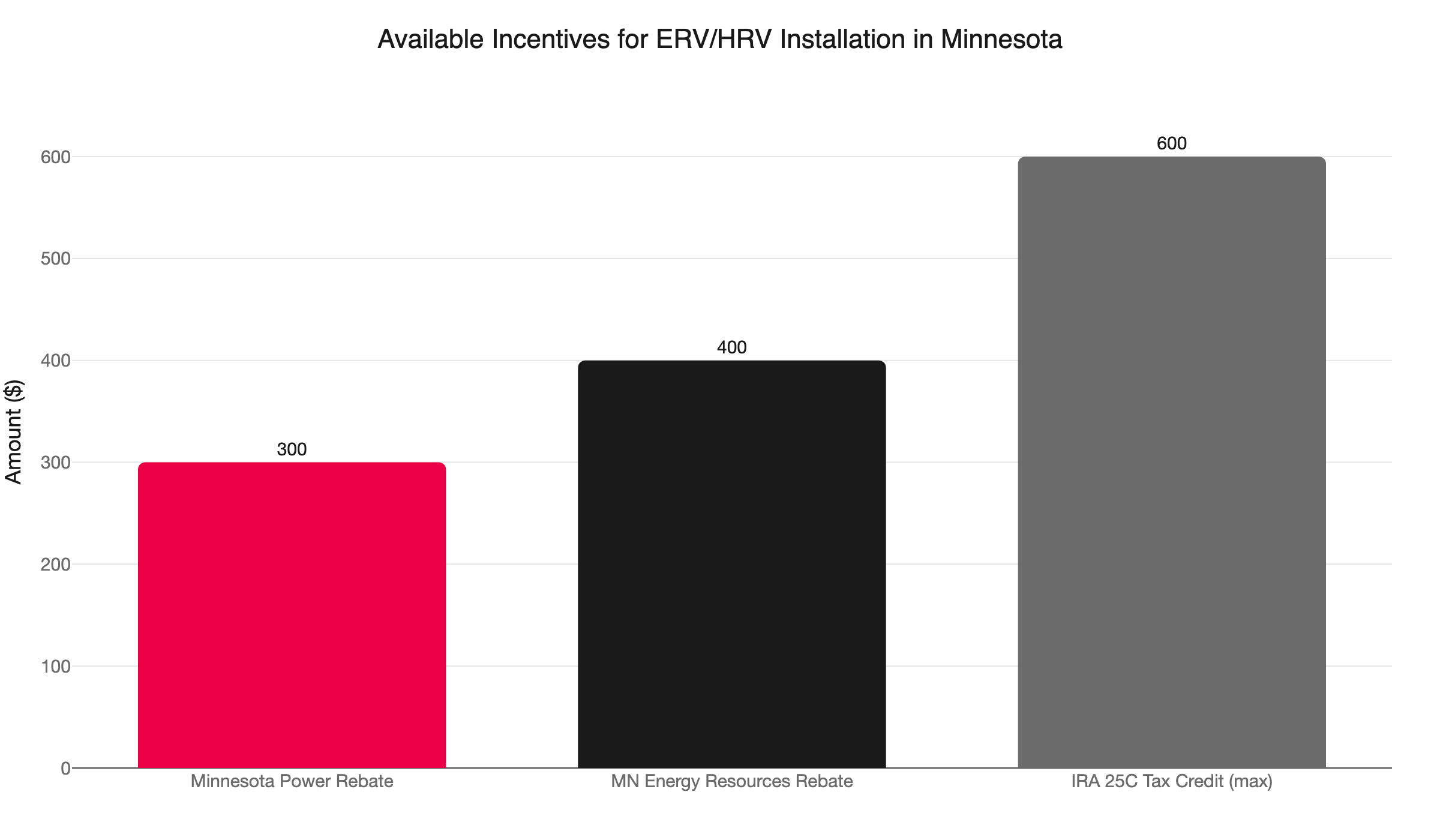
- Minnesota Power, Minnesota Energy Resources, and the IRA 25C tax credit can stack to $1,300 or more toward ERV or HRV installation.
What Are VOCs and Why Do Levels Spike After Renovation?
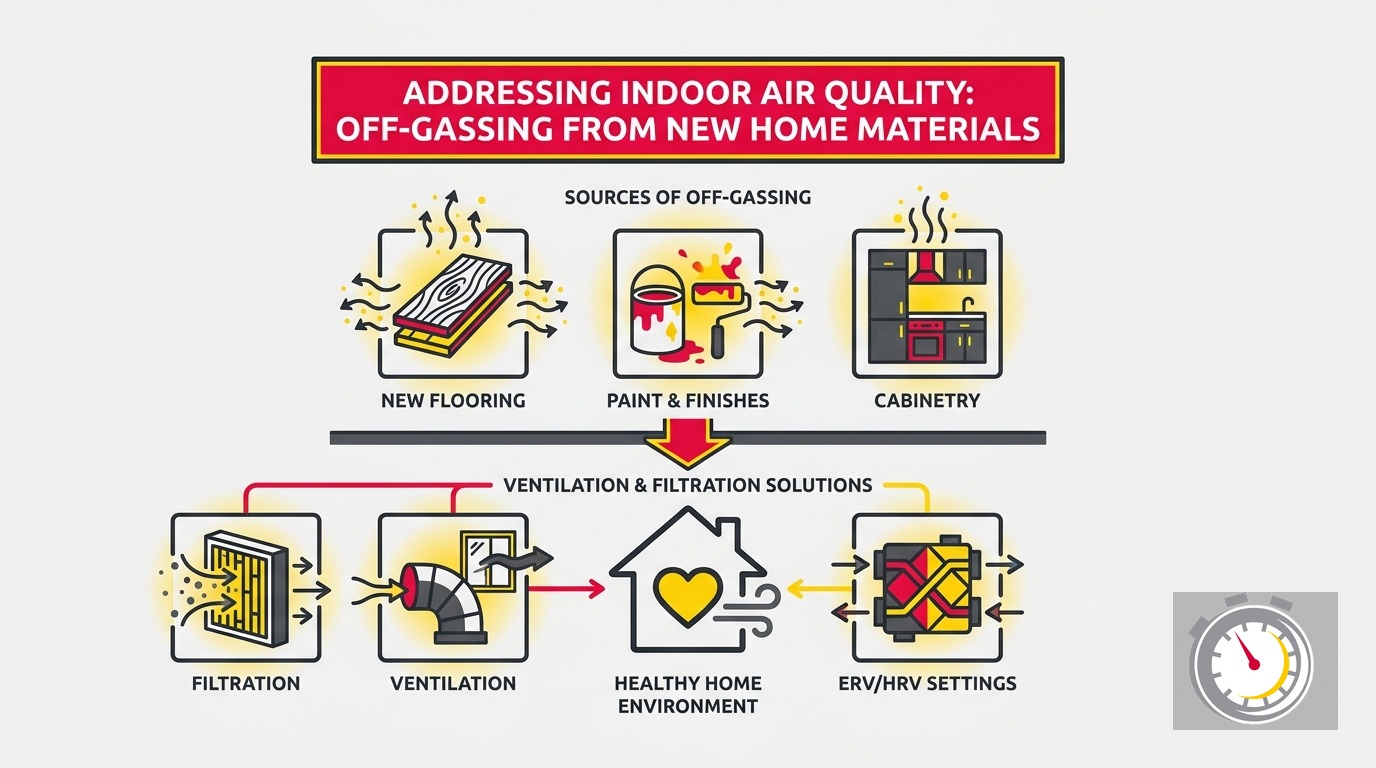
VOCs, or volatile organic compounds, are gases released by building materials. New flooring, paint, adhesives, and cabinetry all off-gas VOCs at peak levels immediately after installation, then decline over the following months. There is no state or federal VOC limit for residential spaces in Minnesota. Symptoms are the only practical cue to act.
VOCs are not a single chemical. They are a large family of gases - formaldehyde, benzene, toluene, xylene, and hundreds of others - released from paints, finishes, adhesives, laminates, pressed wood, carpet backing, and cabinetry. That new-construction smell after a renovation is real chemistry in your air.
The EPA documents that indoor VOC concentrations run consistently 2 to 5 times higher than outdoor levels, even before renovation materials are added. After a renovation, concentrations climb significantly above that already-elevated baseline.
New laminate and engineered wood flooring off-gasses formaldehyde at peak concentration right at installation. The most significant drop occurs in the first 2 to 4 months. Off-gassing continues at lower levels for up to a year. Heat accelerates emissions: materials installed in September can spike again when your home reaches peak temperature the following July.
The Minnesota Department of Health lists acute VOC exposure symptoms as eye, nose, and throat irritation; headaches; nausea; dizziness; and worsened asthma, appearing within hours to days. Chronic exposure over years carries cancer risk and liver, kidney, and central nervous system damage. Critically: there is no state or federal VOC standard for non-industrial residential spaces in Minnesota. There is no number to check against. If occupants are symptomatic, that is the signal to act.
The EPA’s framework for addressing post-renovation VOCs follows three priorities in order: eliminate sources by choosing low-VOC materials in the first place, mitigate what remains by sealing exposed engineered wood, and then ventilate by bringing in fresh outdoor air. Ventilation is the action step when the materials are already in place.
Why “Open a Window” Fails for Minnesota Indoor Air Quality
Every article about renovation VOCs gives you the same advice: open your windows. That is useful guidance if you can follow it.
In the Twin Cities, you cannot for roughly five months of the year. Minnesota averages 155 to 160 days below freezing. From November through March, opening windows to clear renovation VOCs is not a ventilation strategy. If you install new hardwood floors in October, renovate a kitchen in November, or finish a basement in September, you are walking into the cold months with elevated off-gassing and no passive way to clear it.
Modern Minnesota construction compounds the problem. Homes built to current energy codes are far tighter than older stock. The natural air infiltration that once provided passive dilution - drafts around older windows, gaps in framing - has been engineered away. That benefits your heating bill significantly. It also traps indoor air pollutants with far less natural dilution than older homes ever had.
A tighter envelope combined with peak renovation off-gassing, combined with a sealed Minnesota winter, is the exact scenario where mechanical ventilation shifts from optional to necessary.
Does Your HVAC Filter Remove VOCs?
No. HVAC filters, even high-MERV options, capture airborne particles: dust, pollen, dander, mold spores. VOCs are gases, not particles. A MERV 13 filter passes gaseous VOCs without reducing them. Activated carbon media is the separate filtration layer that adsorbs VOC gases from the airstream.
This distinction matters in practice. Upgrading to a higher-MERV filter after a renovation is a reasonable step for particle control, and it is the right move for overall air quality. But if the symptom driving the decision is headaches and throat irritation from renovation off-gassing, a MERV upgrade does not touch the cause.
Activated carbon works through adsorption: carbon surfaces bond with VOC molecules and pull them out of the airstream. Activated carbon media can sit alongside your standard filter in a media cabinet, or in a dedicated whole-home air purifier. It has a shorter service life than a standard filter because it saturates. Once the carbon is loaded, it stops adsorbing. Replacement schedule depends on the concentration of compounds in your air, which is higher after a renovation.
The right carbon product also depends on what you are dealing with. Formaldehyde from new flooring behaves differently in filtration than solvent vapors from fresh paint. If you have a mix of sources - new floors, painted walls, and new cabinetry all at once - a broad-spectrum activated carbon media is the practical starting point.
For a full breakdown of what MERV ratings do and do not do, our post on air purifiers, filters, and MERV ratings explained covers the mechanics in detail.
What Can an ERV or HRV Do About VOCs After Renovation?
An energy recovery ventilator (ERV) or heat recovery ventilator (HRV) draws stale indoor air out and pulls filtered outdoor air in while recovering most of the heat energy. This continuously dilutes VOC concentrations. In a Minnesota winter, it is the primary mechanical tool for reducing post-renovation off-gassing.
Here is the mechanism. Your home is at 70°F. Outdoor air is at 5°F. Bringing in that outdoor air without recovery would require your furnace to heat it by 65 degrees. Multiply that across hours of continuous ventilation and the energy cost adds up fast. An ERV or HRV captures 70 to 85% of the heat from the outgoing exhaust air and transfers it to the incoming fresh air stream before it enters your living space. You get continuous air exchange. You do not get an oversized furnace bill.
ASHRAE 62.2 establishes minimum whole-house ventilation rates for residential buildings. ERVs and HRVs achieve full credit under the standard. They are the designed mechanical solution for tight, energy-efficient homes. That describes most modern Twin Cities construction. Post-renovation off-gassing is exactly the high-load scenario they are built to handle.
The math of dilution is straightforward: fresh air in, VOC-laden air out, every hour of operation. Each exchange cycle lowers the concentration in your home. Running an ERV or HRV at elevated airflow during the first weeks after renovation work is complete accelerates this far more than maintenance-mode operation would.
ERV vs. HRV: Which One Is Right for a Minnesota Home?
For most Twin Cities homes, an ERV is the better fit. It transfers both heat and moisture, preventing indoor humidity from falling further in cold, dry Minnesota winters. An HRV transfers heat only. Homes with strong existing dehumidification may prefer an HRV, but the ERV handles the full Minnesota climate profile better for most households.
The humidity question is what most ERV and HRV guides skip entirely.
A Minnesota winter already dries your home out. You run a humidifier, deal with static electricity, and wake up with dry sinuses. An HRV exchanges heat but also exhausts indoor moisture with the outgoing air. In a home that is already running low on humidity, an HRV compounds the problem.
An ERV transfers moisture along with heat. In cold winter conditions, it recovers a portion of the indoor humidity from the exhaust air before it exits. Your home maintains relative humidity without requiring the humidifier to work harder. In summer, when Minnesota air is humid, the ERV’s moisture rejection reduces the dehumidification load on your air conditioner. It handles both ends of the climate.
According to Rise, the ERV versus HRV decision turns on your home’s existing dehumidification capacity. Homes with powerful whole-home dehumidifiers already in place can manage moisture without ERV recovery. For most Twin Cities homes - particularly tight modern builds where winter dryness is a regular complaint - the ERV is the right call.
We cover the full decision framework in our post on ERV vs. HRV: which ventilation system is right for Minnesota.
The One Setting Most Homeowners Never Change
Here is what every “increase ventilation” article leaves out: the instructions for how to actually operate the equipment.
Many newer Twin Cities builds include an ERV or HRV as part of the original HVAC installation. The proposed Minnesota code change would make them standard in all new single-family construction. The problem is not the hardware. Rise documents that the most common ERV and HRV mistake is leaving the system at factory default settings that do not match the home’s actual ventilation needs. Factory defaults are calibrated for steady-state normal occupancy. They are not calibrated for the elevated VOC loads a major renovation generates.
Here is what to look at and adjust:
- Boost mode. Most ERVs and HRVs have a boost mode on the wall control. In boost, the unit runs at maximum rated airflow rather than the default lower rate. Set boost to run continuously for the first 2 to 4 weeks after renovation work is complete and the space is being occupied again.
- Intermittent vs. continuous. Many units ship set to run intermittently: 20 minutes per hour is a common default. After a renovation, switch to continuous operation. Accumulating air exchange hours as quickly as possible is the goal during the off-gassing peak.
- Runtime duration. For a large-scope renovation - new flooring plus fresh paint plus new cabinetry across a significant portion of the home - plan for 4 to 6 weeks at elevated ventilation before stepping back to maintenance mode. A smaller scope can be managed in 2 to 3 weeks.
If you are unsure what mode your unit is currently running, or if the controls are unclear, we can check the configuration on a service visit and set it correctly for your situation.
The Bake-Out and Flush-Out Protocol
This is an established building science technique that most renovation guides never mention.
A bake-out intentionally raises the home temperature - typically to 85 to 90°F - for 24 to 48 hours. At elevated temperature, building materials release their VOC load at an accelerated rate. The heat compresses off-gassing that would otherwise unfold gradually over weeks into a shorter, more concentrated window.
The flush-out follows immediately. Run the ERV or HRV at maximum airflow for 12 to 24 hours after the bake-out, exhausting the concentrated VOC-laden indoor air and drawing in fresh outdoor air. The goal is to exchange as much air volume as possible while the peak concentration is present.
The result is a shorter overall off-gassing period. Instead of a months-long gradual decline, you drive a compressed high-concentration peak and ventilate it out. The materials continue off-gassing afterward at lower levels, but the acute exposure window has been managed.
A few practical caveats apply:
- Run a bake-out only after materials are fully cured. Fresh paint that has not dried or adhesives that have not set will not respond the same way. Wait until the work is complete and cured before attempting the protocol.
- You need sufficient ventilation capacity to execute the flush-out effectively. An undersized ERV or HRV may not exchange enough volume for a very large renovation footprint. A service check before attempting the protocol on a large job is worthwhile.
- This protocol complements low-VOC material selection. It does not replace it.
How Do You Know If Your Air Quality Is Improving?
A consumer-grade home air quality monitor tracks VOC levels and shows trends over days and weeks. You can confirm whether your ventilation is working and how long the off-gassing peak lasts. If readings plateau, that signals something else: a new source you have not identified, or ventilation capacity that is not keeping pace.
Devices in the $150 to $400 range detect total VOC concentration and display trends over time. Run your ERV in boost mode for a week, then check the trend. If the VOC reading is declining steadily, the ventilation is working. If it plateaus or rises, you have a signal to investigate: another off-gassing source, a system that is not running at the setting you think it is, or materials releasing faster than expected due to temperature.
Pair the monitor reading with symptom tracking. If occupants stop experiencing headaches and eye irritation, that is meaningful confirmation that concentrations have dropped to tolerable levels - regardless of what the monitor shows in absolute terms.
For a full guide to what home air monitors track and how to read the data, see our post on home air quality monitoring for Twin Cities homeowners.
If symptoms are significant, or occupants have asthma or chemical sensitivities, a professional air quality test provides specific compound identification. That changes the mitigation plan. Not all VOCs respond the same way to ventilation, and some materials benefit more from sealing than from air exchange as the primary response.
Is Minnesota Requiring ERVs and HRVs in New Construction?
Minnesota’s Technical Advisory Group has proposed requiring an HRV or ERV in all new single-family, two-family, and townhome construction under the 2024 IRC adoption. The proposal covers all Minnesota climate zones. It is not yet in effect, but the direction is clear.
The Minnesota Department of Labor and Industry Technical Advisory Group submitted the proposal as part of the state’s 2024 International Residential Code adoption process. If it passes, heat recovery ventilation becomes a code baseline for new residential construction in Minnesota. Not an upgrade. A standard.
For existing homeowners, this matters in two ways. First, if your home already has an ERV or HRV, now is the right time to verify it is configured correctly and that you know how to operate it for high-demand scenarios like post-renovation off-gassing. Most homeowners with these systems have never been walked through the controls. Second, if your home does not have one, a major renovation is a practical trigger for adding one. The construction disruption is already happening. Adding ventilation equipment during a renovation is more cost-effective than scheduling a standalone installation later.
What Will This Cost, and Are There Rebates?
ERV and HRV installation typically runs $1,500 to $3,900 installed in the Twin Cities, depending on system type, home size, and ductwork configuration. Three active incentive programs can stack to cover a significant portion of that cost.
Available incentives for qualifying ERV and HRV installations:
- Minnesota Power: $300 rebate for ERV or HRV with a sensible recovery efficiency (SRE) of 60% or higher at 32°F, installed by December 31, 2026, through a program contractor. (Details)
- Minnesota Energy Resources: $400 rebate for qualifying HRV or ERV installation. Confirm current availability at mnenergyresources.com before applying, as program availability can change.
- IRA 25C federal tax credit: Up to $600 for qualifying ventilation upgrades under the Inflation Reduction Act. Confirm the current year’s guidance directly with the IRS, as program amounts have been subject to update.
Those three sources can combine to $1,300 in incentives on a single installation. Stacking utility rebates with federal tax credits in Minnesota is worth doing carefully - for a full walkthrough, see our guide to stacking HVAC rebates and tax credits in Minnesota.
Financing is available for larger IAQ equipment purchases. Ask about current terms when you call.
When to Call Northern One Hour
Our team handles both sides of post-renovation indoor air quality: configuring and testing equipment you already have, and installing equipment your home is missing.
We can assess your existing ERV or HRV settings, confirm the system is sized and configured correctly for your home, add activated carbon filtration to your airstream, run a whole-home IAQ consultation, or install a new ERV or HRV where one does not exist. We are locally owned and operated in Ramsey, serving the Twin Cities metro and surrounding communities.
When you schedule with us, we show up. “Always On Time… Or You Don’t Pay a Dime!(R)” is not a marketing line - it is the standard we hold on every call.
Call (763) 260-6662 or book online to schedule. If your renovation is coming up and you want to plan your IAQ approach before the work starts, that conversation is easier than a remediation call after the materials are already in.
Frequently Asked Questions
How long do VOCs last after a home renovation? +
Do HVAC filters remove VOCs from indoor air? +
Is an ERV or HRV better for a Minnesota home after renovation? +
What rebates are available for ERV or HRV installation in Minnesota? +
Need a technician now?