
Furnace Filter After Construction Dust: Twin Cities Guide
Key Takeaways
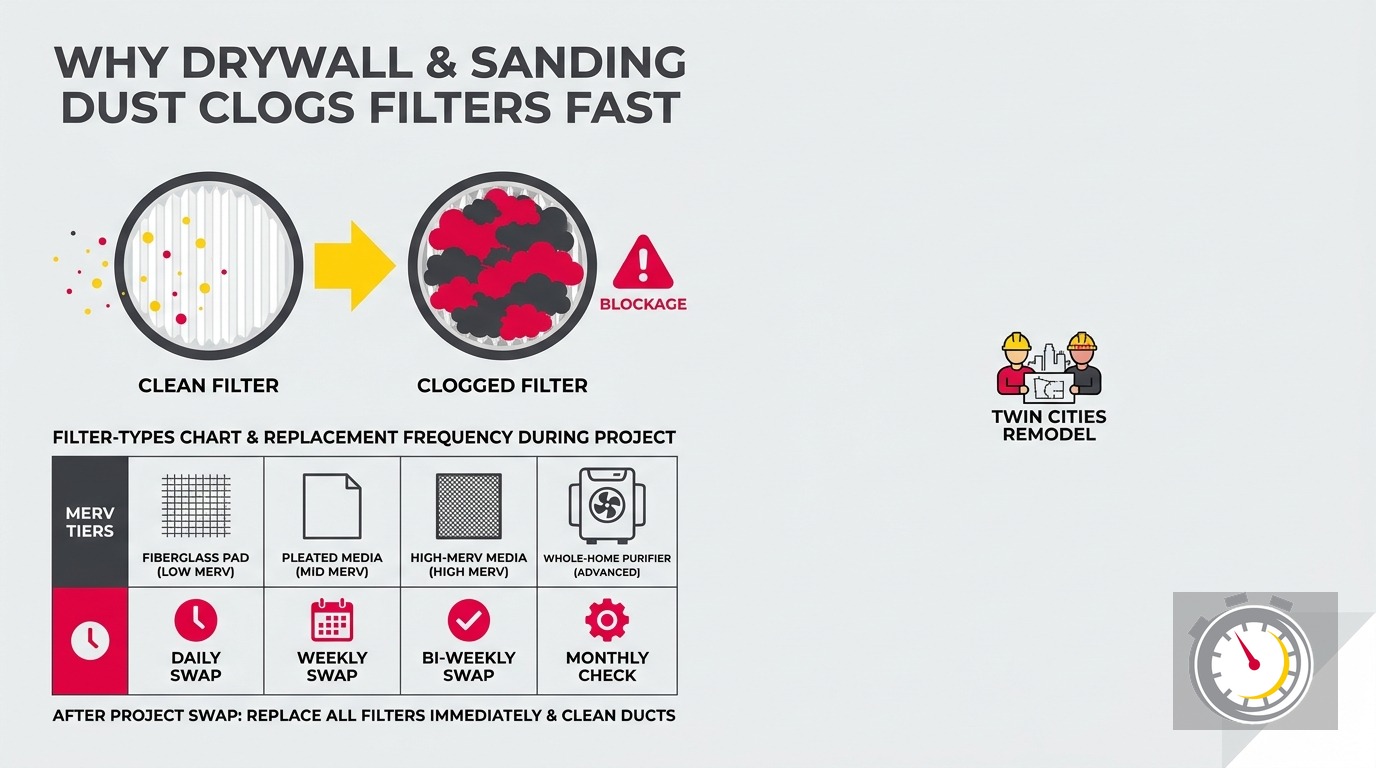
- Drywall and sanding dust is finer than everyday household dust, so it clogs a filter far faster than normal use.
- The best plan is to keep the blower off and seal the registers during dusty work.
- If the system must run, check the filter every few days.
- Install a fresh filter after final sanding and cleanup, then check it again about a week later.
- A cheap filter clogs fast. A high-MERV 1-inch filter can restrict airflow. A 4-inch media cabinet solves both problems.
- Minnesota remodels often happen with the heat on in winter, so dust loads the filter quickly.
- Homes built before 1978 need lead precautions during demolition.
The Short Answer
Replace your furnace filter right after final sanding and cleanup. Then check it again about a week later. During dusty work, keep the blower off and seal the registers. If the system must run, check the filter every few days.
Drywall and sanding dust is very fine, and it loads a filter face quickly. A clogged filter restricts airflow. A calendar schedule won’t protect your furnace. A schedule built around the phases of the remodel will.
We are Northern One Hour, a locally owned and operated Twin Cities heating and cooling company. We see dust-choked systems after remodels every year.
Why Does Drywall and Sanding Dust Clog a Furnace Filter So Fast?
Drywall and sanding dust is extremely fine and arrives in huge volume. It coats the filter face within hours of heavy work. Once the surface is blocked, air can’t pass freely. A normal filter might last months. A construction zone can ruin it in days.
Think of a coffee filter. Pour water through it and it flows. Stir in fine flour and the flow slows to a trickle. A furnace filter behaves the same way.
Remodel dust is worse than regular dust for a few reasons:
- Particle size. Sanded joint compound breaks into very small particles. They pack tightly on the filter face.
- Volume. Sanding a single room can release far more dust than a month of normal living.
- Constant airflow. A running blower pulls dust toward the return grille, and the filter sits right in that path.
- Hidden entry points. Dust travels through open doors, gaps, and return vents, even to rooms far from the work.
A clogged filter does real harm. MNCEE notes that restricted air flow can lower the efficiency of the furnace. In Minnesota, that matters. The same source says we spend 60 percent of our utility bill on heating and cooling our homes.
A clogged filter also strains the blower. Your furnace works harder and your rooms heat unevenly. In bad cases, the furnace shuts itself off. If that sounds familiar, our guide on furnace cycling caused by a dirty filter explains what to look for.
Should You Run the Furnace During a Remodel?
Ideally, no. The EPA advises homeowners to seal off supply and return registers during renovation or construction. It also says not to operate the heating and cooling system until after cleaning up the dust. A running blower pulls dust into the filter and the ducts.
When the work is dusty, we recommend this plan:
- Seal every register in the work zone. Tape plastic sheeting over supply and return openings. The EPA remodeling guidance calls for taping over any supply and return registers. That helps keep pollutants from spreading and from contaminating the ducts.
- Build a barrier. The EPA says a simple barrier is 6 mil poly sheeting taped over doors and other openings in the room. For high-dust jobs such as demolition, it calls for isolation rather than flap barriers.
- Turn the system off at the thermostat. Set it to off, not just to a lower temperature. Make sure the fan setting is not on “on.”
- Wait until cleanup is done. Resume normal operation only after the dust is cleaned up.
The fan setting trips up many homeowners. If your thermostat runs the fan constantly, the blower keeps pulling dust. Our post on auto versus on fan settings explains the difference.
What if you cannot turn the heat off?
This is the Minnesota problem. A January remodel with no heat isn’t practical. If the system must run, expect the filter to load quickly. Check it every few days. Seal off every register you can inside the work zone. Heat the rest of the house normally.
Some homeowners also put a temporary space heater in the work area. That is a judgment call. We cover the cost side in our guide to electric space heaters versus central heat.
How Often Should You Change the Filter During and After a Remodel?
Change it before work starts, check it every few days if the system must run, replace it after final sanding and cleanup, and check again about a week later. This phase-based schedule beats a calendar interval because dust load depends on the work, not the date.
Many guides give one number. One popular home-improvement site says to change your furnace filter every 30 days, or even more frequently, during a remodeling project. That is a fair starting point. It doesn’t say why, and it says nothing about drywall specifically.
Here is a schedule built around the phases of a remodel.
Phase 1: Before work starts
Install a fresh filter before the first tool comes out. A clean filter gives you a baseline. Any dust that reaches the system lands on new media. Write the date on the frame so you can track it.
Check the fit too. The EPA says to be sure you do not have any missing filters. It also says air cannot bypass filters through gaps around the filter holder. If your slot cover is missing or loose, see our post on air bypass around the filter slot.
Phase 2: During dusty work
Demolition, drywall hanging, mudding, and sanding are the dusty stages. You have two options:
- Best: Blower off, registers sealed, work zone isolated.
- If the system must run: Check the filter every few days. Replace it as soon as the face looks gray or caked.
The EPA puts it simply: if your filters become clogged, change them more frequently. That fits remodel season well. Keep spare filters on hand so a swap never waits on a store run.
Phase 3: After final sanding and cleanup
Wait until the dust is cleaned up. Then install a brand-new filter. Don’t reuse the old one. Fine dust embeds deep in the media, and vacuuming won’t restore airflow.
Run the system normally with the new filter in place.
Phase 4: One week later
Pull the filter again about a week after cleanup. Even a careful cleanup leaves some dust behind. Settled dust gets stirred up once the blower runs and people move through the house. If the filter looks dirty, replace it. If it looks clean, return to your normal interval.
Our general guide on how often to change your HVAC filter in Minnesota can help you settle into a routine afterward.
Your thickness matters too
Filter thickness changes the math. MNCEE says a filter about one inch thick likely needs to be replaced every month. It says a three to six inch filter can likely last several months. After a remodel, shorten both intervals. Those numbers are a normal-life baseline, not a remodel schedule.
What Does a Dirty Furnace Filter Look Like?
A dirty filter looks gray, fuzzy, or caked with a visible layer of dust. The pleats may look packed or flattened. After drywall work, you may see a pale, chalky coating. If you can’t see light through the media when you hold it up, replace it.
Don’t wait for a calendar date. Try this quick inspection:
- Turn the furnace off.
- Slide the filter out.
- Hold it up to a bright light.
- Look for light passing through the media.
Here is how to read what you see:
- Light passes through easily: The filter is fine. Slide it back in.
- Light is dim and spotty: The filter is loading. Plan a swap soon.
- No light passes through: The filter is clogged. Replace it now.
- White or chalky film: That is typical of drywall dust. Replace it, even if the filter is newer than you expected.
Also look at the grille and the filter slot. Dust settled around the frame means air may be bypassing the media. Check that the filter fits the slot. A wrong-size filter lets air and dust slip around the edges. We cover that in our post on wrong-size furnace filters.
These signs mean the system is already struggling:
- Weak airflow at the vents
- Rooms that heat slowly
- A furnace that runs longer than usual
- A furnace that shuts off before the house warms up
- Visible dust puffing out of the registers
If you notice several of these, replace the filter first. If the symptoms continue, call us.
Which MERV Rating Is Best for Dust?
For a standard 1-inch filter, pick MERV 8 or lower. MNCEE says a 1-inch filter should carry a Minimum Efficiency Reporting Value (MERV) rating of 8 or less. Higher ratings can negatively affect air flow through the furnace. A thicker filter handles higher MERV better.
MERV measures how well a filter traps particles. Higher numbers catch smaller particles. That sounds like the obvious choice for construction dust, but there is a trade-off.
- A cheap, low-MERV filter clogs fast during a remodel. It also lets finer particles through.
- A high-MERV 1-inch filter is dense. It can restrict airflow even when clean, and during a dusty remodel it loads even faster.
- A thicker media filter has more surface area. It traps fine dust without choking the blower.
For most homes, the best answer is a 4-inch media cabinet. MNCEE suggests a 4-inch filter for higher MERV. It also says high-MERV filters should be swapped at least every three months. The thicker filter gives dust more room to collect before airflow suffers.
The EPA adds a useful rule. It says to use the highest efficiency air filter recommended by the manufacturer of your heating and cooling system. Your furnace manual sets the ceiling. Check the label on the furnace or look up the model number before you buy.
A practical approach for remodel season
For a short remodel with a 1-inch slot:
- Use a basic, low-cost MERV 8 or lower filter during the dusty phase.
- Buy several, because you will swap them often.
- Switch to your preferred filter after cleanup is finished.
That keeps your good filter free of construction dust. It also keeps airflow healthy while the work continues.
Some homeowners ask about allergies and finer particles. Our post on the best furnace filter for allergies in Minnesota covers that choice once the remodel is behind you.
Can Your HVAC System Handle a MERV 13 Filter?
Maybe, but not every system can. A MERV 13 filter is dense. In a standard 1-inch slot, it can restrict airflow on many furnaces. Check your manufacturer’s maximum recommendation first. If you want MERV 13, a 4-inch media cabinet is usually the safer setup.
MERV 13 is a good filter. The real question is whether your blower can pull air through it.
Here is how to decide:
- Read the furnace manual or label. The manufacturer lists the filter rating it supports.
- Check the slot depth. A 1-inch slot limits you to a thin, dense filter. A media cabinet lets you go thicker.
- Think about your blower. Variable-speed motors cope better with resistance. Older single-speed blowers struggle more.
- Watch for symptoms. Weak airflow, long run times, or a whistling return grille after a filter change are warning signs.
MNCEE warns that going above MERV 8 in a 1-inch filter can negatively affect air flow through the furnace. That is why the media cabinet matters. It lets a higher rating work without strangling the system.
We go deeper in our post about whether MERV 13 filters restrict airflow. If you’re unsure what your system can handle, ask us. We can check static pressure and tell you for certain.
Do not use MERV 13 as a construction filter
Even if your system handles MERV 13, it is a poor choice for the dusty phase. Construction dust will clog it within days, and each swap costs more. Save it for after cleanup.
What Changes for Minnesota Winter Remodels?
Minnesota furnaces run through a long heating season, and many remodels happen with the heat on. That loads the filter fast. You can’t simply shut the system off in January. Seal what you can, check often, and plan extra filter swaps.
Our climate shapes the plan in a few ways.
- Long run times. A furnace in a Twin Cities winter runs for hours each day. A running blower moves more air past the filter.
- Sealed homes. We keep windows closed for months. Dust has nowhere to go but the filter, the ducts, and the surfaces.
- Dry winter air. Dry air lets fine dust hang in the air longer. It also makes static and dust cling to surfaces.
- Limited ventilation. Opening windows to clear dust isn’t realistic when it is below zero.
For a winter project, we suggest this:
- Isolate the work zone with plastic and tape.
- Seal the supply and return registers inside that zone.
- Keep the thermostat fan on auto.
- Check the filter every few days.
- Keep spare filters on hand.
- Heat the rest of the house normally.
If you are finishing a basement, our guide to finished basement heating and cooling covers airflow planning. If you are adding space, our post on HVAC planning for a home renovation helps you plan before the walls go up.
Spring and summer remodels are easier on the filter, but not risk-free. The AC blower pulls dust the same way. Seal the registers and keep the system off during dusty work.
What About Homes Built Before 1978?
Treat any pre-1978 home as if its paint contains lead. The EPA remodeling guidance says homes built before 1978 should be treated that way. Demolition and sanding dust in those homes needs lead precautions. That includes isolating the work area and keeping the HVAC system off.
Many Twin Cities homes were built before 1978. That includes much of Minneapolis and St. Paul. If you are remodeling one, talk with your contractor about lead-safe practices before work begins.
For your HVAC system, the stakes are higher:
- Keep the blower off during demolition and sanding.
- Seal registers with plastic and tape.
- Don’t vacuum with a regular household vacuum. It can spread fine dust.
- Ask your contractor about lead-safe cleanup.
- Replace the filter after cleanup, and handle it carefully.
We are an HVAC company, not a lead abatement firm. Follow the EPA’s guidance and your remodeler’s lead-safe process. Our part is keeping dust out of your ducts and your furnace healthy.
Older homes can also hide other duct surprises. Our post on asbestos duct wrap in older Minnesota homes explains why you should not disturb old duct insulation on your own.
Mistakes That Let Dust Into Your Ducts
Most dust problems come from a few repeat mistakes. Avoid these and your furnace will fare much better.
- Running the blower during sanding. This is the biggest one. The system pulls dust straight into the return and the ducts.
- Leaving registers open in the work zone. Dust drops into open supply vents and settles in the ductwork.
- Using a thin, cheap filter and forgetting it. It clogs in days, then starves the blower.
- Reusing the old filter after cleanup. Fine dust is embedded deep in the media.
- Buying a high-MERV 1-inch filter for the dusty phase. It restricts airflow and clogs even faster.
- Skipping the one-week check. Leftover dust gets stirred up once the system restarts.
- Ignoring gaps around the filter. The EPA warns that air can bypass filters through gaps around the filter holder.
- Forgetting to remove the register covers. After cleanup, a taped-over register blocks airflow. Remove the plastic once the dust is gone.
That last one is easy to miss. Make a checklist, and put “remove register covers” right after “install new filter.”
When to Call a Pro
Call us if the furnace struggles after the filter swap, or if dust may have reached your ducts. A fresh filter fixes a clogged filter. It does not fix dust that already settled in the ductwork, blower, or coil.
Call if you see any of these:
- Weak airflow even with a new filter
- Visible dust blowing from the registers
- A furnace that cycles on and off or shuts down
- A musty or dusty smell when the system runs
- Rooms that stay cold after the remodel
- Any remodel where the system ran during demolition or sanding
Here is what we can do:
- Inspect the system. We check the filter fit, blower, and airflow.
- Check for dust in the ducts. Our duct cleaning service can address buildup. For more background, read our guide on duct cleaning after a home renovation.
- Tune up the furnace. A furnace tune-up checks the blower and safety components after a dusty season.
- Recommend the right filter setup. If your 1-inch slot is limiting you, we can talk through a media cabinet.
If airflow still seems off after the work, you may also want a duct airflow balance once the project settles.
We are locally owned and operated, and we know how Twin Cities homes handle a remodel in winter. We also stand behind our timing. Our promise is “Always On Time… Or You Don’t Pay a Dime!(R)” That means we arrive within the time window you select. If the technician doesn’t show up on time, you don’t pay for the service.
Call Northern One Hour
Seal the registers and keep the blower off when you can. Swap the filter after cleanup, then check it again in a week.
If you’re unsure about your filter, your ducts, or your system, we can help. Call (763) 260-6662 or book online. We will get a locally owned Twin Cities team to your door, on time.
Frequently Asked Questions
Do air filters filter out dust? +
Do I need duct cleaning after a remodel? +
Can I just vacuum and reuse my old filter after drywall work? +
Need a technician now?