
Furnace Loud Boom When Starting: Causes and Safe Steps
Key Takeaways
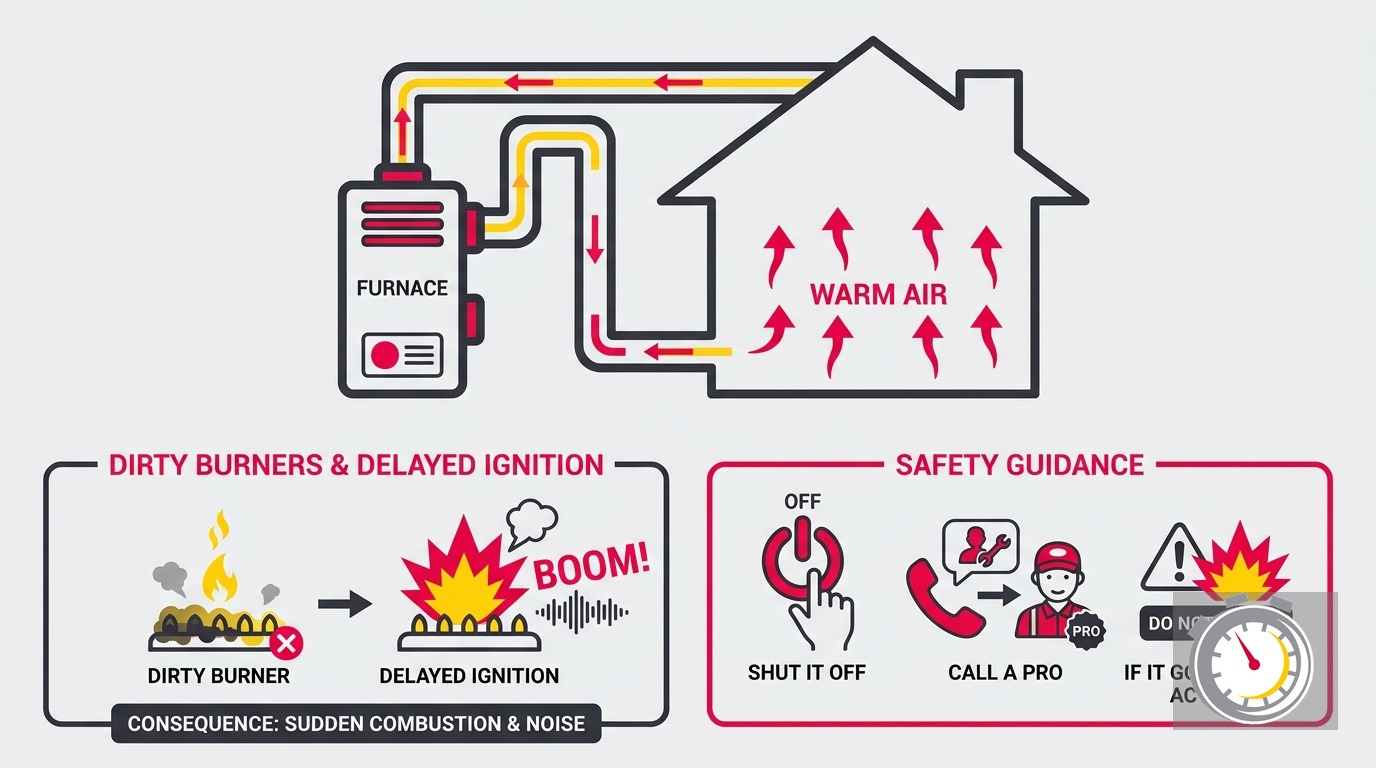
- A boom at startup usually means delayed ignition: gas builds up, then lights all at once.
- Common causes are dirty burners, a weak igniter, and a gas pressure problem.
- A repeated or loud boom means turn the furnace off at the thermostat and call a pro.
- Repeated ignition shocks can stress the heat exchanger, which matters for carbon monoxide safety.
- Minnesota law requires working carbon monoxide alarms near sleeping rooms.
- A fall tune-up is the best way to prevent this problem.
- Do not open the burner area or adjust gas parts yourself.
The Short Answer on a Furnace Boom
A furnace loud boom when starting almost always means delayed ignition. Gas flows into the burners, but the flame doesn’t light on time. Then all that gas lights at once. The sudden burst makes the bang you hear.
Is it safe to keep running? Not if it happens more than once. A single soft whoomp is a warning. A loud boom, or a boom every cycle, means you should shut the furnace off and call a pro.
We are Northern One Hour Heating & Air Conditioning, a locally owned and operated Twin Cities company. We see this problem every fall, when homeowners fire up the furnace for the first time.
What Causes a Furnace to Boom at Startup?
Quick answer: A boom happens when gas collects in the burner area before it lights. The delay can come from dirty burners, a weak or failing igniter, or a gas pressure problem. When the flame finally catches, the built-up gas burns at once and makes a loud bang.
A normal start is quiet and smooth. The usual order looks like this:
- The thermostat calls for heat.
- The draft inducer fan starts and clears the vent.
- The igniter heats up.
- The gas valve opens.
- The burners light in a steady line.
- The blower starts after the heat exchanger warms up.
The gas valve opens only when the igniter is ready. If the flame doesn’t catch right away, gas keeps flowing. The longer the delay, the more gas collects. That’s why a late flame sounds like a boom instead of a click.
Think of a campfire. A small match lights a little kindling with a quiet pop. Pour on too much fuel first, and the fire jumps up in a rush.
Delayed ignition is not the same as a normal click
Some sounds are normal. You may hear the inducer fan hum, a click from the gas valve, or a soft tick as metal warms. These are short and mild.
A boom is sharp, loud, and deep. You may feel it in the floor or hear it in the next room. The furnace is telling you something is off.
Why Does My Furnace Make a Loud Noise When I Turn It On?
Quick answer: A loud noise at startup can come from several places. A boom points to delayed ignition. A bang or pop from the walls points to ductwork. Grinding or squealing points to the blower motor or bearings. The timing of the sound tells you where it comes from.
Listen closely the next time the furnace starts, and use timing as your clue.
- A boom right as the flames light: This is delayed ignition, the main subject of this post.
- A bang or pop a few seconds after the blower starts: This is often ductwork expanding as warm air rushes in.
- Squealing or grinding while the blower runs: This points to the blower motor, a belt on older units, or worn bearings.
- Rattling that comes and goes: Often a loose panel, a loose duct joint, or debris in the blower.
- Clicking with no flame: Often a failing igniter, flame sensor, or control board issue.
If your sound is a squeal or a grind, read our guide to furnace blower motor failure signs and costs. If the noise is a steady rattle or bang, our post on furnace banging, popping, and squealing sounds can help you sort it out.
A true boom at ignition is a safety issue. Don’t guess.
Should I Keep Running a Furnace That Booms?
Quick answer: No. If the boom is loud, or if it repeats on more than one cycle, stop using the furnace. Turn the thermostat to off, leave the furnace off, and call a technician. A one-time soft whoomp still deserves a visit, but you can watch it briefly while you book.
Many pages blur this line, so here is a simple rule.
- One soft whoomp, never again: Turn the furnace off, book a visit this week, and keep your CO alarms on.
- A loud boom, even once: Shut it down and call right away.
- A boom on every cycle: Shut it down and call right away.
- A bang followed by a whoosh: Treat it as an emergency. Do not restart the furnace.
- A boom plus a gas smell, soot, or a CO alarm: Leave the house, then call from outside.
Your shut-off now checklist
If the boom is loud or repeating, follow these steps:
- Set the thermostat to “off.” Do not just lower the temperature.
- Wait. Do not press the reset button over and over.
- Check that your CO alarms are working and not beeping.
- Open a window if you notice any odd smell.
- Do not open the burner compartment or remove panels.
- Call a licensed HVAC technician.
If you smell rotten eggs, don’t flip switches or use your phone inside. Leave and call your gas utility from outside. Our guide on what to do when you smell gas near your furnace walks through those steps.
Need heat while you wait? A short stretch in a cold house beats a risky restart. Our emergency steps for a furnace that is out tonight cover safe ways to stay warm.
Dirty Burners vs. Igniter vs. Gas Pressure
Most booming furnaces trace back to one of three causes. Each delays the flame in a different way.
Dirty or clogged burners
Burners are small metal tubes with tiny ports. Gas flows through those ports and lights in a row. Over time, dust, rust flakes, and soot can clog them.
When ports clog, the flame can’t spread evenly. Gas lingers in the blocked areas and lights late. That late light is the boom.
ENERGY STAR notes that a dirty burner can make equipment run unsafely and inefficiently. That’s why burner cleaning is part of a real tune-up.
Signs of dirty burners:
- A boom or rumble at startup
- Flames that look uneven, lazy, or yellow-orange instead of steady blue
- Soot near the burner area
- A furnace that runs longer than it used to
A weak or failing igniter
The igniter is a small part that glows hot to light the gas. Over time it cracks or weakens. A weak igniter may not get hot enough to light gas on the first try.
The gas valve may open before the flame is ready. Gas builds up, then lights late. The result is the same boom.
Signs of a weak igniter:
- A long pause between the fan starting and the flames lighting
- Starts that work on the second or third try
- Clicking with no flame
- More trouble on cold mornings
Our post on furnace igniter failure signs and replacement cost covers this in depth. In the Twin Cities, flame sensor or igniter service typically runs $95-$325. A dirty flame sensor can mimic these symptoms, so see our guide on cleaning a dirty flame sensor.
Gas pressure problems
Gas pressure that is too high or too low changes how gas leaves the burners. Too much gas can flood the burner area. Too little can give a weak, unstable flame.
Pressure problems can come from the regulator, the gas valve, or the supply line. In deep cold, supply issues can also play a role. See our post on natural gas pressure during a cold snap.
Only a trained technician should test or adjust gas pressure. ENERGY STAR lists gas connections and gas pressure among the items a contractor should check.
Quick comparison
| Cause | What you notice | Who fixes it |
|---|---|---|
| Dirty burners | Boom plus uneven or yellow flames | A technician cleans the burners |
| Weak igniter | Delay before flames, multiple tries | A technician replaces the igniter |
| Gas pressure | Boom, weak flame, or flooded start | A technician tests and adjusts |
Some furnaces have more than one issue at once. A pro checks all three before the furnace runs again.
Is the Boom Actually Your Ductwork?
Quick answer: Sometimes. Metal ducts expand when warm air rushes through them, and that can sound like a bang. The key difference is timing. Ductwork noise comes after the blower starts. Ignition boom comes when the flames light, before the blower runs.
Homeowners confuse these two sounds more than any other. Ducts are thin metal. When heat hits them, they flex and pop, and it can sound like a loud knock in the walls.
How to tell the difference:
- Ignition boom: Sharp and deep. It comes from the furnace itself, right as the flames start.
- Duct pop: Hollow and metallic. It comes from walls, floors, or ceilings, and often repeats as ducts heat and cool.
- Location: Stand next to the furnace. If the sound is loudest there, think ignition. If it is louder in a room, think ducts.
Our guide on ductwork ticking and popping from thermal expansion explains the harmless version. Duct noise is usually an annoyance, not a hazard.
If you can’t tell the two apart, play it safe. Treat the sound as an ignition issue until a technician says otherwise.
How Can I Tell If My Furnace Is Leaking Carbon Monoxide?
Quick answer: You cannot see or smell carbon monoxide, so you need working CO alarms. Warning signs include headaches, dizziness, nausea, and confusion that ease when you leave the house. A furnace problem plus these symptoms means get to fresh air, then call 911.
Carbon monoxide, or CO, is a gas made when fuel burns without enough air. It is odorless, which makes alarms your main defense.
Why a boom connects to CO
A furnace boom means combustion isn’t running as it should. Repeated ignition shocks can stress metal parts over time. One of those parts is the heat exchanger, which keeps burner gases out of your home’s air.
A cracked heat exchanger can let combustion gases leak into the airstream. That doesn’t happen with every boom. But a furnace that booms isn’t burning cleanly, and you should rule out damage. Our guide on cracked heat exchanger signs explains what technicians look for.
Symptoms of CO poisoning
The U.S. Consumer Product Safety Commission lists these CO poisoning symptoms:
- Headache
- Dizziness
- Weakness
- Nausea
- Vomiting
- Sleepiness
- Confusion
If you suspect poisoning, get to fresh air right away. Then call 911. The same CPSC page says more than 200 people in the United States die every year from accidental non-fire related CO poisoning linked to consumer products. The page doesn’t tie that number to furnaces alone, but it shows why alarms matter.
Check your alarms today
CPSC advises battery-operated CO alarms, or alarms with battery backup, on every level of the home and outside sleeping areas. Interconnected alarms are best, because when one sounds, they all sound.
Minnesota has a firm rule too. Minnesota Statute 299F.51 requires an approved and operational CO alarm within ten feet of each room used for sleeping. The same statute says no one may remove batteries from a required alarm or make it inoperable.
Do this now:
- Press the test button on every alarm.
- Replace dead batteries.
- Check the date on each unit and replace old alarms per the maker’s directions.
- Add alarms near bedrooms if any are missing.
Our Carbon Monoxide Furnace Safety guide for Minnesota homeowners goes further on placement and what to do when an alarm sounds. For placement near gas equipment, see CO detector placement near a furnace or boiler.
Minnesota winters raise the stakes
Our homes are sealed tight from November through March, and furnaces run hard. Snow and ice can also block vent terminations outside, which stops exhaust from leaving the house. If you have a high-efficiency furnace, check that the outdoor pipes stay clear. Our post on high-efficiency furnace vents blocked by snow and ice shows what to look for.
Why Should You Not Fix a Booming Furnace Yourself?
Quick answer: A booming furnace involves live gas, hot parts, and combustion safety. A wrong adjustment can raise the risk of fire, a gas leak, or carbon monoxide. Homeowners can change filters and clear snow from vents. Everything inside the burner area belongs to a trained technician.
We understand the urge to save money. But this is the wrong place to experiment. ENERGY STAR warns that improperly operating gas connections are a fire hazard and can contribute to health problems.
What you can safely do:
- Replace or check the air filter. ENERGY STAR says to inspect, clean, or change filters once a month.
- Clear snow and ice from outdoor vent pipes.
- Keep the area around the furnace clear of boxes and clutter.
- Test your CO alarms.
What you should leave alone:
- Opening the burner compartment
- Cleaning burners with a brush or vacuum
- Bending or adjusting the igniter
- Turning screws on the gas valve
- Bypassing safety switches
Safety switches exist for a reason. If a limit or rollout switch trips after a boom, take that as a message and don’t jumper it. Our post on rollout switch trips explains why.
What Does a Pro Actually Check on a Boom Call?
Quick answer: A technician inspects the burners, igniter, flame sensor, gas pressure, and heat exchanger. They also check venting and combustion quality. The goal is to find the cause of the delay and confirm the furnace burns safely before it runs again.
Many contractors say “schedule an inspection” and stop there. A real visit covers more.
- Safety first. We confirm the gas is off and test for CO around the furnace.
- Visual burner check. We look for rust, soot, and clogged ports.
- Burner cleaning. If ports are blocked, we clean them properly.
- Igniter test. We check that it heats fast and fully.
- Flame sensor check. A dirty sensor can cause shutdowns and odd starts.
- Gas pressure test. We measure pressure against the manufacturer’s range.
- Heat exchanger inspection. We look for cracks, hot spots, or damage.
- Venting and draft check. We confirm exhaust leaves the house.
- Combustion test. We check how cleanly the furnace burns. See what a combustion analysis tests.
- Test cycles. We run the furnace several times to confirm smooth starts.
These steps line up with what ENERGY STAR says a contractor should check: gas connections, gas pressure, burner combustion, and the heat exchanger.
Other parts that may be involved
Sometimes the cause hides deeper. A weak draft inducer, a failing pressure switch, or a control board fault can disrupt the start sequence. Gas valves can also stick or leak through.
- Draft inducer motor: typically $375-$900 installed in the Twin Cities. Read about draft inducer failure.
- Control board: around $750 installed. See control board failure symptoms.
- Pressure switch and gas valve: see our posts on pressure switch failure and gas valve failure.
These figures are starting points for typical jobs. Your price depends on your furnace make, model, and the exact cause. We explain the price before we start work.
For service details, see our furnace repair page.
How Do You Prevent a Furnace Boom Before Winter?
Quick answer: Book a fall tune-up before the first hard freeze. A technician cleans the burners, tests the igniter, checks gas pressure, and inspects the heat exchanger. Add monthly filter checks and working CO alarms. Catching small problems early keeps them from becoming loud ones.
Prevention costs less than repair and is safer. ENERGY STAR recommends annual pre-season check-ups. It also advises checking your heating system in the fall, since contractors get busy once winter arrives.
That matches what we see. The first cold snap in the Twin Cities brings a rush of calls. Furnaces that sat idle all summer start up with dusty burners and tired igniters.
Your fall prevention plan
- Schedule a tune-up in September or October. Our furnace tune-up service covers burners, ignition, gas pressure, and safety checks.
- Change filters on schedule. Set a monthly reminder during heating season. Our guide on how often to change your HVAC filter helps you pick a schedule.
- Keep the furnace area clear. Dust and stored items near the furnace can feed dirty burners. See furnace clearance rules.
- Test CO alarms each month.
- Watch for early warning signs. Slow starts, yellow flames, and new smells all deserve a call.
- Run a fall startup checklist. Use our fall HVAC startup checklist.
What it costs
A single tune-up visit in the Twin Cities typically runs $95-$250. An annual maintenance plan typically runs $195-$390. Compare that with an emergency visit in January, when after-hours rates can add $180-$270 per hour on top of standard rates.
Is a plan worth it? Many homeowners find it is. Our post on whether an HVAC maintenance plan is worth it breaks it down.
When Does a Booming Furnace Mean Replacement?
Quick answer: Replacement makes sense when a technician finds a cracked heat exchanger, or when the furnace is old and repairs keep stacking up. A boom alone does not mean you need a new furnace. Most boom causes, like dirty burners or a weak igniter, are repairable.
Most boom calls end in a repair. Cleaning burners or replacing an igniter is common and affordable. Some findings change the math.
Consider replacement if:
- The technician finds a cracked heat exchanger.
- The furnace is near the end of its life.
- Repairs have piled up over a few seasons.
- Your heating bills keep rising.
- Parts are hard to find.
Furnaces in Minnesota often last many years, but age brings risk. Our guide on how long furnaces last in Minnesota helps you run the age and replace math. If a heat exchanger fails, compare the costs in our post on heat exchanger replacement vs. a new furnace.
A furnace replacement in the Twin Cities typically runs $3,900-$7,800 installed. High-efficiency models cost more. Our furnace replacement cost guide explains the tiers. You can also review HVAC financing options if a larger job is on the table.
We never push a replacement when a repair will do. We show you what we found and explain your options plainly.
How Northern One Hour Handles a Booming Furnace
We are locally owned and operated. Our team lives and works in the same Twin Cities neighborhoods we serve. We know what a January cold snap does to a furnace, and we know how stressful a loud bang feels at night.
When you call, expect this:
- A clear time window that you choose.
- A technician who arrives within that window.
- A safety check before any repair begins.
- A plain explanation of the cause and your options.
- Honest, transparent pricing before work starts.
We stand behind our on-time promise: “Always On Time… Or You Don’t Pay a Dime!(R)” We arrive within the time window you select. If the technician doesn’t show up on time, you don’t pay for the service. We also back our work with a 100% satisfaction guarantee.
Time matters most with a safety issue like this one. Read more about why on-time service matters in the Twin Cities.
Do this today
If your furnace booms at startup, here is the short list:
- Turn the furnace off at the thermostat.
- Test your CO alarms and replace dead batteries.
- Leave the burner area alone.
- Call Northern One Hour at (763) 260-6662, or book online.
Give a booming furnace a safe stop and a professional look.
Call (763) 260-6662 or book online to schedule fast. We serve Minneapolis, St. Paul, Ramsey, Blaine, Maple Grove, Plymouth, Brooklyn Park, Woodbury, Bloomington, and nearby Twin Cities communities.
Frequently Asked Questions
What does a blown blower motor sound like? +
Is a single soft whoomp at startup an emergency? +
Can a dirty air filter cause a furnace boom? +
Should I relight or restart a furnace after it booms? +
Need a technician now?