
Crawl Space HVAC Efficiency Minnesota: The Hidden Drain
Key Takeaways
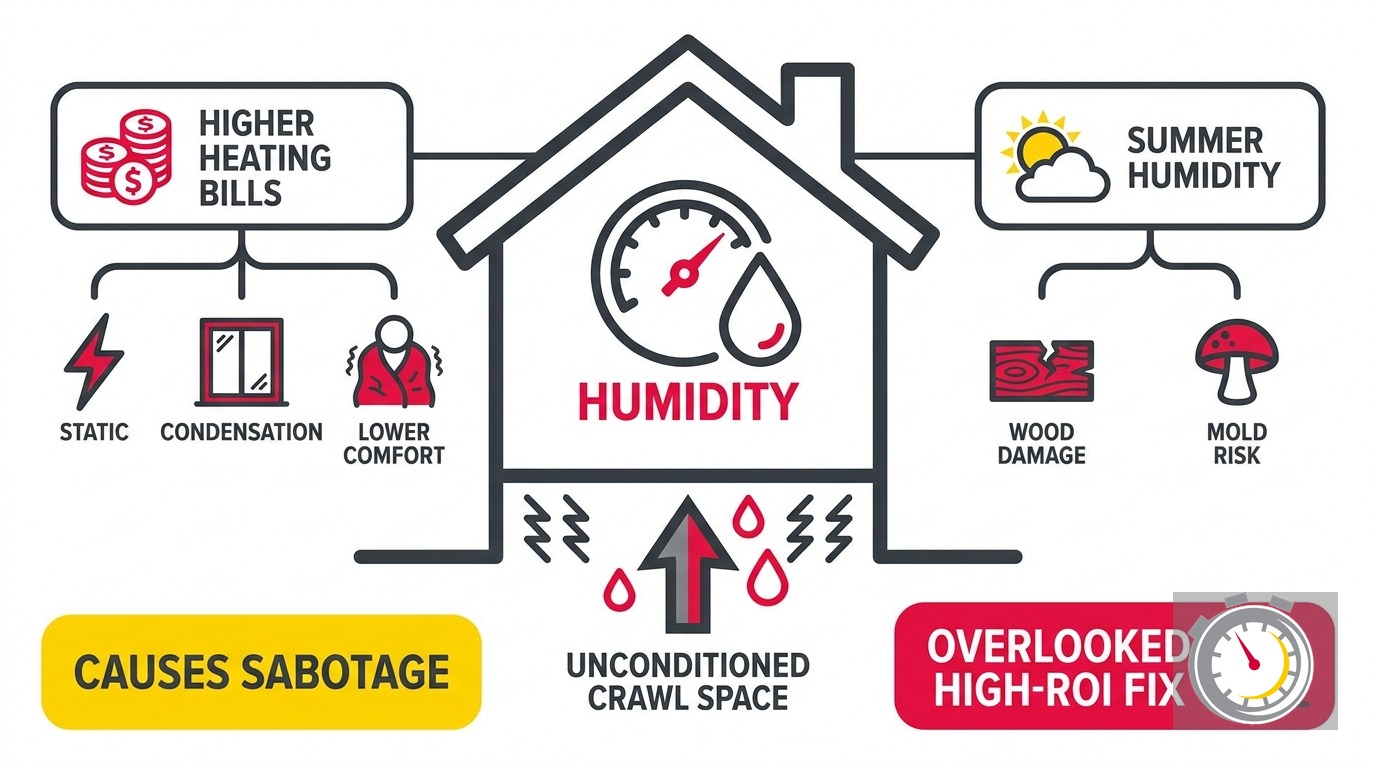
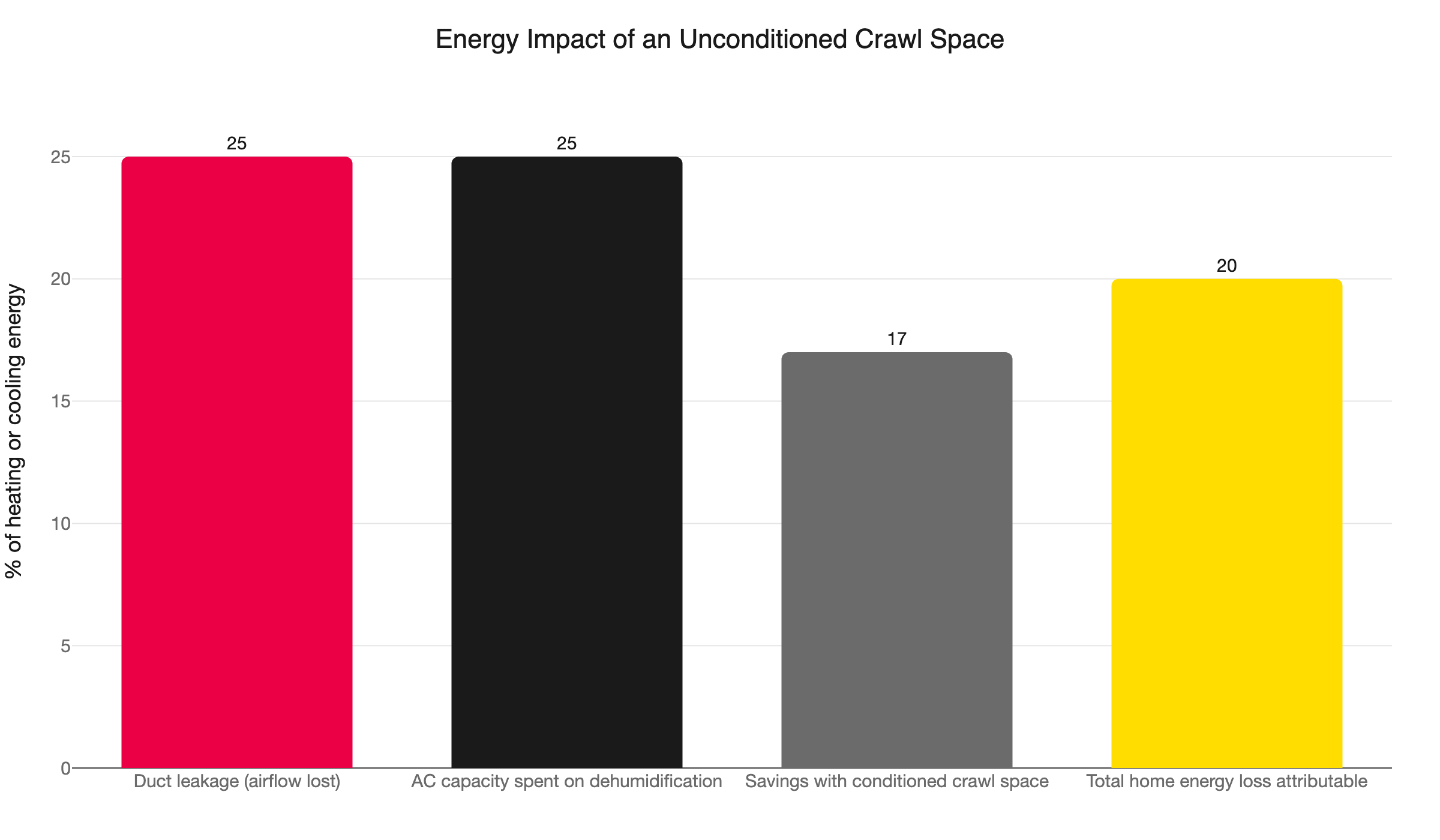
- An unconditioned crawl space can contribute to 15-25% of your home’s total energy loss through duct leakage, air infiltration, and floor assembly heat transfer.
- Leaky ducts running through an unconditioned crawl space lose 20-30% of total conditioned airflow before it reaches any living space.
- In summer, a vented crawl space forces your AC to spend 20-30% of its capacity on dehumidification instead of cooling.
- DOE Building America research found conditioned crawl spaces cut heating and cooling energy use by 15-18% and reduce humidity by more than 20%.
- Minnesota’s 2020 Energy Code sets duct insulation requirements for unconditioned spaces and wall insulation requirements for unvented crawl space configurations.
- Xcel Energy and CenterPoint Energy both offer rebates for air sealing and insulation that can stack with a future heat pump upgrade.
- An HVAC comfort assessment is the right first step. It shows how much your crawl space is costing your system before you invest in equipment upgrades.
Why Does My Heating Bill Stay High Even After I Replaced My Furnace?
A new furnace cannot fix a leaky envelope. If your ducts are losing conditioned air into an unconditioned crawl space before it reaches your living areas, a more efficient furnace just burns expensive BTUs faster on air you never feel. The equipment is not the problem.
The crawl space likely is. When supply and return ducts run through an unconditioned crawl space, they can lose 20-30% of total airflow through duct leakage and thermal transfer. That loss happens before a single register delivers air to a room. No equipment upgrade closes that gap until the envelope is addressed first.
Here is what happens in a typical Twin Cities home with a vented or uninsulated crawl space during a Minnesota winter:
- Cold outdoor air infiltrates the crawl space through vents and gaps in the sill plate.
- That cold air draws heat through the floor assembly, chilling the rooms above.
- Duct leaks bleed conditioned air directly into the crawl space instead of your bedroom or living room.
- The furnace runs longer cycles trying to compensate for heat that never reaches the living space.
- Your bill increases. Your comfort does not follow.
This pattern repeats every heating season. Because it looks like a furnace problem from inside the house, it often triggers an equipment replacement that does not actually solve the issue. Getting a comfort assessment before committing to new equipment is the smarter move.
The Four Ways an Unconditioned Crawl Space Drains Your HVAC System
Most conversations about crawl spaces focus on moisture and mold. Those are real problems. But the bigger picture for crawl space HVAC efficiency in Minnesota is what the space does to your equipment’s performance. An unconditioned crawl space attacks your system through four simultaneous channels.
1. Duct leakage. Supply and return ducts running through the crawl space lose conditioned air through every gap, seam, and failing joint. The DOE identifies duct leakage as responsible for 300 CFM or more of lost airflow - 20-30% of your total system output - before air reaches your living space. This is the single largest efficiency drain in many homes. Our post on leaky ductwork and duct sealing covers the full scope of what that loss looks like and what fixing it actually costs.
2. Air infiltration via the stack effect. Warm air rises and exits the home through the roof and attic. Cold air enters from the bottom: through crawl space vents, gaps around the sill plate, and penetrations in the floor assembly. The crawl space is the bottom of the stack, and every gap in the floor system is an entry point for outdoor air.
3. Humidity loading on the AC. In summer, the stack effect partially reverses. Warm, humid outdoor air is drawn in through crawl space vents and rises into the living space. Your air conditioner then has to remove that moisture before it can reduce the air temperature. This dehumidification burden can consume 20-30% of your AC’s capacity - capacity that should be going toward cooling your home.
4. Thermal bypass through the floor assembly. Even where ducts are properly sealed, an uninsulated floor assembly conducts heat downward in winter and lets heat rise in summer. Minnesota’s Climate Zone 6 calls for R-19 to R-30 for floors above unconditioned spaces. Most homes built before the 2009 code updates fall short of that range.
These four losses stack. Together, the DOE estimates that unconditioned crawl spaces contribute to 15-25% of a home’s total energy loss. That explains why a new furnace often fails to improve bills as much as expected.
How Does My Crawl Space Make the House More Humid in Summer?
Warm, humid outdoor air enters through crawl space vents and rises into the house via the stack effect. Your air conditioner then has to remove that moisture before it can cool the air, consuming 20-30% of its total capacity on dehumidification instead of temperature reduction. The result: the house never feels quite cool enough, and runtime climbs.
This is the piece of the crawl space story that insulation and waterproofing contractors rarely address. They focus on sealing moisture pathways at the foundation. They do not account for what the resulting humidity load does to your air conditioner’s available capacity.
The impact shows up in a few consistent patterns:
- The house feels sticky or muggy even when the AC is running continuously.
- Humidity readings stay above 55-60% on moderate summer days. Mold growth begins when relative humidity exceeds 55%, which means a wet crawl space creates air quality risk throughout the living space above it, not just in the crawl space itself.
- The AC compressor runs more cycles or longer cycles than expected. Both are signs the latent load - moisture removal - is higher than the system was designed to handle.
- Musty odors drift upward from the crawl space into the living areas. The EPA estimates one-third of all structures have damp conditions that promote mold and bacterial growth. Given that people spend roughly 90% of their time indoors, that is not a minor concern.
A properly conditioned crawl space removes the moisture at the source. A whole-home dehumidifier can address it at the equipment level. Our dehumidifier services and our post on basement humidity control in Minnesota cover both approaches in detail.
What Does Minnesota’s Energy Code Require for Crawl Spaces?
Minnesota’s 2020 Energy Code adopts the 2018 IECC with state amendments. For crawl spaces, it requires that unvented configurations include wall insulation extending 24 inches below grade, a continuous Class I vapor retarder on exposed earth, and that all ducts in unconditioned spaces meet minimum R-value thresholds. Vented configurations must meet floor insulation requirements instead.
The key code sections for homeowners and contractors are:
- R402.2.10: Crawl space walls may substitute for floor insulation only when the crawl space is unvented. Wall insulation must extend from the floor to finished grade and an additional 24 inches below grade. Exposed earth requires a continuous Class I vapor retarder with joints overlapped 6 inches and sealed.
- Table R403.2.1: All supply and return ducts in unconditioned spaces must meet minimum R-value insulation requirements. A certificate must be posted at the electrical panel confirming compliance.
These are minimums. For Climate Zone 6 - which covers the Twin Cities and most of southern Minnesota - the DOE recommends R-19 to R-30 for floors above unconditioned spaces, and R-15 to R-19 for crawl space walls in an unvented configuration. Homes in northern Minnesota fall in Climate Zone 7, where requirements are higher.
Many homes in Ramsey, Blaine, Brooklyn Park, and the older Minneapolis and St. Paul neighborhoods were built under earlier codes. A crawl space that passed inspection in 1998 or 2004 may not meet current performance targets. The only way to know is to look.
Why Do Fiberglass Batts Fail in Minnesota Crawl Spaces?
Fiberglass batt insulation absorbs moisture, loses R-value when wet, sags off the floor joists, and eventually falls entirely. In a Minnesota crawl space, this can happen within just a few years of installation. When the batts fall, there is no floor insulation at all.
This failure is specific to the material in a damp environment. Fiberglass does not bond to the joists. It relies on friction and stapling. Once moisture cycles through enough heating and cooling seasons, the material compresses and the staples lose their grip.
What works instead:
- Closed-cell spray foam: Adheres directly to the joists. Creates an air barrier and vapor retarder in a single pass. Holds its R-value when damp because the closed-cell structure does not absorb moisture.
- Rigid EPS panels: Rated for damp environments. Typically used against crawl space walls in a conditioned configuration, where they serve as both insulation and a moisture barrier.
Which option fits your home depends on whether you are converting to a conditioned crawl space or improving an existing vented configuration. An HVAC comfort assessment can clarify which approach delivers the most performance gain relative to your current equipment and duct layout.
Should I Fix the Crawl Space Before Replacing My HVAC System?
In most cases, yes. A new HVAC system sized to a leaky envelope is sized to the wrong load. Seal and insulate the crawl space after installation, and the system may be oversized for the corrected heat loss. Oversized equipment short-cycles, delivers poor humidity control, and wears faster than a properly sized unit.
This sequencing problem shows up regularly in the Twin Cities market. A homeowner replaces an aging furnace. The contractor sizes the new unit to the current measured heat loss - which includes the crawl space penalty. A year or two later, the homeowner encapsulates the crawl space. The heat loss drops. Now the furnace is too large for the corrected load, and comfort problems follow.
DOE Building America research found that conditioned crawl spaces reduced heating and cooling energy use by 15-18% and reduced humidity by more than 20%. Those are meaningful load changes that directly affect what size equipment a home actually needs.
The right sequence:
- Get a comfort assessment to understand your actual heat loss and where it comes from.
- Seal and insulate the crawl space.
- Re-run the load calculation with the corrected envelope numbers.
- Select and install HVAC equipment sized to the corrected load.
If your equipment is at end of life and cannot safely wait for the envelope work, ask your contractor to account for the planned crawl space improvement in the sizing calculation. We do this as part of every system recommendation at Northern One Hour. If a heat pump is part of the plan, ask us about financing options - larger HVAC projects often qualify, and pairing the upgrade with the Xcel rebate sequence below can change the math significantly.
Minnesota Rebates That Can Help Offset the Cost
Crawl space work itself - sealing, vapor retarder installation, insulation - is typically handled by an insulation or encapsulation contractor. But the rebate picture connects directly to your HVAC upgrade sequence, especially if a heat pump is on your horizon.
Xcel Energy (for customers in the Xcel service territory):
- Air sealing: up to $600 of project cost, when paired with qualifying attic or wall insulation. Not available as a standalone measure.
- Bonus rebate: an additional $600 if you complete qualifying insulation and air sealing and then install a qualifying heat pump within two years.
- Crawl space insulation rebate eligibility varies. Confirm directly with Xcel before starting work.
CenterPoint Energy (for natural gas customers):
- Attic air sealing only: $750.
- Attic air sealing plus qualifying insulation: $1,300.
- Wall insulation: $1,950.
- Crawl space insulation is not listed as a separate line item in current public materials. Verify eligibility directly with CenterPoint. Work must be done by a BPI-certified Rebate Eligible Installer.
Federal 25C tax credit:
This credit expired December 31, 2025. Insulation work completed in 2026 does not qualify.
For a full summary of current utility incentives, our post on Xcel and CenterPoint HVAC rebates in Minnesota covers the current landscape in detail.
The rebate strategy worth planning around: complete crawl space air sealing and insulation now, capture the utility rebate, then upgrade to a cold-climate heat pump within two years to claim the Xcel bonus. That sequencing can return meaningful money on what is otherwise a significant project cost.
What Does an HVAC Comfort Assessment Actually Cover?
A comfort assessment reviews how your HVAC equipment performs against your home’s actual thermal envelope. It covers equipment sizing, duct static pressure, room-by-room temperature differentials, indoor humidity levels, and the visible condition of ducts in unconditioned spaces including your crawl space.
It is not a sales call. It is a structured diagnostic review designed to show you where performance is being lost and what the highest-return fixes are.
When our team comes out, we look at:
- Current equipment capacity relative to your actual measured heat loss and cooling load.
- Static pressure in the duct system. High static pressure often signals significant duct leakage in the crawl space or elsewhere in the distribution system.
- Temperature differentials between rooms and between floors.
- Humidity levels throughout the house, including the basement and crawl space access point.
- Visible duct condition in any unconditioned space: crawl space, attic, or attached garage.
- Signs of moisture entry, insulation failure, or air bypass at the floor assembly.
We document what we find and explain it in plain terms. If your crawl space is the primary driver of high bills and uneven comfort, we will say so and explain what upstream work gets you the best return. If the equipment itself is the limiting factor, we will say that too.
We are locally owned and operated in Ramsey, Minnesota. We serve the Twin Cities metro and surrounding communities, and we show up when we say we will. “Always On Time… Or You Don’t Pay a Dime!(R)” is how we run every service call.
What Should I Check in My Crawl Space Before Heating Season?
Start with a visual inspection through the access panel. Look for sagging or fallen insulation, standing water or a wet vapor barrier, gaps in duct connections, or dark staining on the floor joists. You do not need to climb in to see the most important warning signs. Any one of these findings is grounds for a professional assessment before winter heating is in full swing.
Here is what each warning sign means for your HVAC system:
- Sagging or fallen fiberglass batts: No floor insulation exists at those locations. Cold transfer from the crawl space to the rooms above is direct and continuous.
- Standing water or a wet vapor barrier: Moisture is actively entering. Duct connections and any equipment in the crawl space are at risk.
- Duct gaps or disconnected sections: Conditioned air is exhausting into the crawl space. This is duct leakage loss in its most visible form.
- Dark staining on floor joists: Mold growth is underway. Humidity has been persistently above the threshold where biological growth begins.
If you find any of these, schedule a comfort assessment before heating season peaks. Ask the technician to check duct static pressure and inspect visible duct runs at the same time as the furnace tune-up.
Call us at (763) 260-6662 or schedule online. We serve Ramsey, Blaine, Maple Grove, Plymouth, Brooklyn Park, Woodbury, and the greater Twin Cities metro. We will be there when we say we will.
Frequently Asked Questions
Does crawl space insulation help with HVAC efficiency in Minnesota? +
Can a crawl space cause high AC bills in summer? +
What rebates are available for crawl space insulation in Minnesota? +
Need a technician now?