
Electrical Panel Upgrade for Heat Pump: Twin Cities Costs
Key Takeaways
- An electrical panel upgrade for a heat pump in the Twin Cities costs $7,700 to $9,500 installed. National averages of $2,000-$5,000 do not apply here.
- Minnesota’s 2023 electrical code requires a whole-home surge protector and an outdoor emergency shutoff on every service upgrade. Both are included in that installed price.
- Xcel Energy must coordinate the disconnect and reconnect before and after the work. Plan for extra lead time.
- A 3-ton heat pump requires a dedicated 240V circuit drawing 30 to 40 amps. Cold-climate units designed for Minnesota winters often draw at the higher end of that range.
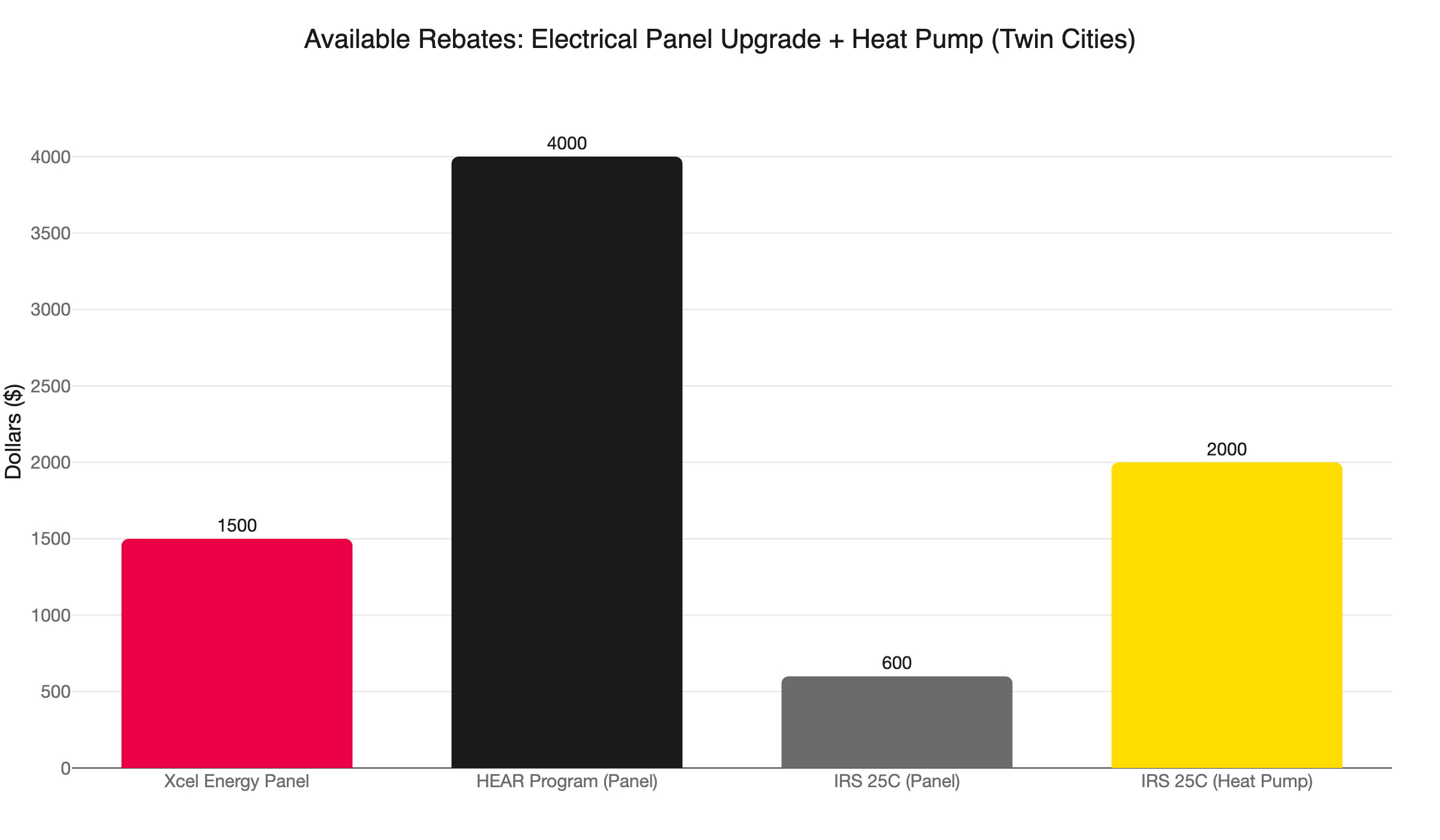
- Income-qualified homeowners can stack Xcel ($1,500), the HEAR program ($4,000), and the IRS 25C heat pump credit ($2,000) for up to $7,500 in total offsets.
- Northern One Hour handles the HVAC side. Call (763) 260-6662 or book online to start with a heat pump assessment.
The Number That Stops Heat Pump Projects Cold
A homeowner reads an article about switching to a heat pump. The article mentions a panel upgrade might be needed. It quotes a cost of $2,000 to $5,000. The homeowner notes it and moves on.
Then they call a local electrician. The quote is $8,500.
Nothing is wrong with that quote. The homeowner just got their first look at what an electrical panel upgrade for a heat pump actually costs in the Twin Cities.
National cost articles draw on national averages. They do not account for Minnesota’s code cycle, Xcel Energy’s role in every service upgrade, or Twin Cities labor rates. All three push the number well above what you read online. A homeowner who budgets $3,000 and receives an $8,500 quote does not have a dishonest contractor. They have a budget gap nobody warned them about.
This post covers what the Twin Cities job actually includes, why the number lands where it does, and how to stack rebates that can erase most of the difference. If you are budgeting a heat pump project right now, these are the numbers to use.
Does Every Heat Pump Require an Electrical Panel Upgrade?
Short answer: No, but most older Twin Cities homes do. The only way to know for certain is a load assessment by a licensed electrician.
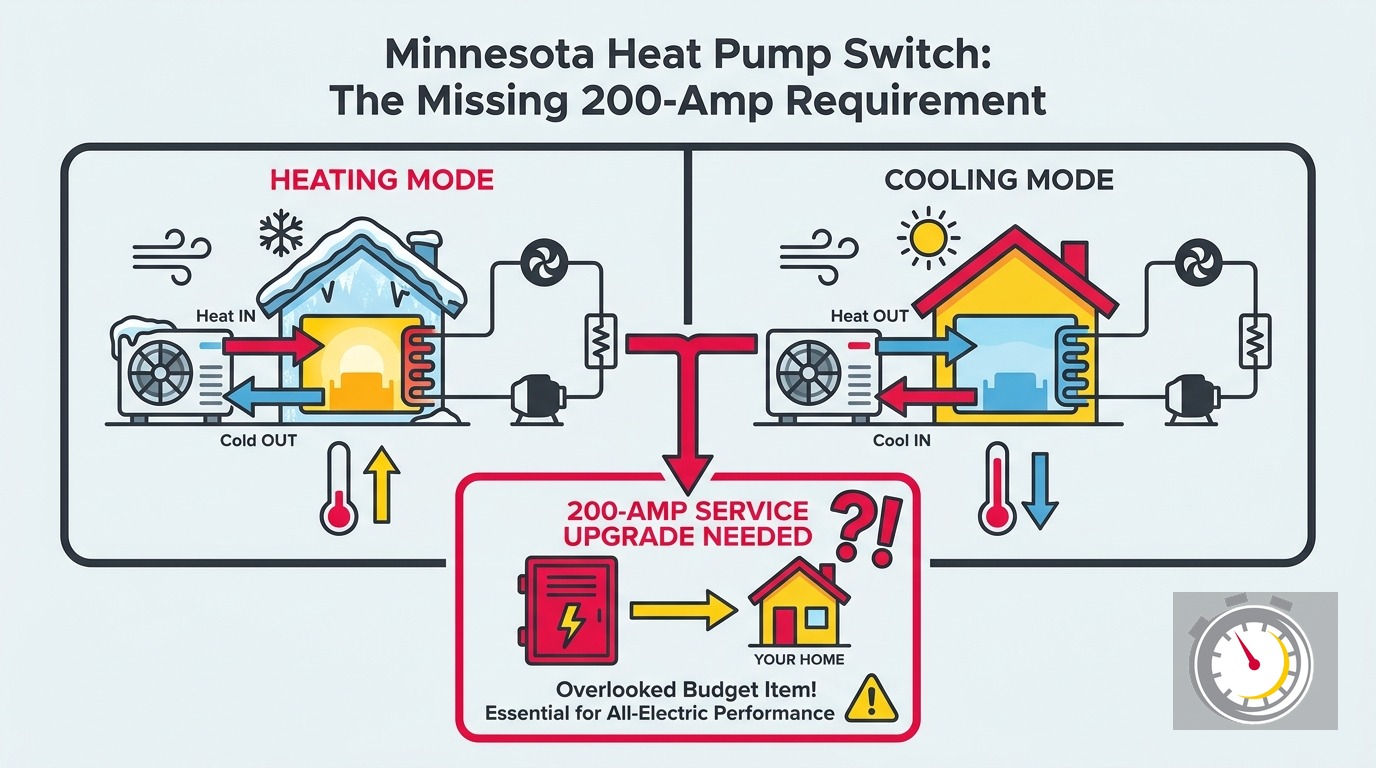
A 3-ton heat pump requires a dedicated 240V circuit drawing 30 to 40 amps, plus a double-pole breaker occupying two adjacent slots in your panel. If you are on 100-amp service and your panel is already carrying a dryer, an electric range, a water heater, and possibly an EV charger, the available capacity may simply not exist.
Units with electric backup heat strips draw even higher amperage and can require a second dedicated breaker. For a Minnesota climate, backup strips are not optional equipment. When outdoor temperatures drop well below zero, the heat pump compressor alone cannot always keep up. The strips engage.
Inverter-driven, variable-speed units ramp up gradually and produce a lower startup surge than single-stage units. That helps with breaker sizing. But the sustained running load is what a panel assessment focuses on, not just the startup current.
Nationally, roughly 25 to 35 percent of heat pump installs require a panel upgrade. In Minnesota, older housing stock and cold-climate units that run harder both push that share higher. If your home was built before 1980 and still runs on 100-amp service, assume an upgrade is in your future.
What Does an Electrical Panel Upgrade for a Heat Pump Cost in the Twin Cities?
Short answer: A 100-to-200-amp service upgrade in the Twin Cities runs $7,700 to $9,500 installed. A 150-amp upgrade is approximately $8,100. A sub-panel without a service upgrade costs $1,400 to $2,300.
The national range quoted in most articles is $2,000 to $5,000. That figure reflects national average labor and does not include Minnesota-specific code items. In rural Minnesota, the range is $1,800 to $4,500, still below the metro figure. The Twin Cities premium has a specific cause, which the next section breaks down.
Why Is the Twin Cities More Expensive Than the National Average?
Short answer: Three things drive the gap: Minnesota’s 2023 electrical code adds mandatory line items, Xcel Energy controls the service entrance and must schedule every disconnect, and Twin Cities labor rates exceed the national average.
Minnesota’s 2023 electrical code. Minnesota adopted the 2023 NEC. That code requires a whole-home surge protector and an outdoor emergency shutoff on every service upgrade. These are not optional upsells. They are required to pass inspection. The whole-home surge protector runs approximately $527 as a standalone line item. The outdoor emergency shutoff adds hardware and labor on top of that. Both are baked into the $7,700 to $9,500 figure.
Xcel Energy’s role. Xcel owns the service entrance up to the meter. Before your electrician can work on the meter socket and service panel, Xcel must schedule a disconnect. After the inspection passes, Xcel must reconnect. You cannot coordinate this on a Saturday morning. The Xcel scheduling step adds lead time to the job. Most homeowners do not find this out until they have already committed to an HVAC install date.
Metro labor rates. Licensed electricians in the Minneapolis metro charge more per hour than rural Minnesota or the national average. The same job that runs $4,500 in Greater Minnesota runs $8,500 in Ramsey or Maple Grove. That is not a markup. It is the market.
Permits and inspections. Every service upgrade in Minnesota requires a permit and a final inspection. That is a code requirement, not a contractor add-on. The mechanical permit for the heat pump side is separate: typically $75 to $200, usually rolled into the HVAC installer’s quote.
What Does the $7,700 to $9,500 Include?
Short answer: The installed price covers the new panel, meter socket, updated grounding, a code-required whole-home surge protector, an outdoor emergency shutoff, Xcel coordination, and the permit and inspection. All of these are required items in Minnesota, not optional upgrades.
A complete 200-amp service upgrade in the Twin Cities covers:
- The new 200-amp service panel
- Meter socket replacement
- Updated grounding and bonding to current code
- A code-required whole-home surge protector (approximately $527)
- An outdoor emergency shutoff (2023 NEC requirement)
- Xcel Energy disconnect and reconnect coordination
- Permit and final inspection
This is the minimum required to pass inspection in Minnesota today. It is not a premium version of the work.
If you receive a quote significantly below $7,700, ask the contractor specifically whether the surge protector, outdoor shutoff, and permit are included. A quote that excludes those items is a quote for non-compliant work. Beyond the code violation, unpermitted electrical work can complicate a home insurance claim or a future sale.
Is a Sub-Panel a Cheaper Path to the Same Result?
Short answer: Sometimes. A 60-to-100-amp sub-panel fed from your existing main panel costs $1,400 to $2,300. It works only if your main panel already has enough capacity and open slots to feed it.
A sub-panel makes sense when your main service is already 200 amps, the heat pump install is far from the main panel (a detached garage, a finished basement, or a room addition on the far end of the house), and you just need a local distribution point. The sub-panel delivers the dedicated 240V circuit without a full service upgrade.
A sub-panel does not work when your main panel is 100 amps and already loaded. Adding a sub-panel to an undersized main is a code violation and a fire risk. If your service is 100 amps, the correct path is a full service upgrade. A licensed electrician’s load assessment will confirm which situation you are in before any money changes hands.
Why Do Cold-Climate Minnesota Heat Pumps Draw More Power?
Short answer: Minnesota design temperatures regularly hit -20°F. Cold-climate units rated to -13°F or lower keep the compressor running rather than switching to resistance backup heat. That sustained compressor load sits at the high end of the amperage range.
A heat pump spec sheet shows rated efficiency and capacity at standardized test conditions. Those test conditions are not -20°F. A unit marketed as a cold-climate heat pump needs to maintain meaningful heating output when your home needs it most: deep winter nights in January.
NEEP-certified cold-climate units meet the requirement for Minnesota utility rebates. These units are engineered to run the compressor efficiently at low ambient temperatures instead of relying on electric resistance strips. That is the right design for Minnesota. It is also more efficient than cycling backup strips constantly.
The tradeoff is that the sustained compressor draw at low ambient temperatures runs toward the high end of the 30-to-40-amp range. When an electrician sizes your dedicated circuit, they account for Minnesota design temperatures, not Arizona ones. That is part of why a proper Twin Cities electrical job costs what it does.
If you want a thorough look at cold-climate heat pump performance in Minnesota, see our guide on heat pumps in Minnesota and whether they are a good fit.
How Do Rebates Stack Against the Upgrade Cost?
Short answer: An income-qualified Twin Cities homeowner can combine Xcel’s $1,500 panel rebate, up to $4,000 from the HEAR program, and a $2,000 IRS 25C heat pump credit for $7,500 in total offsets. That covers most of the panel upgrade cost on its own.
Here is each rebate, what it covers, and what to watch for.
Xcel Energy panel rebate. Xcel offers up to $1,500 on a qualifying electrical panel upgrade that supports efficient electric equipment, including heat pumps. Your electrician typically handles the application. If you are an Xcel customer, ask your electrician to include the rebate paperwork in their quote process.
HEAR program. The IRA’s High-Efficiency Electric Home Rebate Act offers up to $4,000 toward an electrical panel upgrade for income-qualified households. As of 2026, this program has faced federal funding uncertainty. Verify current Minnesota program status before building this rebate into your budget. It also requires a pre-application before the work begins, not after.
IRS 25C panel credit. Under the Energy Efficient Home Improvement Credit, a panel upgrade that enables a qualifying heat pump installation is eligible for 30 percent of cost, up to $600. This counts against the $1,200 envelope-and-electrical annual cap, which is separate from the heat pump credit cap.
IRS 25C heat pump credit. A qualifying air-source heat pump earns a 30 percent credit up to $2,000 per year. This is the single largest federal credit available for residential HVAC. It is separate from the panel credit cap.
A fully stacked scenario for an income-qualified homeowner: Xcel $1,500 + HEAR panel $4,000 + IRS 25C heat pump $2,000 = $7,500 in total offsets on a $7,700 to $9,500 panel job. That leaves $200 to $2,000 of the panel cost uncovered before any utility or federal rebates on the heat pump equipment itself.
Not every homeowner qualifies for the HEAR program. Even without it, Xcel’s $1,500 plus the 25C panel credit ($600) plus the 25C heat pump credit ($2,000) brings $4,100 in offsets within reach of any homeowner who files federal taxes.
For a full breakdown of how to layer these programs, see our post on heat pump rebates and tax credits in Minnesota.
What Northern One Hour Handles (and What We Don’t)
A heat pump project crosses two licensed trades: HVAC and electrical. These are separate scopes. That is not a runaround. It is how licensed work is structured in Minnesota.
Northern One Hour’s scope. We size the heat pump using Manual J load calculations, install the indoor air handler or coil, set the outdoor unit, run the refrigerant lines, connect the low-voltage thermostat wiring, and pull the mechanical permit. We coordinate the job sequence so the electrical upgrade happens before we energize the HVAC system.
The electrician’s scope. They upgrade or add to the panel, run the dedicated 240V circuit to the outdoor unit, install the outdoor disconnect box, coordinate the Xcel disconnect and reconnect, and pull the electrical permit. Their work must pass inspection before our connection goes live.
We are locally owned and operated in Ramsey. When you call us, you reach a team that services Twin Cities homes year-round. We know what the panel story looks like in this market. We stand behind our work and show up when we say we will: “Always On Time… Or You Don’t Pay a Dime!(R)“
How to Build a Realistic Budget Before You Commit
The worst time to discover your panel needs upgrading is after you have already signed an HVAC contract and the electrician comes out for their quote. Get these steps in order.
Step one: electrical assessment first. Have a licensed electrician assess your panel and current service before you commit to any HVAC purchase. Ask them specifically: “Will this panel support a 3-ton cold-climate heat pump with electric backup strips in Minnesota?” Get a written scope and price.
Step two: HVAC quote second. Contact Northern One Hour for a heat pump assessment. We size systems for your actual home using load calculations, not rules of thumb based on square footage alone.
Step three: apply for rebates before the work starts. The HEAR program requires a pre-application. Xcel’s rebate application runs through your electrician. The IRS 25C credits are claimed at tax time, but you need documentation from both the electrical and HVAC receipts to file correctly.
Step four: sequence the work correctly. Electrical upgrade first. HVAC installation second. Running these in reverse creates delays and can require rework.
If you want to see whether your home is a heat pump candidate, call (763) 260-6662 or visit our heat pump services page to book an assessment. We serve Ramsey, Blaine, Maple Grove, Plymouth, Brooklyn Park, Minneapolis, St. Paul, Woodbury, Bloomington, and the surrounding Twin Cities metro.
For homeowners not yet ready to invest in a full panel upgrade, a dual-fuel heat pump paired with your existing gas furnace may be the right transition. The heat pump handles moderate weather. The gas furnace covers the deep cold. The electrical draw is lower, and many homes on 100-amp service can accommodate the load without a full upgrade right away.
Whatever path fits your timeline and budget, the starting point is an honest load assessment and a straight answer on what your home actually needs. That is what we do.
Frequently Asked Questions
How much does an electrical panel upgrade for a heat pump cost in Minnesota? +
Does every heat pump require a panel upgrade? +
What rebates are available for an electrical panel upgrade in Minnesota? +
Does Northern One Hour do electrical panel upgrades? +
Need a technician now?