
HVAC for Home Addition Minnesota: 3 Options for a -12°F Winter
Key Takeaways
- Minneapolis has a design heating temperature of -12°F. Generic advice written for warmer climates will steer you wrong on equipment selection.
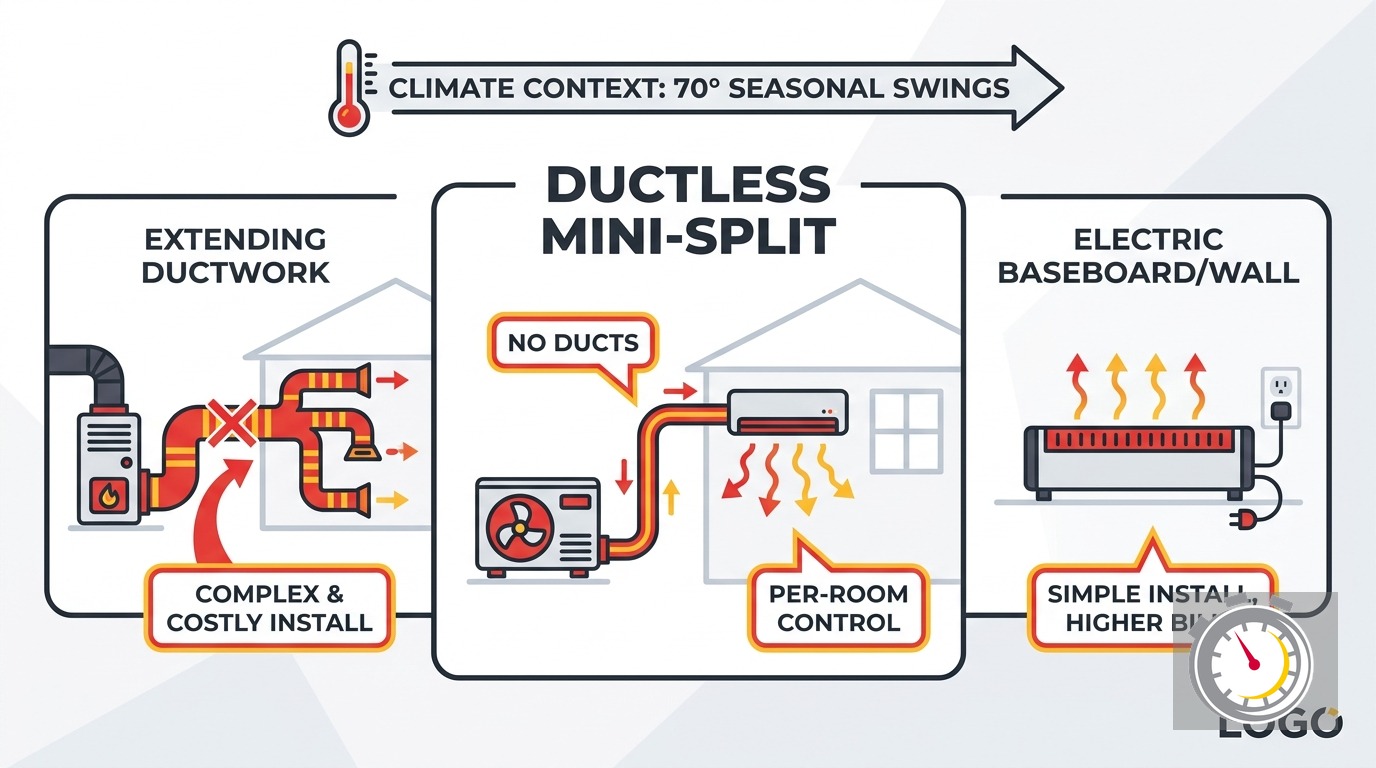
- Three options exist for conditioning a home addition: extend existing ductwork, install a cold-climate mini-split, or run electric resistance baseboard. Each fits a different situation.
- Duct extension only works if your existing system has confirmed spare capacity. A Manual J load calculation and blower test are required by Minnesota code before extension is recommended.
- The dual-fuel setup (cold-climate mini-split paired with a gas furnace) is the standard Twin Cities approach for most additions.
- MN Rules 1346.0104 requires a mechanical permit, a licensed contractor, and proof the addition will not overload the existing system.
- The federal Section 25C heat pump tax credit expired December 31, 2025. Zero federal credit applies to 2026 installations.
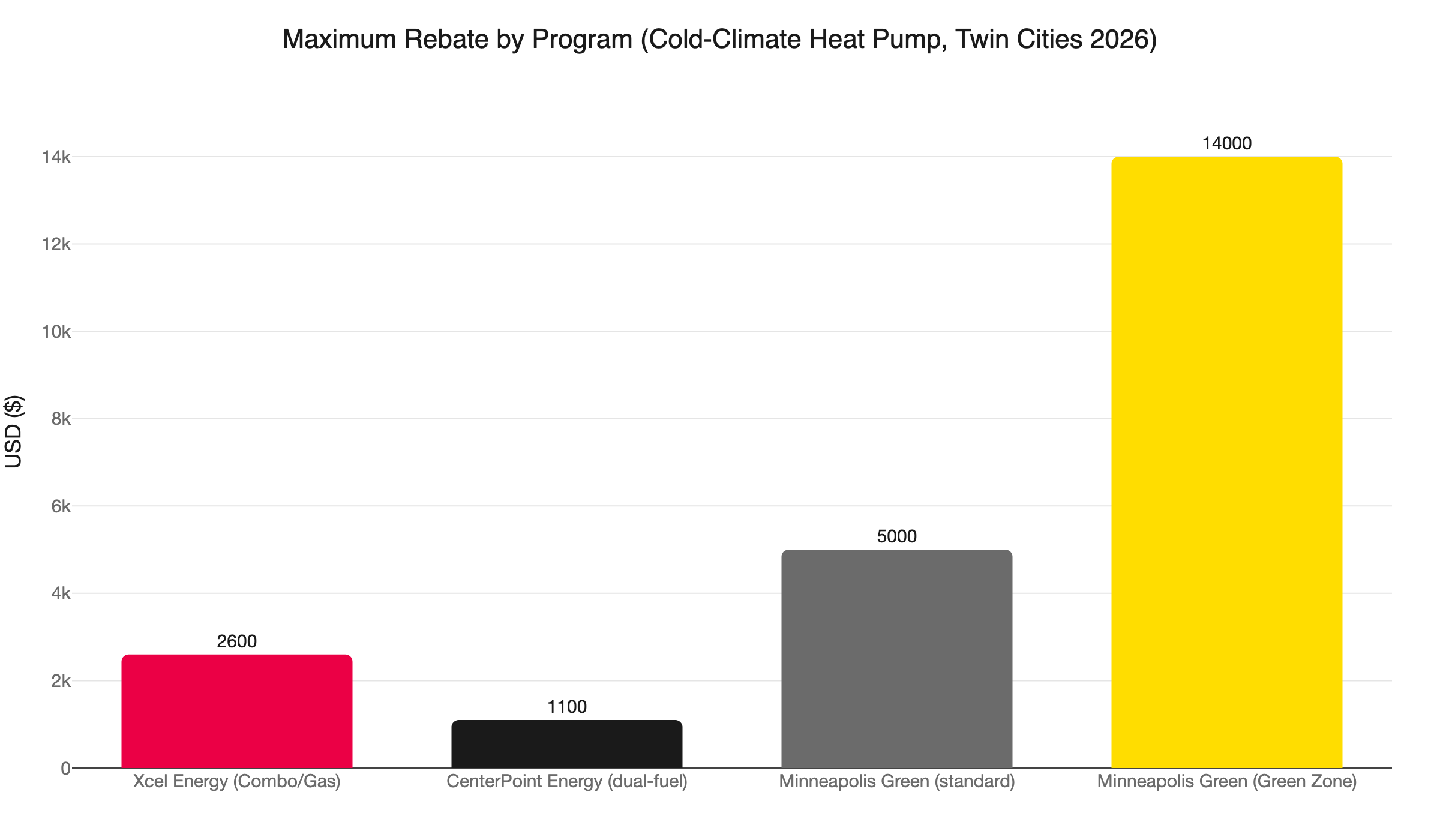
- Xcel Energy offers up to $2,600 for a qualifying cold-climate heat pump. CenterPoint Energy adds $1,100 for dual-fuel systems. Minneapolis homeowners can stack far more through the Green Cost Share program.
HVAC for Home Addition Minnesota: Why Generic Advice Fails Here
Most articles about HVAC for home additions are written by contractors in Utah or Pennsylvania. Their advice skips the questions that matter most in Minnesota: What happens to your heat pump at -12°F? Can your existing system absorb the new load? What does state code actually require?
The Twin Cities metro operates at a 99% design heating temperature of -12°F. That is the outdoor temperature your system must overcome to keep your home at 70°F on the coldest nights of the year. Summer cooling loads push into the upper 80s. The result is close to a 100-degree operational swing that your equipment must handle reliably.
Adding a home addition changes the thermal math for your whole house. A 400-square-foot addition to a 1,400-square-foot home is a 29% increase in conditioned area. Your furnace and air handler were sized for what you had, not what you are building. The core question to answer before picking any option: where does the heating and cooling for this new space come from, and can your existing equipment absorb it?
What Are the Three Options for Heating and Cooling a Home Addition?
The short answer: Extend your existing ductwork if the system has proven spare capacity, install a cold-climate mini-split if it does not, or use electric resistance baseboard only as a last resort. Most Twin Cities additions end up with a mini-split or a duct extension verified by a load calculation.
Extend the Existing Ductwork
Extending ductwork runs new supply and return branches from your existing air handler into the addition. The whole home stays on one thermostat and one system. It is the simplest arrangement when the conditions support it.
The critical condition is spare capacity. An HVAC contractor runs a Manual J load calculation and a blower static pressure test to determine whether the system can push air through the added resistance. If the blower is already operating near its limit, adding ducts will reduce airflow in the rest of your home and leave the addition under-conditioned in both heating and cooling seasons.
Installation typically runs $1,500 to $5,000 nationally. The range depends on how far the new runs must travel and how accessible your existing trunk lines are. A finished ceiling between the air handler and the addition raises the cost significantly. Basement or crawl space access brings it down.
Duct extension is the right call when:
- Your system is less than 8 to 10 years old and was not already near capacity
- The addition is on the same floor level as the main trunk line
- Access for running new duct is straightforward
- A load calculation confirms the blower can handle the added resistance
Add a Cold-Climate Mini-Split
A cold-climate ductless mini-split pairs an outdoor compressor with a wall-mounted air handler inside the addition. It runs on its own refrigerant circuit, independent of your existing ductwork. The addition gets its own zone, its own thermostat, and its own heating and cooling source.
Single-zone installation typically runs $3,500 to $8,000. The range depends on line-set length, whether a new electrical circuit is needed, and local labor rates.
The Minnesota-specific qualifier: the unit must be rated for cold-climate operation. Equipment must appear on the NEEP cold-climate product list and achieve a coefficient of performance (COP) of 1.7 or better at 5°F. Both conditions are required to qualify for utility rebates, and both matter for reliable performance here. A standard unit rated to 0°F will lose meaningful output well before the worst nights of a Minnesota winter arrive.
Mini-split is the right call when:
- Your existing system cannot absorb more load
- The addition is a sunroom, garage conversion, bonus room, or attached structure with no existing duct access
- You want independent temperature control for the new space
- You want to qualify for Xcel or CenterPoint utility rebates
Install Electric Resistance Baseboard
Electric baseboard is the least expensive option to install. It requires no ductwork, no refrigerant lines, and relatively simple electrical work per room.
It is the most expensive to run. Electric resistance converts every watt of electricity into one watt of heat. A cold-climate heat pump moves two to three or more watts of heat energy for every watt it consumes. In Minnesota, with a long, cold heating season, that operating cost gap adds up to hundreds of dollars per year.
Baseboard makes sense only in a space used rarely: a detached workshop that needs an occasional temperature boost, or a three-season porch. For any regularly occupied room, the long-term operating cost makes baseboard the wrong choice.
Does My Existing System Have Enough Capacity to Extend Ductwork?
The short answer: Only a load calculation and blower static pressure test can answer that. Do not assume the system has room. Adding ducts to an already-loaded air handler weakens airflow throughout your home and may leave the addition under-conditioned year-round.
This is not just good practice. MN Rules 1346.0104 requires that additions to a mechanical system shall not cause the existing system to become unsafe, hazardous, or overloaded. The mechanical permit inspection will confirm compliance with that rule.
A contractor who recommends duct extension without running Manual J numbers and testing static pressure is skipping a step that the code requires. If the load calculation shows the system is near its limit, you have two paths. You can add a standalone mini-split for the addition, or you can upgrade the full system to handle both loads. The calculation tells you which situation you are actually in before any work begins.
Is a Cold-Climate Mini-Split Right for a Minnesota Addition?
The short answer: For most Twin Cities additions, yes. A cold-climate unit rated to -15°F handles Minnesota winters without depending on your existing system’s spare capacity. It qualifies for utility rebates, gives the addition its own zone, and pairs naturally with an existing gas furnace in a dual-fuel configuration.
Our post on ductless mini-splits in older Twin Cities homes covers how these units perform across different house types. The short version: a properly specified cold-climate unit is a reliable heating and cooling source in Minnesota. A unit specified for a milder climate is not.
Sizing the mini-split correctly for the addition matters as much as choosing a cold-climate model. A contractor must run a Manual J calculation for the addition specifically, not repurpose the number from the main house assessment. An oversized unit will short-cycle: it heats or cools the space too fast, then shuts off. The result is uncomfortable temperature swings and excessive humidity in summer. An undersized unit will run continuously on cold days without reaching your set temperature.
What Is the Dual-Fuel Approach and Why Is It Standard in Minnesota?
The short answer: Dual-fuel pairs a cold-climate heat pump or mini-split with an existing gas furnace. The heat pump handles heating efficiently when outdoor temperatures are moderate. The furnace takes over below roughly 30-40°F. It is the dominant Twin Cities setup because most homes already have gas heat and because CenterPoint Energy’s rebate specifically requires this configuration.
The logic is straightforward. Heat pumps are most efficient when outdoor temperatures are moderate. Below a threshold called the balance point, a gas furnace is both more efficient and more reliable. In a dual-fuel system, the switchover happens automatically based on outdoor temperature.
For a home addition, dual-fuel usually looks like this: the addition gets a cold-climate mini-split, the existing gas furnace continues to heat the original house, and both systems operate independently. The mini-split in the addition is not replacing the furnace. It is adding a conditioning source for new square footage that the furnace was never sized to cover.
This setup is rebate-eligible with both Xcel Energy and CenterPoint Energy, which is a significant financial reason to consider it when your home already has a gas furnace in place.
What Does Minnesota Code Require for HVAC in a Home Addition?
The short answer: A mechanical permit, a licensed Minnesota HVAC contractor, compliance with MN Rules Chapter 1346 and the Minnesota Energy Code (Chapter 1322), and proof that the addition does not overload the existing system. Minneapolis, St. Paul, and some suburbs add local requirements on furnace efficiency.
Here is what each requirement means in practice:
Mechanical permit. Any new or modified mechanical system in a home addition requires a permit. This applies whether you are extending ducts or installing a mini-split. The permit triggers the inspection.
Licensed contractor. Minnesota requires a licensed mechanical contractor for this scope of work. Homeowner self-installation is not permitted.
AFUE minimums. The state minimum for new gas furnaces is 80% AFUE. Minneapolis and St. Paul require 90%+. Edina requires 92%+. If your duct extension ties back to a furnace below the local minimum, the city may require a furnace upgrade as part of the project. Confirm your city’s requirements with your contractor before finalizing scope.
No overloading the existing system. MN Rules 1346.0104 is explicit: additions to a mechanical system must not cause the existing system to become unsafe, hazardous, or overloaded. The load calculation and blower test are how a contractor proves compliance at inspection.
Energy code baseline. Minnesota’s energy code, Chapter 1322, is based on IECC 2018 with state amendments. It sets insulation, air sealing, and ventilation requirements that affect how the mechanical load for the addition is calculated and what the inspector looks for.
What Rebates Can I Stack for HVAC in a Minnesota Home Addition?
The short answer: Xcel Energy offers up to $2,600 for a qualifying cold-climate heat pump. CenterPoint Energy adds $1,100 for a dual-fuel system paired with a 92%+ AFUE gas furnace. Minneapolis homeowners can stack a Green Cost Share grant on top. The best available combination depends on your utility providers and location in the metro.
Here is how each program works:
Xcel Energy. If you are both an Xcel electric and Xcel gas customer (a Combo/Gas customer), Xcel rebates $2,000 for a qualifying cold-climate air-source heat pump or mini-split. An additional $600 is available if you installed qualifying insulation or air sealing within the prior two years, bringing the maximum to $2,600. If you are an electric-only Xcel customer, the base rebate is $1,500. Equipment must appear on the NEEP cold-climate product list with a COP of 1.7 or better at 5°F.
CenterPoint Energy. CenterPoint rebates $1,100 for a ducted heat pump paired with a 92%+ AFUE gas furnace in a dual-fuel setup. The switchover to the gas furnace must occur at 40°F or below. Standalone mini-splits, ground-source systems, and full-electric setups are not eligible for the CenterPoint rebate.
Stacking Xcel and CenterPoint. If your home has Xcel electric service and CenterPoint gas service, you can stack both rebates on a qualifying dual-fuel system. Combined maximum: $3,100.
Minneapolis Green Cost Share. Minneapolis homeowners can apply for an additional grant on top of utility rebates. The maximum is $5,000 for properties outside the Green Zone and up to $14,000 for properties inside the Green Zone, for 1-4 unit residential buildings. You must qualify for a CenterPoint or Xcel rebate first. For a Minneapolis homeowner adding a mini-split to an addition, the combined total can meaningfully change the cost picture.
HEAR (Home Electrification and Appliance Rebates). Minnesota’s HEAR program would offer up to $8,000 per heat pump for lower-income households. As of mid-2026, the program has not launched and has no announced start date. Do not budget for it in a current project.
Our post on Xcel and CenterPoint HVAC rebates in Minnesota has current program requirements, income limits, and instructions for applying.
Is the Federal Heat Pump Tax Credit Still Available in 2026?
The short answer: No. The Section 25C Energy Efficient Home Improvement Credit expired December 31, 2025. The One Big Beautiful Bill Act, signed July 4, 2025, ended the program. Any heat pump installed in 2026 qualifies for zero federal credit, regardless of purchase date or when the contract was signed.
Many homeowners planning a 2026 addition are still expecting the 30% credit capped at $2,000 that applied to heat pump installations in 2023 through 2025. That credit no longer exists. The IRS credit page confirms the expiration.
Plan your budget without the federal credit. The Xcel, CenterPoint, and Minneapolis Green Cost Share programs are confirmed active and are where the real incentive money sits right now. A contractor familiar with the current rebate landscape can help you document and submit for every program you qualify for.
Ready to Plan HVAC for Your Addition?
The right option depends on four things: the size and layout of the new space, whether your existing system has reserve capacity, which utility serves your home, and where in the metro you are located.
Start with a load calculation. A qualified contractor runs Manual J numbers, tests blower static pressure, and tells you whether duct extension is viable or whether a mini-split is the right path. That assessment also determines which rebates apply and how much you can expect back.
We are locally owned and operated in Ramsey, MN, and we serve the full Twin Cities metro: Minneapolis, St. Paul, Blaine, Maple Grove, Plymouth, Brooklyn Park, Woodbury, Bloomington, and surrounding communities. We pull permits, coordinate rebate paperwork with your utility, and show up when we say we will. That is the “Always On Time… Or You Don’t Pay a Dime!(R)” promise.
Call us at (763) 260-6662 or schedule your consultation online to get your load calculation done and your rebate options reviewed.
Frequently Asked Questions
Do I need a permit to add HVAC to a home addition in Minnesota? +
Can I extend my existing ductwork to heat a home addition? +
What rebates are available for HVAC in a Minnesota home addition in 2026? +
Is the federal heat pump tax credit still available in 2026? +
Need a technician now?