
How to Clean Your Outdoor AC Unit (Twin Cities Guide)
Key Takeaways
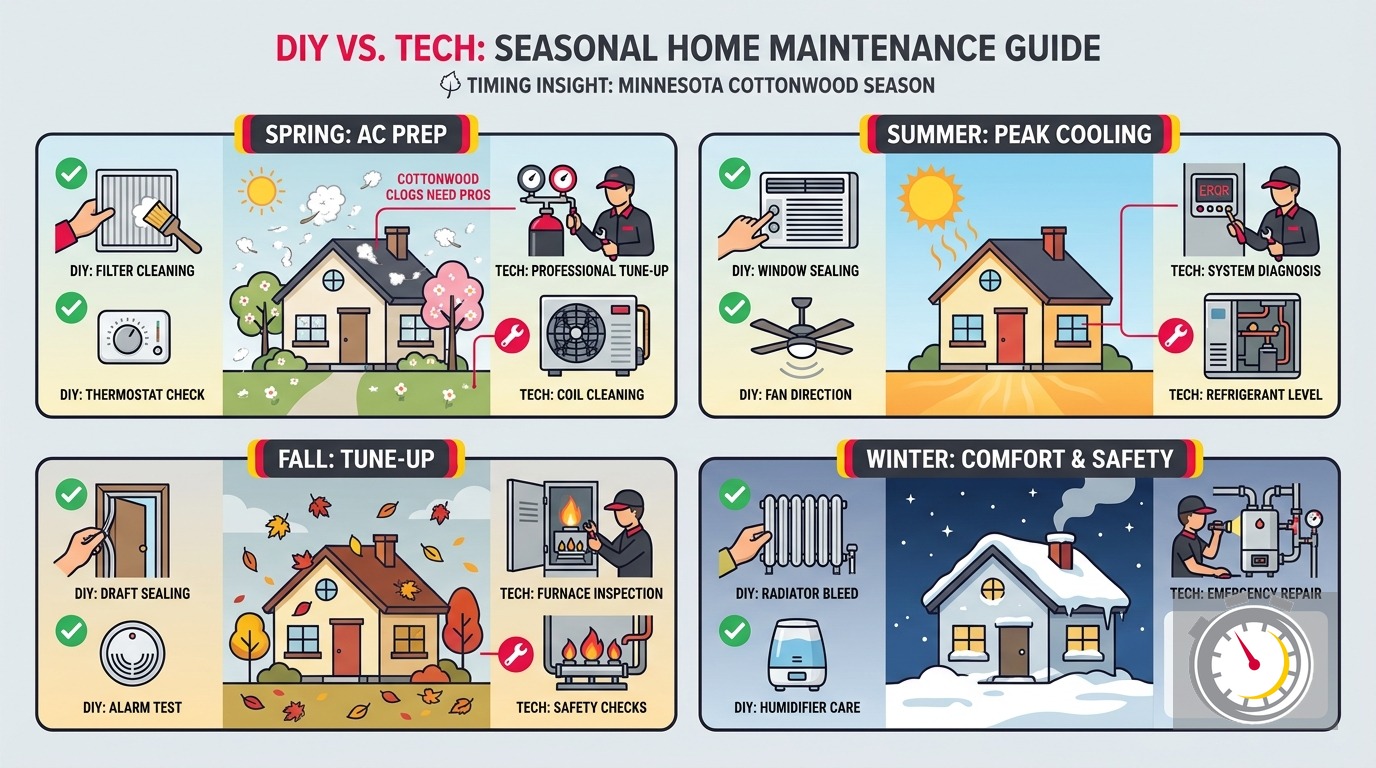
- Cottonwood peaks from late May through mid-June in the Twin Cities. That window turns a once-a-year task into a weekly routine.
- A cottonwood-clogged condenser can cut AC output by 30 to 50%. Compressor replacement starts at $1,950 and can reach $4,500 or more.
- Homeowners can rinse the condenser, swap filters weekly, and maintain 2-foot clearance. Everything inside the unit housing is licensed-tech territory.
- Federal law (EPA Section 608) prohibits homeowners from handling refrigerant. This is a legal line, not just a skill gap.
- Book your professional AC tune-up in April or early May, before cottonwood peaks and before contractors fill their schedules.
- Xcel Energy customers may qualify for up to $450 in rebates on a qualifying replacement. The federal 25C tax credit expired after December 31, 2025.
- Northern One Hour is locally owned and operated in Ramsey, MN. Call (763) 260-6662 or book online.
Why Minnesota’s Cooling Season Starts With a Warning
Most guides on how to clean outdoor AC unit are written for a national audience. They say clean it once a year and call it done. That advice works in Phoenix. It does not work here.
Every spring, cottonwood trees across the Twin Cities shed dense white seeds. According to MPR News, dispersal peaks from late May through mid-June. A warm spring pushes it earlier. A cold one drags it into late June.
That peak lands exactly when most homeowners fire up their AC for the first time. The unit sits through a Minnesota winter. You flip it on. Within days, it is packed with cottonwood fluff.
Ignore it for a week or two, and you are not just running the system less efficiently. You are working toward a compressor failure.
This guide covers exactly what you can safely do yourself, what you should never touch, and why the date on your calendar matters as much as the cleaning itself.
What Happens When Cottonwood Clogs Your Condenser?
Cottonwood fluff blocks airflow through the condenser fins. Efficiency drops 30 to 50% within days. The compressor overheats under sustained strain. If it fails, replacement runs $1,950 to $4,500. A weekly rinse prevents all of it.
Your outdoor AC unit (the condenser) moves heat from inside your home to the outside air. It does this through thin aluminum fins. Those fins transfer heat into air passing through them. That transfer depends entirely on airflow.
Restrict the airflow, and the system has to work harder to accomplish the same job.
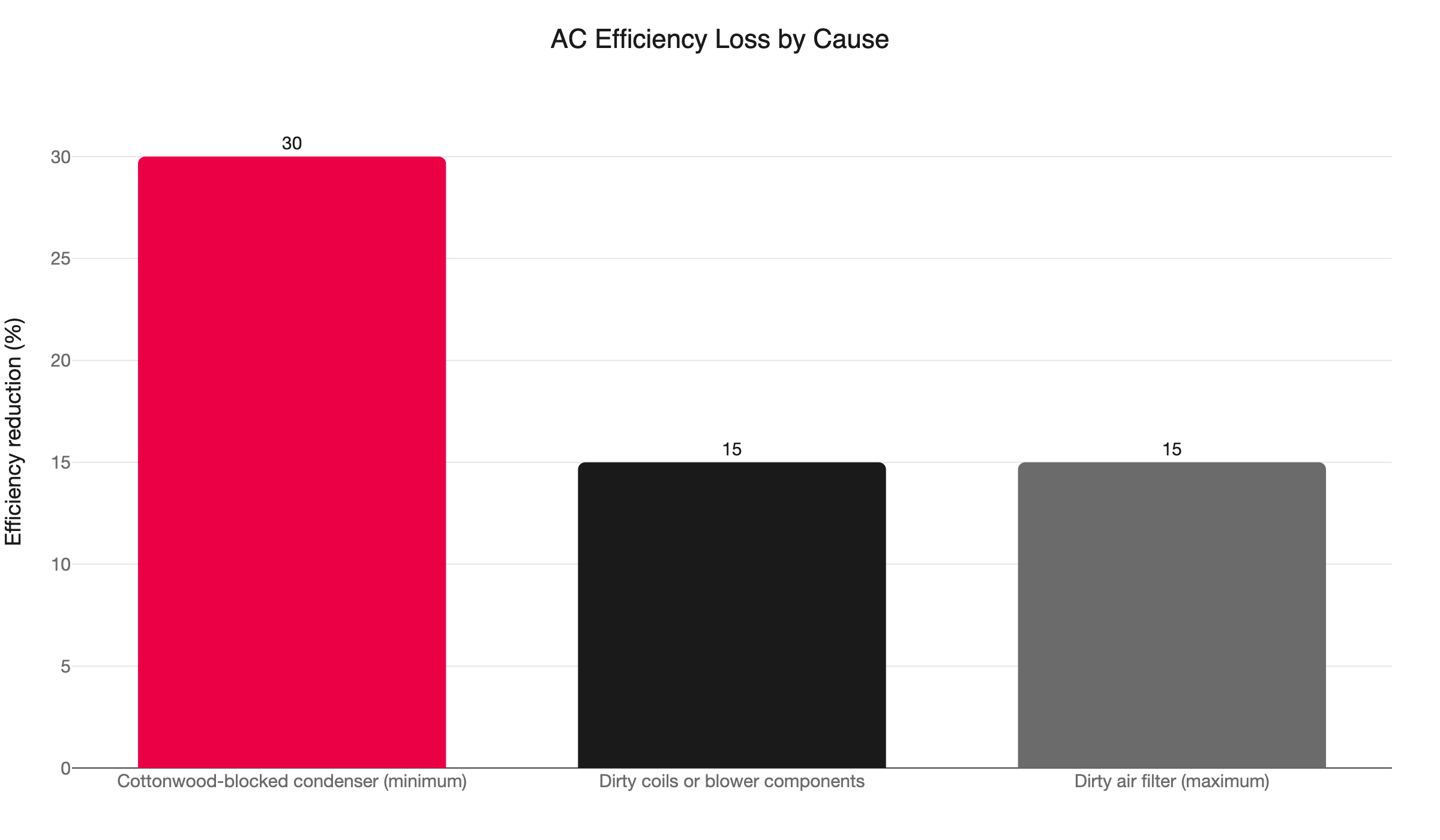
Research published this year found that cottonwood fluff on the condenser coil reduces AC efficiency by at least 30%. During peak cottonwood weeks, CBS Minnesota reported that efficiency loss can reach 50% and compressor or fan motor burnout is a documented failure mode.
A 30 to 50% drop is not “it runs a little slower.” On a hot afternoon, the system strains for hours. It works to cool a house it would normally cool in 30 minutes. That sustained effort overheats the compressor.
When the compressor fails, the cost jumps fast. See our guide on AC compressor signs, repair costs, and what to expect in the Twin Cities. A replacement runs $1,950 to $4,500 in this market.
A 15-minute garden-hose rinse prevents all of that.
How Do You Clean Your Outdoor AC Unit Step by Step?
Cut power at the disconnect box, clear debris by hand, then spray the fins gently with a garden hose from the inside out. No pressure washer. No stiff brush. Let it dry 20 minutes before restoring power.
Here is the complete homeowner checklist:
Step 1: Cut power to the unit. Find the outdoor disconnect box. It is mounted on the wall near the condenser. Flip it to OFF. Also shut the system off at the thermostat. Do not skip this step.
Step 2: Clear debris by hand. Remove cottonwood clumps, leaves, sticks, and grass clippings from the top and sides of the unit. Use your hands or a soft cloth. Do not use a leaf blower aimed directly at the fins.
Step 3: Rinse the fins with a garden hose. Spray from inside the unit outward if you can safely reach the interior. Otherwise, spray from the outside at a low angle. The goal is to flush debris out, not drive it deeper. A garden-hose nozzle on the “shower” setting is the right tool.
Step 4: Let it dry. Wait 20 to 30 minutes before restoring power. Do not run the system on a wet unit.
Step 5: Restore power and test. Turn the disconnect back to ON. Run the system and confirm cool air at your vents within a few minutes.
Step 6: Confirm clearance around the unit. Keep at least 2 feet of clearance on all sides. Trim shrubs, pull weeds, and remove anything that restricts airflow. This is a year-round requirement, not just a cottonwood-season task.
That is the full homeowner process. It takes 15 to 20 minutes.
How Often Should You Clean the Outdoor AC Unit During Cottonwood Season?
Rinse the condenser weekly from late May through mid-June. Check your air filter every week during that same window. Cottonwood can choke a clean filter in days, not the usual month. Resume normal monthly cadence after the season ends.
Normal AC maintenance runs on a monthly filter-check schedule. Cottonwood season breaks that cadence entirely.
Research shows cottonwood can load a standard filter to the point of airflow restriction within days. A filter that looked clean on June 1 can be choking the system by June 7.
ENERGY STAR notes that replacing a dirty filter with a clean one lowers AC energy consumption by 5 to 15%. That is the fastest single efficiency gain a homeowner can make. It takes five minutes and costs a few dollars.
Put it on your calendar: weekly rinse, weekly filter check, from late May through mid-June. After that, go back to monthly.
Also check the condensate drain line once a month during the season. A heavy cottonwood year means more debris near the indoor unit. If water is pooling near your air handler, the drain is probably clogged.
What Should You Never Do to Your Condenser?
Do not use a pressure washer. Do not scrub with a wire brush. Do not remove the top grille unless you are a qualified technician. The capacitor inside holds a dangerous electrical charge even after power is cut.
Here are the homeowner mistakes that cause more damage than cottonwood does:
Pressure washers. The force permanently bends the aluminum fins. Bent fins block airflow. A technician has to straighten them at the next service visit. In bad cases, the coil needs full replacement.
Wire or stiff brushes. Same result. These fins are designed to be rinsed, not scrubbed.
Removing the top grille. The capacitor inside stores electrical charge even after the disconnect is flipped off. Leave the housing closed unless you know how to safely discharge it.
Spraying into the top of the unit. This drives debris deeper into the coil. Spray from the outside at a low angle, or from inside the unit outward.
Running a clogged unit. If the condenser is packed with cottonwood and the AC is blowing warm air, shut it down. Rinse it. Let it dry. Then restart. Continuous operation on a blocked coil builds heat that damages the compressor.
Planting dense shrubs right against the unit. Airflow restriction does not come only from cottonwood. Ornamental grasses or shrubs within a foot of the unit create the same problem year-round.
What Work Requires a Licensed Technician?
Any task that touches the refrigerant circuit, the internal electrical components, or anything inside the unit housing belongs to a licensed tech. Federal law requires Section 608 certification to handle refrigerant. That is not a skill gap. It is a legal line.
Here is the full list of tasks that belong to a licensed technician:
Refrigerant inspection and charge. Federal law (EPA Section 608) requires certification to purchase, handle, or recover refrigerants. Homeowners cannot legally service the refrigerant circuit, regardless of skill level. This is a hard stop.
Electrical connection inspection. The capacitor, contactor, and all internal wiring need to be checked for wear, looseness, and corrosion. A failing capacitor is one of the most common summer breakdown causes. Caught early, it costs $195 to $500. Left alone, it can take the compressor with it.
Internal coil cleaning. The evaporator coil inside your air handler needs cleaning too. You cannot rinse it from the outside. ENERGY STAR notes that airflow problems from dirty coils or blower components reduce system efficiency by up to 15% independently of anything happening outside.
Bent fin straightening. Using a fin comb incorrectly causes more damage than it fixes. Leave this to the technician during a scheduled tune-up visit.
Refrigerant leak diagnosis. If the system repeatedly loses charge, there is a leak somewhere. Finding and sealing it requires specialized equipment.
Diagnosis when a rinse is not enough. If you clean the condenser, swap the filter, and the AC still blows warm air, a tech needs to find the actual cause.
When Is the Best Time to Book Professional AC Service?
April or early May. That is before cottonwood peaks, before contractors fill their schedules, and before the first heat wave of the year. A homeowner who waits until July has already run the system through its hardest weeks without a tech’s eyes on it.
ENERGY STAR recommends scheduling professional cooling-system checkups in spring, before the season begins. Contractors book up quickly once summer arrives.
For Twin Cities homeowners, that general advice has a specific local deadline.
The window:
- April or early May: A technician can inspect refrigerant charge, clean both coils, test the capacitor and contactor, and verify airflow. All of this happens before the system faces its first real Minnesota summer load.
- Late May through mid-June: Cottonwood season peaks. Appointment availability tightens. The system is already running under the worst conditions of the year.
- July and August: Peak cooling season. Emergency call volume goes up. So do wait times.
Book in April. That single scheduling decision covers the tune-up, catches small repairs before they become large ones, and eliminates breakdown risk during a heat wave.
Our professional AC maintenance service covers the full licensed-tech checklist above. Northern One Hour is locally owned and operated in Ramsey. We serve Minneapolis, St. Paul, Blaine, Maple Grove, Plymouth, Brooklyn Park, Woodbury, Bloomington, and the surrounding metro. “Always On Time… Or You Don’t Pay a Dime!(R)” - on every visit.
What Does a Professional AC Tune-Up Include?
A technician checks refrigerant pressure, inspects and cleans both coils, tests the capacitor and contactor, clears the condensate drain, and verifies the full electrical system. A standard tune-up at Northern One Hour runs $95 to $250.
A tune-up is not an inspection. It is a calibrated service visit that covers everything a homeowner cannot safely access.
Here is what our team addresses on a standard visit:
- Refrigerant pressure and charge
- Evaporator coil condition and cleaning
- Condenser coil condition and cleaning
- Capacitor test and replacement if needed
- Contactor inspection
- All electrical connections throughout the unit
- Condensate drain clearance
- Blower motor and condenser fan motor operation
- System airflow and supply/return temperature differential
- Thermostat calibration and staging
A tune-up runs $95 to $250. A compressor replacement runs $1,950 to $4,500. That comparison makes the argument on its own.
For a full breakdown of what each item covers and current pricing in Minnesota, see our detailed guide on what an AC tune-up includes and what it costs.
What If the Unit Still Underperforms After Cleaning?
If you rinse the condenser, swap the filter, and the AC still struggles, the problem is somewhere else. Common causes include low refrigerant from a leak, a failing capacitor, a dirty evaporator coil, or a system that is nearing the end of its useful life.
Here are the most common culprits:
Low refrigerant. A refrigerant leak does not seal itself. The system slowly loses charge and cooling capacity. Watch for ice forming on the refrigerant lines, constant running without reaching setpoint, and warm air at the vents.
Failing capacitor. A weak capacitor makes the compressor or fan motor struggle to start. It is one of the most common summer breakdowns and one of the least expensive repairs: $195 to $500.
Dirty evaporator coil. If the indoor coil is coated with dust or debris, it cannot absorb heat efficiently. This is a tech-only job.
Airflow restrictions indoors. Closed or blocked registers, a failing blower motor, or collapsed flex duct all choke airflow from the inside. A clean condenser does not help if the indoor side is restricted.
Age and wear. If your system is 12 to 15 years old or more, its performance baseline has likely declined. A tech can evaluate whether repair or replacement makes more financial sense.
Do not run a clearly struggling system for more than a day or two without calling for service. The longer it runs under strain, the higher the repair bill climbs.
Is It Time to Replace?
Not every clean condenser is worth keeping. A few signals that replacement makes more sense than continued repairs:
- Your AC is 12 to 15 or more years old.
- You are facing a compressor repair over $1,950 and the unit is near end of life.
- The system runs R-22 refrigerant, which is no longer manufactured.
A mid-tier central AC replacement in the Twin Cities runs $7,500 to $10,400 installed. A high-efficiency unit at 18 SEER2 or better starts around $11,000 to $15,600.
For Xcel Energy customers, a qualifying replacement at 13.4 SEER2 or better is eligible for up to $450 in rebates. Applications must be submitted within 60 days of installation. Confirm your utility before assuming this applies. Outer-ring suburbs like Shakopee, Prior Lake, and Buffalo may be on electric co-op service territories, where rebate structures differ.
One note on federal incentives: the 25C tax credit for high-efficiency AC equipment expired for installations completed after December 31, 2025. The Xcel rebate is currently the primary financial incentive for most Twin Cities homeowners replacing a central AC in 2026.
Northern One Hour offers financing on qualifying installations. For a full cost breakdown, see our guide on AC replacement cost in Minnesota.
Call (763) 260-6662 or book a consultation online to talk through whether repair or replacement is the right call for your home.
Frequently Asked Questions
How often should I clean my outdoor AC unit in Minnesota? +
Can I use a pressure washer on my outdoor AC condenser? +
When should I schedule professional AC service in the Twin Cities? +
Will homeowners insurance cover an AC compressor failure? +
Need a technician now?