
Thermostat Says Cooling but AC Not Running: Fix Guide
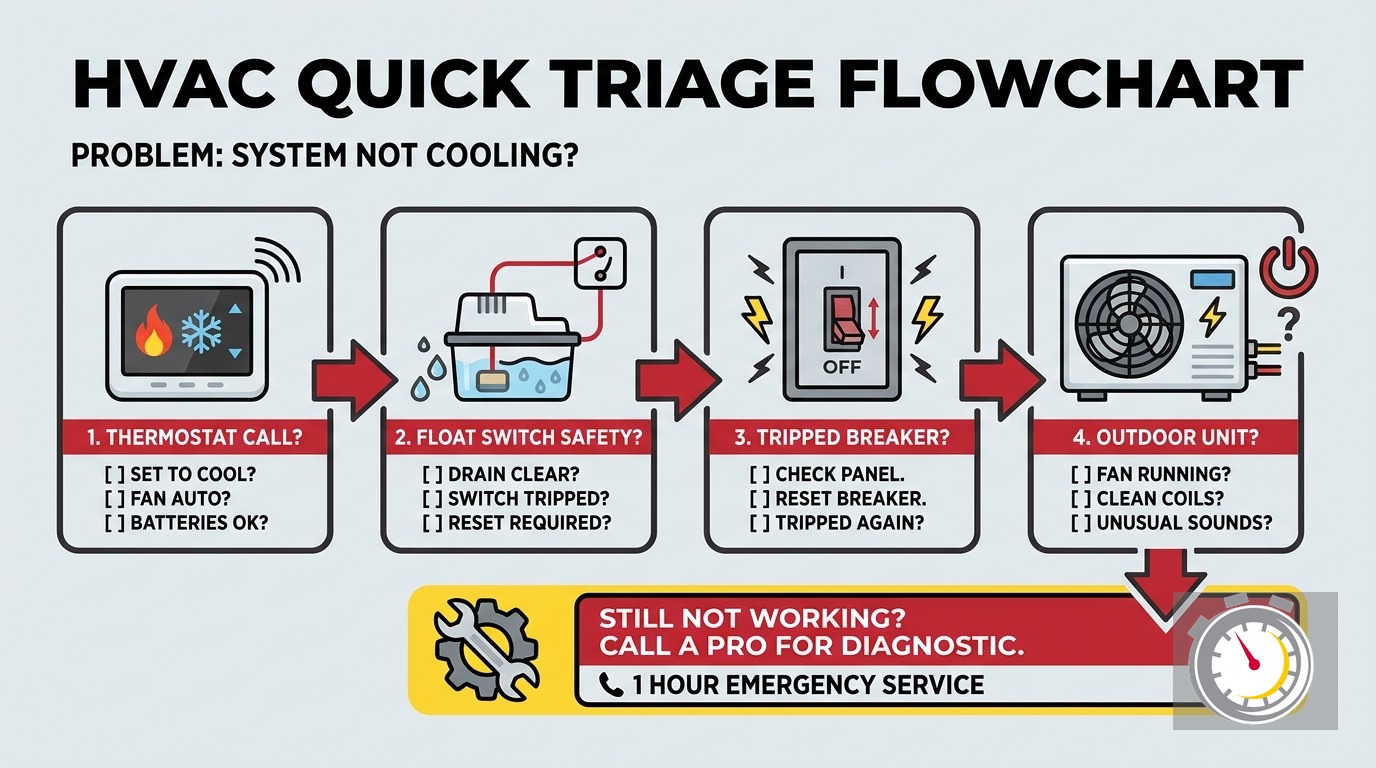
Key Takeaways
- A thermostat that says “cooling” is only asking for cooling. It does not mean the system is answering.
- Start with the easy checks: mode, setpoint, and batteries.
- Note whether the indoor blower runs. That one clue splits the problem in two.
- A full drain pan can trip a float switch and shut your AC off on purpose. Never bypass it.
- A tripped breaker is a warning. Do not keep resetting it.
- Capacitors can hold a charge. Leave the outdoor unit panel closed.
- Energy Star recommends annual pre-season check-ups by a contractor to keep your system at peak performance.
- Our on-time promise applies when you book: we arrive within the time window you select, or you don’t pay for the service.
Thermostat Says Cooling but AC Not Running? Start Here
It’s a hot afternoon in the Twin Cities. The thermostat reads 78 and shows “cooling.” Nothing happens. You hear no hum and feel no cold air.
You’re not alone. This is one of the most common summer problems we see, and the cause usually shows up in a short, ordered check.
Most guides hand you a flat list of possible causes, and you’re left guessing which one fits your home. This guide works the other way. You follow what you can see and hear, one step at a time. Each step rules something in or out.
We are Northern One Hour Heating & Air Conditioning, locally owned and operated, based in Ramsey. We see this problem every cooling season, and we built this checklist around the way a technician thinks.
The steps run in this order:
- Is the thermostat really calling for cooling?
- Is the indoor blower running while the outdoor unit stays quiet?
- Has the float switch shut the system off?
- Are the breakers and the outdoor disconnect on?
- Does the outdoor unit have a failed part?
Stop whenever you reach a step that needs a professional. We flag those points clearly.
What Does It Mean When the Thermostat Calls for Cooling and Nothing Happens?
Short answer: The thermostat is only a switch that sends a low-voltage request. When you see “cooling” and get no cold air, that request is not turning into action. The break can be at the thermostat, in a safety shutoff, in the power supply, or in the outdoor unit.
Think of your AC as a chain. The thermostat asks. The indoor unit and a control board pass the request along. The outdoor unit then starts the compressor and fan. A break anywhere in the chain gives you the same result: a warm house.
That’s why guessing doesn’t work. Five different problems can look identical from the couch. Your job is to find where the chain breaks.
Each link leaves clues. A blank screen, a running blower, standing water, a dead outdoor fan, and a silent unit all point to different places.
Is the Thermostat Actually Calling for Cooling?
Short answer: Check three things first: the mode, the setpoint, and the power. The mode must read “cool.” The setpoint must sit below the room temperature. The display must be on, with fresh batteries if your model uses them. These checks take two minutes and solve more calls than you might expect.
Start at the wall and work through this list:
- Mode: Make sure the thermostat is set to “cool,” not “heat,” “off,” or “fan only.”
- Setpoint: Set it at least five degrees below the current room temperature. A setpoint barely under the room reading may not trigger the system.
- Hold or schedule: Look for a hold, vacation, or schedule setting that overrides your change.
- Batteries: If the screen is dim or blank, replace the batteries.
- Fan setting: Set the fan to “auto” so it follows the cooling cycle.
Give the system a few minutes after you change a setting. Many units delay the outdoor unit’s start to protect the compressor. Wait about five minutes before you decide nothing is happening.
A blank screen is a clue
A blank screen doesn’t always mean dead batteries. On many systems, a safety switch in the drain system can cut the low-voltage power that feeds the thermostat. When that switch trips, the screen can go dark.
This doesn’t happen on every system. It depends on how yours was wired. If you replace the batteries and the screen stays blank, jump ahead to the float switch step.
Our thermostat blank screen guide covers this in more depth.
If the thermostat is calling
Say the screen is on and the settings are right. The display says cooling. Move to step two and see what the indoor unit is doing.
Is the Indoor Blower Running While the Outdoor Unit Stays Silent?
Short answer: This one clue splits the problem in two. If the indoor blower runs but the outdoor unit is silent, suspect the outdoor unit or its control signal. If nothing runs at all, suspect power, a safety switch, or a thermostat that is not calling.
Walk to your vents and listen. Then go outside to the condenser, the big box with a fan on top.
Here is how to read what you find:
- Indoor blower runs, outdoor unit silent: The system is getting the request, but the outdoor side isn’t starting. Look at the breaker, disconnect, and outdoor parts in steps four and five.
- Nothing runs indoors or outdoors: Power or a safety shutoff is the likely cause. Look at the float switch and breakers in steps three and four.
- Outdoor fan spins but air from vents is warm: This is a different problem. Our guide on an outdoor unit that runs while the AC blows warm air walks through it.
Note any sounds too. A hum with no fan movement points to a failed start part. A click with no follow-up can mean a bad contactor. Silence can mean no power reached the unit.
Don’t open any panels to listen closer. Stay outside the cabinet.
Check your filter while you are there
While you’re at the indoor unit, check the air filter. Energy Star advises that you inspect, clean, or change air filters once a month in your central air conditioner, furnace, or heat pump.
A clogged filter doesn’t usually stop a system cold on its own. It does strain the equipment and can set up bigger problems. A fresh filter is cheap insurance.
Could the Float Switch Be Shutting Your AC Off?
Short answer: Yes. A float switch is a small safety device that watches your condensate drain. If the drain pan fills with water, the switch shuts the AC off to prevent a leak. A clogged drain line is the usual trigger. Standing water in the pan is your clue.
Your AC pulls moisture out of the air as it cools. That water collects in a pan and drains away through a line. In the Twin Cities, the drain often runs to a floor drain, a pump, or the outdoors.
When that line clogs, water backs up and the float switch lifts with the water level. It breaks a circuit and stops the system. This is a feature, not a flaw. It keeps water out of your ceiling, walls, and basement.
How to check it
Look at the indoor unit and the area around it. Your furnace or air handler may sit in a basement, closet, or attic. Watch for these signs:
- Standing water in the drain pan or on the floor below it
- A drain line that looks backed up or is dripping
- Slime or algae near the drain opening
- A musty smell near the unit
Energy Star lists this as a regular upkeep task. It says to check and inspect the condensate drain in your central air conditioner, furnace, or heat pump when in cooling mode. A line that gets checked is less likely to clog on the hottest day.
What not to do
Never bypass or jumper the float switch. Some online advice suggests it. We strongly advise against it. The switch is the only thing standing between a clogged line and a water-damaged home, and removing it just hides the warning.
Don’t reach into wiring to test it either. Turn the system off at the thermostat and call us if you’re unsure.
What to do if you find water
Turn the thermostat to “off.” Don’t run the system while the pan is full. If you can safely reach the pan, you can remove standing water with a wet-dry vacuum.
Then find out why the line clogged. Our guides on clearing a clogged condensate drain line and on a full drain pan explain the causes and fixes. A clog that keeps returning needs a professional cleaning and a look at the drain slope.
If the pan is dry, the switch isn’t the issue. Move on to step four.
Is a Tripped Breaker or Open Disconnect the Problem?
Short answer: Possibly. Your AC uses a breaker in the main panel, and often a second one for the indoor unit. The outdoor unit also has a disconnect box on the wall. Check that all are on. If a breaker has tripped, reset it once at most. A second trip means a real fault.
Power problems are common and easy to check. Work through them in this order:
- Indoor unit switch: Many furnaces and air handlers have a service switch that looks like a light switch. Make sure it’s on.
- Main panel: Find the breakers labeled for the AC, condenser, furnace, or air handler. A tripped breaker sits in a middle or off position.
- Outdoor disconnect: Look for a metal box on the wall near the condenser. Check that it’s fully closed and the pull-out block, if present, is seated.
If a breaker is tripped, switch it fully off, then fully on. Do this once. If it holds, watch the system for a few minutes.
Do not keep resetting it
A tripped breaker is a warning. Too much current flowed through the circuit. Common causes include a failing compressor, a bad fan motor, a shorted wire, or a weak start part.
If the breaker trips again, stop and leave it off. Repeated resets can overheat wires and damage the equipment. Our article on why an AC keeps tripping the breaker explains the usual causes.
Work inside the electrical panel belongs to a licensed electrician. We handle heating and cooling equipment, not electrical panel repairs. If the panel looks damaged, burned, or buzzing, call an electrician right away.
A note on storms
Summer storms in Minnesota can trip breakers or cause power surges. If a storm just passed, a tripped breaker may be a one-time event. Still, watch for repeats. Surge protection for your HVAC equipment can reduce risk over time.
What Can Go Wrong at the Outdoor Unit?
Short answer: The most common outdoor failures are a bad capacitor or a worn contactor. The capacitor gives the motors a start boost. The contactor is the switch that sends power to the compressor and fan. Both are small parts, and both need a technician to test and replace safely.
If the indoor side checks out and power reaches the condenser, the trouble is likely outside. This is where homeowners should stop. Here is what a technician looks for.
Failed capacitor
The capacitor stores a charge and releases it to start the fan motor and compressor. When it weakens, the motors may hum but not start. The fan may spin slowly or not at all.
You may notice a humming sound, a fan that needs a push to start, or a unit that clicks on and off. A swollen top on the capacitor is another sign, but only a technician should look.
Capacitors can hold a charge even with the power off. Never open the panel and touch one. Our guide on bad AC capacitor symptoms and cost covers what to expect.
Capacitor repair in the Twin Cities typically runs $195 to $500 for the part and labor. The repair is often quick, and it can bring a dead system back to life.
Worn contactor
The contactor is an electrical switch. It closes when the thermostat calls, sending power to the outdoor unit. Over time, the contacts can pit, stick, or burn.
A bad contactor can leave a unit that won’t start, one that starts and won’t stop, or one that clicks loudly with no result. It can also cause a hum at the unit with no fan motion.
Other outdoor causes
Other issues are less common but possible: a failed fan motor, a seized compressor, or a control board problem. A compressor repair runs higher, in the range of $1,950 to $4,500 in our area. A technician can tell you whether repair or replacement makes more sense.
Also look around the unit from a safe distance. Check for:
- Tall grass, weeds, or shrubs crowding the cabinet
- Leaves, cottonwood seeds, or debris on the coil
- Ice on the lines or the cabinet
- Anything leaning against the unit
Good clearance helps airflow. Our outdoor AC unit cleaning guide is a helpful read.
Safety Rules Before You Touch Anything
Some of this checklist is safe for any homeowner. Some of it isn’t.
Safe to do:
- Check the thermostat mode, setpoint, and batteries
- Replace the air filter
- Look at the drain pan and drain line without touching wiring
- Check breakers and switches once
- Look at the outdoor unit from a distance
Leave to a professional:
- Opening the outdoor unit panel
- Testing or replacing a capacitor or contactor
- Bypassing or jumping any safety switch
- Repeatedly resetting a breaker
- Any work on wiring, the compressor, or refrigerant lines
Electricity and stored charge are real hazards. A pro has the right meter, gloves, and process. If you smell burning, see sparks, or hear loud buzzing, turn the system off at the thermostat and call us.
Why Does This Happen on the First Hot Day in Minnesota?
Short answer: Our cooling season is short, so the AC may sit idle for months. Parts like capacitors and contactors can weaken while unused. Drain lines can collect debris and slime. The first hot day is often the first real test, and weak parts fail under that sudden load.
This is our own read of local conditions, not a hard rule. But it matches what we see in the field.
Picture a Twin Cities year. Spring swings between heat and cold. Then a hot, humid spell arrives and every AC in the metro starts at once. A system that rested for most of the year faces a full workload with no warm-up.
Idle systems face a few risks:
- Drain lines that dry out, then clog when water flows again
- Dust and debris on the outdoor coil
- Aging electrical parts that were already weak last summer
- Pests or leaves in the outdoor cabinet
That’s why Energy Star recommends you have a contractor do annual pre-season check-ups. A spring visit finds weak parts before the heat does. You can read more in our first start-up checklist for the season.
If your system just failed, don’t panic. Most of these problems are fixable. The sooner you identify the cause, the less likely a small part failure becomes a bigger one.
Symptom-to-Cause Cheat Sheet
Use this quick guide to match what you see to the likely cause.
| What you notice | Most likely cause | Your next move |
|---|---|---|
| Thermostat screen is blank | Dead batteries or a tripped safety switch | Replace batteries, then check the drain pan |
| Screen is on, mode is wrong | Setting error | Set to “cool” and lower the setpoint |
| Standing water near the indoor unit | Float switch tripped by a clogged drain | Turn system off, remove water, call for drain service |
| Indoor blower runs, outdoor unit silent | Breaker, disconnect, or outdoor part | Check power, then call a technician |
| Outdoor unit hums but fan will not spin | Failed capacitor or stuck motor | Turn system off and call |
| Breaker trips again after reset | Electrical fault in the system | Leave it off and call |
| Nothing runs anywhere | Power loss or safety shutoff | Check switches and breakers once, then call |
When two rows seem to fit, work down the checklist in order. The earlier steps are cheaper and safer to rule out.
What Will a Technician Do and What Does It Cost?
Short answer: A technician tests each link in the chain with meters and safety gear. They confirm the thermostat signal, check the drain, test the power, and measure the outdoor parts. Costs vary by cause. A simple repair may run $195 to $500, while a compressor job costs more.
Here is what happens when we arrive:
- Confirm the symptoms. We ask what you saw and heard before the failure.
- Check the thermostat signal. We confirm the call for cooling reaches the equipment.
- Inspect the drain and float switch. We clear clogs and test the safety circuit.
- Test the power. We check voltage at the disconnect and the unit.
- Test outdoor parts. We measure the capacitor, contactor, and motors.
- Explain your options. You get a clear price before any work begins.
We tell you what we found and what it costs. Then you decide.
Here are some common repair ranges in our service area, for parts and labor:
- Capacitor repair: $195 to $500
- Condenser fan motor: $375 to $900
- Compressor replacement: $1,950 to $4,500
- Single tune-up visit: $95 to $250
These are typical ranges, not quotes. Your price depends on your equipment and the part involved.
Repair or replace?
Sometimes a failure signals a tired system. If your AC is old and the repair is large, replacement may be smarter. Our guide on deciding to repair or replace can help you think it through. If you do replace, we offer financing for larger jobs, so you can spread the cost over time.
How Can You Prevent This Next Summer?
Short answer: Change the filter on schedule, keep the drain line clear, keep the outdoor unit clean, and book a spring tune-up before the first hot spell. Small habits catch most problems early. A pre-season check finds weak parts before they strand you on the hottest day.
You can’t prevent every failure, but you can lower the odds. Use this routine:
- Every month in cooling season: Inspect and change the air filter as needed.
- Each spring: Check the drain pan and drain line for water or slime.
- Before the first hot day: Clear leaves and debris from the outdoor unit.
- Every year: Schedule a pre-season check-up with a contractor.
A single tune-up visit typically runs $95 to $250. An annual maintenance plan runs $195 to $390, and it can make the yearly visit easy to remember. Our guide on what a maintenance plan includes can help you decide if it fits your home.
A little regular care keeps the system running better and longer.
When Should You Call Northern One Hour?
Short answer: Call us when you reach any step that needs a pro, or when a simple check does not fix the problem. That includes standing water you cannot clear, a repeat breaker trip, a humming outdoor unit, or any burning smell. Do not wait on a system that may be unsafe.
Call right away if you notice:
- A breaker that trips more than once
- A burning smell or visible scorch marks
- Water on the floor near the indoor unit
- A humming or clicking outdoor unit that will not start
- Ice on the refrigerant lines or coil
- A blank thermostat that stays blank after new batteries
You don’t need to know the cause before you call. That’s our job. Just tell us what you saw at each step of this checklist. It helps us arrive with the right parts and tools.
Our on-time promise
A hot house can’t wait, so we stand behind our promise: “Always On Time… Or You Don’t Pay a Dime!(R)” In plain terms, we arrive within the time window you select. If the technician doesn’t show up on time, you don’t pay for the service.
We are locally owned and operated, and we serve homeowners across the Twin Cities, including Minneapolis, St. Paul, Blaine, Maple Grove, Plymouth, Brooklyn Park, Woodbury, and Bloomington. We back our work with a 100% satisfaction guarantee.
Get your cooling back
Work through the checklist, stay safe, and hand off the hard parts to us.
Call (763) 260-6662 or book online to schedule fast. We will find the break in the chain and get your home cool again.
Frequently Asked Questions
Why does my thermostat say cooling but my AC is not running? +
Can a clogged drain line stop my air conditioner from running? +
Should I keep resetting a tripped AC breaker? +
Is it safe to check the capacitor myself? +
Need a technician now?