
When to Open Windows Instead of Running AC in Minnesota
Key Takeaways
- Relative humidity changes with temperature. It can mislead you into keeping windows shut on some of the driest mornings of the year.
- Dew point is the correct metric. It measures actual moisture content in the air, regardless of temperature.
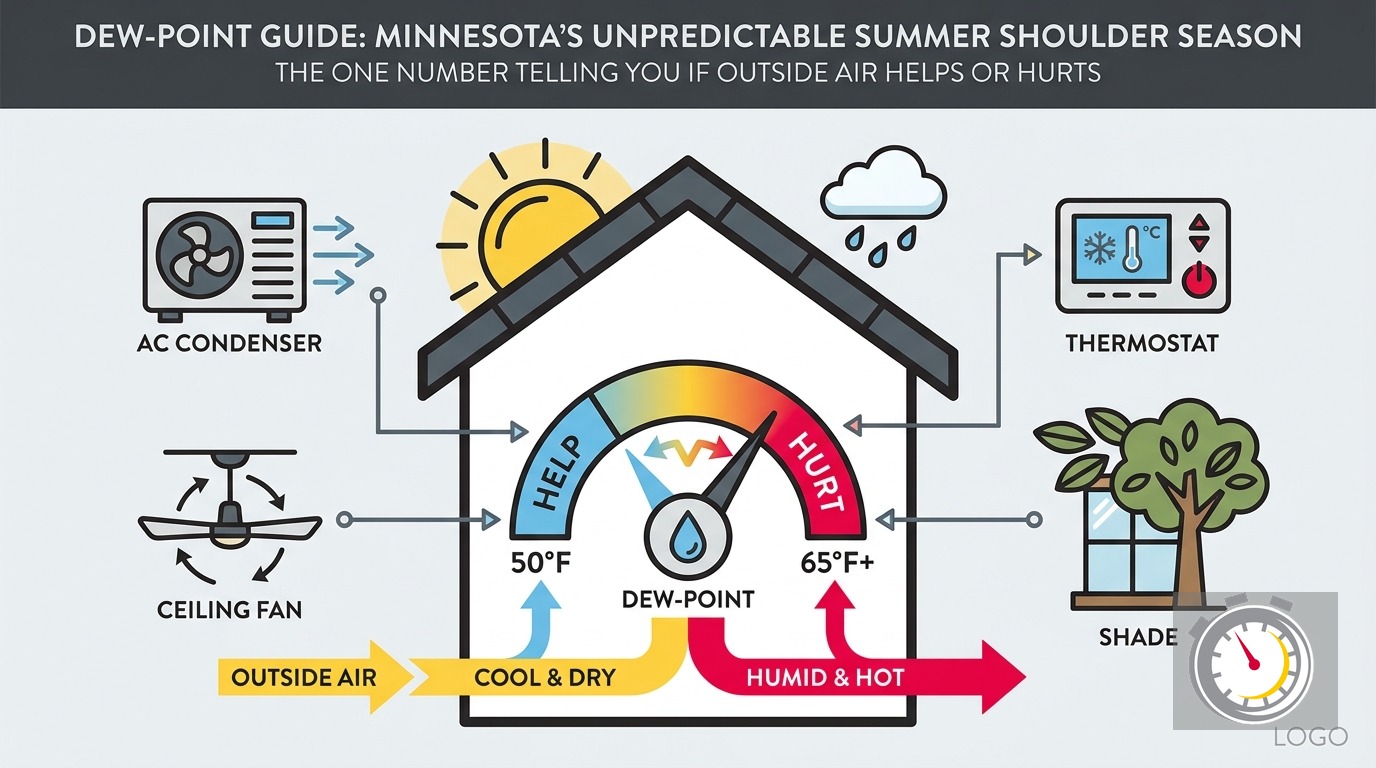
- The rule: if outdoor dew point is below 55°F, open the windows. Above 65°F, keep them closed and run your AC.
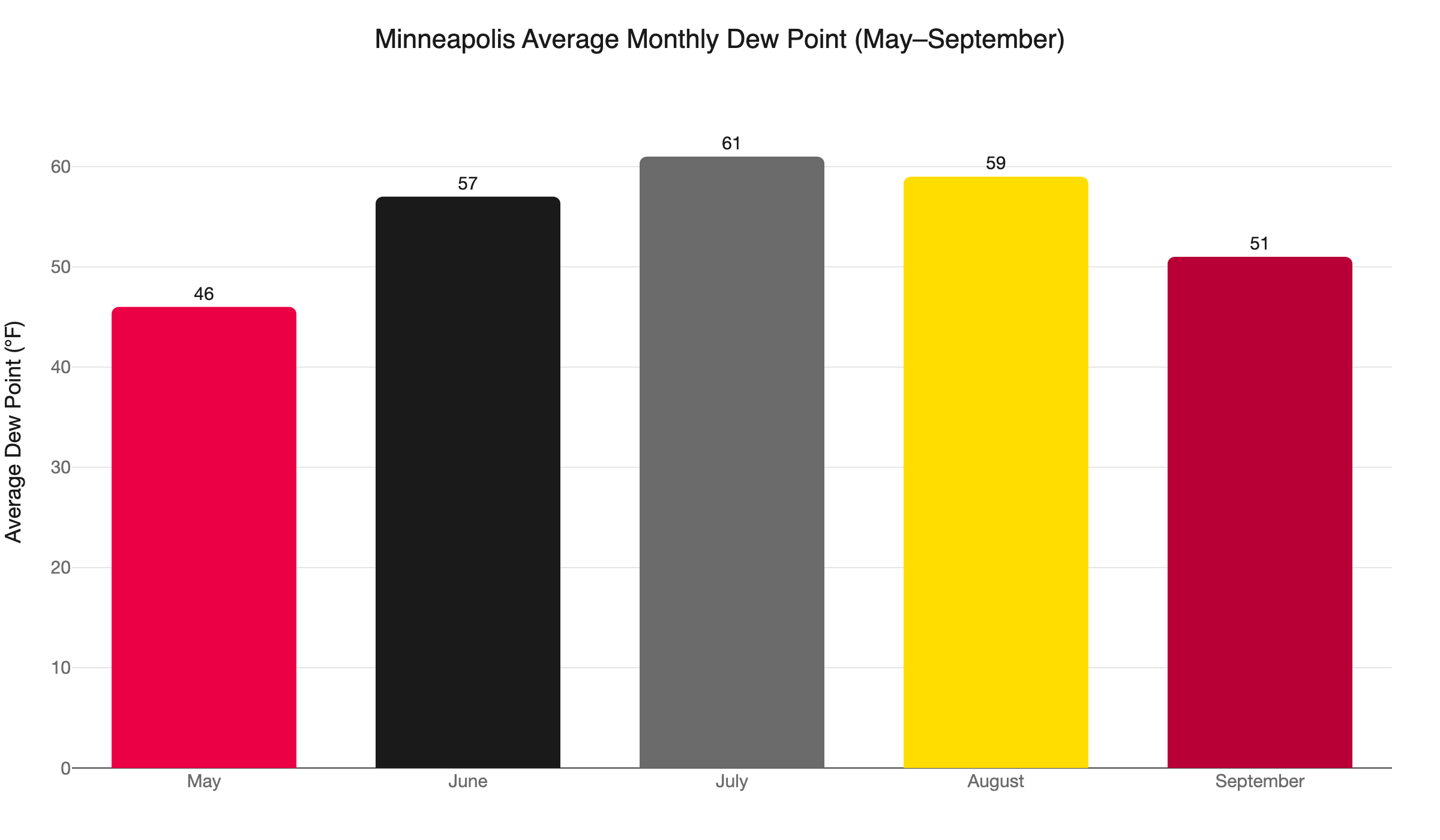
- In Minneapolis, May averages a dew point of about 46°F and September averages 49°F to 52°F. Both are well below the threshold.
- June through August average above 55°F, with July peaking near 61°F. Those months require a daily dew point check, not a calendar assumption.
- Your phone’s weather app already shows the dew point in the hourly forecast. No extra tools needed.
- If your AC struggles to control humidity on closed-window days, that is worth a service call.
Why Does Relative Humidity Lie to You?
Relative humidity tells you how saturated the air is relative to its temperature, not how much moisture the air actually contains. On a cool morning, outdoor RH can read 80% or 90% while the air carries far less moisture than your indoor air. This is the trap that causes homeowners to miss their best ventilation windows of the year.
Relative humidity sounds like the most direct measure of moisture in the air. The problem is that warm air can hold far more water vapor than cool air can. The same amount of water vapor produces a much lower RH reading at 85°F than at 58°F. When temperatures drop overnight, RH climbs. That happens not because the air got wetter, but because cool air saturates more easily.
Here is what that looks like in practice. You wake up on a 58°F May morning. Your weather app shows 85% relative humidity. You leave the windows shut and run the AC. But that outdoor air has a dew point of about 51°F. Your indoor air at 71°F and 58% RH has a dew point of around 55°F. The outdoor air was drier than your indoor air. You just passed up free ventilation.
Energy Vanguard makes this concrete with a specific example. Outdoor air at 58°F and 90% RH has a dew point of 55°F. Indoor air at 72°F and 64% RH has a dew point of 59°F. Despite showing higher RH, the outdoor air is objectively drier. Opening the windows that morning improves the situation. Checking RH alone, you would have kept them shut.
The fix is simple. Stop using relative humidity for this decision. Check the dew point instead.
What Is Dew Point, and Why Should You Use It?
Dew point is the temperature at which air becomes saturated and moisture starts to condense. It is a direct, stable measure of actual moisture content. Unlike relative humidity, it does not shift when the temperature changes. A dew point of 45°F is dry air. A dew point of 70°F is oppressive air. Those facts hold whether it is 60°F or 95°F outside.
Here is the reference point worth memorizing. A comfortable, well-conditioned home sits at 75°F and 50% relative humidity. That produces a dew point of 55°F, as Energy Vanguard notes. Any outdoor air with a dew point below 55°F is drier than that baseline. Bringing it inside reduces indoor moisture. It does not add to it.
Any outdoor air with a dew point above 55°F carries more moisture than that well-conditioned baseline. The higher the dew point climbs, the worse the tradeoff gets.
The WeatherSpark comfort scale maps dew point to how the air actually feels:
- Below 55°F: dry
- 55°F to 60°F: comfortable
- 60°F to 65°F: humid
- 65°F to 70°F: muggy
- 70°F to 75°F: oppressive
- Above 75°F: miserable
In the Twin Cities, most summer days stay in the comfortable-to-humid range. July and August push into muggy and occasionally oppressive. September 2026 offered a sharp reminder that outliers happen. MSP tied its all-time September dew point record of 66°F on September 30, according to the University of Minnesota Extension WeatherTalk blog. That month ranked as Minnesota’s 10th warmest September on record, with late-month dew points running about 20°F above normal.
This is why you check the dew point every time rather than assuming the calendar tells you what the air is doing.
What Does the Dew Point Scale Look Like in Practice?
Four zones cover every decision you will need to make. Below 55°F, open freely. Between 55°F and 60°F, proceed with caution. Between 60°F and 65°F, consider skipping. Above 65°F, keep windows closed and run your AC. One number, four outcomes.
The AEANET dew point guide frames these thresholds this way:
Below 55°F: Open freely. Outdoor air is drier than a well-conditioned home. This is the ideal time to ventilate and give your AC a rest. You bring in drier air and reduce indoor moisture load at the same time.
55°F to 60°F: Proceed with caution. The air is comfortable but not dry. Compare it to how your home already feels. If the house already feels humid, skip the windows. If it feels dry, a short ventilation window is reasonable.
60°F to 65°F: Consider skipping. Outdoor air is now humid. The benefit of ventilation shrinks while the risk of raising indoor moisture grows. On a hot day, you are also trading away cooled indoor air.
Above 65°F: Keep windows closed. Run your AC. This air is muggy to oppressive. Opening windows at this dew point adds moisture to your home and forces your system to re-dehumidify air it has already processed.
The EPA recommends keeping indoor relative humidity below 60%, with an ideal range of 30% to 50%, as part of reducing mold and moisture risk. Letting outdoor air with a high dew point into a tight home can push indoor humidity past 60% faster than you might expect.
What Do Minneapolis Dew Points Look Like Month by Month?
May averages around 46°F and September averages 49°F to 52°F, both well below the open-windows threshold. June through August climb above 55°F, with July peaking near 61°F. The safe ventilation window in the Twin Cities runs through most of May and most of September. June, July, August, and early September require a daily dew point check.
WeatherSpark data for Minneapolis shows the monthly averages:
- May: ~46°F - well below the threshold; open freely on most days
- June: ~57°F - borderline; conditions vary and daily checks matter
- July: ~61°F - above the threshold; keep windows closed on most days
- August: ~59°F - similar to June; muggy stretches are common
- September: ~49-52°F - back below the threshold; good ventilation weather returns
The officially muggy period, when dew points regularly climb to 65°F or above, runs from about June 8 to September 16. That is roughly 3.2 months. Minneapolis averages 8.9 muggy days in July and 7.4 in August. May averages just 0.5.
These are averages. The MN DNR’s Twin Cities dew point data shows the all-time maximum dew point in the Twin Cities was 82°F, recorded on July 19, 2011. Unusual weeks happen within any month, and a single hot humid stretch in what is otherwise a mild September can catch you off guard.
The monthly averages tell you when to be more or less alert. They do not replace a daily check.
How to Find the Dew Point on Your Phone
You do not need a separate weather station or hygrometer. The dew point is already in your phone.
- iOS Weather app: Scroll past the hourly strip on the main screen. The dew point tile appears in the details grid alongside UV index, humidity, and visibility.
- Weather.com: Open the hourly forecast table. Dew point is listed alongside temperature and chance of precipitation.
- Weather Underground: Tap any nearby personal weather station. The current conditions table lists dew point directly.
- National Weather Service (weather.gov): Select the hourly forecast for your location. Dew point appears in the hourly table for every hour.
Check the next two to four hours, not just the current reading. On shoulder-season mornings in Minnesota, dew points often start low and climb as temperatures rise. If the dew point is 50°F at 7 a.m. but forecast to hit 62°F by noon, open the windows in the morning. Close them before midday. Catching that window takes 10 seconds of planning the night before.
Why Do May and September Fool Twin Cities Homeowners?
Cool temperatures push relative humidity readings high on May and September mornings. Homeowners see 80% or 85% RH and assume the air is too humid. In most cases, that cool air carries far less moisture than indoor air at a comfortable temperature. May and September are the best natural ventilation months in Minnesota, and RH alone hides that fact.
The cool-morning trap: it is 57°F on a May morning with 82% relative humidity. Your weather app shows 82% and you leave the windows shut. But that air has a dew point of about 51°F. Your indoor air at 71°F and 58% RH has a dew point of around 55°F. The outdoor air is drier. You just passed up free ventilation and dehumidification.
The warm-evening trap runs the other direction. A July evening reads 87°F and 48% relative humidity. That looks moderate. But 87°F at 48% RH produces a dew point near 65°F. That air is muggy. Opening windows will raise indoor humidity and force your AC to work harder after you close up.
The shoulder season also represents the best energy savings opportunity of the year. The Department of Energy notes that natural ventilation is the least expensive and most energy-efficient way to cool a building. It works best in climates with large day-to-night temperature swings. Minnesota’s shoulder season fits that description precisely. On a low-dew-point night, opening windows costs nothing. Running the AC does.
Should You Run a Window Air Conditioner All Day?
On hot, humid days when the outdoor dew point is above 60°F, yes. Your window AC has already removed moisture from the room. Cycling it off lets humidity creep back in. On cool, dry days when the dew point is below 55°F, open the windows instead. The unit is doing unnecessary work on those days.
A window AC removes both heat and moisture. When it cycles off after reaching the set temperature, outdoor air can infiltrate through gaps around the unit. On a muggy day, that infiltration reintroduces moisture quickly. Keeping the unit running at a slightly higher set point, say 76°F to 78°F rather than 72°F, maintains the dehumidified environment without straining the compressor.
On a 57°F morning with a dew point of 47°F, running a window AC is pure waste. The outdoor air is already doing the job for free.
One broader point: window units cool one room at a time and do not manage whole-house humidity. If your home relies entirely on window units and still feels sticky on closed-window days, a central system handles that moisture problem far more effectively. Our guide on what that upgrade costs in the Twin Cities covers the full picture before you shop.
What Happens When Indoor Humidity Climbs Too High?
Indoor relative humidity above 60% creates real comfort and health risks. The EPA recommends staying between 30% and 50% ideally. High indoor humidity makes a 73°F home feel like 80°F, promotes mold and mildew growth, and can damage wood framing and finishes over time. Bringing humid outdoor air in on a high-dew-point day creates exactly this problem.
High humidity is also a sensory issue. You may find yourself lowering the thermostat to compensate for a sticky house. That runs the AC harder without addressing the actual cause.
Basements are the most vulnerable space in a Minnesota home. Cool basement air sits close to the dew point of incoming warm summer air. Open a basement window on a July afternoon and you may see condensation on walls and floors within hours. If your basement has recurring humidity issues, dedicated basement humidity control is often the most effective long-term solution.
Your central AC dehumidifies as it cools, but only when it runs long enough to complete the process. An oversized system cools the air too quickly and shuts off before finishing the dehumidification cycle. The result is a house that feels cool but persistently damp. If that describes your home, the cause is likely an oversized AC worth diagnosing before next season. A correctly sized system handles both temperature and moisture in a single pass.
It is also worth knowing that very efficient central AC can occasionally pull too much moisture out of the air. If your home feels overly dry rather than humid, that is a separate situation described in our post on what causes that and how to fix it.
When to Call Northern One Hour
The dew point strategy is a free tool you can use every shoulder-season day. It cuts AC runtime on dry days and tells you clearly when to close up and let the system take over.
That strategy only works if your AC is operating correctly. If your system runs constantly without reaching the set temperature, leaves the house feeling damp even with windows closed, or has not had a professional check in the past year, schedule a maintenance visit before the next cooling season starts. Our AC maintenance service covers refrigerant levels, coil condition, and system efficiency, which are the factors that most directly affect humidity control.
We are locally owned and operated in Ramsey, serving the Twin Cities from Blaine to Bloomington and Maple Grove to Woodbury. When you book an appointment, we show up in the time window you select. That is the commitment behind “Always On Time… Or You Don’t Pay a Dime!(R).”
Call (763) 260-6662 or book online when you are ready.
Frequently Asked Questions
How cool should my house be if it's 100 degrees outside? +
What is the 3-minute rule for air conditioners? +
Need a technician now?