
Air Conditioner Making House Too Dry in Summer? Here's Why
Key Takeaways
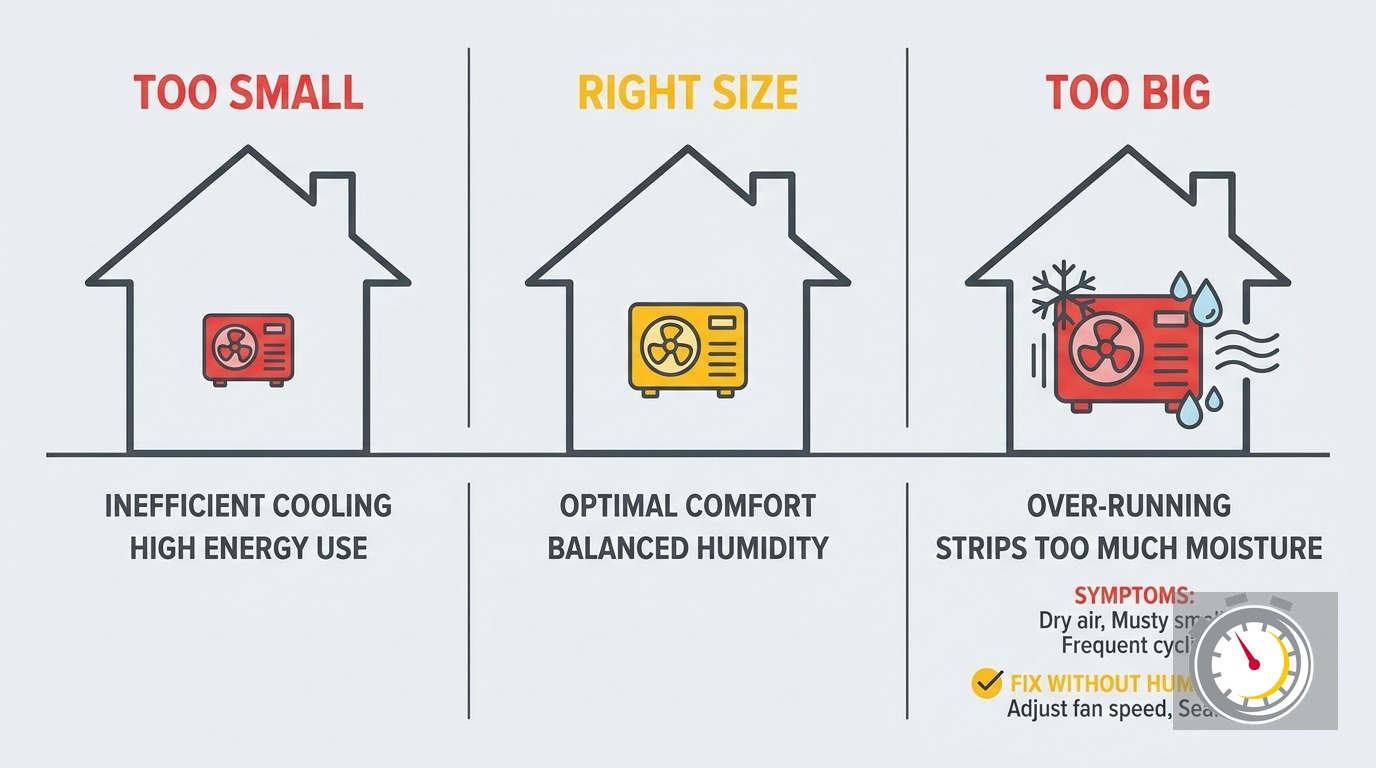
- An AC over-dries your home when the unit is oversized and short-cycles, or when mild outdoor temperatures let latent (humidity) load dominate while sensible (temperature) load stays low.
- The EPA recommends keeping indoor humidity between 30% and 50%. Below 30%, respiratory irritation, static electricity, and wood damage are common.
- The most common free fix is switching the fan from ON to AUTO. Fan-ON blows air over the wet coil during the off-cycle, re-evaporating moisture the coil just collected.
- Raising the thermostat 2-3 degrees reduces daily cycle count, giving indoor humidity more time to stabilize between runs.
- Cycles under 8 minutes on an 80°F day are a short-cycling flag. A Manual J load evaluation is the right response.
- A blower speed adjustment or variable-speed equipment upgrade solves the problem at the equipment level without adding a humidifier.
Your Air Conditioner Making Your House Too Dry in Summer Is a Real Problem
Most articles about AC and summer humidity chase the opposite problem: the system is not removing enough moisture and the house feels swampy. There is a second failure mode that gets far less coverage, and it might be the one you are living with right now.
Your air conditioner is making your house too dry in summer. The AC is running. The house is cool. But your skin is cracking, you are getting static shocks off the doorknob, and your wood floors are starting to show gaps. Indoor humidity has dropped below 30% and nothing about that feels like summer comfort.
This post explains what causes it, how to confirm the AC is the source, and how to fix it without adding a whole-house humidifier.
What Are the Symptoms of an Over-Dry Home in Summer?
Quick answer: Sustained static shocks, cracking or bleeding skin, repeated nosebleeds, gaps between wood floor planks, and a hygrometer reading below 30% RH are the signals. One or two dry days are weather. When the pattern is daily and the AC is running, the humidity is too low.
The clearest diagnostic tool costs about $15. A basic digital hygrometer, available at any hardware store, gives you a live indoor relative humidity reading. Place it in the room where you spend the most time. Check it mid-afternoon after the AC has been running for several hours.
Symptoms to watch for:
- Static electricity when touching metal surfaces, doorknobs, or other people
- Dry, cracked lips and skin that lotion does not fully relieve
- Nosebleeds, especially in children, without illness or allergies
- A scratchy throat in the morning when you have not been sick
- Wood furniture, floors, or trim showing gaps or separation at the seams
- Paper curling at the edges on flat surfaces
ASHRAE Standard 55 sets the summer thermal comfort zone at 73-79°F and 30-60% relative humidity. The standard sets no lower humidity floor for thermal comfort, but notes that skin drying, mucous membrane irritation, and static electricity all occur when RH drops to very low levels. If your hygrometer reads below 30%, you are outside that comfort band.
What Causes an Air Conditioner to Over-Dry Your Home in Summer?
Quick answer: Two distinct failure modes drive this. Either the unit is oversized and short-cycles through the cooling load before the coil can do sustained moisture work, or the unit is correctly sized but mild outdoor conditions let latent load dominate and the AC strips humidity on every short run. Both leave the house cold and dry. Each has a different root cause and a different fix.
Root cause one: the oversized unit
Every pound of water vapor your AC removes from the air must condense on the cold evaporator coil before it drains away. That condensation takes time. The coil has to drop below the dew point and stay there long enough to pull moisture out of passing air consistently.
An oversized unit cools the house too fast. It hits the thermostat set point in 5-8 minutes, shuts off, and the coil never had time for sustained moisture work. The next cycle starts, the temperature drops again quickly, the unit shuts off again. Short-cycling means the unit is effective at cooling but poor at dehumidifying.
The U.S. Department of Energy states it plainly: “Conventional over-sizing to cover for lack of confidence in building enclosure or conditioning system performance causes short-cycling, yielding less moisture removal.” ACCA’s Manual S standard draws the line at 115% of the Manual J calculated load. Any unit above that is oversized by definition and will short-cycle into dehumidification problems regardless of how well it was otherwise installed.
Root cause two: mild-day latent dominance
Even a correctly sized AC can over-dry a home on mild summer days. Think 68-72°F outdoors in late June or early September. On those days, outdoor air carries high relative humidity - the Twin Cities averages 80% RH at 6am in July - but the sensible load on the AC is low. The thermostat barely calls for cooling, but every time it does, the coil strips moisture. The result is a home at 72°F but with humidity at 28%.
This is the scenario most homeowners do not expect: the problem gets worse when the weather is mild, not during heat waves. On a 95°F day, the AC runs long cycles, the coil stays cold and wet, and moisture is removed steadily. On a 68°F morning in July, the unit fires briefly and repeatedly, strips humidity on each short cycle, and the floors start to creak.
Why Do Oversized ACs Short-Cycle? The Sealed-Home Effect
A third angle makes this especially relevant to Twin Cities homeowners. Many older homes in Minneapolis, St. Paul, Ramsey, Blaine, and Plymouth have gone through energy upgrades in the past 10-20 years. New windows, added attic insulation, and air-sealing reduce the sensible load on the AC. If the system was sized before those upgrades, it is now effectively oversized even if it was correctly specified at installation.
Minnesota does not require a Manual J load calculation for replacement equipment, only for new construction under the MN Energy Code. That means many contractors replace a 4-ton unit with another 4-ton unit without checking whether the improved envelope still needs that capacity. The replacement short-cycles from its first season because the house cannot absorb cooling fast enough.
This sealed-up-home scenario is diagnosable. A $15 hygrometer and a phone timer watching cycle lengths will tell you what you need to know in 20 minutes. See our post on oversized AC problems in the Twin Cities for a detailed breakdown of how oversizing compounds over time.
How Do You Know If Your AC Is the Problem?
Quick answer: On a warm but not extreme day, 78-82°F is ideal, note when your outdoor compressor kicks on and when it shuts off. Do this three times. If cycles are consistently under 8 minutes and your hygrometer reads below 35%, the AC is stripping more moisture than the house can replace. That combination is the diagnostic.
Here is the step-by-step check:
- Get a hygrometer. About $15 at any hardware store. Place it in the main living area, away from windows and vents.
- Watch the cycle length. Use your phone stopwatch. Start it when the outdoor compressor kicks on. Stop it when the compressor shuts off. Do this three times and average the results.
- Check the pattern. A well-matched system running on a warm day should run well over 10 minutes per cycle. Consistent cycles under 8 minutes on an 80°F day are a red flag. Under 6 minutes is a strong indicator of oversizing.
- Compare the hygrometer reading. If cycle times are short and indoor humidity is below 30-35%, the AC is the source. If cycles look normal but humidity is still low, the issue is more likely mild-day latent dominance.
Both conditions respond to the same first-line fixes, described next.
The Free Fixes: Fan Setting and Thermostat
You may not need a service call. Two thermostat settings can make a significant difference, and both cost nothing.
Switch the fan to AUTO
This is the single most common mistake that makes summer over-drying worse. When the fan is set to ON instead of AUTO, the blower keeps running after the compressor shuts off. Air flows over the wet evaporator coil during the off-cycle, the moisture that just condensed out of the air re-evaporates, and indoor humidity rises back toward where it started. The coil’s work is partially undone every cycle.
Setting the fan to AUTO stops the blower when the compressor stops. Moisture stays on the coil until it drains through the condensate line. What the coil pulled from your air stays removed. Check your thermostat now. The fan toggle is usually on the main screen or in system settings: AUTO or ON. It should be on AUTO during the cooling season.
Raise the thermostat 2-3 degrees
A higher set point means fewer cooling cycles per day. Fewer cycles means the coil is cold and wet for longer each run, and indoor air has more time between cycles for humidity to stabilize naturally from breathing, cooking, and normal air infiltration.
This is not a permanent comfort sacrifice. Try raising from 70°F to 72°F or 73°F for a day and monitor the hygrometer. Many homeowners find the home feels more comfortable at 72°F with 45% RH than at 70°F with 28% RH. DOE’s Building America research found that at a 75°F set point, perceived air temperature can vary by as much as 11°F depending on indoor RH. A slightly warmer, properly humid room often feels cooler than an over-dried one.
When Should You Call for a Service Technician?
Quick answer: If switching the fan to AUTO and raising the thermostat do not bring humidity into the 35-50% range within a few days, or if cycles are consistently under 8 minutes on warm days, a technician visit is the right next step. A blower speed adjustment is a sub-hour service that often resolves persistent over-drying without replacing any equipment.
Blower speed reduction
The blower fan speed controls how fast air moves across the evaporator coil. Faster airflow means air spends less time against the cold coil surface and the system removes less moisture per pass. Slowing the blower - within manufacturer specs - increases air-to-coil contact time and improves moisture removal without shortening the compressor run.
A technician can make this adjustment in a single visit. The work typically falls within a standard cooling system tune-up, priced at $95-$250 depending on system access and whether the technician finds other items to address. If you have not had a system check this cooling season, this is a practical time to do one.
Ruling out other short-cycle causes
If short cycles are confirmed, a technician will also check for other causes: a refrigerant charge that is slightly high, a dirty evaporator coil restricting airflow, or a clogged condensate drain holding moisture on the coil and triggering a pressure safety shutoff. Those conditions cause short cycles for different reasons than oversizing, and each has its own remedy.
Our post on AC short-cycling causes and fixes covers what a technician looks for and what corrective options look like at each step.
Is a Variable-Speed System the Right Long-Term Fix?
Quick answer: If your AC is past 10-12 years and you have confirmed short-cycling through multiple cooling seasons, a variable-speed replacement addresses the problem structurally. Variable-speed equipment runs at lower capacity for extended runtimes, keeping air moving across a consistently cold, wet coil. This removes significantly more moisture per hour than a single-stage unit running at full capacity in short bursts.
Variable-speed systems avoid short-cycling by design. Instead of running at 100% until the thermostat trips, they ramp down to 40-60% capacity and hold longer cycles. The coil stays at condensation temperature continuously. Air makes extended contact. The system removes more total moisture per day even though each individual cycle feels less aggressive.
DOE’s Building America program identified variable-speed air handlers as the structural solution for homes where conventional sizing fails - specifically homes where low peak loads mean a right-sized conventional unit is still effectively oversized during partial-load conditions. That describes a large share of renovated Twin Cities homes.
For homes where summer humidity swings from 80% RH at dawn to 50% by mid-afternoon, variable-speed equipment removes the tradeoff between correct sizing and latent control. See our detailed post on variable-speed AC benefits in the Twin Cities for what to expect from modern systems.
A central AC replacement at the mid-tier installed level in the Twin Cities starts at $7,500-$10,400. High-efficiency variable-speed systems with 18-20+ SEER2 ratings run $11,000-$15,600 installed. Financing is available for qualifying equipment and installations. If the existing system is past its useful life and short-cycling is confirmed, replacement often makes better financial sense than repeated service visits on a system that is structurally mismatched to the home.
Why Twin Cities Homes Are Especially Vulnerable to This Problem
The Twin Cities sits in HVAC Climate Zone 6, with some of the most extreme seasonal temperature swings in North America. Systems sized for a 95°F design day are structurally oversized on the mild, humid mornings that run throughout June and early September. That mismatch is not a contractor error - it is a design tradeoff that becomes more pronounced as homes get tighter.
Minnesota’s summer humidity is higher than most homeowners register. Minneapolis and St. Paul average 65% daily RH in July, with readings near 80% at 6am. Scientists tracking Minnesota weather have noted an increase in dew-point readings at or above 70°F, which means the latent load your AC handles has grown even as tighter envelopes have reduced the sensible load.
This combination - high outdoor latent load, tighter home envelopes, and AC units sized before renovations - is the exact scenario that produces summer over-drying. The unit was not wrong when it was installed. The home changed around it. The fix starts with measuring what is actually happening (hygrometer plus cycle timer) and then applying corrections that match the root cause.
If cycle times are under 8 minutes on an 80°F day and indoor RH is below 35%, you have the evidence you need to make a confident decision about what to adjust and how.
Ready to Get Your Home Dialed In?
Our team is locally owned and operated in Ramsey, MN. We serve Minneapolis, St. Paul, Blaine, Maple Grove, Plymouth, Brooklyn Park, Woodbury, Bloomington, and the broader Twin Cities area. Whether the fix is a fan setting walk-through, a blower speed adjustment, or a full Manual J evaluation ahead of a replacement, we show up when we say we will.
We back every visit with a 100% satisfaction guarantee and the on-time promise: “Always On Time… Or You Don’t Pay a Dime!(R)”
Call (763) 260-6662 or schedule a cooling system check online and we will take a look.
Frequently Asked Questions
Can an air conditioner make your house too dry in summer? +
What is the ideal indoor humidity level in summer? +
How long should an AC cycle run before shutting off? +
Need a technician now?