
Whole Home Humidity Management Year Round: Minnesota Guide
Key Takeaways
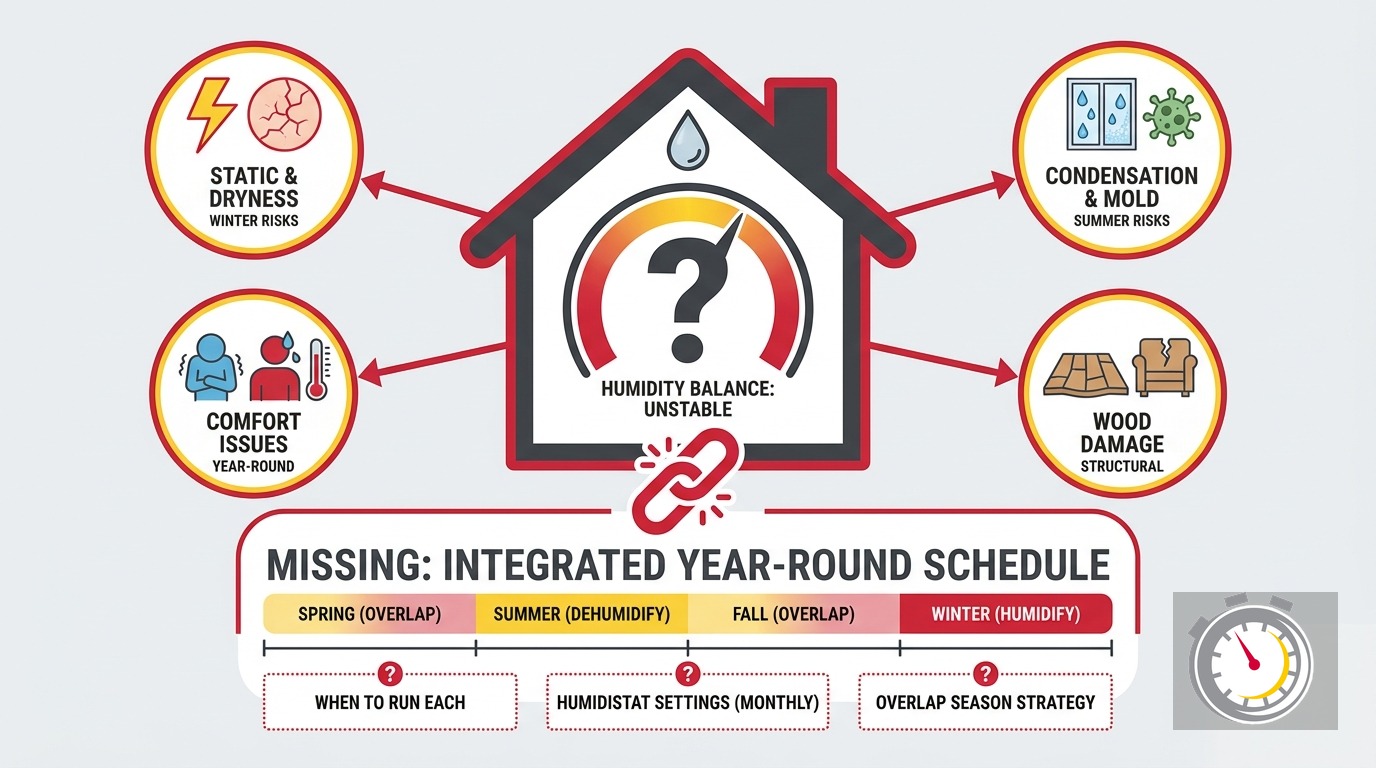
- Minnesota homes need two devices: a whole-home humidifier for winter and a dehumidifier (or air conditioner) for summer.
- The EPA sets the indoor humidity ceiling at 50% to prevent mold, dust mites, and bacteria. That limit applies year-round.
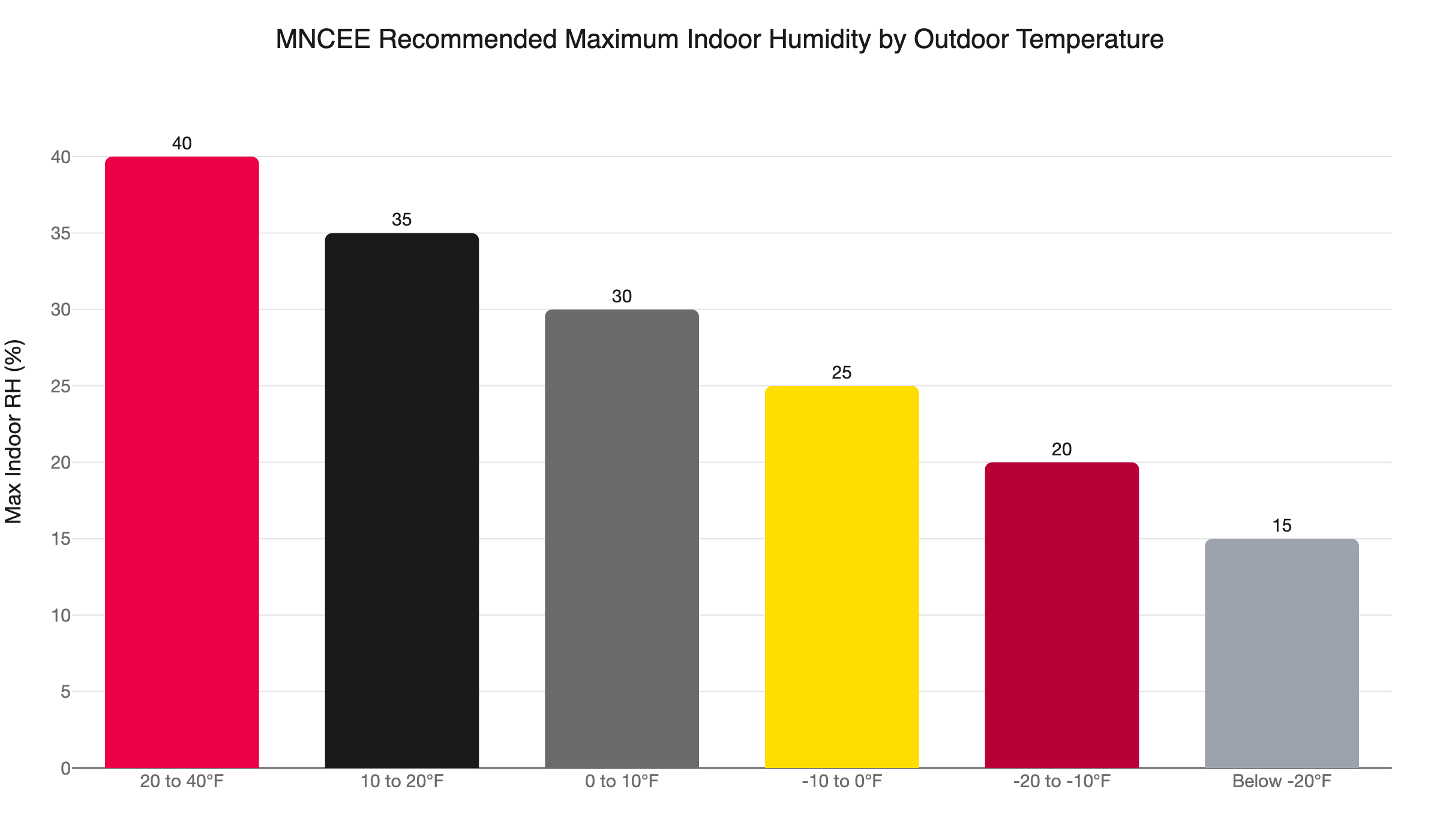
- Your humidistat setting should drop as outdoor temperatures drop. At 0 to 10°F outside, keep indoor humidity below 30%. At -10°F, drop to 25% or lower.
- Turn the humidifier on when outdoor temps fall below 50°F regularly, typically in October. Turn it off when dew points climb above 50°F, typically late April through May.
- April and September are the trickiest months. The right setting may change daily.
- A ducted whole-home dehumidifier controls summer humidity more reliably than portable units.
- We are locally owned and operated in Ramsey, MN. Every visit is backed by “Always On Time… Or You Don’t Pay a Dime!(R)”
What Is the Right Humidity Level for a Minnesota Home?
Keep indoor relative humidity between 30% and 50% year-round. In deep winter, lower the ceiling based on outdoor temperature to prevent condensation on windows and inside walls. In summer, stay below 50% to limit mold and dust mite growth. Without a working humidifier, many Minnesota homes fall below 20% RH on the coldest January days.
The EPA links biological growth directly to humidity levels above 50%, naming mold, dust mites, and cockroaches as primary risks. That ceiling applies in every season.
What sets Minnesota apart is the depth of cold. When outdoor temperatures drop below zero, even modest indoor humidity can condense on window glass and migrate into wall cavities. The answer is not to skip the humidifier. It is to link your humidistat setting to the outdoor temperature. That is what the MNCEE outdoor-temperature curve, covered below, does.
Basements follow a slightly different rule. The EPA recommends keeping basements and crawl spaces below 50% RH to prevent condensation on building materials. A dedicated basement dehumidifier set to 55% RH is the practical way to meet that standard.
What’s the Average Humidity Level in Minnesota?
Outdoor relative humidity peaks in late fall and winter in the Twin Cities. December averages 74% RH outdoors and November averages 73%. That sounds wet, but cold air holds very little moisture. When you heat outdoor air to 70°F indoors, relative humidity collapses. Without a humidifier, a home can see indoor RH below 20% during a January cold snap.
NOAA climate data for Minneapolis-Saint Paul shows the lowest outdoor RH in April (60%) and May (60%). Summer brings the opposite problem: July dew points average 60.1°F and set a record of 82°F in July 2011. Those dew points push humidity inside any time doors or windows open.
The swing between Minnesota’s dry winters and humid summers is unusually wide. That gap is why year-round humidity management requires two devices and a seasonal schedule, not a single setting you set once and forget.
What Is the Maximum Humidity for a House?
The indoor limit is 50% relative humidity. The EPA is direct on this point: “Do not humidify to indoor relative humidity levels exceeding 50 percent.” Above that threshold, conditions support mold, bacteria, and dust mites. That ceiling applies in every room of the house.
In Minnesota winters, the practical ceiling is often lower than 50%. Window condensation can appear before you reach 50% when outdoor temperatures are in negative territory. That is why the outdoor-temperature curve matters more than any single fixed number.
For basements specifically, the Minnesota Center for Energy and Environment (MNCEE) recommends a dehumidifier setpoint of 55% RH. Basements run cooler than the main living area, so the moisture dynamics differ. A setpoint of 55% keeps the basement safe without running the dehumidifier constantly.
Condensation on glass is your real-time signal. Moisture on windows means indoor humidity is too high for today’s outdoor temperature, even if the hygrometer reads below 50%. Drop the humidistat setting and give it a few hours to recover. If you are already seeing frost or water on windows, a post on managing winter window condensation walks through the fix step by step.
How Do Minnesota’s Seasonal Temperature Swings Impact Indoor Air Quality?
Our winters drive indoor air dry enough to irritate airways and crack wood. Our summers bring dew points that push humidity into mold territory. The swing between the two is among the widest of any major U.S. metro.
January in Minneapolis-Saint Paul brings mean overnight lows of 8.8°F and mean afternoon highs of 23.6°F. The full outdoor-temperature curve applies every single day from roughly November through March. Then July arrives with dew points averaging 60.1°F. That is a 50-degree-plus swing in felt moisture between the coldest and most humid months.
Both extremes hurt indoor air quality beyond comfort. Dry winter air irritates the upper respiratory tract and reduces the effectiveness of the mucous membranes that filter airborne particles. It also increases static electricity and can crack hardwood floors and wood trim over time. Summer humidity above 50% RH creates conditions for mold growth within 24 to 48 hours on organic surfaces.
When wildfire smoke is in the picture, your HVAC system plays a role there too. A guide to HVAC filtration and wildfire smoke for Minnesota homes covers how to layer air quality protection during smoke events.
The Winter Humidistat Curve: Setting by Outdoor Temperature
Most homeowners set one humidity number in October and leave it until April. That single habit causes the majority of winter window condensation and moisture damage we see on service calls.
The MNCEE publishes a specific outdoor-temperature-linked table for Minnesota homes. It tells you the maximum indoor RH at each outdoor temperature range:
| Outdoor Temperature | Maximum Indoor RH |
|---|---|
| 20 to 40°F | 40% |
| 10 to 20°F | 35% |
| 0 to 10°F | 30% |
| -10 to 0°F | 25% |
| -20 to -10°F | 20% |
| -20°F or below | 15% |
The MNCEE also notes that whole-home humidistat setpoints are “easy to forget” and recommends checking after every significant outdoor temperature drop. In the Twin Cities, that means adjusting when a cold front rolls through, not once a season.
To use this table: check tonight’s forecast low before you go to bed. If it is -5°F, set the humidistat to 25% or lower. If it warms to 28°F the next afternoon, you can raise it back to 35%. Smart thermostats with built-in humidity sensing can automate these adjustments and remove the guesswork entirely.
The most common mistake is holding the humidistat at 40% through a January cold snap. That single error is responsible for most of the frost damage and condensation calls we respond to each winter.
How Often Should You Dehumidify Your Home?
Run your dehumidifier continuously at its target setpoint, not on a timer. The goal is to hold a target relative humidity, not to run for a fixed number of hours. In Minnesota, the dehumidifier season runs from roughly late May through September. Humid September nights can extend it.
The DOE Building America program found that a ducted whole-house dehumidifier integrated with an HVAC system is “the most effective design for controlling indoor humidity levels separate from cooling.” Portable units handle a single room but struggle to keep a whole home below 50% during a humid Minnesota summer.
When your central air conditioning is running, it removes moisture as a byproduct of cooling. On mild days when the AC is off, that dehumidification stops. That is when a whole-home dehumidifier earns its place. It handles humidity on cool but damp days when the AC would not otherwise run.
For basement dehumidification, set the unit to 55% RH per MNCEE guidance and connect a drain hose so the reservoir does not fill up and shut the unit off mid-day. A post comparing portable and whole-home dehumidifier options for Minnesota homes covers sizing, installation, and cost tradeoffs in more detail.
Your Minnesota Humidity Calendar: Month by Month
Here is the full annual schedule that most humidity guides leave out.
October: Temperatures drop below 50°F regularly in the second half of the month. Turn the humidifier on. Start at 40% RH and monitor windows closely. Condensation on glass means the setting is too high. Drop it by 5% and check again the next morning.
November through January: Deep cold arrives and holds. Follow the MNCEE curve daily. Your humidistat may need to drop to 25 to 30% on the coldest nights. January mean temperatures in the Twin Cities run from 8.8°F overnight to 23.6°F in the afternoon. The full outdoor-temperature curve applies every day for three months straight.
February through March: Still cold, but daylight returns and temperatures gradually rise. Hold to the curve. Watch for warm spells: a stretch of 30°F highs means you can safely raise the setpoint to 35 to 40%.
April: The trickiest month of the year. Overnight frost remains possible while afternoons can reach 60°F. You may run the humidifier in the morning and turn it off by early afternoon. Watch outdoor dew point, not just temperature. Once dew points climb above 45°F, the humidifier adds more moisture than the home needs.
May: Dew points climb above 50°F regularly by mid-month. Turn the humidifier off. Start monitoring indoor RH. If it climbs above 50%, the dehumidifier or the air conditioner should be running.
June through August: High dew points are the norm. The AC runs and removes moisture as a byproduct. On cooler days when the AC is off, run the whole-home dehumidifier to keep indoor RH at or below 50%. July is the peak month: dew points average 60.1°F and occasionally reach the low 70s.
September: Temperatures begin dropping but nights remain humid. Outdoor RH in the Twin Cities averages around 70% in September. The dehumidifier may still run through most of the month. Begin watching evening forecast lows. When overnight temperatures drop below 40°F regularly, start preparing the humidifier for fall use.
When Should You Switch Between Your Humidifier and Dehumidifier?
Switch based on outdoor dew point, not calendar date. If the outdoor dew point is above 50°F, do not run the humidifier, even if the furnace ran the night before. If the dew point is below 40°F and indoor air feels dry, the humidifier should be running.
Fall transition (September-October): The first heating days arrive before dew points drop reliably below 50°F. You may have a stretch of days where mornings call for a small humidity boost and evenings are still warm and muggy. Check the dew point each day and adjust. Do not just turn the humidifier on because the furnace kicked on.
Spring transition (April-May): The furnace still runs some mornings, but afternoon humidity builds quickly. A 58°F day with a 52°F dew point does not need a humidifier. Watch dew point, not temperature, and you will avoid over-humidifying during this unpredictable shoulder season.
Both transitions also affect your air cleaner’s filter load. If you have a whole-home electronic air cleaner, the seasonal shift is a practical time to check and clean it. A guide to whole-home electronic air cleaner maintenance in Minnesota walks through that process.
What Equipment Do You Need for Year-Round Humidity Control?
You need at minimum a whole-home humidifier connected to the furnace and a dehumidifier for summer and basement use. A smart thermostat with humidity sensing makes the humidistat curve adjustments automatic and removes the most common source of seasonal mistakes.
Whole-home humidifiers connect to the furnace and distribute moisture through existing ductwork. A bypass humidifier is the most common type and the most affordable to install. A steam humidifier generates its own moisture and delivers more precise control but costs more to operate. Both types are matched to the home’s square footage, ceiling height, and insulation level during installation.
Whole-home dehumidifiers integrate with your ductwork and run independently of the AC. An ENERGY STAR-qualified unit must meet minimum efficiency standards for moisture removed per kilowatt-hour of electricity used, per DOE Building America benchmarks. Combined with a humidity-sensing thermostat, an integrated system is the closest thing to set-and-forget humidity control available for a Minnesota home.
Smart thermostats with humidity sensing can automate the humidistat curve adjustments described throughout this post. Xcel Energy offers up to $100 back for ENERGY STAR-certified smart thermostats in 2026 (verify current amounts at xcelenergy.com before applying). For a home that has had condensation problems in past winters, a humidity-sensing thermostat is one of the highest-value upgrades available.
An annual maintenance plan keeps both devices working correctly through the season. Plans in the Twin Cities typically run $195 to $390 per year and include a full inspection, cleaning, and adjustments.
Get the Right Help Before Winter Arrives
Minnesota’s climate does not give much margin. A winter that bottoms at -25°F and a July with 80°F dew points are not unusual years. They are normal ones. A home without a working humidifier and dehumidifier strategy will struggle at both ends of the calendar.
If you are not sure whether your current equipment is sized for your home, or if you have seen condensation problems in past winters, our team can assess your setup and walk you through the options. We are locally owned and operated in Ramsey, MN, and we serve the full Twin Cities area, including Minneapolis, St. Paul, Blaine, Maple Grove, Plymouth, Brooklyn Park, Woodbury, and Bloomington.
Call us at (763) 260-6662 or book a visit online. We will be there when we say we will, because that is exactly what “Always On Time… Or You Don’t Pay a Dime!(R)” means.
Frequently Asked Questions
When should I turn my whole-home humidifier on in the fall? +
Can I run a humidifier and dehumidifier at the same time? +
Need a technician now?