
Condensation on Windows in Winter Minnesota: Humidistat Fix
Key Takeaways
- Condensation on windows in winter Minnesota is almost always a humidity problem, not a window problem.
- The primary cause is a whole-home humidifier set too high for the outdoor temperature.
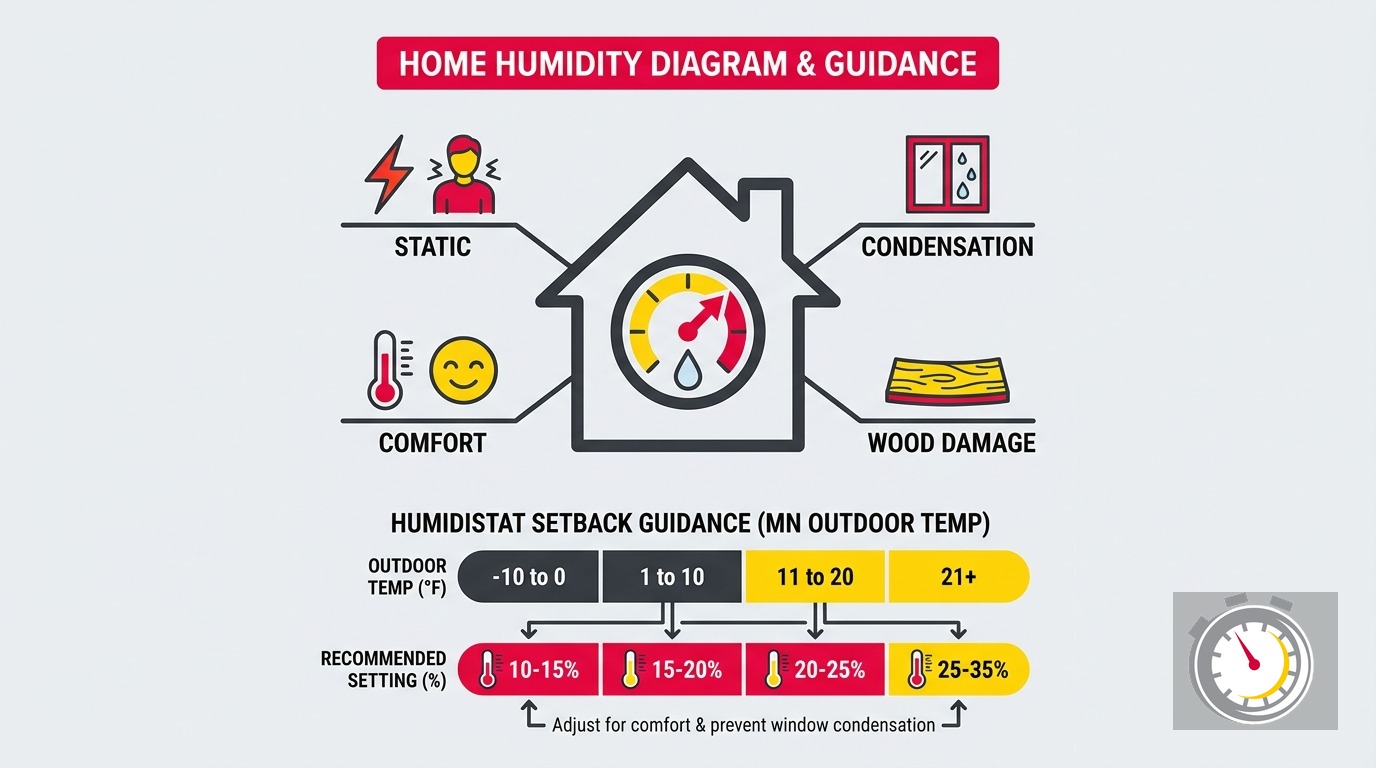
- The correct indoor humidity ceiling at 0°F to 10°F outside is 25-30%. At -10°F to 0°F, drop to 20-25%.
- Energy-efficient windows make condensation more likely, not less. They stop warm air from leaking out around the frame, so moisture hits the glass instead.
- Closing blinds at night traps cold air against the glass and accelerates condensation.
- Sustained over-humidification drives moisture into exterior walls and attic sheathing. Wood rot and mold follow months later.
- A technician can check your humidistat, verify the outdoor sensor, and identify air sealing gaps in one visit.
Why Are My Windows Sweating or Frosted in Winter?
Short answer: Warm, moist indoor air contacts cold glass and reaches its dew point. The moisture drops out as condensation or frost. Minnesota winters make this happen at surprisingly low humidity levels. In most cases, a whole-home humidifier running at the wrong setpoint is the root cause.
Every Twin Cities heating season, we get calls from homeowners who are convinced their windows are failing. Some replaced them last year. Some installed triple-pane units at significant cost. The windows are almost never the problem.
When outdoor temperatures drop to -25°F, frost begins forming on windows at just 13% indoor relative humidity. A modest humidifier running at half capacity can tip a home over that threshold on a bitter night. The problem is not the glass. The problem is the moisture level in your air relative to how cold the glass surface has become.
Understanding that distinction is the key to fixing condensation on windows in winter Minnesota without spending money on windows.
What Actually Causes Condensation on Windows in Winter Minnesota?
Short answer: Warm, humid indoor air meets cold glass. When the glass surface temperature drops below the dew point of your indoor air, moisture condenses out. The colder the outdoor temperature, the lower indoor humidity needs to be to prevent it. Minnesota winters push this threshold hard for weeks at a time.
The physics are straightforward. A single-pane window shows condensation at just 30% indoor relative humidity in moderate cold-weather conditions. A double-pane unit pushes that threshold to 60% RH. Better glass buys real headroom. But it does not protect you if the humidistat is set too high for the outdoor temperature.
Your home in January is balancing two forces. Your heating system pumps warm air through the house. The outdoor cold chills every exterior surface. Every window, exterior door frame, and uninsulated rim joist is a potential condensation point. The colder it gets outside, the colder those surfaces get, and the lower your indoor humidity needs to be.
Most Twin Cities homes run a whole-home humidifier through the heating season. That is the right call. Unhumidified Minnesota homes can drop to 10-15% RH in deep winter, drier than most deserts. The answer is not to stop humidifying. The answer is to humidify the right amount for whatever the temperature is outside.
Is My Whole-Home Humidifier the Problem?
Short answer: Almost certainly, if you have one and the setting has not changed since fall. Whole-home humidifiers are often set once and left there. When January temperatures arrive, that static setting drives too much moisture into the air for the outdoor conditions. The humidistat needs to back off as temperatures drop.
This is the most common and most fixable cause of condensation on windows in winter Minnesota. A bypass or steam humidifier running at 35-40% indoor relative humidity during a -10°F cold snap is doing exactly what it is programmed to do. The programming is wrong for the temperature.
The Center for Energy and Environment, Minnesota’s primary energy efficiency nonprofit, recommends 30-40% indoor humidity in winter. It also warns explicitly that whole-home humidifiers over-humidify when setpoints are not adjusted as temperatures fall. Those two facts belong together. Forty percent is a reasonable target in October or on a mild January day above 20°F. It is not the right number when temperatures are in single digits or below zero.
Two types of humidistats handle this differently. A simple single-dial humidistat sets a fixed indoor humidity target. It runs the humidifier until the home reaches that level, regardless of what is happening outside. A humidistat with an outdoor temperature sensor reads outdoor conditions and automatically scales back moisture output as temperatures drop. If your system has the outdoor sensor option but nothing is wired in, or if the sensor has failed, you may be running a manual system without knowing it.
What Indoor Humidity Should You Target in a Minnesota Winter?
Short answer: Lower than most guides say, and the correct number depends on outdoor temperature. The common recommendation of 40% is appropriate in mild conditions. When Twin Cities temperatures fall to single digits or below zero, the correct indoor humidity ceiling drops to 25-30% or even 20-25%.
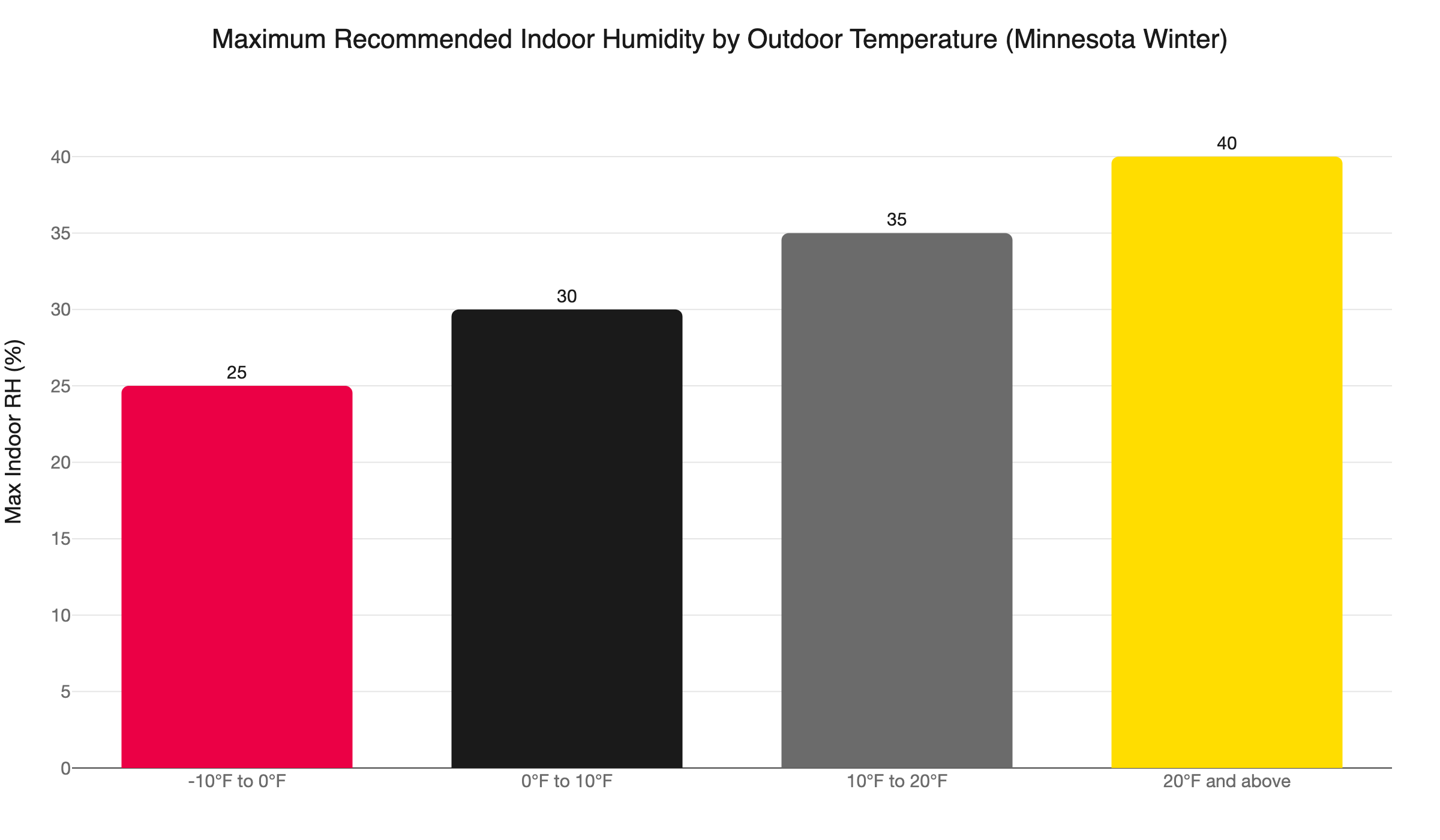
Here is the outdoor-temp-keyed sliding scale from Northern One Hour’s whole-home humidifier guide, consistent with standard HVAC industry guidance:
- At -10°F to 0°F outside: keep indoor humidity at 20-25% maximum.
- At 0°F to 10°F outside: 25-30% is the ceiling.
- At 10°F to 20°F outside: 30-35% maximum.
- At 20°F and above: up to 40% is acceptable.
Twin Cities January and February sit mostly in the 0-20°F range. That means the practical ceiling for much of the heating season is 25-35%, not 40%. Most humidistats are set to 35-40% in October and never adjusted again. By mid-January, those homes are significantly over-humidified for the conditions outside.
If your humidistat has a manual setpoint and no outdoor sensor, check the outdoor temperature each morning during cold snaps and dial the setting accordingly. It only takes a few days to become habit. The alternative is persistent window condensation and, eventually, moisture damage inside your walls.
Modern humidistats with integrated outdoor sensors adjust automatically. If your current control does not have this capability, it is an upgrade worth considering. Our team installs and calibrates humidity controls as part of routine service visits.
Why Did Condensation Get Worse After I Got New Windows?
Short answer: Energy-efficient windows seal tighter. Before, warm indoor air leaked through gaps around the old frame, warming the glass surface slightly. With a tight new frame, the air stays inside. So does the moisture. The condensation is evidence the windows are working correctly. The humidity management is what needs to change.
This is one of the most counterintuitive outcomes in home performance, and window contractors rarely warn customers about it upfront. A homeowner spends several thousand dollars on new windows expecting the condensation to stop. Instead, it continues or shifts to a new location.
Energy-efficient windows and modern air sealing keep interior air inside. That is the design intent. But it also means moisture has nowhere to escape. It hits the cold glass instead. Tight new windows can actually raise effective indoor humidity in winter because the old infiltration path for moist air is gone.
ENERGY STAR estimates that up to 40% of a home’s heating, cooling, and moisture-control costs come from air leakage. When you reduce that leakage through better windows or deliberate air sealing, you change the moisture balance of the home. A humidistat calibrated before the renovation may now be running too aggressively for the tighter envelope.
The fix is the same sliding scale from the section above. For a recently air-sealed home, start at the lower end of each temperature range. Learn how the home responds before moving the setpoint higher.
Does Air Circulation at the Window Make a Difference?
Short answer: Yes, but modestly. Moving warm room air across the glass surface raises the glass temperature by a few degrees. That can keep it above the dew point at mild outdoor temperatures. Closing blinds and drapes at night has the opposite effect. Air circulation is a useful secondary tool, not a substitute for correct humidity management.
Closing blinds and drapes traps cold, still air against the glass, which speeds up dew point contact. The air closest to the glass is not being refreshed with warmer room air. It cools faster and hits dew point sooner.
Leaving blinds open during the day lets warmer room air circulate across the glass. Running a ceiling fan on its lowest setting pulls warm air off the ceiling and moves it toward the windows. Either approach can raise the effective glass surface temperature by a few degrees.
At the margins, that difference is enough to prevent condensation on a mild night when indoor humidity is close to but not over the outdoor-temp threshold. On a -20°F January night with the humidistat set wrong, no amount of air movement will help.
Use air circulation as your last line of defense. It pairs well with a correctly set humidistat. It does not replace one.
Over-Humidification Causes Damage Beyond Wet Windows
Wet glass is frustrating to deal with. What happens inside your walls is worse.
When indoor humidity runs too high for the outdoor temperature, moisture does not stay on the window. It works through the building envelope into exterior wall cavities, through insulation, and into roof sheathing. In Minnesota’s freeze-thaw cycle, that moisture freezes in winter and thaws in spring. Repeat that over a few seasons and you get wood rot, mold on the sheathing, and framing damage that does not announce itself until a contractor opens a wall.
The window condensation you see right now is an early warning. The structural damage follows months later. Fixing moisture damage inside a wall costs far more than a humidistat adjustment ever will.
The Minnesota Mechanical Code treats humidifier installation as mechanical work requiring a permit. Cities including Plymouth, Brooklyn Park, and Apple Valley list humidifiers on their mechanical permit pages. That reflects the real stakes. An improperly controlled humidifier is not just a comfort issue. It is a building-health issue.
If you have run high indoor humidity through multiple Minnesota winters with persistent window condensation, it is worth having a technician assess your attic sheathing and exterior wall cavities. Catching moisture damage early is far less expensive than discovering it during a remodel.
When Should You Call a Technician for Window Condensation?
Short answer: Call when you cannot find or read the humidistat, when condensation continues after you correct the setting, when you suspect the outdoor sensor is not working, or when only one side of the house is affected. Each of those scenarios points to something beyond a simple setpoint adjustment.
Here are the specific situations that warrant a service visit:
The humidistat is not where you think it is. Whole-home humidifier systems often have a humidistat on the unit in the furnace room, a wall-mounted control in a hallway, and sometimes a separate outdoor temperature sensor. That is three controls. Any one of them can be misconfigured or failed.
The outdoor sensor may not be reading correctly. If your system has an outdoor temperature sensor but condensation continues after you adjust for the outdoor temp, the sensor may be reading the wrong temperature. A technician can verify the reading against a known outdoor value and recalibrate or replace the sensor.
Condensation is localized. Condensation on only north-facing windows or in one room may point to a cold-air infiltration gap, a failed window seal, or a localized air circulation issue. Those require a physical inspection, not a humidistat adjustment.
The humidifier has not been serviced in several years. The media pad, water panel, and solenoid valve all need periodic maintenance. A clogged or failing unit may not humidify consistently, creating swings that hit dew point unpredictably.
We are locally owned and operated in Ramsey, MN. We serve the Twin Cities and surrounding communities, and we back every appointment with our on-time promise. “Always On Time… Or You Don’t Pay a Dime!(R)” applies to humidifier inspections the same as any other service call.
A Diagnostic Checklist: Work Through This Before Calling
Work through these seven steps when you first notice condensation on windows in winter Minnesota:
Step 1: Check the outdoor temperature. Look it up right now. That determines the correct indoor humidity ceiling from the sliding scale above.
Step 2: Find your humidistat and read the current setting. It may be on the furnace unit in the furnace room, on a wall panel in a hallway, or both. Note the setpoint.
Step 3: Compare the setting to the correct ceiling. If it is 5°F outside and your humidistat reads 38%, you are running 8-13 percentage points too high. Lower it now.
Step 4: Check whether an outdoor sensor is connected. If your humidistat has a sensor port but nothing is wired in, the unit may default to a fixed setpoint. Adding a sensor is not expensive and handles future adjustments automatically.
Step 5: Open the blinds. Leave them open during the day. Note whether condensation clears or decreases.
Step 6: Note which windows are affected. Condensation on all windows points to whole-home humidity. Condensation on only one side or one room suggests a localized problem that a technician needs to assess.
Step 7: Adjust and wait 24-48 hours. Humidity shifts take time to work through the house. Give the corrected setting at least a full day before deciding it did not help.
If you work through all seven steps and condensation continues, it is time to call a technician.
Fix Condensation on Windows in Winter Minnesota Before the Next Cold Snap
Sweaty or frosted windows are solvable. The fix almost never involves new windows.
Start with the humidistat sliding scale. Adjust the setpoint for the outdoor temperature. Make sure the outdoor sensor is connected and reading correctly. Keep blinds open during the day so room air circulates across the glass. For most Twin Cities homes, those three steps end the problem.
If you have a whole-home humidifier that has not been serviced in several years, a humidifier inspection visit is the right first step. Our technicians check the unit, calibrate the controls, verify the outdoor sensor, and set the system up for what Minnesota winters actually deliver.
For a broader look at your home’s moisture balance, our indoor air quality services cover ventilation, air sealing assessment, and filtration, all of which interact with humidity in ways that affect both comfort and building health. If you want to go deeper on humidity control options, our humidistat settings guide covers the full range of controls and upgrade paths for Minnesota homes.
We serve Minneapolis, St. Paul, Ramsey, Blaine, Maple Grove, Plymouth, Brooklyn Park, Woodbury, Bloomington, and the surrounding Twin Cities area. We are locally owned and operated, and we back every appointment with our on-time promise.
Call (763) 260-6662 or book online to schedule a humidifier inspection or heating service visit. Do not wait for the next cold snap to find out the setting is still wrong.
Frequently Asked Questions
What causes condensation on windows in winter in Minnesota? +
What indoor humidity should I target in a Minnesota winter? +
Why is there more condensation after I installed new windows? +
Can condensation on windows damage my home? +
Need a technician now?