
Whole-House Humidifier Cost in Minnesota: 2026 Guide
Key Takeaways
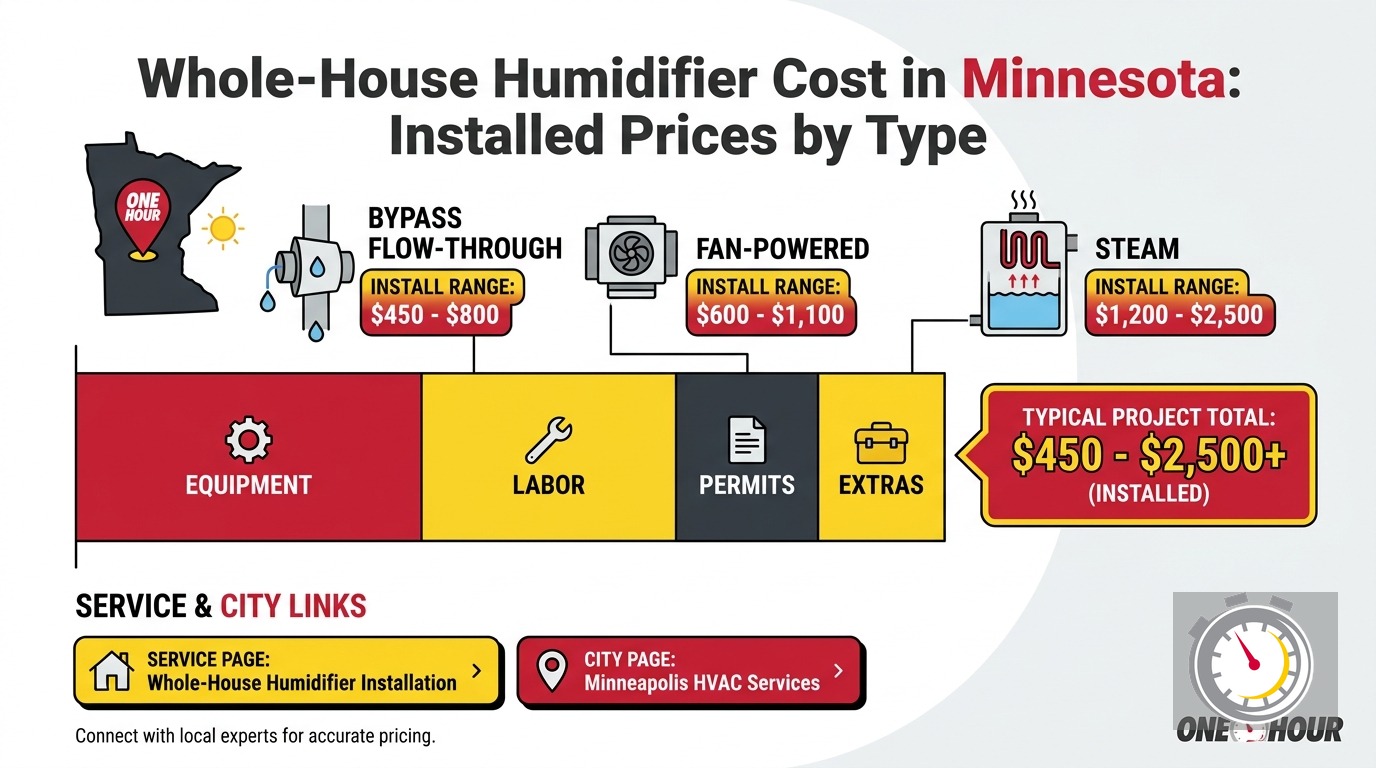
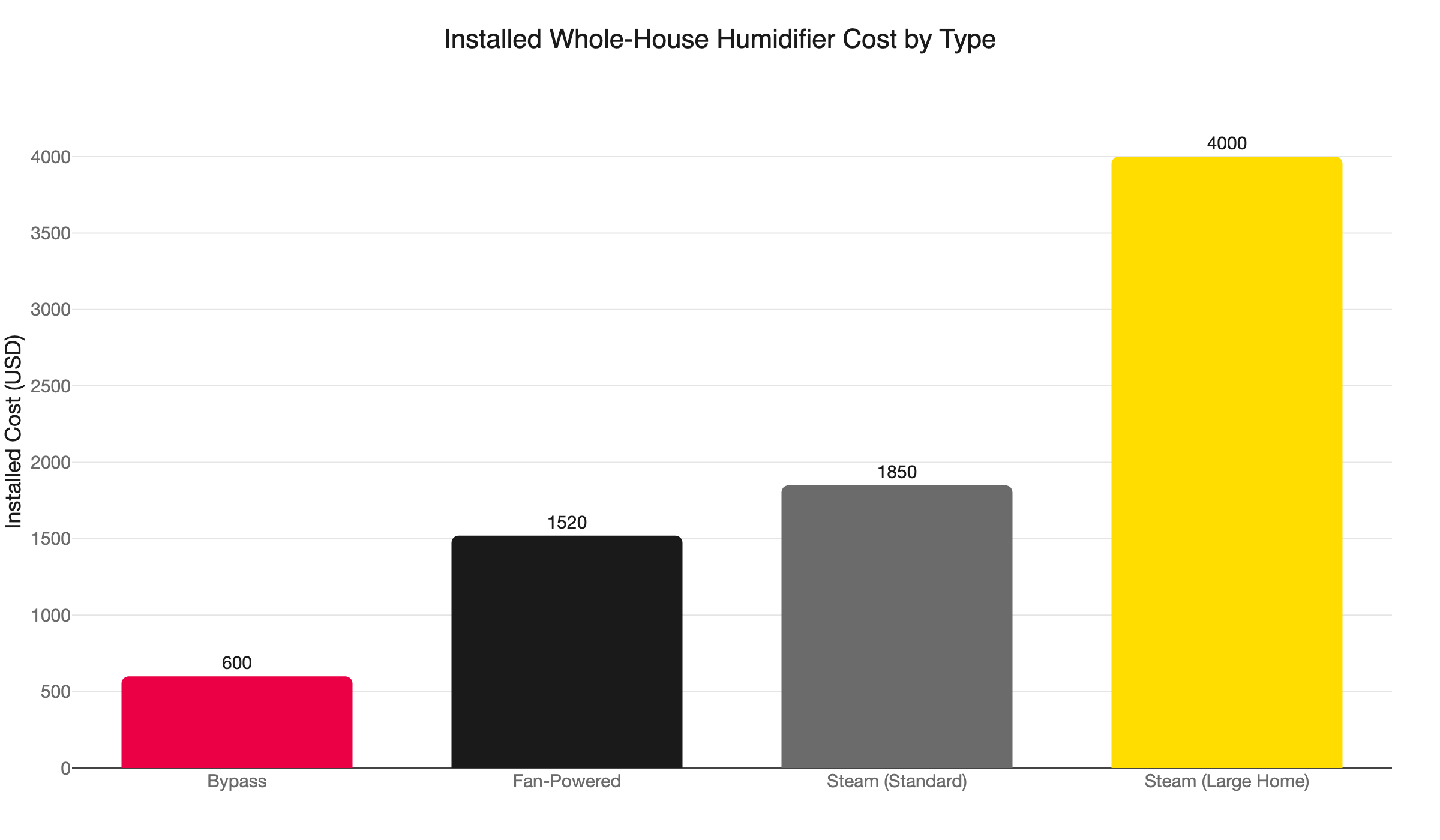
- Whole house humidifier cost runs $400-$800 installed for bypass, $840-$2,200 for fan-powered, and $1,200-$4,200 for steam with a 240V circuit upgrade.
- No utility rebates cover whole-house humidifiers in Minnesota. The ROI case rests on thermostat setback savings, not a utility check.
- Minnesota winters demand a sliding humidity target tied to outdoor temperature. A fixed 40% setting over-humidifies on the coldest days and causes condensation damage.
- Hard water in the Twin Cities raises annual maintenance costs 50-100% above national benchmarks. Factor that into your type selection.
- Permits are required for humidifier installation in many Minnesota cities. Northern One Hour handles permitting where required.
- Call (763) 260-6662 or book a quote on our humidifiers page.
What Does a Whole-House Humidifier Cost to Install?
The short answer: Whole house humidifier cost, installed, runs from roughly $400 for a basic bypass unit to $4,200 or more for a large-home steam install with a new 240V circuit. Where your project lands depends on type, home size, existing electrical, and your city’s permit requirements.
The national average installed cost is $579, with a typical range of $392-$766. That average skews toward bypass installs in straightforward setups. Labor alone runs $100 to $900 depending on access, ductwork configuration, and whether an electrician needs to rough in a dedicated circuit. Twin Cities installs often land toward the middle and upper end of these ranges.
Here is how the three types break down.
Bypass humidifier, installed
A bypass unit mounts on your furnace’s supply or return duct. It diverts a portion of warm airflow across a water-soaked evaporator pad. The airflow picks up moisture and carries it through your home. No separate blower motor is needed, which keeps the price down. The unit runs only when the furnace fan is on.
- Installed price: $400-$800 (Carrier)
- Requires: cold-water saddle valve, drain line to floor drain or condensate pump
- Best for: average-size homes, straightforward duct access, budget-first buyers
Fan-powered humidifier, installed
A fan-powered unit adds its own internal blower, so it humidifies regardless of whether the furnace fan is running. That makes it more effective in larger homes and in high-efficiency builds with short furnace cycles.
- Installed price: $840-$2,200 (AprilAire pricing guide)
- Adds roughly $8-$18 per year in electricity versus bypass
- Best for: homes 2,000-4,000 square feet, variable-speed furnaces, tighter construction
Steam humidifier, installed
Steam units boil water to produce vapor and operate fully independently of the furnace. They deliver the most precise humidity output at any level.
- Standard installed price: $1,200-$2,500 (Carrier)
- Large home with 240V circuit upgrade: $3,800-$4,200
- Energy draw: 1,200-1,915 watts while operating
- Best for: large homes, precision humidity needs, homes where the furnace runs intermittently
Whole-House Humidifier Operating Cost Year Over Year
The short answer: Whole house humidifier cost does not end at installation. Bypass units run $30-$100 per year. Fan-powered units run $50-$130. Steam units run $190-$650 or more annually. In the Twin Cities, hard water pushes every figure toward the top of its range.
Per RealcostIQ’s maintenance cost data:
Bypass - annual
- Water panel (pad) replacement: $15-$35
- Water consumption: $15-$35
- Electricity: near zero (the furnace fan does the work)
- Annual total: $30-$100
Fan-powered - annual
- Water panel replacement: $15-$35
- Water consumption: $15-$35
- Electricity (internal fan): $8-$18 above bypass
- Annual total: $50-$130
Steam - annual
- Electricity (at 1,200-1,915 watts per operating hour): $150-$500 per season
- Canister replacement: $40-$150
- Annual total: $190-$650 or more
Steam units draw significant power because they boil water continuously. In Minnesota, where the humidifying season runs from late October through early April, electricity costs accumulate over a long stretch.
Why Minnesota Changes the Whole-House Humidifier Calculation
Most national cost guides stop at the price table. For Twin Cities homeowners, two factors push real costs and comfort outcomes well past what those guides predict.
Hard water raises your maintenance costs
Minneapolis-area municipal water is moderately hard. That mineral load affects every whole-house humidifier type.
Bypass and fan-powered pads accumulate scale that reduces evaporation efficiency and shortens pad life. In soft-water markets, one pad replacement per season is the standard. In the Twin Cities, plan for two replacements per season. Steam canisters face a steeper problem. Scale builds up faster inside the boiling chamber, and heavier accumulation makes canisters fail earlier. What was a once-per-season replacement nationally becomes every four to six months locally.
The net effect across all types is roughly 50-100% higher annual maintenance costs than national benchmarks suggest. If a resource quotes bypass maintenance at $50 per year, budget $75-$100 here. If steam maintenance is quoted at $150, budget $225-$300.
Does a whole-house humidifier lower your heating bill?
The short answer: Modestly, yes. Humid air retains heat better and feels warmer at the same temperature. Most homeowners can comfortably set their thermostat 2-4 degrees Fahrenheit lower after humidifying, reducing heating costs by roughly 1-2% per degree of setback.
This is the real ROI argument for whole-house humidification in Minnesota. There is no rebate to stack on top of it. The payback comes from lower gas bills over the life of the unit.
If your January gas bill averages $200 and you hold a consistent 3°F setback, you save roughly $6-$12 per month during the heating season. Over a five-month Minnesota winter, that is $30-$60 per year. Over the 10-15 year life of a bypass or fan-powered unit, those savings contribute meaningful payback, though not a fast one. Steam units have higher operating costs that offset a larger share of those savings.
What Humidity Level Should You Set in a Minnesota Winter?
The short answer: Follow a sliding scale tied to outdoor temperature, not a fixed number. The University of Minnesota recommends no more than 40% RH above 20°F, dropping to 15-20% maximum at -20°F or below. A fixed 40% setting will over-humidify on the coldest days and cause condensation damage.
The EPA recommends 30-50% relative humidity for health and comfort. The State of Minnesota’s own indoor air quality guidelines land in the same range. Both are correct as a general band. The problem is that the safe upper limit changes with the outdoor temperature.
Here is the mechanism. Warm, humid indoor air meets cold window glass and exterior wall surfaces. When indoor humidity is too high for how cold it is outside, the dew point of that air exceeds the surface temperature of the glass or wall cavity. Condensation forms. You see it first as water on the windows. Left uncorrected, it becomes frost on frames, moisture migration into the wall assembly, and eventually mold behind the drywall.
Local HVAC sources citing University of Minnesota research document the sliding safe limit:
| Outdoor Temperature | Maximum Indoor RH |
|---|---|
| 20°F and above | 40% |
| 10 to 20°F | 35% |
| 0 to 10°F | 30% |
| -10 to 0°F | 25% |
| -20°F and below | 15-20% |
An outdoor-temperature-sensing humidistat adjusts the setpoint automatically as conditions change. If yours is a manual humidistat, a technician calibrates seasonal setpoints at installation and walks you through when to adjust them during the season.
For detailed guidance on managing these settings through every stage of the Minnesota winter, see our post on humidistat settings for Minnesota winters. For a deeper look at how winter dryness affects your home, our post on whole-home humidifiers and winter dry air covers condensation, wood floors, and static electricity in one place.
Do Utility Rebates Cover Whole-House Humidifiers in Minnesota?
The short answer: No. As of 2026, neither Xcel Energy nor CenterPoint Energy offers rebates for whole-house humidifiers. Minnesota utility programs focus on furnaces, heat pumps, central AC, and smart thermostats. Humidifiers are not on the eligible equipment list.
This surprises homeowners who have budgeted around a rebate that does not exist. Xcel Energy’s residential efficiency programs cover high-efficiency furnaces, heat pumps, and smart thermostats. CenterPoint Energy mirrors that list. The Minnesota Conservation Improvement Program requires utilities to invest in efficiency, but its scope does not extend to humidifiers.
The only financial offset available is the thermostat setback savings described above. If you are planning a furnace or heat pump upgrade at the same time, rebates on that equipment can free up budget for an add-on humidifier install. But the humidifier itself earns no rebate.
Do You Need a Permit for Humidifier Installation in Minnesota?
The short answer: Often, yes. Minnesota Mechanical Code classifies humidifier installation as mechanical work requiring a permit in many cities. Plymouth, Brooklyn Park, and Apple Valley are among those that require it. Permit fees typically run $125 or less.
National cost guides often note that humidifier permits are “usually not required.” That may hold in other states. In Minnesota, skipping a required permit creates problems at resale and can complicate an insurance claim if a failed water connection causes water damage.
Northern One Hour pulls permits where required. If your city requires one, we include that in the installation process.
How Long Does a Whole-House Humidifier Last?
The short answer: Bypass and fan-powered units typically last 10-15 years with consistent maintenance. Steam units last 5-10 years. The boiling cycle degrades steam components faster than evaporative wear affects pad units. Hard water in the Twin Cities shortens any of these lifespans if maintenance is deferred.
Annual pad replacement on a bypass or fan-powered unit is the single most important maintenance task. Skipping it lets scale accumulate, stresses the drain system, and reduces humidity output well before the unit reaches end of life. For steam units, inspect the canister at the start of each heating season. In the Twin Cities, plan for a mid-season inspection as well if your water is hard.
Which Type of Whole-House Humidifier Fits Your Home?
The short answer: Bypass for most average-size Twin Cities homes. Fan-powered for larger homes or tight, high-efficiency builds with short furnace cycles. Steam for large homes, precision humidity needs, or households where the furnace runs intermittently.
Four factors drive the decision: square footage, how airtight and well-insulated your home is, your furnace’s duty cycle, and your water quality.
Choose bypass if:
- Your home is under 2,500 square feet
- You have a standard furnace with long run cycles
- You want the lowest installation and operating cost
- Budget is a primary constraint
Choose fan-powered if:
- Your home is between 2,000 and 4,000 square feet
- You have a high-efficiency variable-speed furnace with shorter run times
- You want humidity output even when the furnace fan is off
- You live in a well-insulated, tightly sealed home
Choose steam if:
- Your home is large or has high mechanical ventilation rates
- You or a family member requires a specific, tightly held RH level for health
- You want complete independence from furnace operation
- You can budget for higher electricity and more frequent canister maintenance
For a detailed side-by-side comparison including installation scenarios, see our post on bypass vs. steam humidifiers for Minnesota homes.
What the Installation Includes
A complete professional installation by a licensed HVAC technician covers:
- Mounting the unit on the supply or return duct plenum
- Connecting a cold-water supply saddle valve
- Running the drain line to a floor drain, utility sink, or condensate pump
- Wiring the unit to the furnace control board or a standalone humidistat
- Calibrating seasonal humidity setpoints to match Minnesota’s sliding target
- Pulling required permits and scheduling any required city inspection
Steam units add a 240V dedicated circuit if one is not already in place. That adds electrician time and cost. It is a primary driver of why large-home steam installs reach $3,800-$4,200. When comparing bypass and steam quotes side by side, confirm whether the electrical rough-in is included in each number.
Beyond Humidity: Whole-Home Indoor Air Quality
A whole-house humidifier addresses one dimension of indoor air quality. It does not filter particles, capture airborne pathogens, or reduce VOCs from renovations or furnishings. If your household also deals with allergies, asthma, or air quality concerns beyond seasonal dryness, our indoor air quality services cover the full range: air purifiers, UV systems, ventilation upgrades, and whole-home dehumidifiers for the summer side of the equation.
Humidity is a year-round issue in Minnesota. A furnace-mounted humidifier handles the October-through-April half. For summer humidity control, ask our team about whole-home dehumidifier options when you call.
Ready to Get a Quote?
Whole house humidifier cost depends on conditions specific to your home: square footage, furnace setup, water quality, ductwork configuration, and your city’s permit requirements. A figure off a national chart is a starting point, not a quote for your house.
Northern One Hour is locally owned and operated in Ramsey, MN. We serve Minneapolis, St. Paul, Blaine, Maple Grove, Plymouth, Brooklyn Park, Coon Rapids, and the surrounding Twin Cities metro. Our technicians assess your home before recommending a type and sizing the unit correctly for your space. We show up when we say we will. That is the promise behind “Always On Time… Or You Don’t Pay a Dime!(R)”.
Call (763) 260-6662 or book an appointment on our humidifiers page. If you are considering a steam unit or a broader indoor air quality project, ask about financing when you call.
Frequently Asked Questions
How much does a whole-house humidifier cost to install? +
Are there utility rebates for whole-house humidifiers in Minnesota? +
What indoor humidity level should I set in a Minnesota winter? +
Does hard water in the Twin Cities affect humidifier operating costs? +
Need a technician now?