
Bypass Humidifier vs Steam Humidifier: Minnesota Winter Guide
Key Takeaways
- Minnesota’s heating season puts most nights at or below 20°F. The safe indoor humidity ceiling at those temperatures is only 20-35%, not the 30-50% that national guides recommend.
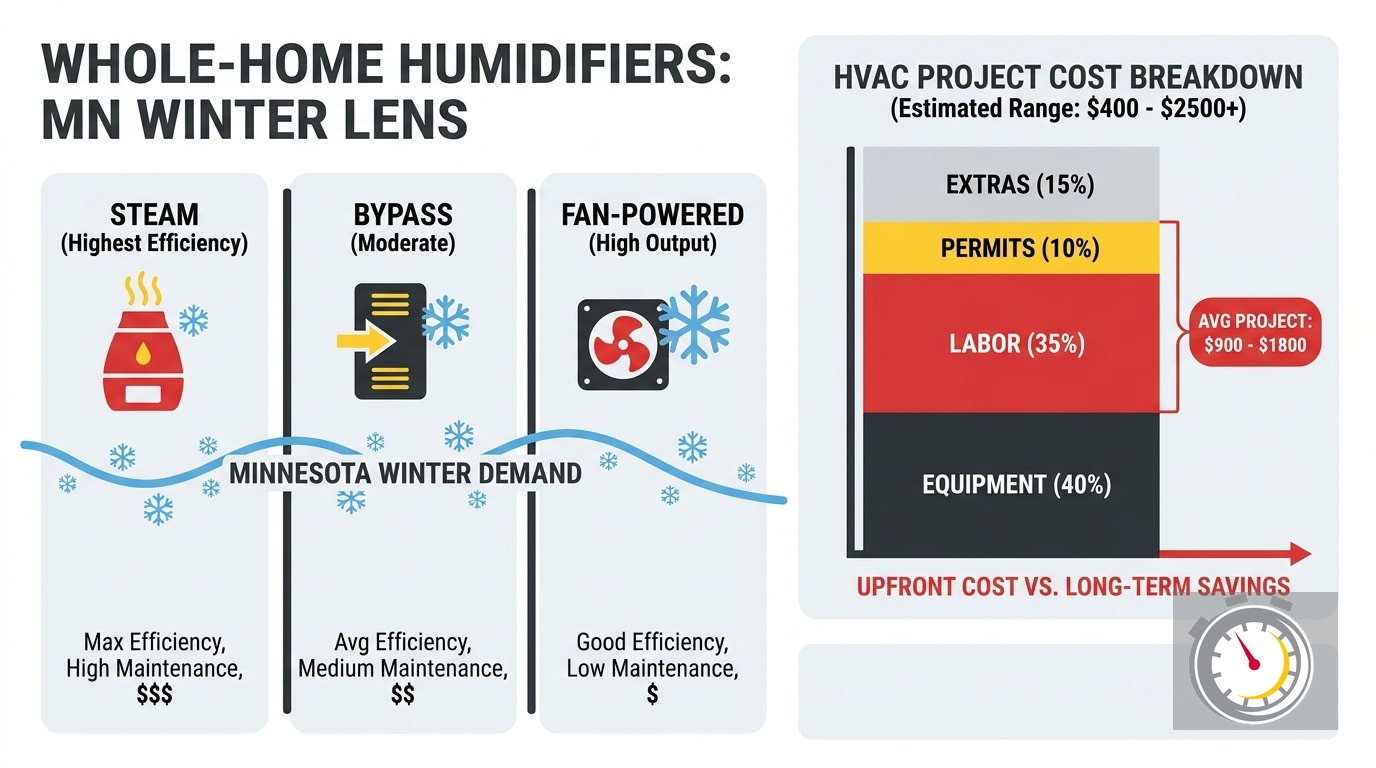
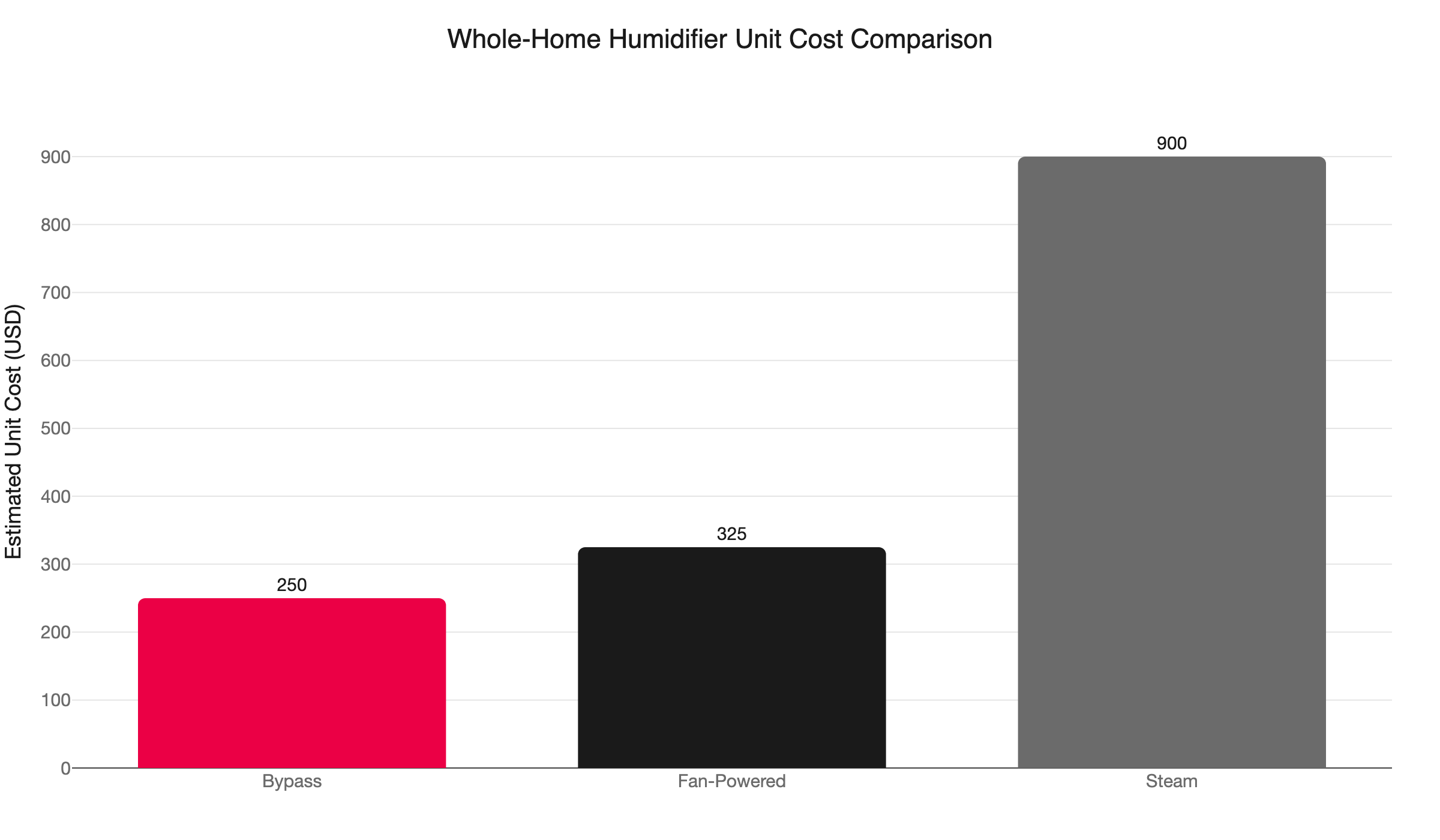
- Bypass humidifiers ($150-350 unit cost) cost less upfront but output drops in polar vortex conditions. Cold air holds less moisture, and bypass units cannot compensate.
- Steam humidifiers ($600-1,200 unit cost) deliver full rated output regardless of outdoor temperature. They cost more to run but are the most reliable choice through a hard Minnesota winter.
- Fan-powered humidifiers are a strong middle option: more efficient than bypass, far less expensive than steam, and better suited for variable-speed furnaces.
- No Xcel Energy or CenterPoint Energy rebate covers whole-home humidifiers in Minnesota. Budget the full cost upfront.
- Minnesota Mechanical Code requires a permit for humidifier installation. Unpermitted work can affect insurance claims and real estate transactions.
- Setting your humidifier too high in cold weather causes condensation behind exterior walls and frost in attics. Use a sliding setpoint that tracks outdoor temperature, not a fixed one.
Why Does Minnesota Dry Air Demand a Different Approach?
Our winters are not what national guides assume. Minneapolis averages a January low of 7°F, with many nights far below zero. Five to six months of constant furnace operation strips moisture from your home fast. A portable humidifier in one room cannot keep up. A whole-home solution is the only practical answer.
Forced-air heating systems do one thing: they move air and heat it. They do not add moisture. The colder it gets outside, the less moisture the air can hold at all. Without a humidifier, indoor relative humidity in a Twin Cities home can fall to 10-15% during a hard cold snap. Wood floors shrink and develop gaps. Door frames shift. Nasal passages dry out. Static electricity follows you from room to room.
Dry air also makes you feel colder at the same thermostat setting. Holding 30-35% RH can make 68°F feel as comfortable as 72°F in drier air. That is a real efficiency benefit over a long heating season.
The EPA recommends keeping indoor relative humidity between 30-50%. Below 30%, biological contaminants thrive more easily. Above 60%, mold growth becomes a risk. Dust mites also thrive above 50% RH, so over-humidifying can worsen allergy symptoms rather than relieve them.
Minneapolis averages a January high of 22°F and a low of 7°F, with long stretches well below zero. That climate context shapes which humidifier type actually makes sense for your home.
The Three Types of Whole-Home Humidifiers
Before comparing bypass humidifier vs steam humidifier performance, it helps to understand what each type does.
Bypass humidifiers use your furnace’s heat to evaporate water from a wet water panel. Hot supply air from the plenum passes through the pad, picks up moisture, and returns to the duct system. A bypass damper routes airflow through the unit. No separate fan, minimal electricity draw, and straightforward installation.
Fan-powered humidifiers work the same way but add a built-in fan. That fan draws air across the water panel independent of the furnace blower. The result: they can operate during low-speed furnace cycles and extract more moisture per gallon of water than bypass units.
Steam humidifiers boil water and inject steam directly into the airstream. They do not rely on the furnace to evaporate anything. They work at any outdoor temperature, at any supply air temperature, and with any heating system, including heat pumps and variable-speed ECM motors.
There is also a fourth type, the drum humidifier, found in older Twin Cities homes. It uses a rotating drum in a standing water reservoir. If your home has one, read the section near the end of this post before running it this season.
What Humidity Level Is Actually Safe in a Minnesota Winter?
The right number depends on outdoor temperature. Below 0°F, hold indoor humidity at 20-25%. From 10-20°F outside, 30-35% is safe. Above 20°F, up to 40% RH is appropriate. Exceeding those ceilings in cold weather pushes moisture into wall cavities and attics. There it condenses and causes structural damage.
Most national guides say pick a number between 30-50% and leave it. That works in a moderate climate. In Minnesota, a fixed setpoint can cause frost in your attic and moisture behind exterior walls.
The physics is straightforward. Cold exterior walls and cold attic sheathing are surfaces where migrating indoor moisture condenses. The more humidity you push into your home during a polar vortex, the more likely it is to migrate outward through the wall assembly and hit something cold. Over time, that is frost buildup, rotting framing, and mold behind drywall.
The Minnesota Center for Energy and Environment provides the right sliding scale for this:
- Below 0°F outdoor: hold RH at 20-25%
- 10-20°F outdoor: hold RH at 30-35%
- Above 20°F outdoor: up to 40% RH
The diagnostic for too much humidity is condensation on your windows. The EPA is direct on the response: if you see moisture collecting on windows, walls, or pipes, dry the surface and reduce the moisture source immediately.
A humidistat wired with an outdoor temperature sensor adjusts your setpoint automatically. A manual humidistat requires you to dial it back when a cold front moves in and restore it when temps recover. A fixed setpoint, never adjusted for conditions, is the wrong tool for Minnesota’s temperature range.
Our guide to humidistat settings for Minnesota winters walks through setup options in detail.
Bypass Humidifier vs Steam Humidifier: Performance at Extreme Cold
At extreme cold, bypass humidifiers struggle. Their output depends on warm supply air and full blower operation, both of which degrade in cold conditions. Steam delivers full rated output regardless of outdoor temperature. That gap is the central tradeoff in the bypass humidifier vs steam humidifier comparison for Minnesota homeowners.
A bypass humidifier is rated to deliver 17-23 gallons per day (GPD) under manufacturer test conditions. Those conditions assume warm supply air, normal blower cycles, and good water quality. In practice, homes with hard water, short furnace cycles, or cold supply air see output 20-35% below rated capacity. On a -10°F night, your bypass unit may reach 22% indoor humidity when the safe ceiling is 20-25%. Technically within range. But when outdoor temps climb to 15°F the next day and you need 30-32%, the unit may not get there reliably.
Steam is a different mechanism entirely. It boils water and pushes steam into the air, independent of furnace operation, supply air temperature, or blower speed. One industry source is clear: steam is “the only technology that delivers full rated capacity regardless of HVAC operation”. A steam unit set to 22% on a -10°F night will hold 22%. Set it to 32% when it is 15°F outside, it holds 32%. That predictability is what you are paying for.
One more factor: if your home has a variable-speed ECM motor or a heat pump, bypass output collapses at low blower speeds and low supply air temperatures. Steam is the only reliable choice for those systems.
What About Fan-Powered Humidifiers?
Fan-powered units are roughly 25% more efficient per gallon than bypass units. They operate independently of the furnace blower, making them better suited for two-stage and variable-speed furnaces. They are the right middle option for most conventional forced-air homes under 2,500 square feet without a heat pump.
Unit cost runs $200-450, above bypass but significantly below steam. Operating costs are similar to bypass: roughly $1-5 per month in electricity plus water. The built-in fan draws air across the water panel throughout the day, not only during furnace cycles. That continuity closes much of the output gap between bypass and steam for homes with conventional furnace operation.
Fan-powered units are not the right answer for homes with heat pumps or ECM motors running at very low speeds. Supply air in those systems can be too cool for evaporative humidification to produce consistent output. For those homes, steam is still the correct choice.
What Does Each Type Cost to Buy, Run, and Maintain?
Bypass unit cost: $150-350. Fan-powered: $200-450. Steam: $600-1,200, plus $300-600 for installation. Monthly operating costs favor bypass and fan-powered at $3-15 combined. Steam runs $10-30 per month in electricity. Water hardness is the biggest maintenance variable for all three types.
Here is a side-by-side breakdown:
Bypass
- Unit cost: $150-350
- Monthly operating: $1-5 electricity, $2-10 water
- Water panel replacement: $15-35 per season in soft-water homes; twice per season in hard-water areas (above 150 ppm)
- Installation: lower labor cost than steam; mounts to the supply or return plenum
Fan-Powered
- Unit cost: $200-450
- Monthly operating: comparable to bypass
- Water panel replacement: same schedule as bypass
- Installation: similar to bypass; requires a power connection for the fan motor
Steam
- Unit cost: $600-1,200
- Installation: $300-600 additional; a dedicated electrical circuit is required
- Monthly operating: $10-30 in electricity (8-14 amp draw during operation)
- Canister replacement: approximately $95 per season for compatible models
The ten-year cost gap between bypass and steam narrows when you factor in performance consistency and maintenance simplicity. A steam unit delivers predictable output. A bypass unit delivers variable output, most noticeably in the worst weather. If you are replacing a furnace at the same time, upgrading to steam is a modest addition to the total project cost.
Do You Need a Permit to Install a Whole-Home Humidifier in Minnesota?
Yes. Minnesota Mechanical Code requires a permit for whole-home humidifier installation. Plymouth, MN explicitly lists it as a mechanical permit trigger. Unpermitted work can result in denied insurance claims and complications when you sell the home.
Plymouth, MN lists humidifier installation in its mechanical permit triggers. This reflects the statewide requirement under Minnesota Mechanical Code Chapter 1346.0105.
The stakes are practical. If a water leak from an improperly installed humidifier causes damage and the work was unpermitted, your homeowner’s insurance may deny the claim. If you sell the home, an unpermitted mechanical installation surfaces in inspection reports. That can delay closing or become a price negotiation.
A licensed HVAC contractor pulls the permit, handles the inspection, and takes responsibility for the installation. For steam units especially, a dedicated electrical circuit is required, and that work must be code-compliant.
For more on what triggers a mechanical permit in Minnesota, see our post on when an HVAC permit is required in Minnesota.
Are There Rebates for Whole-Home Humidifiers in Minnesota?
No. As of the 2024-2026 program year, neither Xcel Energy nor CenterPoint Energy’s Minnesota residential programs include whole-home humidifiers. Plan to cover the full cost of equipment and installation out of pocket.
Xcel Energy’s Minnesota residential rebate program covers heat pumps, insulation, and high-efficiency heating equipment. CenterPoint Energy’s Minnesota program covers water heaters and high-efficiency heating systems. Neither program includes whole-home humidifiers at any tier.
If you are upgrading your furnace or installing a heat pump at the same time, those system-level rebates apply to the heating equipment. The humidifier does not qualify independently.
What If You Already Have an Older Drum-Style Humidifier?
Drum humidifiers rotate through a standing water reservoir. They are water-efficient, but that reservoir is a mold and bacteria breeding ground if not cleaned regularly. If you have not serviced yours in a season or more, replace it rather than run it this winter.
The drum design maintains standing water inside the cabinet. Without regular cleaning, that reservoir can grow mold and bacteria, which then get dispersed into your home’s air supply. A drum humidifier that goes unserviced is one of the more common indoor air quality problems in older Twin Cities homes.
A flow-through bypass or fan-powered unit drains continuously rather than holding standing water. That is a cleaner design from a maintenance standpoint. If a drum unit is more than 10-15 years old and has not been serviced in a few seasons, replacement is the practical choice.
Which Type Is Right for Your Home?
Steam for homes with heat pumps, ECM variable-speed motors, or large square footage. Fan-powered for a conventional forced-air furnace in a home under 2,500 square feet. Bypass for a tight budget, a standard single-stage furnace, and a well-managed humidistat.
Here is the practical decision framework:
- Heat pump or ECM variable-speed furnace: steam is the only reliable choice. Supply air temperatures in these systems are too low for bypass or fan-powered to maintain consistent output.
- Conventional furnace, home over 3,000 sq ft: steam ensures consistent coverage throughout the house.
- Conventional furnace, home between 1,200 and 2,500 sq ft: fan-powered hits the right balance of output, efficiency, and cost.
- Tight budget, single-stage furnace, smaller home: bypass works if you replace the water panel every season and manage your humidistat settings actively when temperatures drop.
In every case, pair your humidifier with a humidistat that accounts for outdoor temperature. A fixed setpoint is not right for a Minnesota winter. Our post on whole-home humidifiers and winter dry air management covers controls and setup in more detail.
Ready to Stop Fighting Dry Air This Winter?
Northern One Hour Heating & Air Conditioning is locally owned and operated in Ramsey, MN. We serve homeowners across the Twin Cities, including Minneapolis, St. Paul, Blaine, Maple Grove, Plymouth, and Brooklyn Park.
If cracked woodwork, scratchy throats, and static electricity have become your winter normal, a whole-home humidifier is the right fix. Our team assesses your current setup, matches the right humidifier type to your furnace and home size, pulls the required permit, and has the system running before the next cold front arrives.
“Always On Time… Or You Don’t Pay a Dime!(R)” When we say we are coming, we show up.
Call (763) 260-6662 or visit our humidifier installation and service page to book an appointment.
Frequently Asked Questions
Which whole-home humidifier works best in a Minnesota winter? +
What humidity level should I set my humidifier to in winter? +
Do I need a permit to install a whole-home humidifier in Minnesota? +
Are there utility rebates for whole-home humidifiers in Minnesota? +
Need a technician now?