
What to Set Your Humidistat in Winter in Minnesota
Key Takeaways
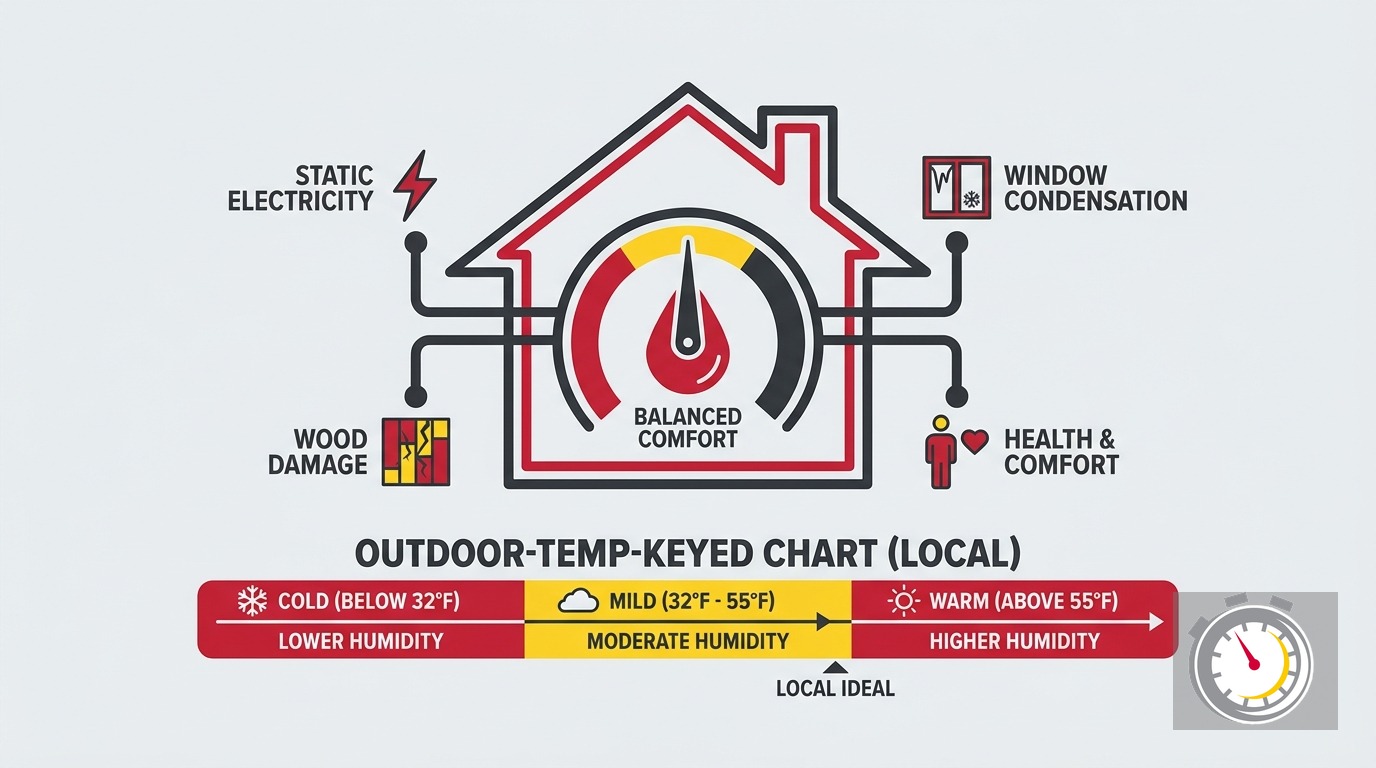
- Your humidistat setting should move with the outdoor temperature. A flat winter number ignores Minnesota’s 40-plus-degree seasonal swings.
- At 20 to 40°F outside, indoor humidity can safely reach 40%. At -10°F and below, you must drop to 25% or lower.
- Window condensation is a warning sign, not just a nuisance. Left unchecked, it leads to attic frost and real structural damage when temperatures rise.
- A family of four adds more than 6 gallons of water vapor per day to indoor air through normal daily activity, with no humidifier running.
- No rebates currently exist for whole-home humidifiers through Xcel Energy or CenterPoint Energy as of mid-2026.
- Northern One Hour Heating & Air Conditioning is locally owned and based in Ramsey. Call (763) 260-6662 if your humidistat setup needs a professional look.
Why Your Humidistat Setting Cannot Stay Fixed All Winter
Minnesota winters do not hold still. A November afternoon in the Twin Cities can sit at 35°F. A January night in Ramsey, Blaine, or Plymouth can drop to -15°F or lower.
Minneapolis averages 72 days per year when temperatures never rise above 32°F, with January minimums reaching -28°F. In a typical February, the Twin Cities see 11 to 20 sub-zero nights. The extreme cold rows in any humidity chart are not theoretical. They apply for weeks at a time every winter.
That swing matters for your humidistat. The amount of moisture indoor air can safely hold against cold surfaces changes as outdoor temperatures fall. A setting that prevents dry skin in November can cause attic damage in January.
Most online guides miss this. They offer a flat “30 to 40% all winter” recommendation without accounting for the 40-plus-degree outdoor temperature range a Twin Cities home experiences from November through February. That guidance works reasonably well at 25°F. It causes problems when it hits -15°F and your humidistat is still running at 38%.
The practical adjustment range across a full Minnesota winter is about 25 percentage points. From a ceiling of 40% at mild outdoor temperatures, you may need to drop to 15% during the coldest January stretches. No single setting covers the whole season.
What Should I Set My Humidistat to in Winter in Minnesota?
The short answer: Check today’s outdoor temperature and match it to the thresholds below. The colder it is outside, the lower your indoor humidity ceiling must go. Treat this as a seasonal reference to revisit weekly, not a one-time setup you can leave alone.
The Minnesota Center for Energy and Environment is the most authoritative local source on this. Their guidance, updated in July 2026, anchors the following thresholds:
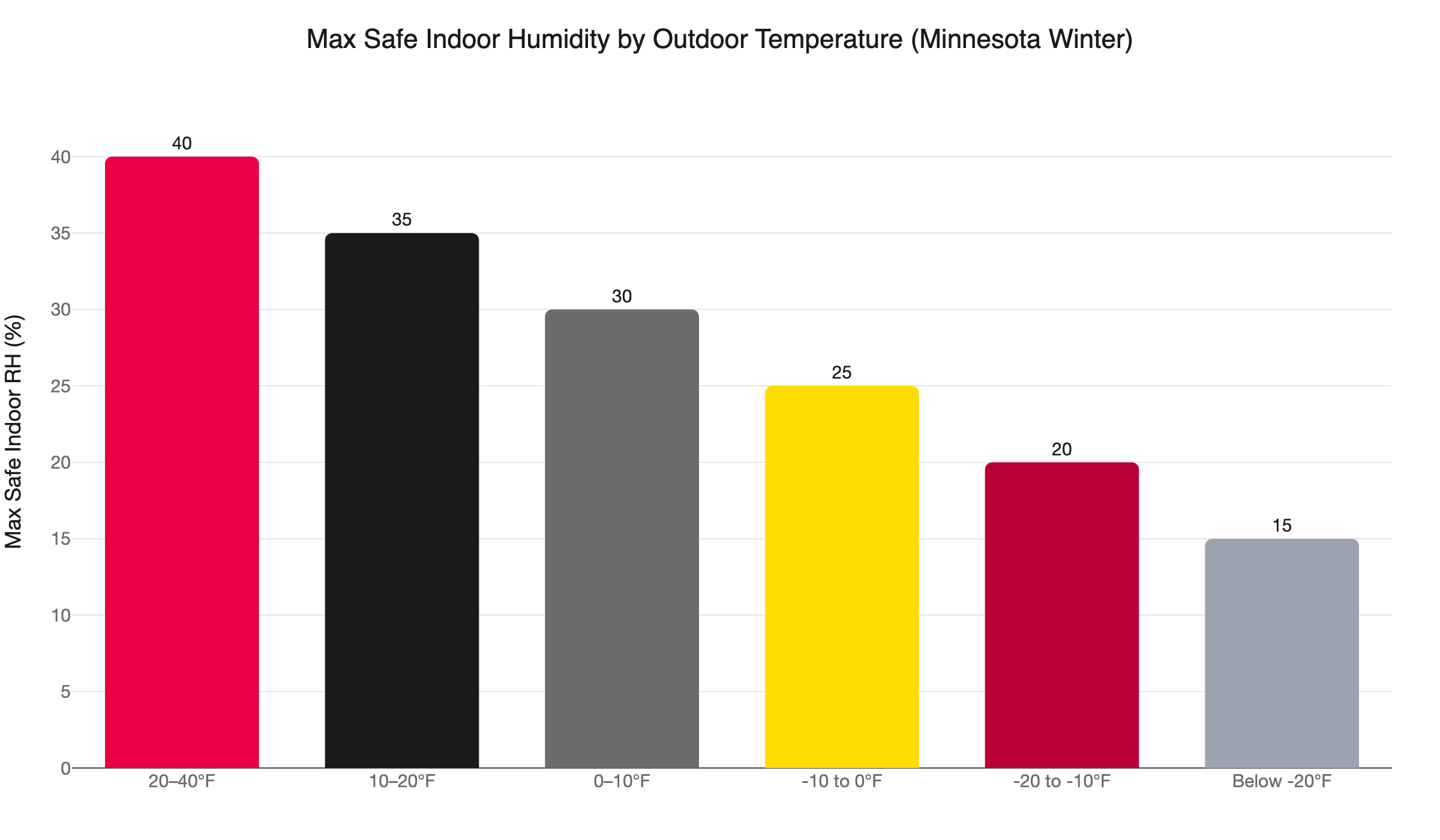
- At 20 to 40°F outside, keep indoor humidity below 40%.
- At 10 to 20°F outside, keep indoor humidity below 35%.
- At 0 to 10°F outside, keep indoor humidity below 30%.
- At -10 to 0°F outside, keep indoor humidity below 25%.
- At -20 to -10°F outside, keep indoor humidity below 20%.
- At -20°F or below, keep indoor humidity below 15%.
These are maximums, not comfort targets. Staying at or below the threshold for today’s outdoor temperature keeps moisture away from cold surfaces where condensation forms. The chart above shows these settings visually. Bookmark it. Use it as a quick reference on any morning in December, January, or February when temperatures swing overnight.
Why Does the Safe Humidity Level Drop as Temperatures Fall?
The short answer: Cold air holds less moisture before reaching its saturation point. When warm, humid indoor air meets a cold surface like a window pane, moisture drops out as condensation. The colder the surface, the lower indoor humidity must stay to avoid crossing the dew point at that surface.
Think of it as a capacity limit. At 15°F outside, your windows and exterior walls get cold enough that even moderate indoor humidity pushes past the condensation threshold at the glass. At -5°F, that threshold drops further. A setting safe at 15°F may already be too high at -5°F.
Windows give you early and visible warning. But moisture does not stop at the glass.
In Minnesota, the real structural risk is attic frost. Moisture migrates through insulation and into attic space, where it freezes against the underside of the roof decking. The buildup is silent and invisible from inside the home. CBS Minnesota has reported on the outcome directly: when temperatures rise, it begins to rain in the attic. Rotted decking, ruined insulation, and mold can all trace back to a humidistat setting that seemed perfectly reasonable all winter.
Window quality changes your personal threshold. Windows rated at a U-value of 0.35 or lower, meaning double or triple pane, are less prone to cold-weather condensation. A well-insulated home can tolerate slightly higher indoor humidity at the same outdoor temperature compared to a home with older single-pane glass. If your windows are original to a 1970s or 1980s Twin Cities build, stay toward the lower end of each range in the chart, not the upper end.
Is 20 to 25 Percent Indoor Humidity Really Safe to Breathe?
The short answer: Yes, though it will feel dry. Human bodies are most comfortable between 40% and 60% relative humidity. Minnesota winters at their worst make that comfort range unreachable without risking structural damage. The lowest settings in the chart apply only during the deepest cold snaps, not all season.
ENERGY STAR’s guidance for cold climates places the comfort and safety window at 30 to 50%, with anything above 50% flagged as a mold risk. Below-30% settings appear in the chart only for outdoor temperatures below -10°F. That is serious cold even by Minnesota standards, but it is not rare here.
This is the central tension of winter humidification in ASHRAE Climate Zone 6, which covers the Twin Cities. When it is -15°F outside and the safe humidity ceiling is 20 to 25%, you are not choosing between moisture and comfort. You are choosing between dry air and structural damage. The building comes first.
A few ways to feel less dry without raising the humidistat past safe limits:
- Add houseplants. They release water vapor passively and localize the benefit to rooms where you spend the most time.
- Stay hydrated. Low-humidity air increases moisture loss through skin and airways.
- Use textiles. Rugs, upholstered furniture, and heavy drapes hold ambient humidity better than hard surfaces and hard floors.
- Run a portable humidifier only in the bedroom, directed at the room rather than aimed at walls or windows.
How Much Moisture Does Your Household Already Generate?
The short answer: More than most homeowners expect. A family of four generates over 6 gallons of water vapor per day through normal daily activity, without any humidifier running. That baseline alone is significant in a well-sealed home during a cold snap.
The U.S. Department of Energy estimates that a family of four adds more than 6 gallons of water vapor daily to indoor air through breathing, cooking, showering, and doing laundry. No humidifier required.
In a tight, well-insulated modern home, that passive load can push indoor humidity toward condensation risk during a deep freeze. Any humidifier you add stacks on top of that already significant baseline. The combination is what tips the math.
Passive moisture management matters all winter:
- Run the kitchen exhaust fan every time you cook on the stovetop.
- Run the bathroom exhaust fan during and for 20 minutes after every shower.
- Verify that your dryer exhausts to the outside, not into a basement or crawl space.
- Keep interior doors open so moisture distributes across rooms rather than concentrating in one area.
If your home is recently weatherized or built to tight energy codes, the moisture your household generates naturally may be enough to approach the lower thresholds in the chart without a humidifier running at all.
What Happens If I Set My Humidistat Too High?
The short answer: Window condensation appears first. That is the warning stage. If the setting stays too high, moisture migrates through insulation into the attic, freezes on the roof decking, and eventually thaws into leaks and structural damage when temperatures climb back above freezing.
The window condensation stage is recoverable. Lower the setting, wipe the glass, and watch for clearing over 24 to 48 hours. Most homeowners stop there without connecting the pattern to what is happening in the attic above them.
The attic frost stage is not recoverable without significant cost. Water staining or soft drywall below an attic space typically signals compromised insulation and possible mold. The roof decking itself may need partial replacement. Repair costs in the Twin Cities regularly run into five figures. That bill far exceeds any humidifier installation or annual calibration visit.
Physical signs that your humidistat has been running too high:
- Condensation on windows, especially in the lower corners of the glass.
- Ice or frost inside exterior walls, visible near outlet covers on outside-facing walls.
- A musty or earthy smell in rooms sharing an exterior wall.
- Heavier-than-usual ice dam formation on roof edges after a cold stretch.
If you see any of these, lower the humidistat immediately. Call (763) 260-6662 if the condensation does not clear within 48 hours. Our indoor air quality team can assess whether moisture has reached your ductwork or HVAC components. Catching it at the window stage is always cheaper than waiting.
Whole-Home vs. Portable Humidifiers: Does the Type Change the Setting?
The short answer: The outdoor-temp-keyed thresholds apply to both types. But whole-home units are easier to over-set because they run quietly and out of sight. MNCEE energy auditors often recommend portable units over whole-home units because the feedback is more visible, which makes homeowners less likely to leave a setting unchanged through a cold snap.
A whole-home humidifier wired to your furnace runs without drawing much attention. You set a number in September and rarely revisit it. That invisibility is the problem when outdoor temperatures drop 25 degrees over three days in December. The setting that worked last week is now too high, and the unit keeps running.
If you have a whole-home unit, build this habit. Every Monday morning from November through February, check the outdoor temperature. Compare it to the thresholds in the chart. Adjust by 5-point steps if needed. The habit takes 30 seconds and can prevent thousands of dollars in moisture damage.
One technical point worth confirming: many whole-home humidifiers include an outdoor temperature sensor. That sensor is supposed to automatically lower the set point as it gets colder outside. Sensors can fail, drift, or be placed where they do not accurately reflect outdoor conditions. A sensor reading 30°F when it is -15°F outside means your unit has been running at the wrong setting for weeks.
Our humidifier service team can check calibration, inspect the water panel, and confirm the outdoor sensor is still reading accurately.
Does Your Ventilation System Affect Your Baseline?
The short answer: Yes. HRV (Heat Recovery Ventilator) homes have a lower indoor humidity baseline because the system trades indoor moisture for dry outdoor air. ERV (Energy Recovery Ventilator) homes retain more indoor moisture. Knowing which type you have changes how carefully you need to watch the humidistat during cold snaps.
The U.S. Department of Energy frames the distinction this way: cold-climate designers who want to keep indoor humidity lower choose HRVs; those who want to retain more indoor moisture choose ERVs. That choice affects your humidistat baseline all winter long.
In an HRV home, the system continuously trades stale indoor air for dry outdoor air. Your household generates 6-plus gallons of water vapor per day, but the HRV is constantly exhausting some of it. Indoor humidity stays lower naturally. The condensation risk is reduced. But your humidifier may need to work harder to keep indoor air from feeling uncomfortably dry.
In an ERV home, moisture transfers across a membrane and stays inside the building envelope. Indoor humidity holds higher with less humidifier run time. The flip side: during a cold stretch, an ERV home can climb past the safe ceiling more quickly. Watch the outdoor temperature thresholds closely if you have an ERV.
For a closer look at which system fits Minnesota conditions best, see our post on ERV vs. HRV ventilation systems for Minnesota homes.
Are There Rebates for Humidifiers in Minnesota Right Now?
The short answer: No. As of mid-2026, neither Xcel Energy nor CenterPoint Energy offers rebates on whole-home humidifiers. No offset is available through utility programs. Plan for the full installation cost.
Xcel Energy’s current Minnesota residential rebate program covers heat pumps, high-efficiency furnaces, smart thermostats, and cooling equipment. Humidifiers are not included. Minnesota’s HOMES and HEAR programs, funded through the federal Inflation Reduction Act and administered by the Minnesota Department of Commerce, had not launched as of June 2026.
We include this because some online content implies rebates exist without checking current availability. If you are budgeting a humidifier installation, do not build in a utility offset that is not there.
The financial argument for proper humidification is not a rebate calculation anyway. It is the cost of one attic moisture event compared to the cost of a humidifier plus annual calibration. Attic repairs in the Twin Cities regularly run into five figures. A properly maintained whole-home humidifier costs a fraction of that spread across years of service. The math favors prevention.
For rebates that do currently exist on HVAC equipment, see our guide to Xcel and CenterPoint HVAC rebates in Minnesota.
How Do You Know Your Humidistat Is Reading Accurately?
The short answer: The humidistat is only as accurate as its sensor. Sensors drift over time and can read 5 to 10 points off actual indoor humidity. That error is significant when the margin between a safe setting and a damaging one is only 5 points wide.
A simple check costs $10 to $15. Buy a digital hygrometer at any hardware or big-box store. Place it in your main living area, away from HVAC vents and exterior walls. After an hour, compare its reading to the humidistat display. If they differ by more than 5 points, the humidistat sensor may need cleaning or professional recalibration.
Signs that warrant a professional inspection:
- The humidistat reads 35%, but you still see window condensation on a relatively mild day.
- The unit runs continuously even at a low set point.
- You hear water dripping from the humidifier when the furnace is off.
- Visible mineral scale or buildup around the water panel or distribution tray.
For any of these, call (763) 260-6662 or book online. Northern One Hour Heating & Air Conditioning is locally owned and operated in Ramsey, MN. We serve the full Twin Cities metro, including Minneapolis, St. Paul, Blaine, Maple Grove, Plymouth, Brooklyn Park, Woodbury, and Bloomington. We show up when we say we will. That is the promise behind “Always On Time… Or You Don’t Pay a Dime!(R).”
Setting the Humidistat: Your Next Steps
If you have not adjusted your humidistat since last fall, now is the time. Check today’s outdoor temperature, find the matching threshold in the chart, and compare it to your current setting.
At or below the threshold? You are fine. Keep checking weekly through February.
Above the threshold? Lower the setting by 5 points. Check your windows after 24 hours. Repeat if condensation persists.
Condensation already visible? Lower the setting immediately. Give it 48 hours. If improvement does not come, call a technician.
Winter humidity management in a Minnesota home is not a one-time setup. The adjustment from early November to deep January is roughly 25 percentage points. No single setting is right for the whole season. Homeowners who protect their homes check the setting weekly. They adjust for current outdoor conditions. They call for help when the equipment is not responding as expected.
Our indoor air quality team and humidifier service are here for exactly that. Call (763) 260-6662 or book an appointment online. We will be there when we say we will.
Frequently Asked Questions
What should I set my humidistat to in winter in Minnesota? +
What happens if I set my humidistat too high in winter? +
Does a whole-home humidifier need different settings than a portable one? +
Are there rebates for whole-home humidifiers in Minnesota? +
Need a technician now?