
AC Unit Too Loud for Neighbors Placement: Twin Cities Fixes
Key Takeaways
- Minnesota sets noise limits for residential neighbors, and the nighttime limit is lower than the daytime limit.
- Placement matters most. Distance from bedroom windows beats almost any add-on.
- Sound blankets can cause airflow and heat problems. Ask a technician before you wrap anything.
- A deck over an AC unit needs open airflow, service access, and a check of local rules.
- Variable-speed and two-stage units run quieter because they rarely run at full blast.
- Heat pump outdoor units run in winter, so their noise lasts all year.
- Call (763) 260-6662 or book online, and we will look at your unit and your lot.
The Short Answer for Loud Outdoor Units
If your ac unit is too loud for neighbors, placement is usually your biggest lever. Distance, direction, and nearby walls decide how much sound reaches the next yard.
Start by moving the unit away from bedroom windows and property lines. Keep it off reflective walls and out of tight corners. Then check the unit for worn parts that add noise.
Twin Cities lots make this harder. Side yards are narrow, and houses sit close together. A unit that was fine for the first owner can bother the family next door.
We are Northern One Hour Heating & Air Conditioning, locally owned and operated in the Twin Cities.
Why Is the Outdoor AC Unit So Loud?
An outdoor AC unit is loud because it holds a compressor and a big fan, and both make noise. Worn bearings, loose panels, vibration, and a dirty coil add to it. Single-stage units also run at full power every cycle.
Most of the sound comes from three parts:
- The compressor. This pump moves refrigerant, and it hums when it runs.
- The condenser fan. It pulls air across the coil. Fan blades and motor bearings can whine or rattle.
- The cabinet. Thin panels and loose screws vibrate and amplify everything.
Some noise is normal. A steady hum is fine. A new rattle, buzz, grind, or squeal is not.
Dirt makes it worse. A clogged coil forces the fan and compressor to work harder. Our guide to cleaning your outdoor AC unit shows what safe cleaning looks like. For a full list of sounds and what each means, read why your AC is so loud.
A failing fan motor is a common cause of a sudden new noise. A condenser fan motor repair typically runs $375 to $900 in the Twin Cities. Fixing it early often quiets the unit for good.
Can Neighbors Complain About Your Air Conditioner?
Yes, neighbors can complain. Minnesota has noise limits for residential areas, and a loud AC unit can exceed them, especially at night. Whether a complaint goes anywhere depends on how your city handles noise and what a measurement shows.
Most neighbor issues never get that far. A friendly conversation often solves it. Still, learn the rules before a complaint lands on your porch.
If a neighbor raises the issue, start with the facts:
- When does the noise bother them most?
- Is it a steady hum or a rattle?
- Does it happen only on the hottest days?
A rattle usually means a repair. A steady hum usually means a placement or equipment fix. Either way, acting early keeps the relationship good.
Cities enforce noise rules in their own ways. Call your city office to learn how yours handles noise concerns.
What Does Minnesota’s Noise Rule Say?
Minnesota’s noise rule sets limits for residential properties. Daytime is 7:00 a.m. to 10:00 p.m., and nighttime is 10:00 p.m. to 7:00 a.m. The nighttime limit is 50 dBA for the level exceeded half the hour. Daytime is 60 dBA.
The rule is in Minn. R. 7030. It uses two measures for homes:
| Measure | Daytime | Nighttime |
|---|---|---|
| L50 (exceeded 50 percent of an hour) | 60 dBA | 50 dBA |
| L10 (exceeded 10 percent of an hour) | 65 dBA | 55 dBA |
The same page defines the day and night windows. A “dBA” is a decibel reading weighted to match how people hear.
The Minnesota Pollution Control Agency noise guide explains how this works in practice. It describes a one-hour sample. Daytime noise cannot exceed 65 dBA for more than 10 percent of the time, which is 6 minutes. It also cannot exceed 60 dBA for more than 50 percent of the time, which is 30 minutes.
This matters for your AC because cooling systems run longest on hot nights. That is when the lower nighttime limit applies. A unit that seems fine at noon can be a problem at 2 a.m.
We are not a testing lab, and we do not measure sound for legal cases. If compliance worries you, ask your city how it measures noise. We can help you choose placement and equipment that lower the sound at the source.
Where Should You Place an AC Unit on a Tight Twin Cities Lot?
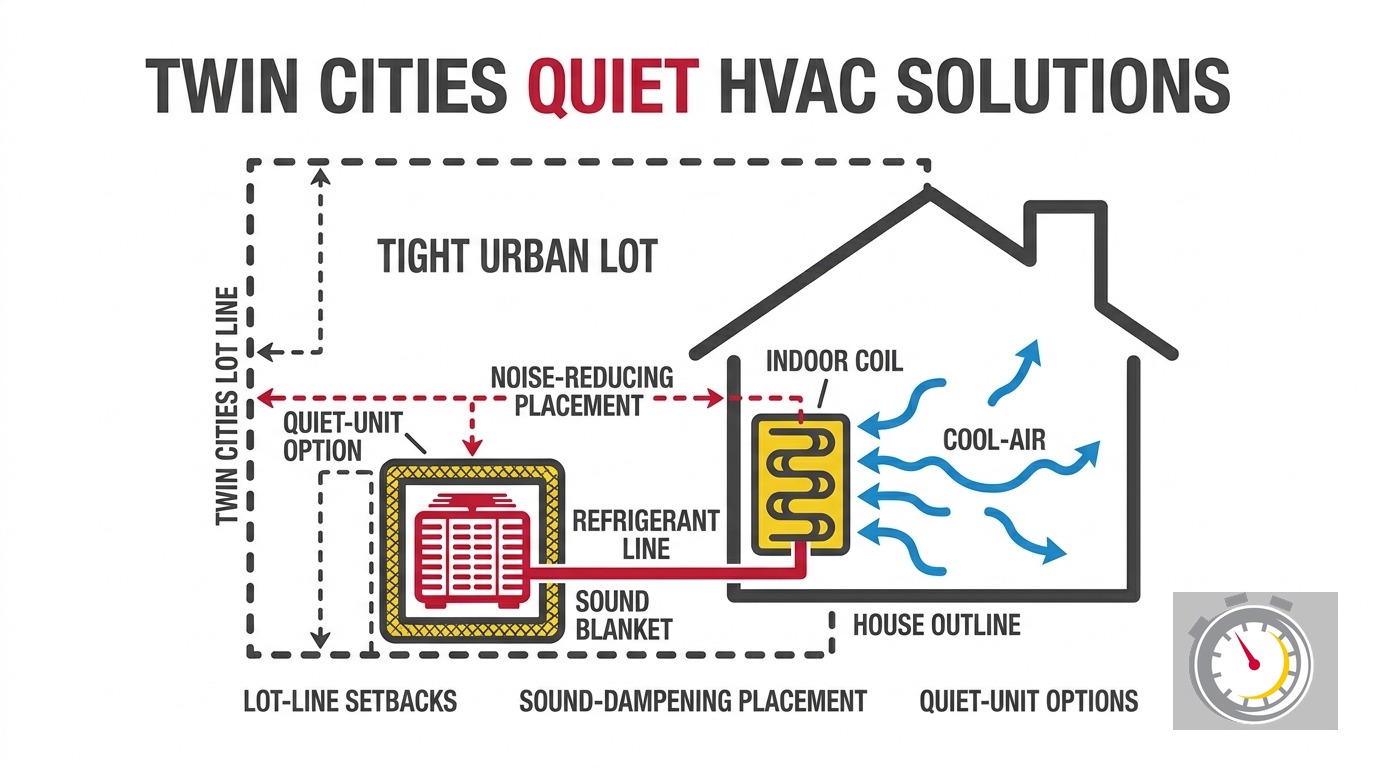
Place the unit as far from bedroom windows and property lines as your lot allows. Aim the fan away from neighbors, avoid reflective walls and tight corners, and keep clear space around it for airflow. Put it near your own less-used rooms, not theirs.
Use this checklist when you pick a spot:
- Distance from neighbor windows. Sound drops as it travels, so every extra foot helps.
- Distance from your own bedrooms. Sound that annoys you also annoys them.
- Fan direction. The fan blows air up on most modern units. Side noise still travels toward whatever faces the unit.
- Walls and corners. Hard walls bounce sound back. Corners trap it and make it louder.
- Airflow clearance. The coil needs open space to breathe.
- Service access. A technician must be able to reach every side.
Corners are the classic mistake. Two walls reflect sound toward the same spot. A unit in the open side yard may be quieter than one tucked into a corner, even if the corner looks hidden.
Clearance affects noise too. A cramped unit runs hotter and louder. Our guide to AC condenser clearance and landscaping covers how much space the unit needs.
Shade helps your bills, but not your noise. Plants do not block sound much, and they can crowd the coil. See our post on shading your outdoor AC unit for safe ways to do it.
Twin Cities Yard Rules and Setbacks
Cities set rules for where equipment can sit in your yard. Minneapolis requires required yards to stay open from the ground to the sky, with listed exceptions. Central AC is one of those exceptions, up to five feet tall. Always confirm the exact distance with your city before you move a unit.
The City of Minneapolis publishes a permitted obstructions table. Section 540.890 says required yards “shall remain open and unobstructed from ground level to the sky” except as the table allows. The table lets window AC units project up to 18 inches. It also covers central AC and heating equipment up to five feet tall.
We do not quote a minimum distance here. It depends on your zone and lot, and it can change. Suburbs have their own codes too. Plymouth, Richfield, and Eagan, for example, write their own rules.
The safest step is a quick call. Ask your city planning or zoning office three things:
- Can the unit sit in a side yard or rear yard?
- How far must it sit from the property line?
- Do you need a permit to move it?
In Minneapolis, you can start with 311 at 612-673-3000. Our guide to when an HVAC permit is required explains the usual permit steps.
Narrow lots leave little room. The quietest legal spot may not be the easiest one. In that case, equipment choice matters more, and we cover it below.
Do Sound Blankets Work, and Are They Safe?
Sound blankets can lower noise a little, but they carry risks. A wrap can trap heat, block airflow, and strain the compressor. Some manufacturers may also object to unapproved add-ons. Talk to a technician before you wrap anything around your condenser.
A condenser must release heat. It pulls air through the coil and pushes it out the top. Cover too much of the cabinet and the unit cannot shed heat. Then it runs hotter, works harder, and may get louder.
The main risks:
- Blocked airflow. Heat builds up around the coil.
- Higher run time. The system fights to hit the thermostat setting.
- Component wear. Heat shortens the life of the compressor and motors.
- Warranty questions. Check your warranty terms before you add anything to the unit.
Sound blankets also do little for a unit with a worn part. A rattling fan or a failing compressor needs repair, not a wrap. Our guide to compressor failure signs and repair costs shows what to watch for. A compressor replacement typically runs $1,950 to $4,500 in the Twin Cities.
If you want a barrier, think about a separate solid fence or screen. Keep it well off the unit, with open space on every side and above. Ask us to check the spacing first.
Vibration pads are another small fix. A level, solid pad stops the cabinet from buzzing against the ground. A tech can also tighten panels and refrigerant line supports that shake loose over time.
Can You Build a Deck Over an AC Unit?
You can build near an AC unit, but covering it is risky. The unit needs open air above and around it, plus room for service. A deck can also trap and bounce sound. Check your city’s rules and talk to a technician before you build.
Decks cause trouble in four ways:
- Hot air gets trapped. The condenser blows warm air upward, and a low deck recirculates it.
- Sound bounces. A deck underside can reflect noise out and down.
- Repairs get harder. A tech must reach the unit to service it.
- Rules may apply. Yard and permit rules can limit what goes near equipment.
If you plan a deck, plan the AC at the same time. Leave plenty of open space around the unit and keep the area above it clear. Think about where sound will bounce.
Some homeowners move the unit before building. That can be cleaner than building around it. A move needs new refrigerant lines, so ask about line set replacement costs first.
We cannot give you the exact clearance your city requires. We can walk the site, flag problems, and help you plan a layout that works for both your deck and your AC.
Which Quiet-Unit Options Cut Noise the Most?
Variable-speed and two-stage units cut noise the most. They run at lower speeds most of the time, so they hum instead of roar. Look at the unit’s sound rating too. A lower outdoor decibel rating usually means a quieter neighbor experience.
How the main options compare:
- Single-stage AC. It runs at full power every time. It is the loudest type when running.
- Two-stage AC. It runs on low most days and ramps up only on hot ones.
- Variable-speed AC. It adjusts in small steps and often runs slow and steady.
Slower fans make less noise. They also cut the on-off surge you hear when a single-stage unit kicks on. Our guide to variable-speed AC benefits explains how this works in Twin Cities summers.
Sound ratings help you compare. Our post on HVAC sound ratings and quiet systems shows how to read them. Ask for the outdoor rating before you buy, and compare models side by side.
Sizing matters too. An oversized unit short-cycles, which means it turns on and off a lot. Each start adds noise. Read our post on oversized AC problems. A proper load calculation helps, and our explainer on right-sized HVAC systems shows how.
Refrigerant changes may also affect you. If your unit uses R-410A, replacement may come up sooner than you expect. Our posts on the R-410A phase-out and the R-454B refrigerant change explain what you face. If you may replace anyway, choose a quiet model.
If you also see warm air from your vents, check our guide to AC running but blowing warm air. A struggling unit often gets louder before it fails.
Does Heat Pump Noise Matter in Winter Too?
Yes. A heat pump’s outdoor unit runs in winter as well as summer, so its noise lasts through the heating season. Defrost cycles can add short bursts of sound. Placement and sound ratings matter just as much for a heat pump as for an AC.
Many Twin Cities homeowners now choose heat pumps. That means the outdoor unit works more months of the year. A noisy spot you tolerated in July can wear on neighbors in January.
Winter brings its own issues. Snow and ice can build up around the unit, and drifts can block airflow. Our guides to heat pump outdoor unit snow clearance and normal heat pump noises explain what to expect.
Vibration is another factor. A unit mounted against the house can pass a hum through the wall. Read our post on heat pump vibration noise for fixes.
Ductless mini splits suit tight lots. Their outdoor units are small and can sit in spots a large condenser cannot. See our guide to mini split vs. window AC options for a comparison.
What Does a Quieter Setup Cost?
Costs vary with the fix. A tune-up or small repair costs far less than a move or replacement. Central AC replacement for a mid-tier system typically runs $7,500 to $10,400 installed in the Twin Cities. A high-efficiency unit runs $11,000 to $15,600.
Start with the cheapest fix and move up only if you need to.
| Fix | Typical cost |
|---|---|
| Single tune-up visit | $95-$250 |
| Capacitor repair | $195-$500 |
| Condenser fan motor | $375-$900 |
| Compressor replacement | $1,950-$4,500 |
| Central AC, mid-tier installed | $7,500-$10,400 |
| Central AC, high-efficiency (18-20+ SEER2) | $11,000-$15,600 |
These are typical ranges, not quotes. Your price depends on your home and equipment. Our AC replacement cost guide breaks it down further.
A tune-up is the cheapest first step. A tech can tighten panels, check the fan, and clean the coil. See what a visit covers in our AC tune-up guide. An annual maintenance plan typically runs $195 to $390.
Rebates can help if you replace. Xcel Energy lists rebates for qualifying equipment. Per a 2024-2026 Xcel Minnesota rebate summary, central AC pays $150 at 13.4 SEER2. It pays $450 at 15.2 SEER2 with 12.0 EER2. Ducted air-source heat pumps pay $1,600 for combo or gas-only customers. A third-party site hosts that summary, so confirm the amounts with Xcel before you plan around them.
You can stack some programs. Read our guides on Xcel and CenterPoint rebates and stacking rebates for how it works.
Larger jobs raise the question of payment. We offer financing options for bigger projects. Our guide to HVAC financing explains what to know before you apply.
A Simple Plan to Quiet a Loud Unit
Follow these steps in order. Stop when the noise is fixed.
- Listen first. Note the sound type and the time of day it bothers people.
- Clean and tighten. Book a tune-up. Many noises come from loose parts or a dirty coil.
- Check the clearances. Make sure nothing blocks airflow around the unit.
- Level the pad. A solid base cuts buzzing and vibration.
- Consider a screen. Use a solid barrier set well back from the unit.
- Repair worn parts. A bad fan motor or capacitor adds noise fast.
- Move or replace. If the spot is the problem, plan a move. If the unit is old, choose a quiet model.
Skip the wrap unless a technician approves it. Most fixes in steps 1 through 6 cost far less than a replacement.
How Northern One Hour Helps
We are locally owned and operated, and we work on Twin Cities homes every day. We know tight lots, short side yards, and neighbors who sit just a few feet away.
When you call, we look at the unit, the lot, and the sound. We check the fan, the coil, the pad, and the clearances. We tell you what is worth fixing and what is not. Our AC repair team handles noisy parts. Our AC installation team helps you pick a quieter system and a better spot.
You choose the time window, and we arrive within it. If our technician does not show up on time, you do not pay for the service. That is our promise: “Always On Time… Or You Don’t Pay a Dime!(R)” Read more about why on-time service matters.
Call (763) 260-6662 or book online, and we will help you find a quieter fix for your lot.
Frequently Asked Questions
Does a fence help block AC noise? +
Does a louder AC mean something is broken? +
Should I move my AC unit or replace it? +
Need a technician now?