
Does Shading Your AC Unit Save Energy? The Real Numbers
Key Takeaways
- Does shading AC unit save energy? Measured field data says barely: 0.1% average efficiency gain across three homes, 1% at best.
- The DOE’s “up to 10%” figure has no published methodology. A Snopes investigation rated the underlying claim unproven.
- Shading your home’s west-facing walls and windows cuts cooling energy by 15-35%. That is 15 to 30 times more effective than shading the condenser.
- A poorly placed shade structure can recirculate hot exhaust air back across the intake coil. That forces the system to work harder, not less.
- Minneapolis-area code requires 12-24 inches of clearance on the condenser’s sides and 5 feet above. Permanent structures also face property-line setback rules.
- The better bets for lower cooling bills: a seasonal tune-up, a smart thermostat, improved air sealing, and strategic landscaping around the house itself.
Does Shading Your AC Unit Save Energy?
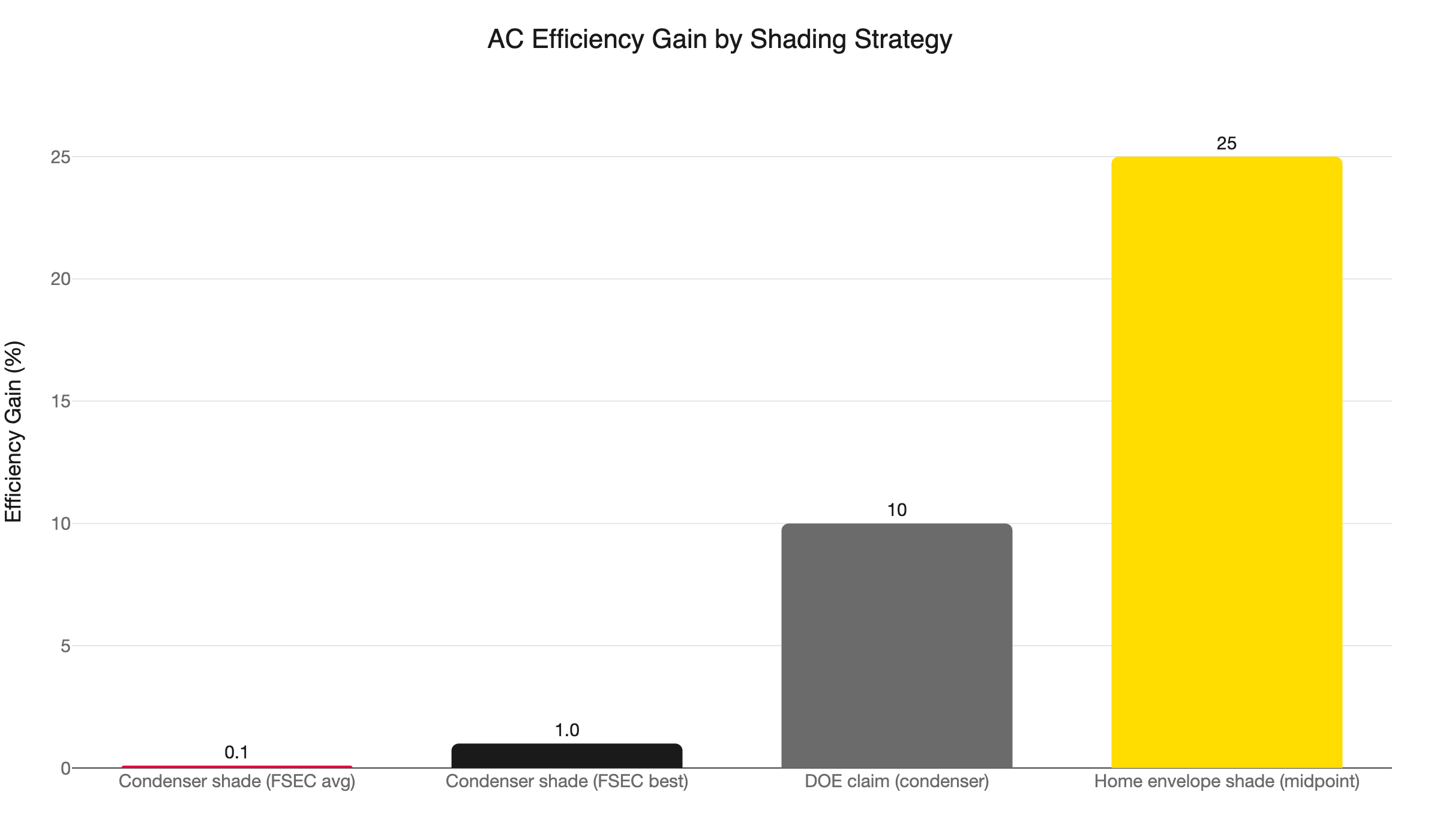
The short answer: Barely, and possibly not at all. A 1996 FSEC field study measured real condenser shading at three homes over two full cooling seasons. The average efficiency improvement was 0.1%, within the study’s own margin of error. The best result at any single site was 1%.
That 0.1% average is the only measured data we have. The rest of the landscaping-tip internet has run for three decades on a DOE claim that has never come with a published methodology.
So why is the measured gain so small? The answer is physics.
A standard 3-ton condenser moves roughly 170,000 cubic feet of air per hour across its coils. That airflow volume is enormous relative to the cabinet’s surface area. The metal casing of the condenser does not conduct significant solar heat to the refrigerant inside. Most heat exchange happens at the fins and coils, where outdoor air flows directly through.
When direct sunlight hits the cabinet, it raises the condenser-inlet temperature by at most 0.2 degrees Fahrenheit. At the accepted rate of 1.2% efficiency gain per degree F, that caps direct-shade savings at well under 0.25%. A 2002 ACEEE analysis by the same FSEC researchers confirmed this theoretical ceiling.
The physics and the field data agree. Shading the box does not move the needle.
What the Field Research Actually Found
The FSEC study ran at three Florida residential sites over two full cooling seasons. Researchers used paired data loggers and measured actual energy consumption before and after condenser shading was applied.
Here is what they found:
- Site 1: 1% efficiency gain (the best result in the study)
- Site 2: Near zero change
- Site 3: Near zero change
- Average across all three sites: 0.1%, plus or minus 2.0%
That margin of error matters. A 0.1% average with a +/- 2.0% band means the effect was statistically indistinguishable from zero. The shading could have helped or hurt, and the instruments could not tell the difference.
Most people assume a condenser sitting in direct sun must be getting hot and working harder because of it. That intuition is understandable. Metal in the sun heats up fast. But the condenser is not a passive solar collector. It is an active heat-rejection machine moving air at high volume. The cabinet surface temperature barely reaches the refrigerant circuit.
The researchers concluded that the casing conducts very little solar heat to the fins and refrigerant. The 2002 ACEEE follow-up put a theoretical ceiling on the physics. If direct shade lowers condenser-inlet air temperature by 0.2 degrees F, and each degree is worth 1.2% efficiency, the ceiling is well under 0.25%. No shade structure can engineer around that constraint.
Why Does the DOE Claim “Up to 10%”?
The short answer: Nobody knows. Energy.gov states that shading the outdoor unit can increase efficiency by up to 10%. That claim has circulated for years. But neither the DOE nor any source citing it has published a field study, a lab test, or a data set to support it.
The number directly contradicts the FSEC field measurements and the ACEEE theoretical ceiling. One plausible explanation: the DOE may be conflating two different interventions. Shading the condenser is one thing. Shading the entire home is another. The results are completely different. If the agency folded strategic landscaping around a house into a figure labeled “shade the unit,” it would explain the gap.
Snopes investigated the related claim that covering an AC unit with an umbrella or canopy lowers energy bills. They rated it unproven and misleading. They also quoted a DOE spokesperson directly: “This is a myth. Shading an AC with an umbrella would have a negligible effect.”
That is the same agency that published the 10% figure. Their own representative called it a myth.
The honest takeaway: the DOE claim should not be taken at face value. It contradicts measured data, and the agency’s own staff contradicts it. Use it as a conversation starter, not as a basis for a landscaping project.
When Does Shade Actually Hurt Your AC?
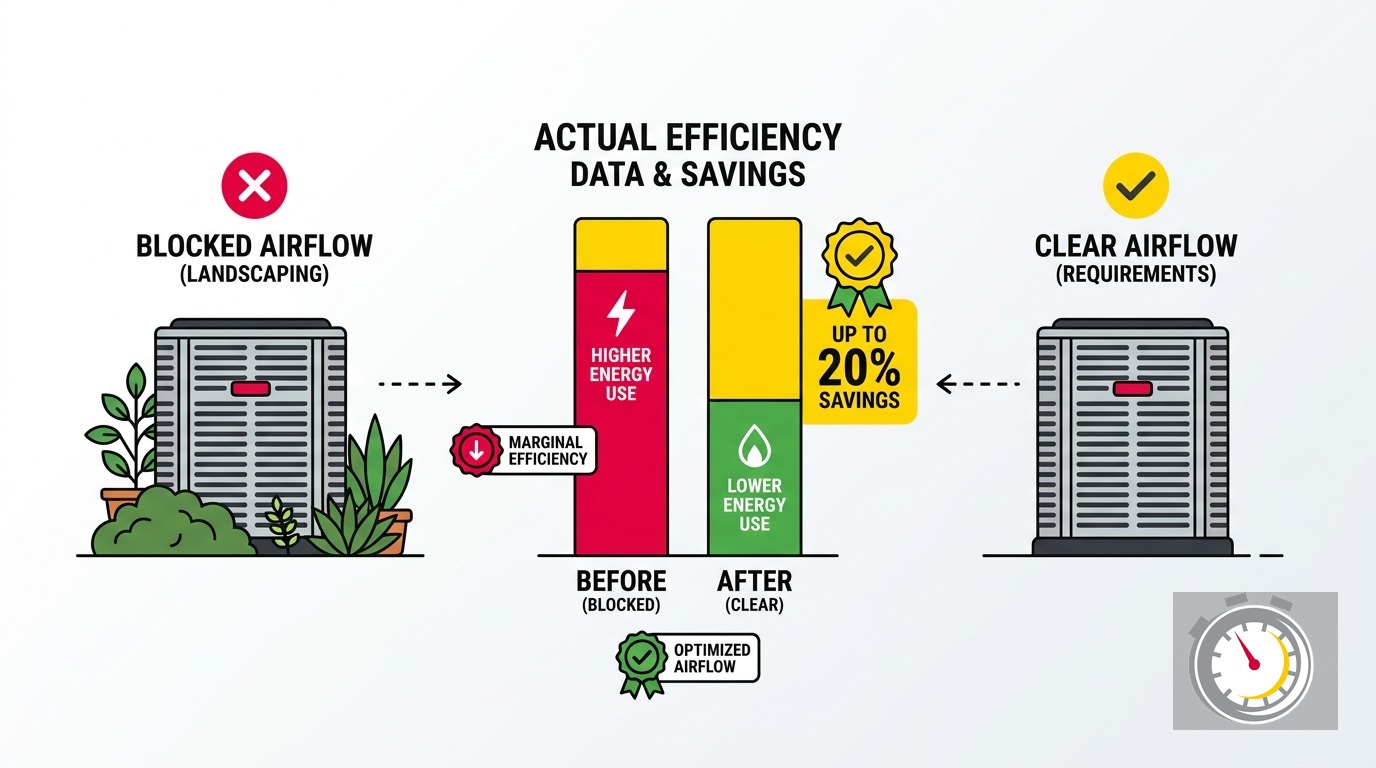
The short answer: When it restricts airflow. The condenser exhausts heat upward and draws cool air in from the sides. When a fence, trellis, or dense shrub surrounds the unit too tightly, that exhaust air loops back across the intake coil. The unit now operates in air hotter than ambient temperature, and efficiency drops below baseline.
Manufacturer specs and the 2024 IRC establish minimum clearances for exactly this reason: typically 12-24 inches on the sides and 5 feet of unobstructed space directly above. These are not aesthetic guidelines. They are the engineering margins required to prevent recirculation.
The practical problem is predictable. Most homeowners who want to hide the condenser plant shrubs or build a lattice screen close enough to create the recirculation effect. They add something intended to save energy. They end up spending more instead.
A technician diagnosing an overworked system will often find a too-close fence or an overgrown shrub as the culprit. It is more common than most homeowners expect.
If the theoretical gain from condenser shading is already under 1%, and airflow restriction pushes efficiency below baseline, the risk-reward calculation is easy. A shade structure that respects clearances has marginal upside. One that does not has real downside.
Where Shade Really Pays Off
The actual efficiency gains from shading come from your home’s envelope, not from your condenser.
Research from the Building America Solution Center and USDA Forest Service data show that three well-placed trees can cut annual cooling energy use by 10-50% and save $100-$250 per year. Strategic landscaping around west-facing walls and windows produces a 15-35% reduction in cooling energy. That is 15 to 30 times larger than the measured condenser-shading benefit.
Two mechanisms drive this:
Solar gain reduction. West-facing windows are the biggest summer heat source in most Twin Cities homes. Afternoon sun drives radiant heat directly into the living space. Because that heat enters before the thermostat has a chance to respond, the AC starts every cooling cycle at a higher setpoint. A tree or tall shrub shading those windows reduces the heat load before the system ever turns on. Shorter cycles, lower bills.
Evapotranspiration. Trees release water vapor as they grow. That natural evaporation cools the surrounding air by several degrees. Lower ambient temperature near the home means the air your condenser actually draws in is cooler. This reduces condenser-inlet temperature the way shading the cabinet tries to, but at a dramatically larger scale.
To make the gap concrete: if your home spends $200 per month on cooling during peak summer, a 25% reduction from home shading saves $50 per month. Condenser shading at 0.1% saves $0.20. That is the actual difference between these two strategies.
If you have $500-$1,000 to spend on trees and shrubs this fall, put them on the west and southwest sides of the house. Shade the windows and walls. That is where the return on investment is.
Does Shading AC Unit Save Energy in a Minnesota Summer?
The short answer: Less than anywhere else in the country. The Twin Cities averages roughly 12-15 days above 90 degrees Fahrenheit per year, based on NOAA climate normals. That is the narrow window when high ambient temperature meaningfully stresses a properly sized condenser.
Compare that to Phoenix or Houston, where systems operate at 95 degrees or hotter for 60 or more days per year. Even if condenser shading offered a 1% efficiency gain in those climates, the benefit compounds across a long, brutal season. In Minnesota, you are optimizing for a problem that appears for about two weeks per summer.
There is also a self-selecting problem with this advice. The days you feel most motivated to shade the condenser, the genuinely brutal 95-degree days, are the days when it would matter most. But those days are rare here. Most Twin Cities cooling happens at 78-88 degrees, where condenser stress is minimal and the shading effect is even smaller than what the FSEC measured.
The FSEC study that found 0.1% average savings was conducted in Florida. If the results were that marginal in a climate built to stress AC equipment, the effect here is smaller still.
This is not an argument to skip maintenance. A dirty evaporator coil or a low refrigerant charge will cost far more than condenser shading will ever save. Our guide to extending your AC’s lifespan covers the items that actually move your cooling bill.
What Are the Clearance Rules for Condenser Placement?
The short answer: Equipment specs require 12-24 inches on the sides and 5 feet above. In Minneapolis, permanent structures near the pad also face 3-5 foot setbacks from the property line, measured to the edge of the equipment pad.
If you are planning a shade structure, pergola, or lattice screen near your condenser, you need to know both sets of rules before you build.
Equipment clearances. The 2024 IRC and manufacturer documentation require a minimum of 12-24 inches on the sides and 5 feet of clear vertical space directly above, where heat is expelled upward. An HVAC technician who finds a system running extended cycles will check clearances early in the diagnostic. A violation does not need to be dramatic to cause real problems.
Minneapolis zoning. Minneapolis Chapter 535 requires any permanent structure near the condenser to meet property setbacks of 3-5 feet, measured from the edge of the equipment pad. Most suburban municipalities across the metro follow similar rules. Check with your city before you build anything.
A setback violation can surface during a home sale. Inspectors flag it. Your HVAC manufacturer’s warranty may also require minimum clearances to remain valid.
If you want to screen the condenser for aesthetics, use an open lattice design and keep it well outside manufacturer minimums. Function before form.
What Should You Do Instead?
The short answer: Spend the budget where the data says it pays. A tune-up, a filter swap, a smart thermostat, and strategic home landscaping all deliver documented, measurable results that condenser shading cannot match.
1. Schedule a tune-up. A professional AC maintenance visit catches dirty coils, worn capacitors, low refrigerant, and airflow problems before they compound. These are the real efficiency killers. A tune-up runs $95-$250 and typically pays back quickly in lower runtime hours.
2. Check your filter. A clogged air filter restricts airflow across the evaporator coil. That is a documented, measurable efficiency loss. Check it monthly in summer. Replace it every one to three months depending on your household and whether you have pets.
3. Install a smart thermostat. A Wi-Fi thermostat that lets the temperature drift while you are away cuts cooling costs by 10-15%. That is a real, documented savings. No permits required, no clearance rules, no landscaping budget.
4. Shade the house, not just the unit. Strategic trees and shrubs on the west and southwest sides of the house deliver 15-35% cooling energy reductions. Put the landscaping budget there.
5. Ask about a system upgrade if yours is aging. A central AC unit older than 12-15 years loses efficiency as components wear. A modern high-efficiency central AC system running at 18-20+ SEER2 uses significantly less energy than a 10-SEER unit from a decade ago. High-efficiency installs in the Twin Cities typically start at $11,000-$15,600. Xcel Energy offers up to $400-$450 in rebates for qualifying units, stackable with the federal 25C tax credit of $600. See the full rebate breakdown here.
Ready to Lower Your Cooling Bill?
The research is clear. Shading the condenser is not the lever. Real cooling savings come from a well-maintained, properly charged system and from managing heat before it enters the house.
Northern One Hour is locally owned and operated in the Twin Cities. Our team serves Ramsey, Blaine, Maple Grove, Plymouth, Brooklyn Park, Woodbury, Bloomington, and the surrounding metro. We show up when we say we will. That is our guarantee: “Always On Time… Or You Don’t Pay a Dime!(R)”
Call us at (763) 260-6662 or book your service visit online. We will give you a straight answer on what will actually move your cooling bill this season.
Frequently Asked Questions
Does shading an AC unit actually save energy? +
Can a shade structure damage my AC unit? +
What actually reduces cooling costs in a Minnesota summer? +
Are there rebates for high-efficiency AC in Minnesota? +
Need a technician now?