
Heat Pump Steam Coming Off Outdoor Unit: Is It Normal?
Key Takeaways
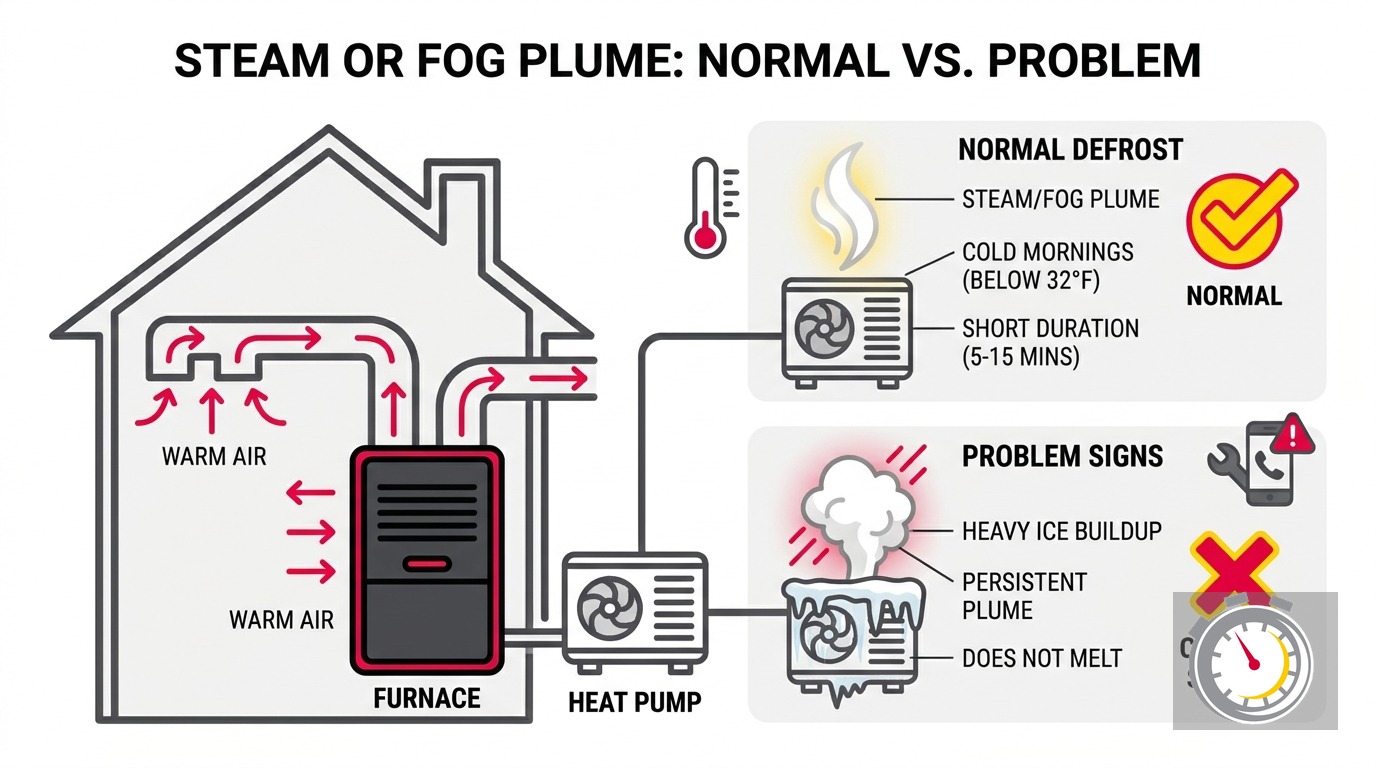
- Steam during defrost is melted frost turning to vapor. It is normal in cold, damp weather.
- A Trane guide calls this steam “perfectly normal” and lists a cloud, AUX heat, a swooshing sound, and a paused fan as normal signs.
- Most cycles end within a few minutes. Cycles that run past 15 minutes suggest a fault.
- Back-to-back cycles in mild weather, thick ice that stays, or heat that stops completely are problem signs.
- A faint dusty smell from backup heat strips can happen early in the season. A strong burning smell means shut the system off and call.
- Clear snow and ice from around the unit, but never chip ice off the coil.
- Use our four-step ladder: normal, watch, call the same day, or shut off.
Is Steam Coming Off Your Heat Pump Normal?
In most cases, yes. A white plume rising from your outdoor unit on a cold morning is usually a defrost cycle. The unit is melting frost off its coil, and the melting frost turns to vapor. That is not smoke, and it is not a leak. What matters is how long it lasts and how the unit behaves afterward.
We are Northern One Hour Heating & Air Conditioning, a locally owned and operated HVAC company in Ramsey, serving the Twin Cities. Every winter, homeowners call us after spotting a cloud around their heat pump. Most of the time, we tell them to relax and grab a stopwatch.
Why Is There Steam Coming Out of My Heat Pump?
Short answer: Frost builds on the outdoor coil when the unit pulls heat from cold, damp air. The unit then reverses briefly to warm the coil and melt that frost. The melting frost evaporates into a visible cloud. That cloud is the steam you see.
Here is the simple version.
In winter, your heat pump pulls heat out of the outdoor air. To do that, the coil gets colder than the air around it. Trane notes the coil runs 10-20°F colder than the air. When the coil drops below freezing, moisture in the air turns to frost on its surface.
A frosty coil cannot move heat well. So the system pauses heating and runs a defrost cycle. Warm refrigerant flows through the outdoor coil. The frost melts, and some of it flashes to vapor in the cold air.
Think of it like a car’s windshield defroster. It looks dramatic, but it keeps the system working.
What Does a Normal Defrost Cycle Look and Sound Like?
Short answer: A normal cycle brings a white cloud, a swooshing or whooshing sound, a paused outdoor fan, and AUX heat on your thermostat. Then everything returns to normal. The cloud fades, the fan restarts, and the frost on the coil is gone or nearly gone.
Trane lists these signs as normal:
- A steam cloud around the outdoor unit
- AUX heat showing on the thermostat
- A swooshing sound as the refrigerant flow reverses
- The outdoor fan pausing
All four can happen at once, which looks alarming if you are not expecting it.
The swoosh is the reversing valve shifting. It is a normal sound. For other sounds that are fine, see our guide to normal heat pump noises versus problem sounds.
Air inside the house may feel a bit cooler for a few minutes. Backup heat kicks on to fill the gap while the outdoor coil thaws.
How Long Should a Defrost Cycle Last?
Short answer: Most cycles last between a few minutes and about 15 minutes, depending on the control type and how much frost built up. A cycle that runs past 15 minutes, or cycles that repeat back to back in mild weather, point to a problem.
Sources give slightly different numbers. Controls vary, so that is expected.
- Trane says demand defrost cycles are usually 3-5 minutes.
- PickHVAC says a typical cycle runs about 2-10 minutes, and up to 15 in heavy frost.
- HVAC School says each cycle typically lasts 5 to 15 minutes.
The spread makes sense. Demand defrost only runs when the system detects frost. Time-based controls run on a schedule, whether or not much frost has built up. PickHVAC says time-based controls check every 30-90 minutes.
A good rule: most cycles end well under 15 minutes. If yours runs longer, or the gap between cycles shrinks, write it down. You will want that note later.
How Does Defrost Look at 25°F Versus Well Below Zero?
Short answer: Defrost is most common in the 20s and 30s, when the air is cold and damp. At well below zero, the air holds very little moisture, so frost builds more slowly. The plume can still look large, because cold air makes vapor easy to see.
Twin Cities weather matters here.
Trane says defrost is more common in the 20s and 30s. That describes a typical November, March, or damp January day. The air is cold enough to frost the coil, and there is plenty of moisture to feed it.
On a 25°F morning, you may see a thick, billowing cloud. It rises, drifts, and disappears in a minute or two. The coil often looks wet and shiny afterward. You may see water on the base or on the ground below.
At -10°F, things look different. The air is so dry that frost builds more slowly, so you may see defrost less often. When it does run, the vapor hangs low like fog because the air is so cold.
The unit also works harder in deep cold. Minnesota’s Center for Energy and Environment (CEE) field study found that the efficiency and capacity of older heat pumps drop significantly below 40°F. It also found that the newest generation can operate down to 0°F to -13°F.
None of this makes steam a problem. Your system may simply lean on backup heat more in a deep freeze. To see when that happens, read our post on the heat pump balance point and backup heat.
Is It Normal to Have Condensation on a Heat Pump?
Short answer: Yes. A heat pump makes water in winter, just as an AC does in summer. Melted frost runs off the coil and drains from the base. The water itself is normal. What matters is whether it drains away or pools and refreezes around the unit.
All that frost has to go somewhere.
In summer, you may see a damp pad or drip line near your AC. In winter, the heat pump drops meltwater from the coil. It should flow out through the base of the unit and soak into the ground or run off.
Minnesota makes this tricky. The water hits frozen ground and can refreeze in minutes.
Watch for these three trouble spots:
- The base of the unit. If water pools under the cabinet and freezes, the ice can build up the sides of the coil.
- Walkways and steps. Meltwater that runs toward a path becomes a slip hazard.
- The drain slots. Packed snow can block the openings where water should leave.
If your unit sits on a pad or bracket, keep the area below open. Clear gravel, mulch, and leaves away from the base so the meltwater can leave.
Our guide on snow clearance around a heat pump shows how much room your unit needs.
Why Is My Outside Unit Constantly Running?
Short answer: In cold weather, a heat pump runs for long stretches. That is normal. It heats slowly and steadily instead of in short bursts. Constant running is only a concern if the house stays cold, defrost cycles pile up, or the unit never cycles off at all in mild weather.
Many homeowners notice this their first winter. A furnace blasts hot air and shuts off. A heat pump delivers warm air in a steady, gentle stream.
So the outdoor unit may run for hours on a cold day. The colder it gets, the longer it runs. Longer run time means more frost, and more frost means more defrost cycles.
HVAC School says defrost routines occur every 30 to 90 minutes of compressor run time. If your unit runs all afternoon, you may see several plumes. That alone is not a fault.
Sizing plays a part too. The CEE study says a heat pump should be sized to meet 100% of heating load at outdoor temperatures of 10°F or below. That CEE page does not cover defrost, so we cite it only for sizing. A unit that is too small may run nonstop and still lose ground on cold days.
Two things point to a real problem:
- The house will not hold temperature, even with the unit running all day.
- The unit runs constantly in mild weather, such as the 40s.
If you are not sure how your system stages up and down, our post on how heat pump staging works explains what you should hear and see.
How Do You Run the Stopwatch and Thermostat Test?
Short answer: Time one full cycle, watch your thermostat for AUX heat, and check that the unit returns to normal afterward. It takes about 20 minutes and a phone. The results tell you whether you have a normal cycle or one that needs a technician.
This is the simple test we give homeowners over the phone. You need no tools.
Step 1: Start your timer when the plume begins. Note the time when you first see steam and hear the swoosh. Your phone stopwatch works fine.
Step 2: Check the thermostat. Look for AUX or EM HEAT. AUX during defrost is normal, so note it. EM HEAT is a manual setting and a different thing. Our guide on when to use emergency heat explains the difference.
Step 3: Stop the timer when the plume ends. The fan should restart and the cloud should fade. AUX heat should turn off soon afterward.
Step 4: Check the coil. Look at the coil from a safe distance. It should be wet, clear, or lightly frosted. A thick sheet of ice is not normal.
Step 5: Time the gap. Wait for the next cycle and note the time. In steady cold weather, cycles should space out. Back-to-back cycles are a red flag.
Write down three numbers: cycle length, gap between cycles, and the outdoor temperature. A technician can use those details right away.
What Should You Clear and Check Outside?
Short answer: Clear snow drifts from around the unit, keep the base open so meltwater can drain, and watch for ice on walkways. Look for blocked airflow on all four sides. Never chip ice off the coil or pour hot water on it.
Minnesota winters bring problems that mild-climate guides skip. Here is a quick outdoor checklist.
- Snow drifts. Wind packs snow against one side of the unit. That blocks airflow and speeds up frost.
- The base. Keep the slots under the cabinet open. Packed snow or ice there traps meltwater.
- Roof runoff. Water from a gutter or roofline that drips on the unit can build ice fast. Redirect it if you can.
- Walkways. Salt or sand paths near the unit where meltwater runs.
- Top of the unit. Brush off snow gently. Keep the fan opening clear.
- Vegetation and fences. Leave room around the unit for air to move.
Use a soft broom or your gloved hand. Keep shovels and ice picks away from the coil. The fins are thin and bend easily. A bent coil cannot move heat well, and repairs cost more than a service call.
Turn the system off before you work close to the unit. A running fan and moving parts are a hazard.
For clearance distances and drift control, see our post on outdoor unit snow clearance.
When Is Steam a Warning Sign?
Short answer: Steam alone is not a warning sign. Watch for steam paired with ice that will not melt, cycles over 15 minutes, back-to-back cycles in mild weather, or heat that stops completely. Those signs mean the defrost system is stuck, or something else is wrong.
Each source we reviewed lists slightly different red flags. Together, they give a clear picture.
Trane lists these problem signs: constant cycles, cycles getting longer, and frost and ice spreading.
PickHVAC adds that cycles over 15 minutes, or back-to-back cycles in mild weather, suggest a fault. It also flags thick ice that stays after the cycle ends.
HVAC School advises calling for service if the unit stops heat completely, or if the coil is covered in a sheet of ice.
Here is our plain-language summary of what to watch:
- Ice that grows from one cycle to the next
- A coil that looks like a block of ice, not just frosty
- Cycles that start soon after the last one ended
- A fan that stays off, or a unit that hums and does not restart
- Cold air from the vents for more than the short defrost window
- Indoor temperature falling even with AUX heat on
Possible causes include a failed sensor, a stuck reversing valve, low refrigerant, or a bad control board. A technician has to find which one. We cover one common cause in our post on reversing valve failure symptoms.
If your coil is heavily iced, our guide on a heat pump covered in ice explains what you are likely seeing.
Should You Worry About a Burning Smell With the Steam?
Short answer: It depends on the smell. A faint, dusty odor for a few minutes can happen when electric backup heat runs for the first time in months. A strong, sharp, or lingering burning smell, especially with steam, means shut the system off at the thermostat and call us.
Sources disagree here, so let us sort it out.
PickHVAC says steam with a burning smell means you should shut the system off and call a pro. It also says steam itself is not a fire or a refrigerant leak. Another guide treats a faint smell from heat strips as normal.
Both can be right. They describe different smells.
Likely normal:
- A light, dusty, warm-toast smell
- It shows up the first time AUX heat runs this season
- It fades within a few minutes
- No smoke, no sparks, no popping sounds
Shut it off and call:
- A sharp, acrid, or electrical smell
- A smell that lasts more than a few minutes
- Any visible smoke, not just white vapor
- A smell that returns each time the system runs
- A tripped breaker alongside the smell
Vapor is white, soft, and fades quickly. It rises from the coil area. Smoke is gray or dark, may smell, and may come from the cabinet or the wiring side.
If you are unsure, trust your nose. Set the thermostat to off, then call us. A faint dusty smell can wait for a normal visit. A burning smell cannot.
What Is the Escalation Ladder?
Short answer: Use four levels. Normal means do nothing. Watch means keep notes. Call the same day means a problem is likely. Shut off means a safety concern. Matching what you see to the right level keeps you safe and saves you from needless calls.
Level 1: Normal. You see a steam cloud, hear a swoosh, and see AUX heat. The cycle ends in under 15 minutes. The fan restarts. The coil is clear or lightly frosted. Do nothing and enjoy your warm house.
Level 2: Watch. Cycles seem a bit longer or more frequent than last week. The outdoor temperature is in the 20s or 30s, and the air is damp. Run the stopwatch test. Clear snow and drifts. Check again in a day or two.
Level 3: Call the same day. Any of these:
- Cycles regularly last past 15 minutes
- Cycles repeat back to back in mild weather
- Ice covers the coil and does not clear
- The fan stays off after defrost
- Indoor heat is falling, even with AUX heat on
Call us and keep your notes handy. If you can, snap a photo of the coil.
Level 4: Shut off. Any of these:
- A strong burning smell
- Visible smoke
- Sparking, loud buzzing, or a tripped breaker that trips again
- A coil buried in ice with the system still running
Set the thermostat to off. Do not keep trying to restart it. Then call.
Losing heat on a sub-zero night is serious. Our guide on a heat pump not heating in sub-zero weather covers what to do while you wait for a technician.
What Happens When You Call Northern One Hour?
Short answer: We book a visit, arrive in the window you pick, and diagnose the defrost problem on site. We check sensors, the reversing valve, the control board, airflow, and refrigerant. Then we explain the fix and the cost before we start work.
We are locally owned and operated, so the person who answers the phone knows Twin Cities winters. We know your 25°F damp mornings and your -10°F deep freezes.
Our promise is simple: “Always On Time… Or You Don’t Pay a Dime!(R)” In plain terms, we arrive within the time window you select. If the technician does not show up on time, you do not pay for the service.
A heat pump visit usually covers:
- Reading the cycle history and control settings
- Checking the defrost sensor and the reversing valve
- Looking at the coil, fan, and drainage
- Testing refrigerant pressures and electrical parts
- Checking that backup heat stages on and off correctly
If the fix is a small part, we tell you the cost up front. If the system is near the end of its life, we walk you through your options. Larger jobs, such as a replacement, can be financed, and we will explain the choices without pressure. We also keep a 100% satisfaction guarantee behind our work.
Learn more about our heat pump repair service, or book online.
Next Steps
A cloud of steam on a cold morning is usually your heat pump doing its job. Time the cycle, check the thermostat, clear the snow, and keep the base open. If something looks off, call early, not late.
Under 15 minutes is normal for most cycles. Back-to-back cycles in mild weather are not. Ice that grows, heat that fades, or a burning smell all call for a technician.
Not sure what you are seeing? Call Northern One Hour at (763) 260-6662, or book online and pick the time window that works for you. We will help you sort normal from not normal, and we will show up on time.
Frequently Asked Questions
Can I spray warm water on my heat pump to melt the ice? +
Does steam mean my heat pump is leaking refrigerant? +
Should the outdoor fan stop during defrost? +
Why does the thermostat show AUX heat during defrost? +
Do newer heat pumps make less steam? +
Need a technician now?