
HVAC Zone Damper Stuck Repair Cost: Twin Cities Guide
Key Takeaways
- A stuck-closed zone damper can spike static pressure, freeze the evaporator coil, and destroy the compressor. Treat it as urgent.
- Common signs: one zone persistently too hot or cold, no airflow at a supply register, or an actuator with a fault indicator light.
- Homeowners can safely check airflow at registers and inspect the actuator indicator. Static pressure measurement and refrigerant work require a licensed HVAC technician.
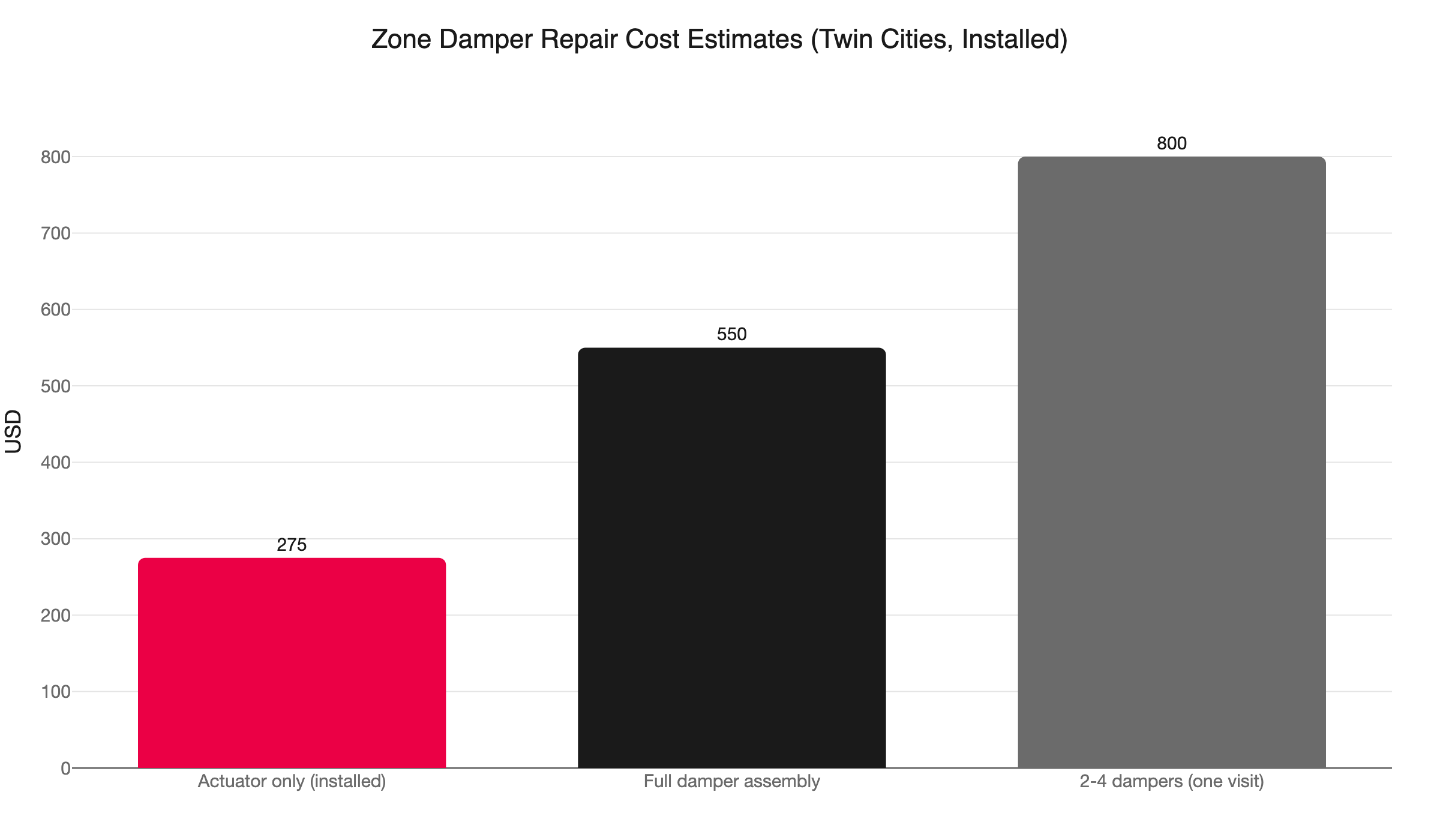
- Single actuator replacement: $200-$350 installed. Full damper assembly: $300-$800. Two to four dampers in one visit: $400-$1,200.
- Repair is usually the right call unless the blade housing is warped or multiple zone system components are failing at once.
- No utility rebates cover zone damper work. The federal 25C tax credit expired December 31, 2025 and did not apply to damper components.
- Zoning systems can meaningfully reduce annual heating and cooling costs. A working damper is worth repairing.
What Is a Zone Damper and Why Do They Fail?
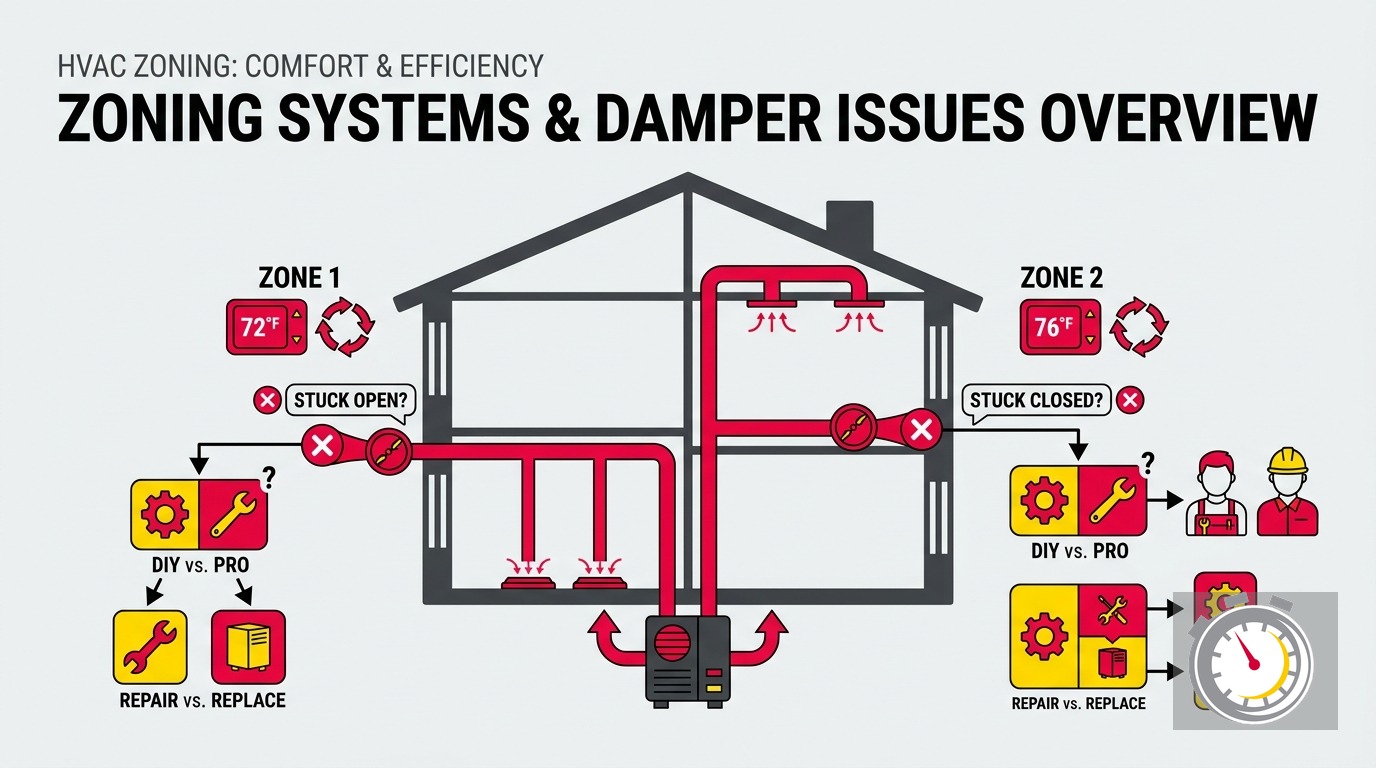
A zone damper is a motorized blade inside your ductwork. It opens and closes to direct conditioned air to a specific part of your home. In a zoned HVAC system, each zone has its own thermostat. The zone control board reads each thermostat and signals the dampers to open or close in response.
When the system is working correctly, a damper in a satisfied zone closes. That redirects airflow toward rooms that still need heating or cooling. When a damper fails, it freezes in place. Stuck open means that zone gets conditioned air whether it needs it or not. Stuck closed means that zone gets nothing.
One design detail worth knowing: zone dampers come in two types. A normally open damper fails to the open position if it loses power. A normally closed damper fails shut. Which type you have determines how a failure shows up - and which scenario is more urgent. Normally closed dampers that lose power or motor function create the compressor-damage scenario described below. Normally open dampers that fail stuck-open are a comfort problem but a less immediate hardware risk.
Dampers fail for a few specific reasons. The actuator motor wears out - most last 10 to 15 years. Gear wear, blade oxidation from humidity, and vibration-loosened wiring connections are the most common culprits. Minnesota’s freeze-thaw cycles accelerate actuator gear wear and blade rust. Cold, rigid duct runs transmit more vibration during HVAC startup. That vibration can work low-voltage connections loose at the actuator terminal over many heating seasons.
October startup, after months of cooling-season idle, is when stuck dampers most often surface. The transition back to heavy heating demand is when a marginal actuator finally gives out.
Is My Zone Damper Stuck - or Is Something Else Wrong?
Short answer: If one zone is consistently off-temperature while the rest of the house is comfortable, a stuck damper is the most likely cause. A clogged filter, closed register, or failing control board can mimic the same symptoms. A quick airflow check at the supply register narrows it down in minutes.
Hold your hand near the supply register in the problem room while the system is actively running. Almost no air movement points to a stuck-closed damper. Full, strong airflow regardless of what the thermostat calls for suggests a stuck-open damper.
If airflow is normal but the temperature is still wrong, the problem is more likely the zone thermostat, temperature sensor, or control board. Those are different diagnoses with different repair costs.
A dirty filter can also restrict airflow across the whole system and make one zone look like a damper problem. Check the filter before you call, especially at the start of heating season. Our post on HVAC zoning systems for two-story homes explains how dampers, control boards, and zone thermostats interact if you want a complete picture before calling.
What Does a Stuck Zone Damper Feel Like in a Twin Cities Home?
Short answer: A stuck-closed damper makes one room feel like the furnace forgot it exists. A stuck-open damper makes that zone impossible to control - it gets full heat or cooling no matter what the thermostat says. Either way, the temperature in that room will be noticeably and persistently off from the rest of the house.
In a Minneapolis or Ramsey home with a two-zone system, this typically shows up as an upstairs corridor that stays cold all winter while the main floor is comfortable. Or a finished basement running 8 to 10 degrees warmer than the thermostat setting.
The stakes are not abstract. The Twin Cities sit in IECC Climate Zone 6A, where winter design temperatures reach as low as -9°F. A stuck-open damper serving a bedroom zone in January can leave that room dangerously cold while the furnace runs continuously. The zone thermostat driving the heat call is two rooms away and already satisfied.
That is not just uncomfortable. It is a livability problem - especially for elderly family members or young children sleeping in that room.
The heating season here runs October through April: roughly seven months where your dampers cycle through heating positions daily. A mechanical failure is most likely to surface in early fall, when the system transitions from cooling-season idle back into heavy heating demand.
The Stuck-Closed Cascade: Why This Qualifies as an Emergency
Most homeowners treat a stuck damper as a comfort complaint. It is - but it is also a hardware risk. A stuck-closed damper can trigger a chain reaction that destroys the most expensive component in your HVAC system.
Here is how it unfolds. The damper closes and stays closed. Static pressure builds in the supply plenum. The blower pushes air against resistance it was not sized for. Reduced airflow across the evaporator coil causes incomplete refrigerant evaporation. Liquid refrigerant reaches the compressor. That is called slugging, and it destroys the compressor. Secondary risks include blower motor burnout and, in gas systems, heat exchanger cracking from sustained elevated operating temperatures.
A central AC compressor replacement costs $1,950-$4,500. A zone damper actuator costs $200-$350 installed. Letting a stuck-closed damper run through a Minnesota heating season is a gamble with bad math.
Our post on high static pressure symptoms and fixes covers what to watch for if you think this cascade may already be underway.
ENERGY STAR reports that leaky ducts alone can reduce heating and cooling system efficiency by as much as 20 percent. A stuck-closed damper adds supply-side pressure on top of that existing loss. Your system runs longer cycles, the wear compounds, and then both the bill and the failure arrive together.
What Can You Safely Check Before Calling a Technician?
Short answer: You can check airflow at supply registers, inspect the actuator indicator light, and verify that wiring connections are seated. Static pressure measurement, refrigerant-side work, and control board diagnostics require a licensed HVAC technician.
Airflow check at the register. While the system is actively running, hold your hand near each supply register and note which zones have airflow and which do not. Write it down. This gives a technician a clear starting point and may reduce time on the diagnostic visit.
Actuator indicator light. Most modern actuators have a small LED on the motor body. Green typically means normal operation. Red or yellow signals a fault or stall. If you can safely reach the actuator - usually mounted on the duct near the zone control panel - note the indicator color without touching any wiring.
If you do not see a light on the actuator itself, check the zone control panel. Many panels have status LEDs or fault codes for individual zones. A steady red light next to a zone label usually means that damper is not responding to commands. The meaning varies by brand, so note the model number for the technician.
Wiring connections. Vibration from HVAC startup can loosen low-voltage connections at the actuator over time. If you are comfortable in your mechanical room, visually confirm the wiring harness is seated. Do not probe terminals or test voltage without HVAC electrical training.
What to leave to a licensed tech. Static pressure testing requires a manometer and system-specific data to interpret. Refrigerant inspection is federally regulated. Control board work involves higher-voltage terminals. None of these are homeowner tasks.
One common mistake worth flagging: manually closing registers or grilles in other rooms to “help” a struggling zone. Our post on closing HVAC vents in unused rooms explains why that approach compounds the static pressure problem rather than solving it.
How Much Does HVAC Zone Damper Stuck Repair Cost?
Short answer: A single actuator replacement runs $200-$350 installed. A full motorized damper assembly costs $300-$800. Two to four dampers replaced in one service visit typically fall in the $400-$1,200 range. Emergency service adds $180-$270 per hour on top of standard rates.
These figures reflect consensus from multiple independent cost sources. They are a reference range, not a quote. Every job needs a diagnostic visit before pricing, because labor varies with duct access, system configuration, and actuator type.
Actuator-only replacement. This is the most common fix. The damper blade and housing are intact; only the motorized actuator that operates the blade has failed. Parts alone run $80-$150 for the motor. Installed, expect $200-$350 depending on duct accessibility and actuator type. Minnesota homes often have duct runs with reduced clearance near ceiling joists or in finished spaces. More limited access means more labor time, which pushes costs toward the higher end of the range.
Full motorized damper assembly. When the blade or housing is warped, corroded, or physically damaged - not just the actuator - the full assembly is replaced. A single unit runs $300-$800 installed.
Multi-damper jobs. Replacing two to four dampers in one visit typically runs $400-$1,200 total. Shared diagnostic and access work reduces the per-unit labor cost compared to scheduling three separate calls.
After-hours and emergency calls. If a stuck damper is creating a compressor risk or a comfort emergency in January, emergency service carries an additional $180-$270 per hour above standard rates. Fixing the damper before the system compounds into a larger failure is almost always the lower-cost path.
Diagnostic visit. A service call to test and diagnose a zone damper issue typically runs $95-$250 depending on system complexity. Ask upfront whether the diagnostic fee applies toward the repair if you proceed the same visit.
Repair vs. Replace: How Do You Decide?
Short answer: If the blade housing is intact and the system is under 15 years old, repair the actuator. If the housing is warped, multiple components are failing, or the control board is also degrading, price a full zone system overhaul before committing to incremental repairs.
Three questions guide the decision:
Is the blade housing intact? A warped or cracked housing cannot hold a seal regardless of how good the new actuator is. If the housing is damaged, replace the full assembly. If the housing is solid, an actuator swap is the right call.
How old is the damper assembly? Actuators typically last 10 to 15 years. If you are replacing one actuator on a 13-year-old system and two others already show fault indicators, replacing all three in one visit costs less than three separate service calls over two winters.
Are other zone system components degrading? Zone control board replacement runs about $750 installed. If the board is also showing fault behavior, factor that into the comparison between targeted repairs and a full zone system replacement. A technician who can diagnose all components in one visit gives you a real cost comparison to work from.
For context on what happens downstream when a zone system runs with chronic high static pressure, our post on AC compressor signs and repair costs is worth reading before you make a call.
Does Zone Damper Repair Require a Permit in Minnesota?
Short answer: A like-for-like actuator swap almost certainly does not require a permit. Any ductwork modification or control board replacement probably does. Ask your contractor which category the work falls under before they start.
Minnesota Rules 1300.0120, Subpart 4 exempts “replacement of any part that does not alter approval of equipment or make the equipment unsafe” from the permit requirement. A like-for-like actuator swap on an existing damper assembly likely qualifies under that exemption. Cutting into ductwork or replacing a zone control board does not.
Minnesota does not issue a statewide residential HVAC license, but contractors performing heating, cooling, or refrigeration work must file a $25,000 bond with the Minnesota Department of Labor and Industry. Most cities add local registration requirements on top of that. Verify that your contractor is bonded and locally registered before work begins.
Are There Rebates or Tax Credits for Zone Damper Repair?
Short answer: No. Xcel Energy and CenterPoint Energy do not currently offer rebates for zone damper repair or replacement. The federal 25C tax credit expired December 31, 2025 and never applied to zone damper components. There is nothing to chase here.
The real savings from a working zone system are operational. Zoning can meaningfully reduce annual heating and cooling costs compared to a single-thermostat setup. Getting your damper working restores that efficiency immediately. That payback is more valuable than any rebate on the repair itself.
ENERGY STAR notes that 20 to 30 percent of the air moving through a typical duct system is lost to leaks, holes, and poorly connected ducts. A stuck-closed damper adds supply-side pressure on top of that existing loss, forcing longer run cycles. Fixing the damper stops that compounding waste.
If your home has older ductwork with significant leakage, pairing a damper repair with duct sealing is worth asking about at the same diagnostic visit.
Schedule Your Zone Damper Diagnostic
If you have a room that consistently cannot hold temperature, or an actuator with a fault indicator, do not let it sit. A stuck-closed damper in a Minnesota winter puts the compressor at risk. A compressor failure costs many times more than the damper repair that would have prevented it.
Northern One Hour is locally owned and operated in Ramsey, MN. We serve Minneapolis, St. Paul, Blaine, Maple Grove, Plymouth, Brooklyn Park, Woodbury, Bloomington, and the surrounding Twin Cities metro.
Every visit is backed by “Always On Time… Or You Don’t Pay a Dime!(R).” If our technician does not arrive within the time window you selected, you do not pay for the service.
Call (763) 260-6662 or book online to schedule a zone damper diagnostic. We test the actuators, measure static pressure, inspect wiring, and give you a clear repair recommendation with transparent pricing before any work begins. If the job involves larger repairs, we can walk you through financing options as well.
Frequently Asked Questions
How do I know if my zone damper is stuck? +
How much does it cost to repair a stuck HVAC zone damper in the Twin Cities? +
Can I fix a stuck zone damper myself? +
Will a stuck zone damper damage my HVAC system? +
Need a technician now?