
AC Cools at Night but Not During the Day: Why It Happens
Key Takeaways
- An AC that cools at night but not during the day is usually losing a fight with afternoon heat, not failing overnight.
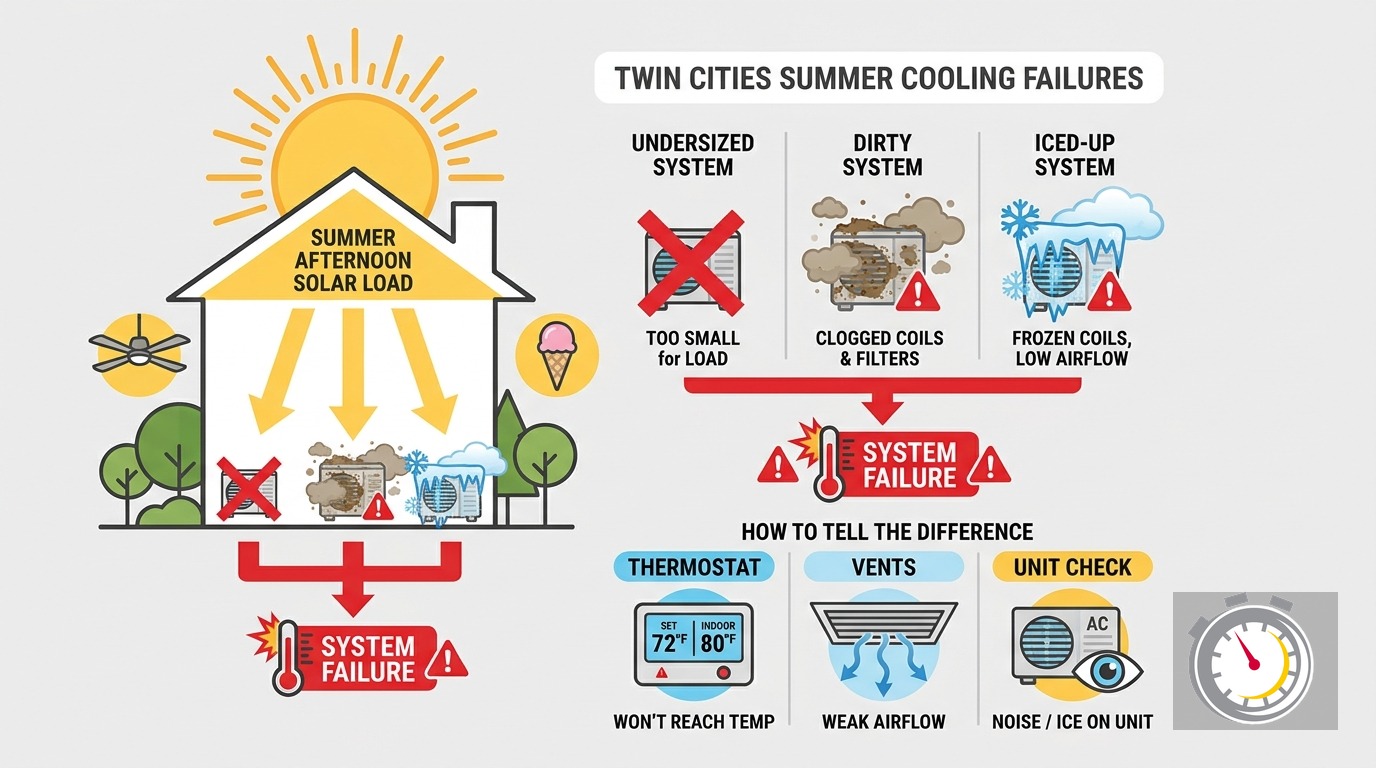
- Three causes look alike: an undersized system, a dirty system, and an iced-up system. They fail on different schedules.
- Undersized and dirty systems fall behind slowly as the afternoon heats up. An iced coil often runs fine for hours, then collapses.
- Check your filter, supply vents, outdoor coil, and indoor lines for ice before you call.
- If the checks come up clean and the house still lags, ask for a load calculation, not just a recharge.
- We are locally owned and operated, and we back every visit with our on-time promise.
Is it normal for an AC to cool at night but not during the day?
Some lag is normal. Afternoon sun, hot attics, and hot outdoor air all add heat your AC must remove. But a house that drifts several degrees above the setpoint every afternoon points to a problem. The cause is usually size, dirt, or ice.
Think of your AC as a bucket brigade. At night the load is small, so the crew keeps up easily. At 4 p.m. the load doubles or triples. A healthy, right-sized system still keeps pace. A weak one does not.
That makes this symptom useful. It tells you the system can cool, because it does cool at night. The question is why it runs out of capacity when the load peaks.
Why does afternoon sun overwhelm an AC in the Twin Cities?
Your home gains heat from four places in the afternoon: the sun on your roof, the sun through your windows, hot attic air, and warm, humid outdoor air. All four peak at the same time, and your AC must remove all of that heat at once.
Here is what happens in a typical Twin Cities house.
- The roof. Dark shingles soak up sun all day. By mid-afternoon, they pass that heat into the attic.
- The attic. A hot attic heats the ceiling below it. It also heats any ductwork that runs through it.
- West-facing windows. Low afternoon sun pours straight in. Glass lets in far more heat than a wall does.
- Humidity. Humid air carries extra energy. Your AC spends part of its effort pulling water out of the air, not just lowering the temperature.
Night flips all of this. The roof cools. The attic dumps its heat. The outdoor coil sheds heat more easily into cooler air. So the same AC that struggles at 4 p.m. feels strong at 11 p.m.
Our summers can swing fast. A cool morning can turn into a muggy, 90-degree afternoon. Systems with little margin feel that swing first.
You can learn more about how our local summers push equipment in our guide on why an AC keeps running while the home still feels warm.
Should my AC keep up on a 90 degree day?
A properly sized, healthy AC should hold your setpoint on a 90-degree day in the Twin Cities. It may run most of the afternoon. But it should not lose ground hour after hour. If the house climbs well above the setpoint, something is wrong.
Engineers size cooling systems to a design temperature, not to the hottest day ever recorded. A Minnesota rule table, now marked repealed, listed summer design conditions for Minneapolis and St. Paul, including a dry-bulb temperature of 88 degrees. The same rule says summer conditions follow “the one percent annual cooling design conditions.”
Treat that table as a historical reference, not current code. Confirm current requirements before relying on it for any project.
The useful lesson is simple. 88 degrees is a design value, not a ceiling. Real afternoons can run hotter. A system sized tightly to that number has little margin when the thermometer hits 92 or 95.
So a good system on a 90-degree day should run long and keep the house near the setpoint. A system with no margin may run flat out and still slip. For a deeper look at extreme afternoons, read our post on whether an AC should keep up on 95-degree days.
How do I tell an undersized, dirty, and iced-up system apart?
Watch the timeline. An undersized or dirty system falls behind gradually as the afternoon heats up. An iced-up system often cools well for hours, then airflow weakens and cooling drops off fast. Where the failure starts and how it progresses is your best clue.
This is general HVAC knowledge, not a lab result. Every house differs. But the pattern is reliable enough to guide your first checks.
Here is a side-by-side look.
| Clue | Undersized | Dirty (filter or coil) | Iced-up |
|---|---|---|---|
| When it starts | Late morning, worsens through afternoon | Gradual, may show up every day | Often after hours of running |
| How it progresses | Slow drift above setpoint | Slow drift, weaker airflow | Works, then cooling collapses |
| Airflow at vents | Strong | Weak or uneven | Weak, then nearly none |
| Visible signs | None | Gray filter, dirty outdoor coil | Frost on indoor lines or coil |
| Night performance | Fine | Often fine, but may lag | Fine after it thaws |
| Pattern on mild days | Keeps up | Usually keeps up | May still ice |
Use this table as a starting point. Some homes have two problems at once. A dirty filter can even cause ice, which then looks like an undersized system.
What does an undersized AC look like?
An undersized AC runs nonstop through the afternoon and never reaches the setpoint. The air from the vents feels cold and airflow feels strong. The house simply gains heat faster than the system can remove it. By evening, it catches up.
Look for these signs.
- The system runs almost continuously from noon until the sun drops.
- Vent air feels cold, and the airflow is normal.
- The problem is worst on the hottest, sunniest days.
- Some rooms, often west-facing or upstairs, lag the most.
- The house recovers after sunset without any repair.
Several things cause undersizing. Some systems were never sized correctly. Rules of thumb like “one ton per 500 square feet” ignore your windows, insulation, and attic. Other homes changed after the install. New additions, finished attics, or bigger windows add load the old system never planned for.
Most online checklists mention undersizing only in passing, with no way to test it. We think that leaves homeowners stuck. A proper load calculation fixes that. It counts your square footage, insulation, windows, orientation, and air leakage, then tells you what size you need.
You can read more about the process in our guide to right-sizing with a Manual J load calculation.
Do not confuse undersized with oversized. An oversized system cools too fast and shuts off before it removes humidity. That creates clammy rooms, not slow cooling. Our post on oversized AC problems covers that opposite case.
What does a dirty AC look like?
A dirty AC moves less air and transfers less heat. It still cools, but with less strength. The effect grows as the afternoon heats up, because the system has no spare capacity to cover for the dirt. Night may feel fine, but the afternoon exposes the weakness.
ENERGY STAR says airflow problems can reduce a system’s efficiency by up to 15 percent. That is a big handicap on the hottest afternoon of the year.
Three dirty parts matter most.
The air filter
ENERGY STAR advises inspecting, cleaning, or changing filters “once a month.” It also warns that “A dirty filter can increase energy costs and damage your equipment, leading to early failure.”
A clogged filter chokes airflow. Less air crosses the cold coil, so cooling suffers. The coil can also get too cold, which leads to ice. Our guide on how often to change your HVAC filter can help you set a schedule.
The outdoor condenser coil
The outdoor unit dumps your home’s heat into the air. Cottonwood fluff, grass clippings, and dust clog its fins. A clogged coil cannot shed heat well, especially when outdoor air is already hot.
ENERGY STAR notes that “Dirty coils reduce the system’s ability to cool your home.” It recommends cleaning both the evaporator and condenser coils.
The indoor evaporator coil
This coil sits inside your air handler or on top of your furnace. Dust builds up on it over time. You cannot see it without opening the cabinet, so most homeowners never check it.
A dirty evaporator coil acts like a blanket. It blocks heat transfer and airflow at the same time. Read the warning signs in our post on dirty evaporator coil symptoms.
The U.S. Department of Energy also advises changing or cleaning AC filters about once a month, and having the evaporator coil checked yearly, in its Energy Saver guide. Check the guide for the full wording.
What does an iced-up AC look like?
An iced-up AC often cools normally for hours. Then airflow weakens, vent air warms up, and the house heats fast. You may see frost on the copper line near the indoor unit or on the coil itself. Ice blocks the airflow the coil needs to cool.
The sequence usually goes like this.
- The system starts the day cooling well.
- Frost builds on the cold evaporator coil.
- Ice thickens and blocks air from passing through.
- Airflow drops. The coil gets even colder and freezes more.
- Cooling collapses, often in the afternoon.
- If you shut the system off, the ice melts and the cycle can repeat.
This is why ice can look like a “day versus night” problem. Overnight, the system may rest or run less, and the ice melts. By the next afternoon, it starts again.
Common causes include a dirty filter, a dirty coil, blocked or closed vents, a weak blower, and low refrigerant. Low refrigerant means a leak, since refrigerant does not get used up. ENERGY STAR notes that “Too much or too little refrigerant will make your system less efficient.” It advises having the level checked and adjusted if necessary.
If you see ice, turn the AC off and set the fan to run. That helps melt the ice faster. Do not chip it off. Then call us. Our full guide on a frozen evaporator coil explains what to do and what not to do.
A word on sources: we found no government page that explains evaporator icing in detail. So we describe it here in general terms, from field experience, not from a citation.
What can I check myself before calling?
You can do four safe checks in about fifteen minutes. They need no tools beyond a flashlight and a hose. They rule out the most common causes and give us useful information if you do call.
1. Check the filter. Slide it out and hold it to the light. If you cannot see light through it, replace it. Make sure the size matches the slot.
2. Check the vents and returns. Walk through the house. Make sure supply vents are open. Make sure furniture, rugs, and curtains do not block returns. Closing vents in unused rooms can raise pressure and hurt airflow.
3. Look at the outdoor unit. Turn off power at the disconnect first. Look for leaves, cottonwood, grass, or a fence or shrub crowding the unit. Keep clear space around it. Our post on outdoor AC unit cleaning walks through a gentle rinse.
4. Look for ice. Check the copper suction line at the indoor unit. Look for frost or a wet, frozen coil. Note the time you see it.
Also log a simple pattern for a few days.
- What time does the house start to drift?
- How many degrees above the setpoint does it get?
- Does the air from the vents still feel cold?
- Is the thermostat in a sunny spot or near a kitchen?
Thermostat placement matters more than most people expect. A thermostat in direct sun reads high and may confuse your diagnosis. Our guide on thermostat location and accuracy explains this.
Stop at these four checks. Do not open the cabinet, handle refrigerant lines, or touch electrical parts. Those jobs need a trained technician.
What if the checks come up clean?
If your filter is fresh, your vents are open, your outdoor coil is clear, and you see no ice, the problem is likely deeper. The usual suspects are an undersized system, a hidden dirty coil, a weak blower, a leaky duct system, or a refrigerant issue.
Here is how we sort them out on a visit.
- Airflow first. We measure static pressure and check the blower. Restricted airflow causes many “mystery” cooling problems.
- Coil condition. We inspect the indoor and outdoor coils.
- Refrigerant. We check for leaks and verify the charge. A system that is low on charge has a leak somewhere, and topping it off without a repair only delays the problem.
- Ducts. Leaky or uninsulated ducts in a hot attic lose cooling before it reaches the room.
- Load. If everything else is healthy, we check whether the system matches the house.
That last step often gets skipped. Many companies treat each afternoon complaint as a repair job. We think you deserve to know whether the equipment fits your home.
Homes also change over time. If you added insulation, replaced windows, or finished a room, your load changed. Our guide on resizing HVAC after home improvements covers when to recheck.
Heat gain through your attic and west windows can often be reduced. Shade, window film, and attic work all lower the load. Sometimes a small change gives a healthy older system enough margin to keep up.
When should I call for a load calculation?
Call for a load calculation when your filter, vents, and coils are clean, no ice is present, and the house still falls behind every hot afternoon. That pattern points to capacity, not maintenance. A load calculation measures your home’s real needs and compares them to your system.
Other triggers include:
- You added square footage, a sunroom, or a finished attic.
- You replaced windows or added insulation.
- Your upstairs runs much hotter than the main floor.
- The system is more than a decade old and was never sized with a calculation.
- A recent repair did not fix the afternoon problem.
A good calculation should include your actual window sizes, insulation levels, and orientation. It should not rely on square footage alone. Ask to see the results.
If the answer is a bigger or better system, you have options. Variable-speed equipment runs longer at lower output and handles humidity well. Duct improvements can also close the gap without a full replacement. We will lay out the choices and let you decide.
What does it cost to fix?
Costs depend on the cause. A filter change costs little. A tune-up visit typically runs $95-$250. Larger fixes, like coil work, refrigerant leak repair, or ductwork, vary by job. A full replacement is a bigger decision, and we quote it only after a proper evaluation.
Here are the ranges we see for common paths, installed and including parts and labor.
- Single tune-up visit: $95-$250.
- Annual maintenance plan: $195-$390.
- Central AC replacement, mid-tier: $7,500-$10,400.
- High-efficiency central AC (18-20+ SEER2): $11,000-$15,600.
- Duct sealing: about $1,300 and up.
These are starting points, not quotes. Your home may cost more or less. We give you a clear price before we start work.
For larger jobs, ask us about financing. A replacement does not need to hit your budget all at once. Our post on HVAC financing options explains how it works.
Rebates may also help. Xcel Energy publishes a Minnesota residential rebate sheet that lists central AC incentives and a smart thermostat program. Xcel says programs can change or end on 30 days’ notice. Check the current page for amounts before you plan around them.
Xcel also offers a Cooling Sizing and Airflow brochure for homeowners. It supports the same message we give here: size and airflow matter together.
Why does maintenance matter before the next heat wave?
A clean, tuned system has margin. That margin carries you through the worst afternoon of July. Skipping maintenance eats it away a little each year, until one hot week exposes the loss.
A good tune-up covers the items that cause afternoon failures.
- Clean or inspect both coils.
- Check airflow and blower operation.
- Test the refrigerant charge and look for leaks.
- Inspect the drain line and electrical parts.
- Verify that the thermostat reads correctly.
Our post on what a tune-up includes shows the full list. If you want regular visits, a maintenance plan keeps this on the calendar.
Schedule before the heat arrives. Our best slots fill up during the first stretch of 90-degree weather.
Why call a locally owned Twin Cities HVAC company?
We are locally owned and operated. We live in the same summers you do. A Brooklyn Park attic, a Plymouth two-story, and a Woodbury west-facing living room all behave differently, and local knowledge helps us find the real cause faster.
We also respect your time. When you book, you pick a time window, and we arrive within it. If our technician does not show up on time, you do not pay for the service. That is our promise: “Always On Time… Or You Don’t Pay a Dime!(R)”
You also get a 100% satisfaction guarantee and honest, transparent pricing. We explain what we found, show you why, and let you choose. We do not push a replacement when a cleaning will do.
If the afternoon problem points to a sizing issue, we will say so plainly. If it points to a simple fix, we will say that too.
For more on how reliability protects your home, read why on-time service matters in the Twin Cities.
What should I do next?
Start with the four checks. Replace the filter, open the vents, clear the outdoor unit, and look for ice. Then watch the pattern for a few days. Note when the house starts to drift and how far it goes.
If the problem remains, we can help. Our team handles air conditioning repair across the Twin Cities. We diagnose the cause, explain the options, and give you a fair price.
Call (763) 260-6662 or book online. Tell us what time of day the cooling fades, and whether you have seen ice. That detail speeds up the diagnosis.
Do not wait for the next heat wave. A cool house at 4 p.m. is worth a phone call today.
Frequently Asked Questions
Why does my AC not get cold at night? +
How many hours should AC be on at night? +
Need a technician now?