
AC Wont Cool House Below 80 Degrees: Causes and Fixes
Key Takeaways
- If your AC runs all day and the house sits near 80°F, the cause is often airflow, moisture load, or refrigerant. The system is not always dead.
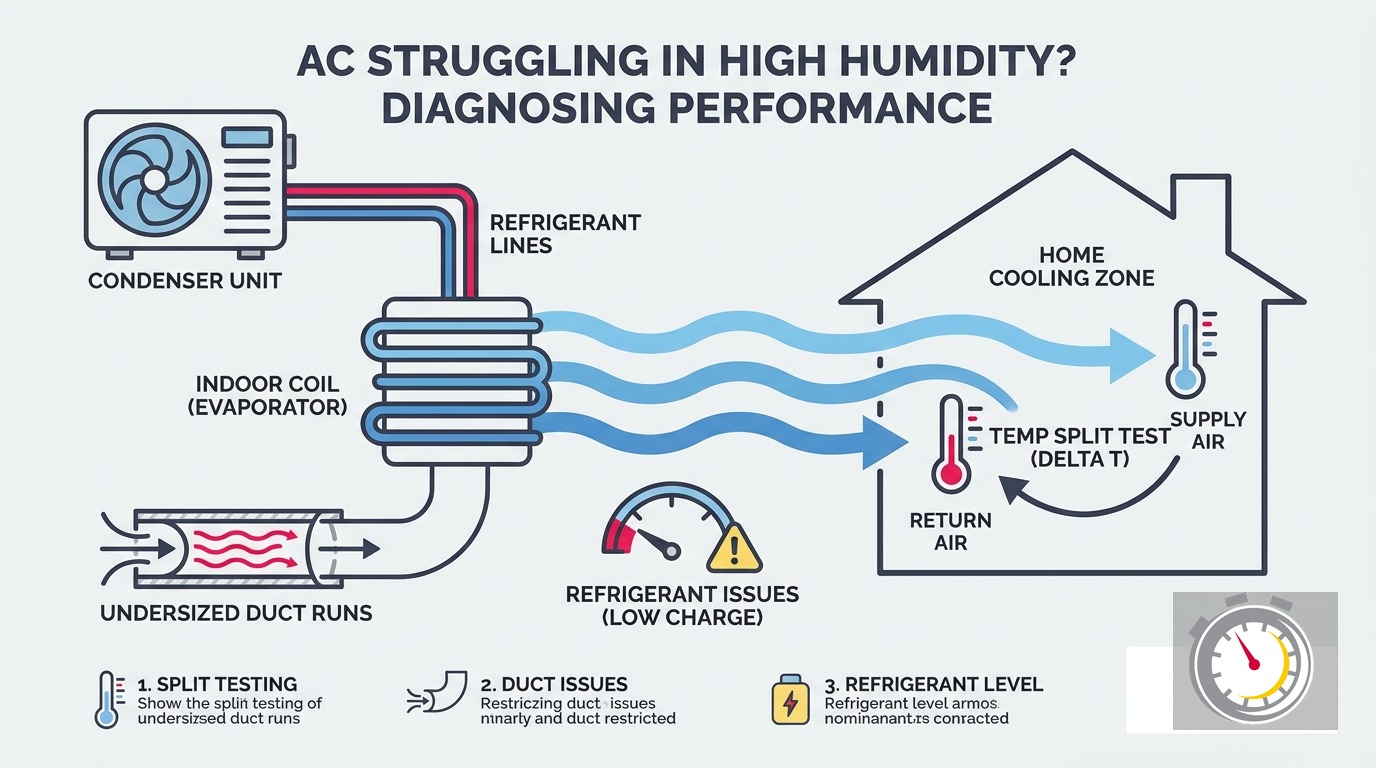
- A temperature split test separates an airflow problem from a refrigerant problem in about 15 minutes.
- Twin Cities dew-point spikes can use up your AC’s capacity even when the equipment is healthy.
- Undersized or restricted duct runs are common in attics and tight joist bays. They starve rooms of cool air.
- Low refrigerant means a leak. Topping it off without finding the leak only delays the next failure.
- Check the filter, clear the outdoor unit, and raise the thermostat a little today. Then book a diagnosis.
Why Is My AC Running but Not Cooling My House?
Your AC runs but cannot hold temperature when something limits how much heat it removes. The usual causes are restricted airflow, dirty coils, low refrigerant, leaky or undersized ducts, or a heavy moisture load. A split test and a duct check tell these apart.
Your AC does two jobs. It lowers air temperature, and it pulls moisture out of the air. Technicians call these the sensible load and the latent load.
On a dry 90°F day, most of the work goes to temperature. On a sticky Twin Cities July day, a big share goes to moisture. The same system feels weaker on the sticky day.
Likely causes:
- A dirty filter or blocked return grille
- A dirty evaporator coil or condenser coil
- Low refrigerant from a leak
- Ducts that leak, kink, or run too small
- A system sized by square footage instead of by load
- A failing part, such as a weak capacitor or a tired condenser fan motor
You can spot some of these yourself. Others need gauges and a manometer.
If your system seems to run nonstop, our post on why an AC keeps running while the home still feels warm walks through the common patterns.
How Cold Should Your AC Actually Be Able to Make Your House?
Most central AC systems are designed to hold a set indoor temperature up to a design outdoor temperature, not to drop the house a fixed number of degrees. On extreme days, holding 78°F may be a win. Sitting at 80°F on a mild day is a warning sign.
Try this test on a day that is moderately hot, not extreme. If the system holds the setpoint at 85°F outside but loses ground at 90°F, it may be near its limit. If it cannot hold at 82°F outside, something is wrong.
Installers size equipment for a target day. A system that handles that day has no spare capacity on a worse one. That is normal and not a defect.
Humidity changes the picture. A 75°F dew point makes air feel heavy, and the coil must remove far more water. Your system can run flat out and still lose ground.
The Minnesota DNR keeps Twin Cities dew point records. They show how rare and intense our worst muggy days are. Most homes here are not sized for the very top of that range, which is a reasonable design choice.
So ask whether your system is doing what it should for today’s weather, rather than why it isn’t 72°F. A temperature split helps answer that.
What Is a Temperature Split, and How Do You Test It?
A temperature split is the difference between the air entering your return and the air leaving a supply vent. As an industry rule of thumb, a healthy system shows roughly 15 to 20°F of drop. A much smaller or larger split points to airflow or refrigerant trouble.
You can run a basic version of this test at home with two simple thermometers.
- Run the AC for at least 15 minutes so it settles.
- Place one thermometer in the return air path, near the filter.
- Place the other in the airflow at a supply vent close to the air handler.
- Wait a few minutes, then read both.
- Subtract the supply reading from the return reading.
Treat the result as a clue. Humidity affects the reading, and so does where you place the probes. A technician uses better tools and also measures coil temperatures and pressures.
How to read it:
- Split in the normal range, house still warm: The system is cooling the air it moves. The problem may be capacity, moisture load, or ducts that do not deliver enough air.
- Split too small: Low refrigerant, a weak compressor, or a failing outdoor fan can cause this. The air leaves the coil barely cooler than it entered.
- Split too large: Airflow is usually too low. The coil gets very cold, but too little air crosses it. Dirty filters, dirty coils, and restricted ducts cause this.
That last case surprises people. A big split looks like a strong system. Often it means the blower is moving too little air, and the coil may freeze. If you see ice on the indoor coil or refrigerant line, read our guide to a frozen evaporator coil.
Don’t stop at the split. A normal split on a house that stays warm is the tricky case, and it leads to the next question.
Is Your AC Just Maxed Out, or Actually Broken?
A maxed-out AC cools normally on mild days and falls behind only in the worst heat or humidity. A broken AC struggles on moderate days too, and it often shows a bad split, ice, odd noises, or rising bills. The pattern over several days tells you which one you have.
Use this quick sort.
Signs of a system that is maxed out:
- Normal split on the test
- Holds the setpoint on moderate days
- Loses ground in the late afternoon on the hottest or muggiest days
- Runs for hours but never short cycles
- Rooms facing west or upstairs lag first
Signs of a system that is actually broken:
- Weak or odd split
- Warm air from vents while the outdoor unit runs
- Ice on coils or lines
- Hissing, buzzing, or humming from the outdoor unit
- Tripped breakers
- Cooling that gets worse each week
If the fan runs but the compressor hums and will not start, see our post on an AC that hums but will not start. A failed start capacitor is a common cause. Capacitor repair, part and labor, often runs $195 to $500.
Time of day matters too. If your AC cools at night but fails in the afternoon, read why an AC cools at night but not during the day. That pattern often points to a system near its capacity limit.
Your system might also be both. An older unit with a dirty coil and a leaky duct has less capacity to give, and the muggy day finishes it off. We see this combination often.
Why Do July Dew-Point Spikes Beat a Working AC?
A system can run nonstop, show a normal split, and still leave the house at 80°F. High dew points load the coil with moisture, and removing that water uses up capacity that would otherwise lower the air temperature. The result is a house that feels warm and sticky.
Think of your AC as a bucket brigade. Each pass of air must be cooled and also dried. When the air is full of moisture, more of the effort goes into drying, and less is left for cooling.
Twin Cities summers pair high dew points with moderate air temperatures. A system sized by square footage can look fine at 90°F and dry. Then it loses ground when the dew point climbs past 75°F.
Sizing method matters here. The U.S. Department of Energy warns that rules of thumb are too often used to size comfort systems. That produces systems that are too big, which leads to higher cost, wasted energy, and frequent on-and-off cycling. The same page points to ACCA Manual J as the load calculation method.
Oversizing hurts in humid weather. A big unit cools the air fast and shuts off before it removes much moisture. The house feels clammy at 76°F.
An undersized or poorly matched system has the opposite problem. It never shuts off and still cannot win. The fix for both is a real load calculation. Our guide to Manual J and a right-sized system explains what that involves.
On a day like this, a technician can run these checks:
- Measure the split and the indoor humidity.
- Measure airflow across the coil.
- Measure static pressure in the duct system.
- Compare run time to outdoor conditions.
If all four look healthy and the house still sits at 80°F during a dew-point spike, your system is working. It may simply lack the capacity for those days. Then the talk turns to options, such as duct upgrades, a dehumidifier, or a better matched system.
Can Undersized Duct Runs Keep Your House at 80 Degrees?
Yes. Ducts that are too small, kinked, crushed, or leaky cannot deliver the air your AC makes. The cool air never reaches some rooms, and the whole system works harder. Duct problems often show up as a normal split with rooms that stay warm.
The AC makes the cool air, and the ducts deliver it. If delivery fails, comfort fails.
The Department of Energy notes that ducts are sized separately from equipment, under ACCA Manual D. Its HVAC renovation guide says a contractor who keeps existing ducts can check them for proper sizing, balanced pressures, and adequate airflow to each register. It also says poorly sized, sealed, or insulated ducts likely contribute to higher energy bills.
Many Twin Cities homes have ducts routed through attics or tight joist bays. Undersized or restricted runs tend to hide there. Flexible duct can sag or pinch. Long runs to a far bedroom lose pressure along the way.
Look for these clues:
- One or two rooms stay warm while others feel fine
- Weak airflow at some registers
- Whistling or rushing sounds at vents
- Dust streaks near duct joints
- Hot attic ducts that are warm to the touch
- A second floor that never catches up
A technician confirms the problem with a static pressure reading. Static pressure is the resistance the blower pushes against. Think of it as blood pressure for your duct system. High readings mean the air path is too tight. Our post on high static pressure symptoms and fixes covers what the numbers mean.
Fixes range from small to large:
- Replace a crushed or kinked flex run
- Add or enlarge a return path
- Seal leaks at joints and boots
- Insulate ducts in the attic
- Rebalance the registers
- Replace undersized trunks or branches
Duct sealing often runs about $1,300. Full duct replacement is a bigger job, typically $6,500 to $13,000. We start with the smallest fix that solves the problem. Not every home needs new ducts.
What Do Refrigerant Problems Look Like?
Refrigerant problems show up as weak cooling, a small temperature split, ice on the coil or lines, hissing sounds, and rising bills. Your AC does not use up refrigerant. If the level is low, there is a leak, and it needs to be found and fixed.
Refrigerant carries heat from inside your home to the outdoor unit. With too little, the coil cannot absorb enough heat. Too much also hurts. ENERGY STAR notes that too much or too little refrigerant will make your system less efficient.
A low charge typically looks like this:
- Warm or lukewarm air from the vents
- Ice on the indoor coil or outdoor line
- A hissing or bubbling sound
- Longer run times with less cooling
- A house that slowly gets worse over a season
Refrigerant is not a do-it-yourself job. Handling it takes training and the right equipment. Don’t buy a top-off kit and guess.
A proper repair has three steps. The technician finds the leak, repairs it, and then weighs in the correct charge. Skip the first step and you pay again next summer. Our guide to refrigerant leak signs in Minnesota shows what to watch for.
Compressor failure is the costly end of this problem. Running low on charge can overheat a compressor. A replacement often runs $1,950 to $4,500. On an older system, that bill makes the repair-or-replace question real.
Check the simple cause too. A dirty coil acts a lot like a refrigerant problem. ENERGY STAR says annual check-ups should clean the evaporator and condenser coils, because dirty coils reduce cooling and make the system run longer. It also says airflow problems can reduce efficiency by up to 15 percent. A tune-up often catches this early, and a single visit typically runs $95 to $250.
What Can You Do Right Now to Help Your AC Keep Up?
Start with free fixes. Change the filter, clear the outdoor unit, open blocked vents, and avoid heat-producing chores in the afternoon. Raise the thermostat a couple of degrees so the system can catch up. Then book a diagnosis if the house still sits near 80°F.
Here is a plan you can follow today.
Step 1: Check the filter. ENERGY STAR says filters should be inspected, cleaned, or changed once a month. A packed filter is the most common cause we find. Swap it and re-test.
Step 2: Clear the outdoor unit. Remove leaves, grass clippings, and cottonwood fluff from the sides. Keep two feet of space around it. Rinse the fins gently with a garden hose. Shut the power off first.
Step 3: Open the vents and returns. Make sure furniture, rugs, and curtains do not block them. Keep bedroom doors from sealing off return air. Do not close vents in unused rooms.
Step 4: Cut the heat load. Close blinds on west-facing windows by midday. Run the oven and dryer in the evening. Use bathroom and kitchen fans to move moisture out.
Step 5: Set the thermostat realistically. Dropping the setpoint to 68°F does not cool faster. The system runs at one speed or stage. Hold at 78°F during a spike and let it recover. Use the fan setting recommended for your system.
Step 6: Run the split test. Use the steps above. Write down the numbers and the outdoor temperature. A technician can use them.
Step 7: Know when to stop. Turn the system off if you see ice, smell burning, hear loud grinding, or notice water pooling. Running a failing system can turn a small repair into a big one.
If the air feels clammy at 76°F, your system may be cycling too fast. Our guide to oversized AC problems explains that case.
What a Northern One Hour Diagnosis Covers
A good diagnosis follows the order described above. We measure first and replace later, so you don’t pay for a part that was never the problem.
On a visit, our technician will typically:
- Check the filter, coils, and blower
- Measure the temperature split
- Check refrigerant charge and look for leaks
- Test the capacitor, contactor, and fan motors
- Read static pressure and inspect the duct system
- Compare indoor humidity to run time
- Explain the findings in plain language
We give you options and no pressure. Some fixes cost under a few hundred dollars. Some call for a larger investment. We tell you which is which.
We are a locally owned and operated Twin Cities company. We know how July works here, and we know the attics and joist bays in local homes. For repairs, see our air conditioning repair service.
Timing matters on a hot day. We stand behind this promise: “Always On Time… Or You Don’t Pay a Dime!(R)” In plain terms, we arrive within the time window you select. If your technician does not show up on time, you do not pay for the service.
When Replacement Makes More Sense Than Repair
Replacement makes sense when the system is old, needs a costly repair, uses an outdated refrigerant, or was never sized properly. A new system sized by load calculation can solve a capacity problem that repairs cannot.
Consider replacement when:
- The compressor has failed on an older unit
- The coil is leaking and the system is well past its prime
- The duct and equipment problems point to a bad match
- Repairs are stacking up each summer
- The load calculation shows the unit is far too small or too large
A mid-tier central AC replacement, installed, typically runs $7,500 to $10,400. High-efficiency 18 to 20+ SEER2 systems typically run $11,000 to $15,600. We offer financing on larger jobs, so ask about it when you get a bid.
Don’t replace just to chase a cooler number. If your ducts are the bottleneck, a new unit will hit the same wall. A good contractor checks the duct system first, using the sizing and pressure checks above.
Permits matter, too. Minnesota’s mechanical code is administered by the state Department of Labor and Industry. Its fact sheet on the 2020 mechanical code lists required inspections. These include a rough-in inspection before covering and a final inspection on completion of the HVAC work. The code adopts Chapters 2 through 15 of the 2018 International Mechanical Code.
We handle the permit and the inspections as part of an install. That protects you at resale and keeps the work to code.
Ask any contractor how they size a system. If the answer is “by square footage,” keep looking. A real load calculation is the right starting point.
What to Do Next
Your AC may be healthy and simply outmatched by a muggy week. Or it may have a fixable problem that costs you comfort every day. You can’t tell from the couch.
The short path:
- Change the filter and clear the outdoor unit.
- Run the split test and write down the numbers.
- Watch the pattern over a few days.
- Call us if the house still sits near 80°F, or if you see ice or hear odd noises.
We will measure the split, check airflow and static pressure, and look at refrigerant. Then we will tell you what we found and what your options are.
Call Northern One Hour at (763) 260-6662 or book online. We will show up in your window and find the real cause.
Frequently Asked Questions
Can a dirty air filter keep my AC from cooling below 80 degrees? +
Does replacing my AC require a permit in Minnesota? +
Need a technician now?