
AC Cant Keep Up First Hot Week of Summer? Normal or Not
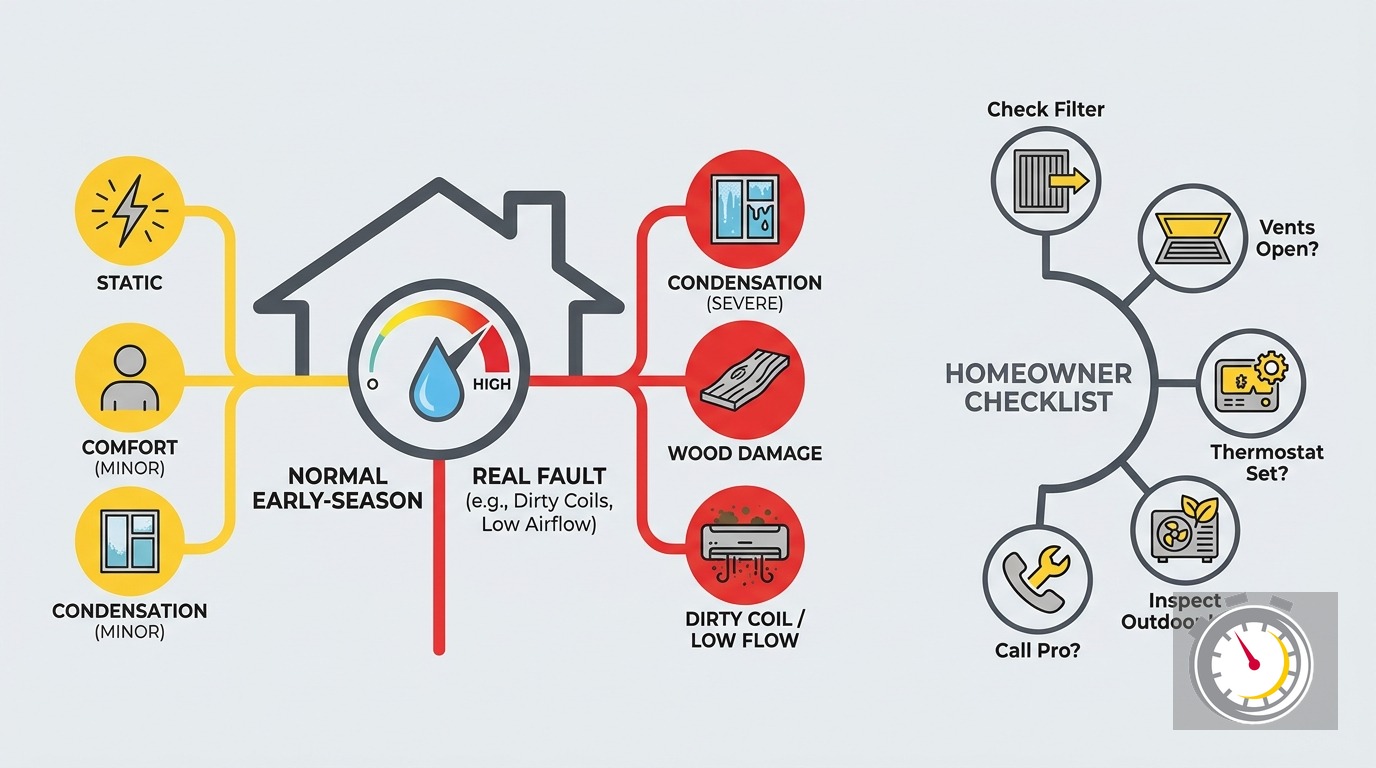
Key Takeaways
- A working AC often runs almost nonstop on the first 95-degree day. That alone does not mean it is broken.
- Humidity is the hidden load. High dew points make the same air temperature feel hotter and make your AC work harder.
- A common rule of thumb says a healthy system cools the house about 20 degrees below the outdoor temperature.
- Check the filter, the outdoor coil, and the drain first. Those three checks fix many cases.
- Warm vent air, ice, short cycling, weak airflow, or water near the indoor unit means a fault. Call a pro.
- Keep indoor humidity at or below 50 percent. A small meter tells you where you stand.
Your AC kept the house fine in May. Then the first real heat wave hit, and now the house sits at 80 degrees while the system runs all afternoon. Is it broken, or just overwhelmed?
If the system runs nonstop on the hottest afternoon but still holds a cooler, drier house, it is probably just working hard. If the air is warm, the airflow is weak, ice shows up, or the system cycles off and on, you have a fault. You can tell which with tools that cost $50 or less.
We are Northern One Hour Heating & Air Conditioning, a locally owned and operated Twin Cities company. We see this call every year. It spikes the first week the dew point climbs.
Why is my AC not keeping up on hot days?
Your AC may be fighting more than the thermometer shows. Heat soaked into walls, attic air, sun on the windows, and humid air all add to the load. After months of rest, a dirty filter or coil can also cut airflow right when demand peaks.
Your cooling system has a fixed capacity. On a mild day you never notice the limit. On a 95-degree day you hit it.
Several things stack up during the first hot week:
- Outdoor heat: The hotter it gets outside, the harder the system must work to move heat out.
- Humidity: Your AC also pulls moisture out of the air. The EPA notes that an HVAC system’s job includes removing moisture from the air before it is distributed through the building.
- Stored heat: Your house soaks up heat for days. Walls, roofs, and furniture release it at night.
- Sun load: Western windows and dark roofs add heat in the afternoon.
- Neglected parts: A clogged filter, a dirty coil, or a blocked drain steals capacity.
The first two are normal strain. The last is a fault you can fix.
Why Minnesota heat hits differently
Our cooling season is short. Your system may sit idle from September to June. Then a heat wave arrives with sticky air.
In late July 2026, MPR News reported that the Twin Cities hit 100 degrees on a Monday afternoon. That morning, the dew point was an “astonishing 81 degrees.” Dew point measures how much moisture is in the air. A high number means the air feels heavy and sticky.
An AC that is fine at a 60-degree dew point can struggle at 75 or higher. The coil has to condense far more water before it can drop the temperature. That is why a house can feel warm and damp even when the system runs hard.
Is your AC just maxed out, or actually broken?
Normal strain still produces cold air and slow progress. A fault produces warm air, ice, odd cycling, or weak airflow. If your house holds about 20 degrees below outdoor temperature and the vents blow cold, you are likely seeing load, not failure.
That 20-degree figure is a widely used rule of thumb, not a guarantee. Older systems, large homes, and humid days may fall short of it. It still gives you a useful starting point.
Signs of normal strain
These point to a healthy system under heavy load:
- The AC runs for long stretches in the afternoon.
- Vents blow noticeably cold air.
- The house cools slowly but keeps improving.
- Temperatures drop overnight when outdoor heat eases.
- The system cycles off and on normally once the sun goes down.
Signs of a real fault
These point to a problem:
- Vent air feels lukewarm or warm while the outdoor unit runs.
- Ice appears on the indoor coil or refrigerant lines.
- The system turns on and off every few minutes.
- Airflow from the vents is weak.
- Water pools near the indoor unit or drips from the ceiling.
- You hear grinding, buzzing, or banging.
- The house keeps getting hotter even in the evening.
If you see one of the fault signs, skip ahead to the checklist below. Several of these have clear causes. Our guide on why a house stays warm while the AC runs covers the common ones in depth.
How cool should my AC keep my house in 100 degree weather?
Expect your AC to hold about 20 degrees below the outdoor temperature. At 100 degrees outside, that means a house near 80 degrees. That may feel warm, but it is normal for many systems. If your home sits well above that and keeps climbing, something is limiting capacity.
Many homeowners find this surprising. Central AC is not built to hold 72 degrees at any outdoor temperature. It is designed around typical peak conditions, not record heat.
What should you expect?
- At 90 degrees outside, a healthy system can often hold the low 70s.
- At 95 degrees outside, expect the mid to upper 70s.
- At 100 degrees outside, expect the high 70s to about 80.
These are ranges, not promises. Insulation, window area, duct quality, and sun exposure all shift them.
Why the heat index matters too
Air temperature is only part of what your body feels. The National Weather Service explains that the heat index measures how hot it really feels when relative humidity is factored in with the actual air temperature. Their example is 96°F air at 65 percent relative humidity, which feels like 121°F. They also note that full sunshine can add up to 15°F to the heat index.
The same thing happens indoors. An 80-degree house with 65 percent humidity feels much worse than an 80-degree house at 45 percent. Humidity control is part of comfort, not a bonus.
If your house sits in the high 70s but feels sticky, check the humidity before you blame the thermostat. We cover that case in our post on AC that will not cool a humid house below 80 degrees.
How long should AC run in 90 degree weather?
On a 90-degree day, a healthy AC may run 15 to 20 minutes per cycle with short breaks, or run nearly continuously in the afternoon peak. Both can be normal. Worry about cycles under about five minutes, or nonstop running with no drop in indoor temperature.
There is no single correct run time. It depends on your home, your system size, and the weather.
Here is a practical way to judge:
- Long, steady cycles in the afternoon: Normal on a hot day.
- Running nonstop from midday through midnight: Possible during extreme heat. Watch whether the house still improves.
- Very short cycles: Not normal. This is called short cycling and signals a problem.
- Running nonstop while the house gets warmer: A fault. Check airflow and call for service if basic fixes fail.
Short cycling can come from a frozen coil, a dirty filter, a bad thermostat location, or an oversized system. Our guide to AC short cycling causes and fixes explains each one. A system that runs long because it is overworked is a different problem.
What can you do right now to help your AC keep up?
Start with free fixes: replace a dirty filter, clear debris from the outdoor unit, close blinds on sunny windows, and hold the thermostat steady. These steps reduce the load and restore airflow. Do them before you call anyone, and do them in order.
You do not need tools for most of this. Work through the list below.
Step 1: Check and change the filter
A clogged filter is the most common cause of weak cooling. ENERGY STAR’s maintenance checklist says to inspect, clean, or change air filters once a month. It also says airflow problems can reduce your system’s efficiency by up to 15 percent.
Pull the filter and hold it to the light. If you cannot see light through it, replace it. Install the new one with the arrow pointing toward the furnace or air handler.
Step 2: Clear the outdoor unit
The outdoor unit dumps the heat from your house. If it cannot breathe, it cannot cool.
- Turn off power at the outdoor disconnect first.
- Remove grass clippings, cottonwood fluff, leaves, and weeds from the sides.
- Keep plants and fences at least a couple of feet back.
- Rinse the fins gently with a garden hose. Never use a pressure washer.
Our post on cleaning your outdoor AC unit walks through the safe method. Pressure washers bend fins and make things worse.
Step 3: Check the vents and returns
Walk the house. Make sure supply vents are open and not blocked by furniture or rugs. Check that return grilles have clear space around them. Closing vents in unused rooms does not help and can raise pressure in the ducts.
Step 4: Cut the heat load
Simple habits lower the work your AC does:
- Close blinds and curtains on sunny windows during the day.
- Run exhaust fans only briefly when cooking or showering.
- Delay the dishwasher, dryer, and oven until evening.
- Use ceiling fans in occupied rooms. They help you feel cooler but do not cool the air.
- Keep doors and windows closed during the hottest hours.
Step 5: Set the thermostat and leave it
Pick a setting around 75 to 78 degrees and leave it. Dropping it to 65 will not cool the house faster. A standard system runs at one speed, so a lower setting only makes it run longer. It can also push a weak coil toward icing.
How do you measure humidity and temperature split at home?
Use two cheap tools. A $50 humidity monitor shows indoor relative humidity, and a pair of thermometers shows the temperature drop across your system. Together, they turn a guess into a number. Both take under ten minutes.
Most guides skip this step, so here is how to do it.
Test 1: Check indoor humidity
The EPA says indoor relative humidity should be kept below 60 percent, ideally between 30 and 50 percent. It also notes that temperature and humidity monitors are generally available for less than $50.
Place the meter in the main living area, away from the kitchen and bathrooms. Read it after the AC has run for an hour.
- Under 50 percent: Good. Your AC is controlling moisture.
- 50 to 60 percent: Acceptable but borderline. Watch for a trend.
- Above 60 percent: Your system is not removing enough moisture. That points to a dirty coil, low airflow, or a system struggling with the load.
High humidity with warm air is a clue. If the air is cool but clammy, see our guide on whole-home dehumidifiers for sticky Twin Cities summers.
Test 2: Measure the supply and return split
The split is the difference between the air going into your system and the air coming out. It shows whether the coil is actually removing heat.
- Run the AC for at least 15 minutes so it settles.
- Place a thermometer in the main return grille. This reads the air heading into the system.
- Place a second thermometer in a supply vent close to the air handler. This reads the air coming out.
- Subtract the supply reading from the return reading.
A split of roughly 15 to 20 degrees is a common healthy range. This is a rule of thumb, and humid days can lower it somewhat.
- Split in range: The system is cooling properly. The problem is likely load or humidity.
- Split under about 12 degrees: The system is not removing enough heat. Suspect low airflow, a dirty coil, or low refrigerant.
- Very large split with weak airflow: Suspect a blocked filter or coil, which also leads to freezing.
Write down your numbers. They help a technician narrow the problem fast. Do not poke into the ducts or the equipment. Use the grilles and vents only.
What do dirty coils and low airflow look like?
Dirty coils and low airflow look like a system that runs hard but cools poorly. You may see weak vent airflow, a low temperature split, high humidity, or ice on the indoor coil. The filter, evaporator coil, and condenser coil all affect capacity, so check each one.
The two coils do different jobs. The indoor evaporator coil absorbs heat and moisture from your air. The outdoor condenser coil releases that heat outside. Dirt on either one cuts capacity.
ENERGY STAR’s checklist calls for cleaning both the evaporator and condenser coils. It also says to check the condensate drain in cooling mode.
Dirty condenser coil (outdoor)
- The outdoor unit looks matted with fluff or dirt.
- The system runs long and the house cools slowly.
- The air from the vents is cool but not cold.
- The unit feels extremely hot and the fan struggles.
You can often improve this with a gentle rinse. Cottonwood season makes it worse in the Twin Cities.
Dirty evaporator coil (indoor)
- Airflow from vents is weak.
- The humidity stays high.
- The coil freezes, then thaws and leaks.
- The system runs a long time with little cooling.
You cannot reach this coil without opening the air handler, so it needs a pro. Our guide on dirty evaporator coil symptoms shows what to look for. If you see ice, read about a frozen evaporator coil and turn the AC off so it can thaw.
Low airflow
Airflow problems have several sources:
- A clogged filter.
- A dirty blower wheel.
- Crushed or leaking ducts.
- Closed or blocked vents and returns.
- A failing blower motor.
Low airflow starves the coil. The coil gets too cold, ice forms, and cooling drops off. This chain explains many “AC cannot keep up” calls.
Drain problems
During humid weather, your coil can pull gallons of water from the air. The condensate drain carries it away. The EPA advises removing standing water from drain pans under cooling coils. A clogged drain can trip a safety switch and shut your AC off, or it can leak into the house.
Look at the drain pan and the drain line near the indoor unit if you can see them. Standing water or a wet floor means a clog. Do not ignore it.
A step-by-step homeowner checklist
Follow this order. Stop when you find a clear problem.
- Look at the thermostat. Confirm it is on Cool, set to Auto, and showing the right temperature.
- Check the filter. Replace it if it is dirty. Mark the date on the frame.
- Walk the vents. Make sure supply registers and returns are open and clear.
- Inspect the outdoor unit. Clear debris and rinse the fins lightly with the power off.
- Listen and look. Note any ice, odd noises, or water near the indoor unit.
- Measure humidity. Read your meter after an hour of cooling.
- Test the split. Record return and supply temperatures after 15 minutes of running.
- Wait 24 hours after fixes. Give the house time to recover before you judge the results.
- Call a pro if the problem remains. Share your notes.
If steps 2 through 4 fix it, you had a maintenance issue. If they do not, your notes save diagnostic time.
When should you call a pro?
Call a pro if the air is warm, you see ice, the system short cycles, water leaks, or your split stays low after the filter and condenser are clean. These problems need tools and training. Turning the system off early prevents damage.
Do not wait on these:
- Ice on the coil or lines: Turn the AC off, set the fan to On to help thaw, and call us.
- Warm air from the vents while the outdoor unit runs: This can mean low refrigerant, a failed part, or a frozen coil.
- Outdoor unit silent or humming without starting: This often points to a bad capacitor, contactor, or motor.
- Water at the indoor unit: A clogged drain can ruin ceilings and floors.
- Burning smell or repeated breaker trips: Shut the system off and call.
Many hot-week failures come from parts that wear out under heavy load. Here is what repairs often cost in the Twin Cities:
- Capacitor repair, part and labor: $195 to $500.
- Condenser fan motor: $375 to $900.
- AC compressor replacement: $1,950 to $4,500.
Many fixes are smaller than people fear. A single tune-up visit runs about $95 to $250. A good tune-up can catch a dirty coil or weak part before a heat wave exposes it. Our AC repair team diagnoses the problem first and explains your options before any work begins.
When replacement enters the conversation
Sometimes the AC is simply too old or too small for your home. If your system is more than 12 to 15 years old, needs repeated repairs, or cannot hold temperature even after a tune-up, a replacement may make sense. Mid-tier central AC replacement typically runs $7,500 to $10,400 installed. High-efficiency 18 to 20+ SEER2 systems run $11,000 to $15,600.
We offer financing on larger jobs, so a replacement does not have to hit your budget all at once. A good installer will size the system properly instead of just matching the old one. Poor sizing is the reason some new systems still cannot keep up.
How do you stop this from happening next summer?
Schedule a tune-up before the first heat wave, change filters monthly, keep the outdoor unit clear, and watch humidity. Preventive care catches the dirty coil or weak capacitor before it fails on a 95-degree afternoon. Spring service costs far less than a July emergency.
A simple year-round plan looks like this:
- April or May: Book a tune-up. Ask the technician to check coils, drain, refrigerant pressure, capacitor, and airflow.
- Monthly during cooling season: Check the filter. Change it when it is dirty.
- After cottonwood season: Rinse the outdoor coil.
- All summer: Keep a humidity meter in the main living area.
- Before the first heat wave: Run the AC for an hour on a mild day to confirm it cools properly.
An annual maintenance plan typically runs $195 to $390. That is often cheaper than one emergency visit. After-hours or emergency calls add $180 to $270 per hour on top of standard rates, so catching problems early saves real money.
Heat waves also cluster. When one hits, every HVAC company gets busy. Early service means you are not waiting in line with your neighbors.
Why call Northern One Hour?
We are locally owned and operated, and we serve homeowners across the Twin Cities. We know how a sudden 100-degree day with a high dew point stresses a system that sat idle for months. We also know when normal strain is just that.
Here is what you can expect from us:
- On-time arrival: We arrive within the time window you select. If our technician does not show up on time, you do not pay for the service. That is our promise: “Always On Time… Or You Don’t Pay a Dime!(R)”
- Honest pricing: We explain the problem and the options before work begins.
- A 100 percent satisfaction guarantee: We want you comfortable, not just fixed.
- HVAC focus: We handle heating, cooling, heat pumps, thermostats, and indoor air quality.
If your AC cannot keep up and your own checks did not solve it, do not sweat through another night. Call (763) 260-6662 or book online, and we will schedule a visit fast. Bring your notes on humidity and the supply and return temperatures. They help us find the cause quickly.
Frequently Asked Questions
Should I set my thermostat lower to cool the house faster? +
Will a bigger AC fix a system that cannot keep up? +
Does the on-time promise apply to AC repair visits? +
Need a technician now?