
Humidifier Setting for Minus 10 Degree Weather: MN Guide
Key Takeaways
- Aim for about 20% indoor humidity when it is minus 10°F outside. Aim for 15% or less at minus 20°F.
- Treat the chart number as a ceiling for the coldest hour, not a daily target.
- Check your windows first. Older double-pane and single-pane glass fogs at much lower humidity than triple-pane glass.
- Lower the humidistat 2 to 5 points at a time. Wait 24 hours, then read your windows.
- A $10 to $50 hygrometer tells you the real humidity in the room.
- A humidifier with an outdoor temperature sensor adjusts for you as the weather changes.
- Moisture on glass day after day means you should turn the humidifier off and lower the setting.
- Tight modern homes hold moisture, so they need ventilation and a lower setting.
What Humidifier Setting Works at Minus 10 Degrees?
Set your humidity to about 20% when it is minus 10 degrees outside. Cardinal Glass lists 20% at minus 10°F for a 70°F home. Treat that number as a ceiling for the coldest hours, then step lower if your windows fog.
One number never fits every home. Your windows, the wind, and how tight your house is all change what works.
Most advice online says to keep humidity between 30% and 50%. That range works on a mild day. It fails on a Minnesota night when the air outside is far below zero. The glass gets cold enough to turn indoor moisture into water, then into frost.
We are Northern One Hour Heating & Air Conditioning, a locally owned and operated company serving the Twin Cities. We see the same pattern every winter. A homeowner sets the humidifier in November. A January cold snap arrives. By morning, the windows are dripping.
Avoiding that takes a window check and some patience. Give every change 24 hours before you judge it.
What Is Relative Humidity, and Why Does Cold Air Change the Rule?
Relative humidity is the share of moisture the air holds compared with the most it could hold at its current temperature. Cold air holds less moisture than warm air. So the same reading sits closer to the limit near cold glass, and water appears on the window.
Think of a sponge that shrinks in the cold. At 70°F, the air in your living room holds a good amount of moisture. The air touching your window is much colder, and that thin layer holds far less.
When that cold layer fills up, the extra moisture has nowhere to go. It turns into drops on the glass. In deep cold, those drops freeze into frost.
That is why the same reading can be fine in November and a problem in January. Your humidifier did not change. The outdoor temperature did.
Why a Hygrometer Beats a Guess
Your wall humidistat sets a goal. It does not always show what the room really holds. A separate meter gives you the true reading.
The EPA says a humidity meter costs “$10-$50” at many hardware stores. Molekule also recommends a hygrometer. We agree. Place one in a main living area, away from the humidifier outlet and bathrooms.
Read it each morning during a cold stretch. It takes five seconds and tells you more than the dial does.
What Is a Good Humidity Level for a Home in Winter?
A good winter level depends on the weather outside. In mild winter weather, 30% to 50% is a common range, and the EPA calls 30 to 50 percent ideal. When it turns bitterly cold, the target drops to 20% or lower.
The advice can look contradictory. NDSU Extension says to “strive for relative humidity levels around 40 percent in the winter.” The EPA says 30 to 50 percent. Yet the cold-weather charts say 20% at minus 10°F.
These sources answer different questions.
- The 40% and 30-to-50% figures are general targets for milder winter weather.
- The 20% figure is a ceiling for the coldest nights.
- The EPA range is a general health range, not a deep-cold target.
Use a sliding scale. Run closer to 30% to 40% on a 25°F day. Drop toward 20% as the forecast heads to minus 10°F. Raise it again when the cold breaks.
For the everyday dial, read our guide on what to set your humidistat in winter in Minnesota. This post covers the extreme end.
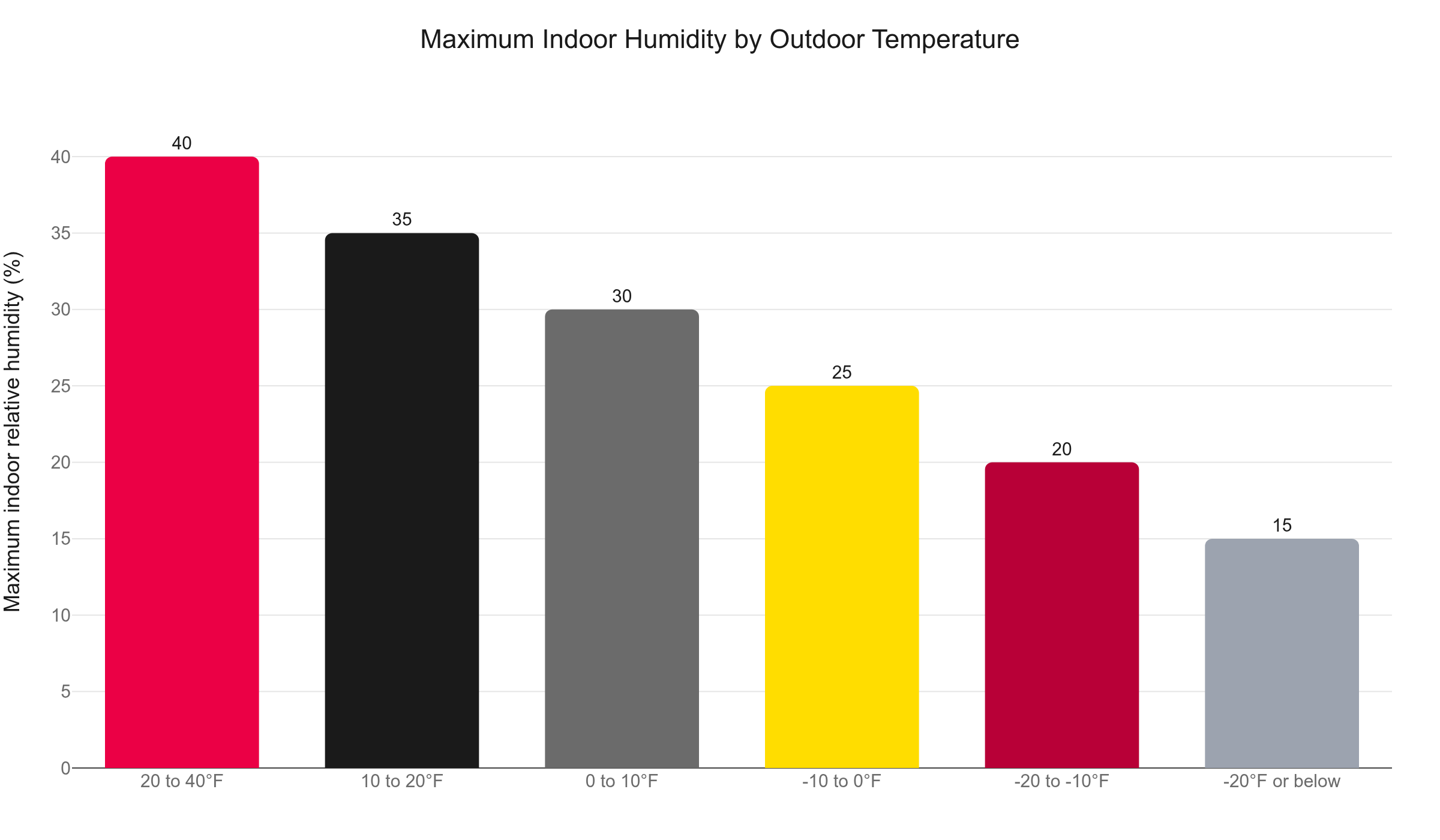
Humidity Targets by Outdoor Temperature
The chart above shows the ceiling for each outdoor temperature band. It comes from the table at MnCEE, the Minnesota Center for Energy and Environment. Keep humidity under 40% from 20 to 40°F. Keep it under 30% from 0 to 10°F. At minus 10 to 0°F, the ceiling is under 25%.
Below that, the numbers get tight. MnCEE lists under 20% from minus 20 to minus 10°F. At minus 20°F or below, it lists under 15%.
Other sources land in the same place. Cardinal’s chart shows 25% at 0°F and 20% at minus 10°F, with the recommended level dropping further as it gets colder. Molekule says humidity at 0°F should not exceed 25%.
A few notes on reading these numbers:
- They assume a home near 70°F inside.
- They are ceilings, not goals. Lower is safe. Higher risks condensation.
- They work best with a real hygrometer reading, not a dial setting.
Your home may fog at a higher or lower number than the chart. Your windows decide that.
Why Does Window Type Change Your Number?
Window glass sets how much humidity your home can handle. Single-pane glass gets coldest and fogs first. Triple-pane glass stays warmer on the inside and tolerates far more humidity.
NDSU gives a clear example. At 40% indoor humidity, double-pane windows start to condense when “the outside temperature dips below zero.” Triple-glazed windows, the same page says, should not condense until about minus 40°F.
The Cold Climate Housing Research Center (CCHRC) in Fairbanks, Alaska, offers rough figures too. At 70°F inside and 0°F outside, CCHRC says condensation starts at about “15 percent relative humidity” on single-pane windows. It lists “25-40 percent” for double-pane and “between 30-50 percent” for triple-pane. CCHRC calls these rough numbers, and Fairbanks is not Minnesota. Still, the pattern holds here.
What that means for you:
- Single-pane windows: Expect fogging at very low humidity. Stay well under the chart numbers.
- Older double-pane windows: The 20% target at minus 10°F matters most for you.
- Newer double-pane windows: You likely have a bit more room, but do not assume.
- Triple-pane windows: You can hold a much higher humidity without fogging.
Many older Twin Cities homes have a mix. A newer kitchen window may stay clear while an old bedroom window drips. The worst window sets your limit.
How Do You Check Your Windows Before You Change Anything?
Start with a look, not a dial. Walk through your home on a cold morning and read your windows like a gauge. They tell you if your current setting is too high.
Check these spots:
- The bottom corners of the glass, where cold air settles
- The window frames and sills, especially wood
- Behind drapes and blinds, where air barely moves
- Bedroom windows, if you sleep with the door closed
- Basement windows and exterior corners of walls
Light fog that clears by mid-morning is a mild warning. Drops that run down the glass are a clear sign. Frost, ice, or water pooling on the sill means you should act today.
The EPA notes that “condensation can be a sign of high humidity.” Be fair to your humidifier, though. MnCEE points out that condensation can also appear with no humidifier at all. Inefficient windows or under-insulated walls can cause it.
Ask one question. Does the moisture show up only when the humidifier runs high? Then your setting is the issue. Does it show up even with the unit off? Then the windows or walls are part of the story.
Our post on condensation on windows in winter covers the causes in more detail.
How Do You Dial In Your Humidifier Step by Step?
Lower the humidistat 2 to 5 points at a time, wait 24 hours, and read your windows. Repeat until the glass stays clear on the coldest morning. Your own windows act as the sensor.
Follow these steps:
- Get a baseline. Put a hygrometer in a main room. Write down the reading and the outdoor temperature.
- Check the forecast. Find the overnight low for the next two nights. Match it to the chart.
- Set the starting point. Pick a setting at or below the chart number for that low.
- Wait a full day. Humidity moves slowly. Do not judge the result after an hour.
- Read the windows. Look at the same spots each morning. Note any fog, drops, or frost.
- Adjust by 2 to 5 points. Fog or drops mean you drop the setting. Clear glass with comfortable air means you hold steady.
- Repeat as the weather changes. A new cold front means a new check.
Be patient with step 4. Many people turn the dial down, see fog an hour later, and turn it down again. By the time the house catches up, the air is far too dry. A slow, steady approach is more comfortable.
Write the final setting on a sticky note near the humidistat, with the outdoor temperature beside it. Next winter, you will have a starting point.
Why Do Wind and Quick Cold Snaps Fog Windows So Fast?
Humidity targets are a ceiling for the coldest hour. A fast drop in outdoor temperature can fog glass within hours. Wind makes it worse because it strips heat from the outside of the glass.
Picture a mild January afternoon near 20°F. Your humidifier sits at 35%, and everything looks fine. By midnight, a front pushes the temperature to minus 10°F. The glass cools quickly, but your house still holds the moisture from the afternoon.
By sunrise, the windows are wet. Nothing broke. The setting matched yesterday’s weather.
How to handle a cold snap:
- Watch the forecast, not just today’s weather. Lower the setting before the front arrives.
- Plan for wind. A windy night chills glass faster than a calm one.
- Expect lag. It can take a day for indoor humidity to fall after you lower the setting.
- Raise it again afterward. When the cold breaks, you can bring the setting back up.
Manual control is hard for this reason. You have to remember to adjust, and the weather does not wait. An automatic control is worth a look.
Can Your Humidifier Adjust Itself as It Gets Colder?
Yes. Many furnace-mounted humidifiers can use an outdoor temperature sensor. This feature is often called an automatic or outdoor reset control. It lowers the humidity target as the outdoor temperature falls, so you do not have to touch the dial.
The sensor mounts outside your home. The control reads the temperature and sets the target to match. On a 30°F day, it holds a higher target. On a minus 10°F night, it drops the target on its own.
This helps in three ways:
- You avoid the 3 a.m. window fog after a sudden cold snap.
- You avoid running dry air all winter just to be safe.
- You stop forgetting a setting you chose in November.
MnCEE makes a related point. It recommends individual humidifiers over whole-home units because whole-home set points are easy to forget. An outdoor reset control fixes that for a whole-home unit. The control remembers so you do not have to.
Without this control, you can still stay safe. Use the step-by-step method above and check the forecast each evening.
To learn how these systems work, read our whole home humidifier winter guide for Twin Cities homes. You can also see our humidifier installation and service options.
When Should You Turn the Humidifier Off Completely?
Turn it off when moisture builds up on your windows or walls day after day. MnCEE advises that with consistent buildup, you should “turn off your humidifier and lower your RH set point before turning it back on.” Let the house dry out first.
Shut it off in these cases:
- Water runs down the glass and pools on the sills.
- Frost builds on the inside of windows and stays all day.
- You see dark spots or damp patches on walls or window frames.
- A hygrometer reads well above the chart number for the weather.
- The air smells musty or damp.
Turning it off is not failure. It is a reset. Give the house a few days. Then restart at a lower setting and use the 24-hour method again.
Other Ways to Lower Moisture
While the humidifier is off, you can pull extra moisture out of the home. NDSU offers practical tips.
- Run bathroom and kitchen fans when indoor humidity is well above 40%. Vent them outside.
- Open drapes at night to cut condensation behind them.
- Do not count on a dehumidifier in winter. NDSU notes they are often ineffective in cold months.
CCHRC adds one more tip. Closing bedroom doors can trap cold, moist air that condenses on windows. If a bedroom window fogs while the rest of the house is clear, try cracking the door open.
Watch for steady sources of moisture too. Long showers, boiling pots, and drying laundry indoors all add water. In a tight home, that water has few places to go.
Why Do Tight Modern Homes Need Extra Care?
Tight, well-sealed homes hold moisture instead of leaking it out. That is good for energy bills. It also means a humidifier setting that worked in a drafty 1950s house can be too high in a newer one.
Older homes leak air all winter. That leakage carries moisture outside, so they often feel dry and need more humidifier output. A newer home with good air sealing keeps moisture in. The same setting can push the glass past its limit.
If your home is tight, keep these points in mind:
- Start your humidity setting lower than a neighbor with an older house.
- Run bath and kitchen fans during and after showers and cooking.
- Watch for stale air, stuffy rooms, or lingering odors.
- Ask about whole-home ventilation if moisture keeps returning.
Fresh air matters as much as humidity. Our guide on stale air in sealed winter homes explains why ventilation belongs in the plan. In a tight house, the right humidifier setting and good ventilation work together.
What Should You Do If the Air Feels Too Dry at 20%?
Many people feel dry skin, static, or scratchy throats at 20% humidity. That is normal in deep cold. Raising the setting will only fog the windows, so use small comfort steps instead.
Try these:
- Drink more water and use lotion and lip balm.
- Keep the setting at the chart number, not above it.
- Add humidity only where you need it, such as a bedroom at night, while watching that room’s window.
- Keep the thermostat steady. Big swings can make air feel drier.
The deep-cold stretch is short. Most Twin Cities winters bring only a handful of nights at minus 10°F. The rest of the season, you can run higher. Accept a little dryness on the coldest nights, and return to 30% or so when the weather warms.
If your home feels dry even in mild weather, the problem may be your equipment. Our post on humidifier running but house still dry covers common causes.
How Can Northern One Hour Help You Get It Right?
We can check your humidifier, set the controls, and add an outdoor sensor if your system supports one. We are a locally owned and operated Twin Cities company, so we know what a Minnesota cold snap does to a house. You get clear answers and no pressure.
Our team can help with:
- Testing your humidifier and humidistat for proper operation
- Setting up automatic outdoor temperature control
- Cleaning and servicing your humidifier before and during winter
- Spotting furnace or ventilation issues that add to moisture problems
- Recommending the right equipment if you need an upgrade
If a larger upgrade makes sense, ask us about financing options. We will explain your choices and what each one costs before any work starts.
We also stand behind the promise we make on every visit: “Always On Time… Or You Don’t Pay a Dime!(R)” In plain terms, we arrive within the time window you select. If your technician does not show up on time, you do not pay for the service.
You do not have to guess about window fog on a minus 10 degree morning. Call us at (763) 260-6662 or book online, and we will help you dial in a setting that keeps your air comfortable and your windows clear.
Frequently Asked Questions
Does a humidifier drop temperature? +
How long should I wait after changing my humidistat in winter? +
Should I run my humidifier when it is below zero? +
Need a technician now?