
Humidity Too High in House Winter? Fixes for Minnesota
Key Takeaways
- The safe indoor level slides with the outdoor temperature. At 0 to 10°F, aim below 30% relative humidity (RH).
- Foggy windows are your early warning. Treat them as a signal to cut humidity right away.
- Check your whole-home humidifier setpoint first. A forgotten setting is a named cause of excess moisture.
- Run bathroom fans for an hour after a shower, and vent them outdoors.
- A continuous low-speed exhaust fan costs only about $15-$20 per year in electricity.
- If windows fog even at a low setpoint, the house itself may need insulation or air sealing.
- Our locally owned team can check your humidifier, controls, and ventilation. Call (763) 260-6662 or book online.
What should indoor humidity be when it is cold outside?
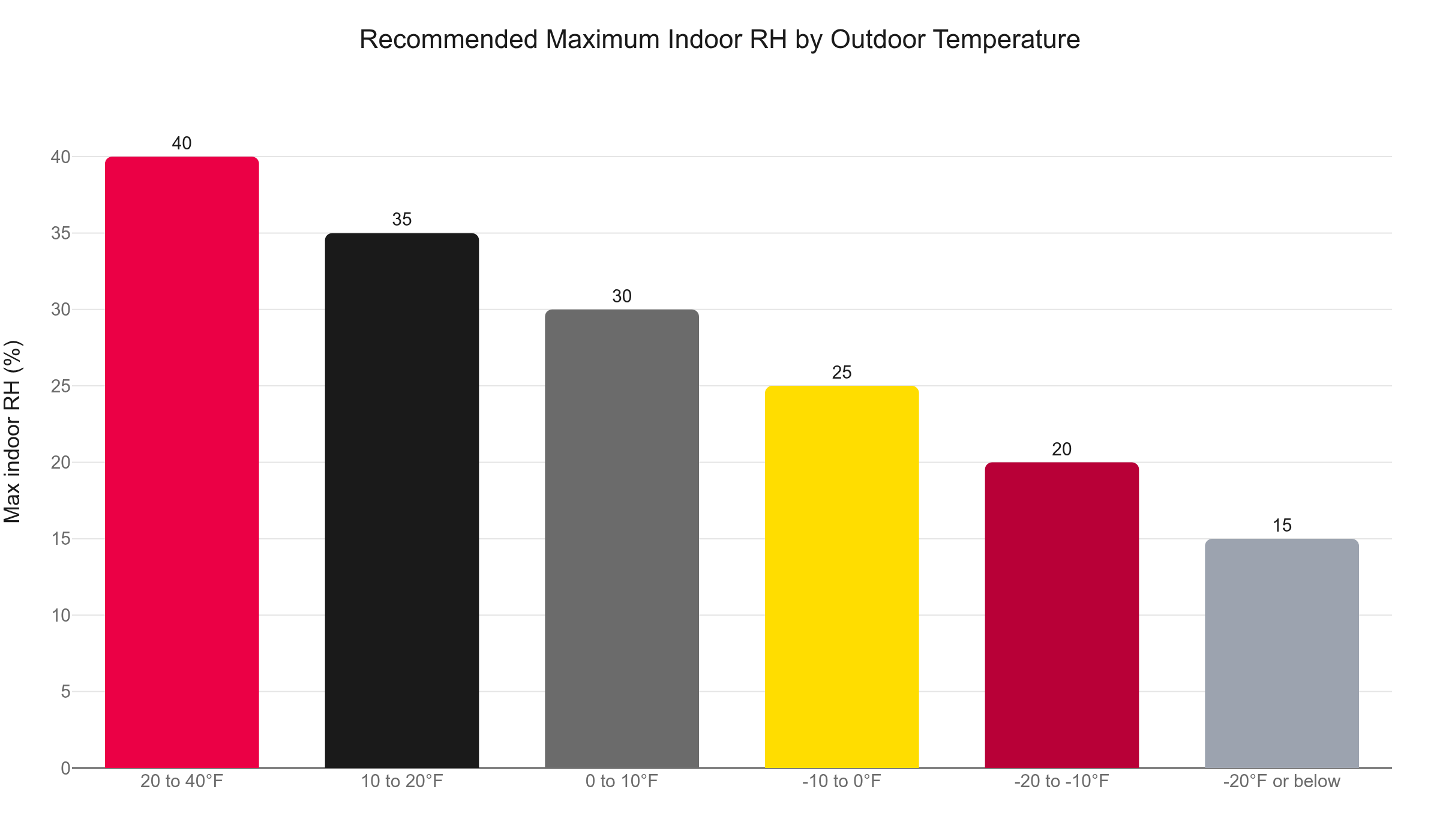
Your target is not one fixed number. CEE’s general guide ties the ideal level to the outdoor temperature. Aim below 40% RH when it is 20 to 40°F outside, and drop to below 15% at -20°F or colder. The colder the day, the lower you set it.
That sliding scale surprises most homeowners. You see “30 to 50 percent” on nearly every website. The EPA says to keep indoor humidity below 60 percent, ideally between 30 and 50 percent. That is a fine yearly baseline. It is not a winter rule for a Minnesota home.
Here is why. Warm indoor air holds moisture. When that air touches a cold window or wall, it cools fast and drops the moisture as liquid. The colder the surface, the sooner it happens. A 40% setting that works in a 35°F November can soak your windows in a January cold snap.
CEE’s guide steps the target down as the weather drops. The chart in this post shows each band. Here are the main points for Twin Cities winters:
- At 20 to 40°F outside, stay below 40% RH.
- At 10 to 20°F, stay below 35%.
- At 0 to 10°F, stay below 30%.
- At -10 to 0°F, stay below 25%.
- At -20 to -10°F, stay below 20%.
Our winters regularly reach the lower bands. Sub-zero mornings are not rare here. So the number that felt right in fall can be too high by January.
CEE also warns that “when it is extremely cold out, 40% RH may still lead to problematic condensation on windows and wall surfaces.” Read that line twice. A reading that looks healthy on the dial can still wet your glass.
The practical rule is simple. Look at the forecast. Before a cold snap, lower your humidifier setpoint. Raise it again when the weather warms. If you want help setting the right numbers, see our guide to humidistat settings for Minnesota winters.
Why is my house humid even when the weather is cold?
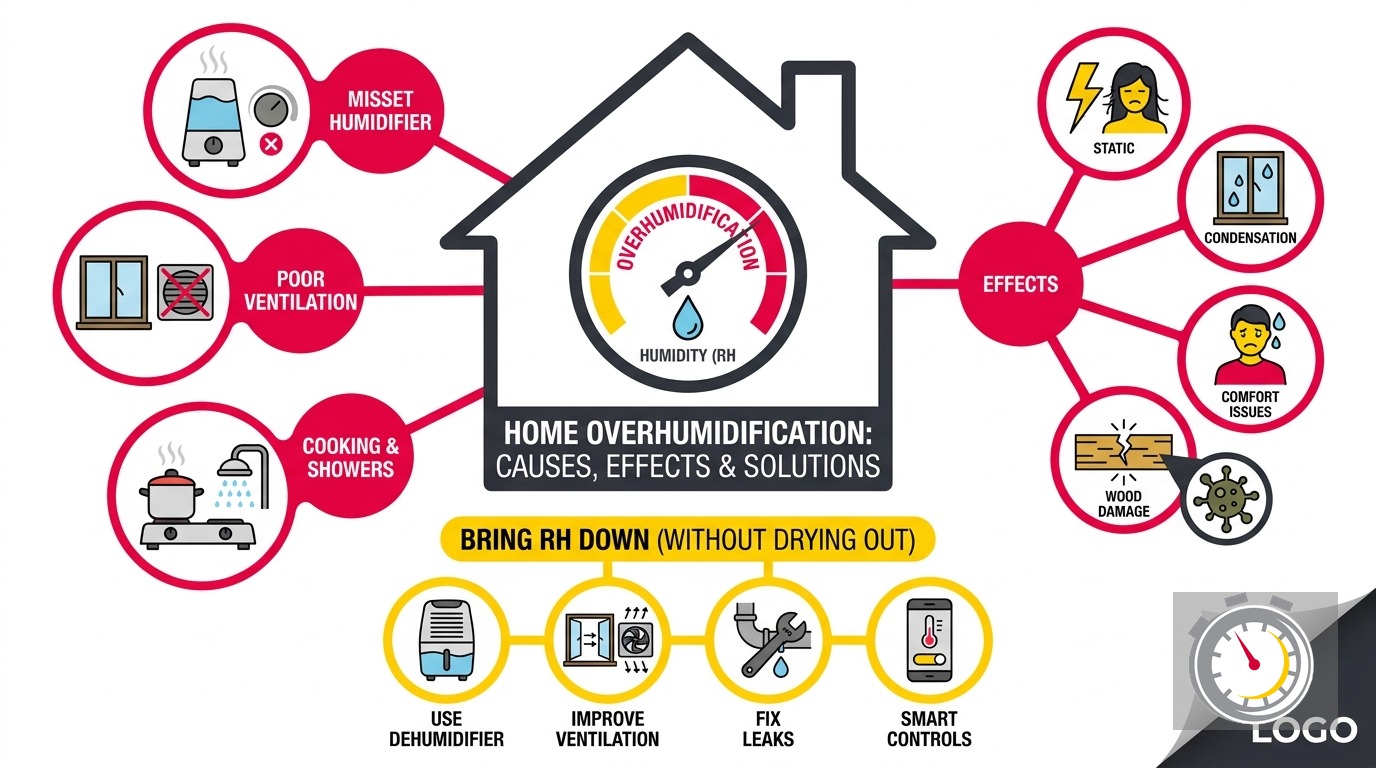
Cold air outside holds very little moisture, but your house makes its own. Showers, cooking, breathing, and a humidifier all add water vapor. A tight home traps it. Weak exhaust fans and a forgotten humidifier setting let the level climb, even on a freezing day.
Minnesota winter air is very dry, as CEE notes. So the moisture you feel is not coming in from outside. It is coming from inside, and it has nowhere to go.
Think of a family of four. Every shower puts steam in the air. Every pot of pasta adds more. Breathing and drying laundry add a little more each hour. In a leaky old house, some of that moisture escapes through gaps. In a newer, tighter house, it stays.
Here are the usual sources, from most to least common in the homes we visit:
- A whole-home humidifier set too high. CEE says forgotten whole-home humidifier settings can rapidly add too much moisture.
- Bathroom steam with no real exhaust. Fans that are weak, short on run time, or vented into the attic leave moisture in the house.
- Cooking without a hood fan. Boiling, simmering, and running the dishwasher all release vapor.
- A tight house with no ventilation plan. Air sealing helps comfort, but it needs fresh-air exchange to match.
- Cold surfaces. Poor windows and thin insulation turn normal humidity into visible condensation.
That last item matters. High humidity and condensation are related, but they are not the same thing. You can have a normal reading and still get wet windows if the glass is very cold. We cover that below.
Seasonal timing also plays a part. Many people set the humidifier in October and never touch it again. By January, the same setting is far too high for the weather. That is the “forgotten setpoint” problem, and it is the first thing we check.
Can my heater cause high indoor humidity?
Not by itself in most cases. A properly vented gas furnace sends its exhaust outdoors, and forced-air heating tends to dry the air. The more common heater-related cause is the humidifier attached to your furnace. If that unit is set too high, it can add too much moisture all winter.
Let’s separate the pieces, because “heater” can mean several things.
Your furnace or boiler. A furnace that vents correctly does not raise indoor humidity. Heating air makes its relative humidity drop. That is why Minnesota homes feel so dry in winter. If your furnace were adding moisture through its exhaust, you would have a venting problem. That is a safety issue, not a comfort issue. Smell fumes or see soot? Leave the house and call us right away.
A humidifier on your furnace. This is the real culprit. Whole-home humidifiers tie into your ductwork and add water to the air your furnace moves. They are great when set well. They are a problem when no one has touched the dial since fall. Our page on whole-home humidifiers explains how the main types work.
Unvented space heaters. Some portable or fireplace-style heaters release moisture into the room. If you use one in a closed space, you may see window fog nearby.
Wet laundry or drying. Drying clothes on racks near vents adds moisture too. This one is easy to miss.
Now the opposite case. If your house feels dry even with a humidifier running, you have a different problem. Our guide on a humidifier running while the house stays dry covers that side. The goal is balance, not zero humidity.
How do I find the cause, step by step?
Work in this order: check your windows, check the humidity reading, turn the humidifier off or down, then check your fans. Each step takes a few minutes and costs nothing. Most homes find the cause by step three.
A good diagnostic order saves you from guessing. Here is the sequence we recommend.
Step 1: Look at the windows. Wake up on a cold morning and check the glass. Do you see fog, water drops, or ice on the inside? The EPA notes that “condensation can be a sign of high humidity.” It is the easiest signal you have. See our guide on condensation on windows in Minnesota winters for more on reading it.
Step 2: Get a real reading. A hygrometer shows your RH. The EPA describes humidity meters as costing “$10-$50.” That is a small price for useful data. Place it in a main living area, not next to the kitchen or a bathroom. Compare the reading with the outdoor table above.
Step 3: Turn the humidifier off or down. Find your humidifier control, often a dial or a digital humidistat. Many homeowners find it set at 45% or higher from the fall. Turn it down. CEE advises that if condensation appears, you should turn the humidifier off and lower the set point before turning it back on. Then give it a day or two. Watch the windows.
Step 4: Check your exhaust fans. Do your bathroom fans actually pull air? Hold a square of toilet paper up to the grille. If it does not stick, the fan is weak or blocked. Does the kitchen hood vent outdoors, or does it just recirculate through a filter? A recirculating hood does not remove moisture.
Step 5: Look at habits. Long hot showers with the door closed, boiling pots without a lid, and indoor clothes drying all add up. Small changes matter.
Step 6: Consider the building. If you did steps one through five and windows still fog, the cause may be cold surfaces. Poor windows and thin insulation do this. We cover that in a later section.
Skip steps and you can chase the wrong fix. Many people buy a dehumidifier first. In a cold house with a humidifier running, that just fights the humidifier. It wastes energy and money.
How can I lower humidity in my home during winter?
Lower your humidifier setpoint first. Then run exhaust fans longer, vent them outdoors, add a continuous low-speed fan if you can, and reduce moisture at the source. Do not start with a dehumidifier. In cold weather, the better fixes keep the home from drying out too far.
Competitors often say “just run a dehumidifier.” That advice fits a damp summer basement. It does not fit a winter house, where the real issue is a mismatch between the humidifier and the weather. Here are the fixes in the order we suggest.
1. Lower the humidifier setpoint
This is the biggest lever and the cheapest. Match your setting to the outdoor table. Lower it before a cold snap, not after the windows already fog.
CEE says to run humidifiers only for short periods and keep RH between 30% and 40%. On the coldest days, that range may still be too high, so go lower. Move it down in small steps, about 5 points at a time. Wait a day, then check the reading and the glass.
Worried about going too dry? That is a fair concern. Dry air brings static shocks, dry skin, and cracked wood. You are not trying to remove all moisture. You are trying to stay just under the condensation line. Our guide to static shocks and low humidity shows how to find that line.
2. Run bathroom fans longer
Showers are a big short-term moisture source. The EPA tells you to “run the bathroom fan or open the window when showering.” A fan works better than a window, though. A window depends on weather and habit.
PNNL’s Building America Solution Center says, “It is recommended to leave the fan running for one hour after a shower for effective humidity control.” That is longer than most people run it. Few people remember to go back and switch it off an hour later. So use a timer switch. PNNL recommends a timer over a standard wall switch.
PNNL also notes that “operable windows should not be relied on for consistent bathroom ventilation.” Cold air through an open window is also a poor trade in January.
3. Vent fans outdoors
A fan that dumps air into your attic does not remove the moisture. It moves it. In a cold attic, that moisture can condense on the roof deck and insulation. PNNL says to “install the fan to vent outdoors, not into an attic, crawlspace, or space between floors.”
Not sure where your fan vents? Look in the attic on a cold day. A duct that ends in open space is a red flag. Our post on bathroom exhaust fan sizing for winter moisture explains how to choose a fan that fits your bathroom.
4. Use the kitchen hood
Cooking and dishwashing release a lot of vapor. The EPA says to “use exhaust fans or open windows whenever cooking, running the dishwasher or dishwashing, etc.” Make it a habit. Turn the hood on before you start the burner and leave it on a few minutes after you finish.
Check where your hood vents. A hood with a filter that recirculates air does not remove water vapor. If you have a choice, a hood that vents outdoors is the better setup. Remember that a strong hood also pulls air out of the house, so it needs a path for replacement air.
5. Add a continuous low-speed exhaust fan
Some homes need steady, quiet ventilation rather than short bursts. CEE’s guide to continuous-running exhaust fans gives these figures:
- Low speed is typically 30-50 CFM.
- Bathing speeds are 50-110 CFM.
- Range hoods need more than 100 CFM when cooking.
CFM means cubic feet per minute. It is how much air the fan moves. The same CEE guide says running a fan continuously “typically costs $15-$20 per year in electricity.” That is a very low cost for steady moisture control. CEE advises raising the speed “when it is humid inside or when there are odors in the home.”
A continuous fan also pulls in replacement air. In a very tight home, a balanced system may be the better choice. An energy recovery ventilator (ERV) or heat recovery ventilator (HRV) swaps stale indoor air for fresh outdoor air and recovers much of the heat. Our post on ERV vs. HRV systems for Minnesota walks through the difference.
6. Cut moisture at the source
Small habits help. Put lids on pots. Take slightly shorter showers. Dry laundry in the dryer, vented outside, not on racks. Fix leaks under sinks and around tubs. Move houseplant clusters out of closed rooms.
None of this is dramatic. Together, it can lower the load on your fans and humidifier.
7. Use a dehumidifier only where it belongs
Basements can run damp even in winter. For basements, CEE says to set a dehumidifier to 55% RH. That target is for the basement, not the main floor. If your basement stays damp year-round, our post on portable vs. whole-home dehumidifiers can help you decide.
When the problem is the house, not the humidifier
Sometimes you lower the setpoint, run every fan, and the windows still fog. Then the problem is cold surfaces. Poor windows and thin insulation make glass and walls cold enough to trigger condensation at normal humidity levels.
CEE says plainly that “inefficient windows or under-insulated walls can cause condensation even without a humidifier.” If your home has single-pane or old double-pane windows, this may be your story. The same goes for older homes with thin wall insulation.
Here is how to tell the difference.
- Condensation is only on certain windows. That points to those windows or walls, not to whole-house humidity.
- Condensation shows up in corners or behind furniture. Cold exterior corners and poor airflow cause this.
- Moisture stains or musty smell appear on exterior walls. Treat this seriously and look for a source.
- The reading is moderate but the glass is wet. The surface is colder than the air around it.
What helps? CEE explains that insulation raises interior surface temperatures so moisture does not condense. Air sealing reduces uncontrolled airflow, and ventilation helps the house “breathe” afterward. The EPA gives similar advice for condensation: reduce humidity, increase ventilation, insulate cold surfaces such as cold water pipes, and increase air temperature.
We are an HVAC company, so we will stay in our lane. We do not insulate walls or replace windows. We can tell you what your HVAC system is doing, and whether your humidity controls and ventilation are working against your house. If you plan upgrades, our guide on air sealing before an HVAC upgrade explains why order matters. A tighter home changes your ventilation needs.
One more tip for older Twin Cities homes. Do not tape plastic over everything and call it fixed. Trapping moisture behind plastic can hide a problem. Find the cause, then fix it.
Is a whole-home humidifier the wrong choice?
Not at all. Many homes in our area need one, especially tight newer homes in a deep freeze. The key is not the equipment. The key is the setting and the upkeep.
CEE notes that its auditors typically recommend individual humidifiers over whole-home units. That is a fair point of view. A single room unit is easy to see, easy to turn off, and easy to control. A whole-home unit works in the background. That is great when it is tuned right and a problem when you forget it.
If you keep a whole-home humidifier, follow a few habits:
- Set a calendar reminder to lower it each time a cold snap arrives.
- Look at your hygrometer at least once a week.
- Check windows each morning in January and February.
- Keep the water panel and parts clean so the unit works as designed.
- Consider a humidifier with an outdoor temperature sensor that adjusts automatically.
That last one deserves a note. Some humidistats track outdoor temperature and lower the target on their own. It removes the “forgot to turn it down” problem. We can tell you if your current unit supports it.
Prefer a simpler path? Turning the humidifier off for the coldest stretch is a legitimate choice. Many Minnesota homes do fine with no added humidity at all during sub-zero weeks. Your skin and your wood floors will tell you if you went too far. Our post on low humidity and hardwood floors covers the dry-air side.
What to do first this week
You do not need a big project to fix most high-humidity problems. Try this plan over a few days.
- Buy a hygrometer and place it on your main floor.
- Check the outdoor temperature each morning and compare it with the CEE bands.
- Lower the humidifier setpoint to match.
- Set a timer on each bathroom fan for an hour after showers.
- Turn on the kitchen hood every time you cook.
- Check windows each morning for a week.
If windows dry out and the reading falls into range, you are done. Keep checking before each cold snap.
If the numbers do not budge, call a professional. A technician can test the humidifier control, check whether the humidifier is running when it should not, and look at your ventilation. A control board or humidistat can fail, and the unit can keep adding water when it should shut off. You cannot see that from the living room.
When to call Northern One Hour
Call us when the DIY steps do not work, or when you are not sure what you are looking at. We are locally owned and operated, and we serve homeowners across the Twin Cities. We know how our winters stress a home.
Here is when a visit makes sense:
- Your humidifier will not hold a setting or seems to run nonstop.
- Windows fog or drip even after you lower the setpoint.
- You see mold, stains, or a musty smell near windows or walls.
- Your fans are weak, noisy, or vent into the attic.
- You want a ventilation upgrade, such as an HRV or ERV.
- You are not sure whether your problem is humidity or cold surfaces.
We can inspect your humidifier, controls, and ventilation, and give you plain answers. If you need a bigger fix, such as a ventilation system, ask us about financing options.
We also keep our word on timing. When you book a visit, we arrive within the time window you select. If the technician does not show up on time, you do not pay for the service. That is our “Always On Time… Or You Don’t Pay a Dime!(R)” promise.
You do not have to live with wet windows and worry all winter. Call (763) 260-6662 or book online, and we will help you bring the humidity back into range without drying out your home.
Final word
High winter humidity is usually a settings and ventilation problem, not a mystery. Match your humidifier to the outdoor temperature. Keep fans working and venting outdoors. Watch your windows, and treat fog as an early alarm.
Start with the simplest step: turn the humidifier down. Then work through the list. If you want a second set of eyes, our team is a call away at (763) 260-6662.
Frequently Asked Questions
Is a humidity of 65 in a house bad? +
Should I run a dehumidifier to fix high humidity in winter? +
How do I measure humidity in my house? +
What humidity setting should my whole-home humidifier use on a very cold day? +
Need a technician now?