
Stale Indoor Air in Winter: How to Improve It in Minnesota
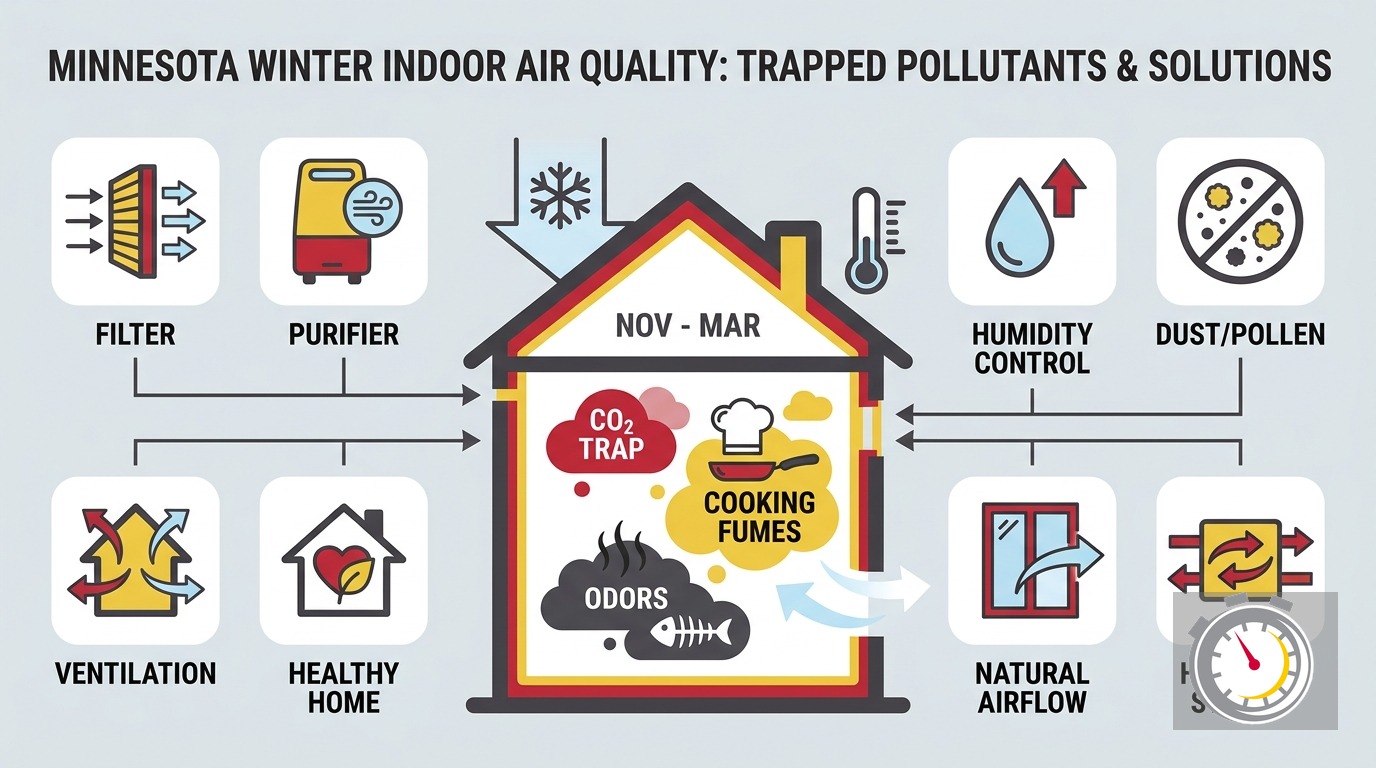
Key Takeaways
- Tight, well-sealed homes hold cooking fumes, odors, and moisture longer. The EPA notes that pollutants can build up when too little outdoor air enters.
- Opening windows at sub-zero temperatures wastes heat. It can also upset how your combustion appliances vent.
- Vent your range hood and bath fans to the outdoors, and use them every time.
- A timed or continuous exhaust fan is the next step up in cost and effect.
- A balanced ERV or HRV brings in fresh air without a big heat penalty.
- Dry air and stale air are different problems. Fix each one on purpose.
- Call (763) 260-6662 if you want a technician to look at your home’s airflow.
Stale Air Is a Ventilation Problem, Not a Cleaning Problem
If your Minnesota home feels stuffy from November to March, the cause is usually simple. Not enough outdoor air is coming in. Candles and air fresheners won’t fix that. Planned fresh air will.
There are options at every budget, and we rank them below from cheapest to most involved.
We are a locally owned and operated Twin Cities HVAC company. We see this problem every winter, in new builds and older homes alike.
Why Does Indoor Air Quality Get Worse in Winter?
Indoor air gets worse in winter because you seal the house up and stop trading air with the outdoors. Windows stay shut, doors open briefly, and heat runs for months. Pollutants from cooking, cleaning, breathing, and furnishings stay inside longer, so levels climb.
Picture a Minnesota January. The windows have not been open since October. The furnace cycles all day. You cook dinner, run the dryer, and take hot showers.
Each of those adds something to the air. Moisture, cooking particles, odors, and the carbon dioxide you breathe out all stay put.
The EPA’s introduction to indoor air quality says buildings designed to minimize outdoor air leakage “may have higher indoor pollutant levels.” It also explains that when little air gets in through leaks, open windows, or mechanical ventilation, the air exchange rate is low and pollutant levels can increase.
That describes a lot of Twin Cities homes. We air-seal, add insulation, and install new windows to cut energy bills. Those upgrades are smart. They also remove the accidental fresh air that leaky houses used to get.
A leaky old house ventilated itself, badly and expensively. A tight house needs a plan.
What Causes Poor Air Quality in Winter?
Poor winter air quality comes from sources inside a closed house: cooking, gas appliances, moisture, cleaning products, pets, and people. With no steady outdoor air to dilute them, these sources build up. Fixing the cause, then adding ventilation, works better than masking the smell.
These are the common culprits in Twin Cities homes:
- Cooking. Frying, searing, and broiling release smoke and fumes. A recirculating hood only filters grease. It does not remove the fumes.
- Gas appliances. Stoves, ovens, and some water heaters add combustion byproducts. A poorly adjusted burner makes more.
- Moisture. Showers, laundry, and cooking add water vapor. Trapped moisture feeds musty smells and window condensation.
- Household products. Cleaners, candles, aerosols, and new furniture release chemicals into the air.
- People and pets. You exhale carbon dioxide all night in a closed bedroom. Pets add dander and odor.
- Dryers and exhaust vented poorly. A dryer that does not vent outdoors puts lint and moisture into the house.
The EPA’s guide to indoor air quality is blunt about gas stoves. It says never to use one to heat your home. It also says a persistent yellow-tipped flame signals the burner is improperly adjusted.
If you see a yellow-tipped flame on your range, have it checked. We cover the same warning sign for furnaces in our guide to yellow flame versus blue flame.
Cooking is the biggest everyday source
Most homeowners underestimate cooking. The EPA says a stove hood with a fan vented to the outdoors “greatly reduces exposure to pollutants during cooking.”
The key words are “vented to the outdoors.” Many hoods only recirculate. They pull air through a mesh filter and blow it back into the kitchen. Look at yours. If no duct runs to a wall or the roof, it is a recirculating model.
Why Can’t You Just Open a Window in a Minnesota Winter?
You can, but it costs a lot and carries risk. At sub-zero temperatures, an open window dumps heat you paid for and can chill pipes and floors near it. It can also change house pressure and cause combustion appliances to backdraft. A planned system is cheaper and safer.
Most online advice says to open windows for 5 to 10 minutes. That works in Atlanta. In Minneapolis at minus 10 degrees, it creates problems.
Here is what happens:
- Your furnace runs hard to recover the lost heat.
- Cold air drops to the floor and chills nearby rooms.
- Pipes near exterior walls get a blast of cold air.
- House pressure shifts, which can pull exhaust gases back down a flue.
The last one matters most. An open window on one side of the house, plus a running dryer and range hood, can starve a furnace or water heater of air. Our post on exhaust fans and furnace backdrafting explains how.
A gas or wood-burning fireplace raises the risk. See our guides on gas fireplace combustion air and range hoods and makeup air.
A brief window crack is still fine on a mild day. Just don’t make it your winter plan.
How Often Should You Air Out Your House in Winter?
Ideally, fresh air should arrive continuously, not in bursts. The EPA describes the air exchange rate as the rate at which outdoor air replaces indoor air. If you must air out by hand, a short burst on a mild afternoon works. A planned system is better.
The EPA’s indoor air guide recommends a ventilation rate of 0.35 ach, or air changes per hour, for new homes. That means about one-third of the home’s air is replaced with outdoor air every hour.
Cracking a window twice a day won’t reach that number. Continuous, controlled ventilation will. That is why newer homes have mechanical systems.
Without one, try this routine:
- Run the bath fan during every shower and for 15 to 20 minutes after.
- Run the range hood whenever you cook on the stovetop.
- Open windows briefly on the mildest afternoons.
- Skip window venting on very cold days or when wind is strong.
- Vent your clothes dryer outdoors, and keep the duct clear.
We don’t offer a magic number of minutes, because every home leaks differently. A technician can measure and tell you what your house needs.
What Does Minnesota Code Say About Fresh Air?
Minnesota’s energy code includes mechanical ventilation rules for homes. One rule requires a balanced mechanical ventilation system, with dampers that close when the system is off. Many older homes predate this thinking. If you have air-sealed or replaced windows, you may have a tight house with no planned fresh air.
The Minnesota Revisor posts the text of rule 1322.0403. It says a balanced mechanical ventilation system must deliver within ”+/- 10 percent of the system’s design capacity.” It also says outdoor air intakes and exhausts need dampers that close when the system is off.
We can’t tell you which code edition applies to your home, since the page shows no version date. If you are building or remodeling, check the effective code with the Minnesota Department of Labor and Industry.
How the rule sizes ventilation
The rule gives a formula. Total ventilation in cubic feet per minute (cfm) equals 0.02 times the square feet of conditioned space, plus 15 times the number of bedrooms plus one.
The continuous rate is half the total. It “shall not be less than 40 cfm.” The rule’s table gives examples:
- 1,000 to 1,500 square feet with 3 bedrooms: 90 cfm total, 45 cfm continuous.
- 2,001 to 2,500 square feet with 3 bedrooms: 110 cfm total, 55 cfm continuous.
These numbers show the scale. A typical family home needs a modest, steady flow of fresh air. That is far less than an open window delivers, but it runs all day.
What this means if your home is older
Many Twin Cities homes were built before rules like this existed. They relied on leaks to bring in air. Then someone added insulation, new windows, and air sealing.
The house got more efficient. It also got stuffier. If that sounds like your home, you haven’t done anything wrong. A piece is missing. Our post on air sealing before an HVAC upgrade covers how the two connect.
How Do You Fix Stale Winter Air, From Cheapest to Most Involved?
Start with free habits, then add a timed exhaust fan, then consider a balanced ERV or HRV. Each step costs more and does more. Most homeowners get good results from the first two. Very tight homes often need the third.
Stop at the step that solves your problem.
Step 1: Fix your range hood and bath fan habits
This step costs little or nothing, and it does the most good for the money.
- Check where your hood vents. If it is recirculating, plan to switch to a ducted hood at your next kitchen update. The EPA advises exhaust fans vented outdoors in kitchens and bathrooms.
- Use the fan every time. Turn it on before you start cooking. Leave it on a few minutes after you finish.
- Run bath fans long enough. Let them run after the shower ends so moisture leaves.
- Vent the dryer outdoors. The EPA says to vent clothes dryers outdoors, too.
- Skip the gas stove as a heater. The EPA says never to use one to heat your home.
- Cut sources. Use fewer aerosols and strongly scented products in winter.
Check that your bath fan is the right size, too. Our guide to bathroom fan sizing and winter moisture walks through it.
One caution. A strong range hood can pull air out of the house faster than it comes in. In the wrong setup, that causes backdrafting. If you have a powerful hood and a gas appliance, ask us about makeup air.
Step 2: Add a timed or continuous exhaust fan
This step costs more, but it gives you a real ventilation plan. A quiet bath fan on a timer or a low continuous setting pulls stale air out all day. Fresh air then leaks in through small gaps in the house.
It works well in homes that are tight but not airtight. It is simple, with few parts to maintain.
It has tradeoffs. An exhaust-only fan creates slightly lower pressure in the house, and the incoming air is cold and unconditioned. In very tight homes, it can pull air from places you don’t want, like around a flue.
So a technician should look at your combustion appliances first. A modern sealed-combustion furnace lowers the risk. An older atmospheric-vent water heater needs a closer look.
We can’t confirm general performance claims for every exhaust approach. Your house is the test, and we check it in person.
Step 3: Install a balanced ERV or HRV
This is the most involved option and the most complete.
An HRV is a heat recovery ventilator. An ERV is an energy recovery ventilator. Both bring fresh air in and send stale air out at the same time. The two air streams pass through a core, so incoming air picks up some warmth from outgoing air.
“Balanced” means the same amount of air goes in as goes out, which keeps house pressure steady. It is also the type Minnesota’s rule describes for mechanical ventilation, with dampers that close when the system is off.
Benefits for a Minnesota winter:
- Fresh air arrives continuously, not in bursts.
- You lose less heat than you would with an open window.
- House pressure stays steady, which helps combustion appliances.
- Rooms stop feeling stuffy, and odors clear faster.
An ERV and an HRV differ in how they handle moisture. Our guide to ERV versus HRV in Minnesota explains the choice. Our post on HRV whole-home ventilation covers how these units work in our climate.
These systems need filter care, and cold climates may also need frost protection. We will walk you through what your unit needs. See also our guide to HRV and ERV filter maintenance.
A whole-home system is a larger job, so ask about financing. We can explain options when we quote. You can also read our overview of HVAC financing.
How Do You Add Moisture to Dry Air in Winter?
Use a whole-home humidifier or a portable unit, and set it by the outdoor temperature. Minnesota winter air is very dry once it warms inside. But too much moisture in a tight house causes window condensation. Control humidity on purpose, and ventilate too.
Dry air and stale air often show up together, but they are different problems.
Dry air feels scratchy. You get dry skin, static shocks, and sore throats. Stale air feels heavy and smells flat. A house can have both at once.
Here is how to handle moisture:
- Use a humidistat. Set it based on how cold it is outside. Our guide to humidistat settings for Minnesota winters explains how.
- Watch your windows. Fogged or dripping glass means humidity is too high for the weather. Our post on window condensation covers the fix.
- Maintain your humidifier. Scale buildup and clogs make it work poorly. See our guide to whole-home humidifier winter dry air.
- Troubleshoot a weak unit. If it runs but the house stays dry, read why a humidifier may run without raising humidity.
Moisture helps comfort in January, but a tight house also traps it. Ventilation and humidity control work as a pair.
Our humidifier services can help you pick the right setup.
What Else Helps Clear Stuffy Air?
Ventilation does the heavy lifting. A few other steps help at the edges.
- Change your furnace filter on schedule. A clean filter keeps dust from circulating. Check our guide on how often to change your HVAC filter.
- Run the fan setting when needed. Our post on auto versus on thermostat fan settings explains the tradeoffs.
- Consider air purification. Filtration cleans particles but does not bring in fresh air. See our air purification options.
- Measure rather than guess. A monitor can show when air gets stale. Read about home air quality monitors.
- Watch for new sources. Renovation and new furniture release chemicals. Our guide to VOC off-gassing after renovation helps.
If someone in your home has a newborn, asthma, or allergies, fresh air matters more. Our guide to indoor air quality for a nursery in Minnesota is a good starting point.
When spring comes, you will want to know what winter left behind. We cover that in what is really in your air after a Minnesota winter.
When Should You Call a Professional?
Call when stuffiness keeps coming back, when you see window condensation or musty smells, or when you have gas appliances and a very tight house. A technician can check airflow and combustion safety together. Do not guess when safety is involved.
Call us if:
- The house smells stale even after you cook with the hood on.
- Windows fog or drip every morning in cold weather.
- You air-sealed or replaced windows and the house now feels stuffy.
- You have a gas furnace, water heater, or fireplace and run strong exhaust fans.
- A carbon monoxide alarm sounds. Leave the house and call emergency services first.
- Family members get headaches or feel tired mostly at home.
For safety, see our posts on carbon monoxide safety and what to do when a CO alarm goes off.
What a visit looks like
We start by listening. We ask where the stuffiness shows up and when. We look at your fans, hood, furnace, and water heater.
Then we explain the options in plain English, cheapest first. You decide what fits your home and budget. We don’t push the biggest system when a smaller fix will do.
We are locally owned and operated, and we live through the same winters you do. Our promise is simple: “Always On Time… Or You Don’t Pay a Dime!(R)”
In practice, we arrive within the time window you select. If your technician does not show up on time, you do not pay for the service.
Get Fresher Air Before the Deep Freeze
You don’t have to live with stale air until April. Start with the free fixes this week. Check your range hood. Run your bath fans longer. Skip the window trick on cold days.
If that is not enough, we can help you add a real ventilation plan. Learn more about our indoor air quality services, or call us.
Call (763) 260-6662 or book online to schedule fast. Northern One Hour Heating & Air Conditioning serves Minneapolis, St. Paul, Ramsey, Blaine, Maple Grove, Plymouth, Brooklyn Park, Woodbury, Bloomington, and nearby Twin Cities communities.
Frequently Asked Questions
Is it safe to open a window when the furnace is running in winter? +
Does Northern One Hour install ventilation systems? +
Will a bigger filter fix stale air? +
Need a technician now?