
Indoor Air Quality for Your Newborn Nursery in Minnesota
Key Takeaways
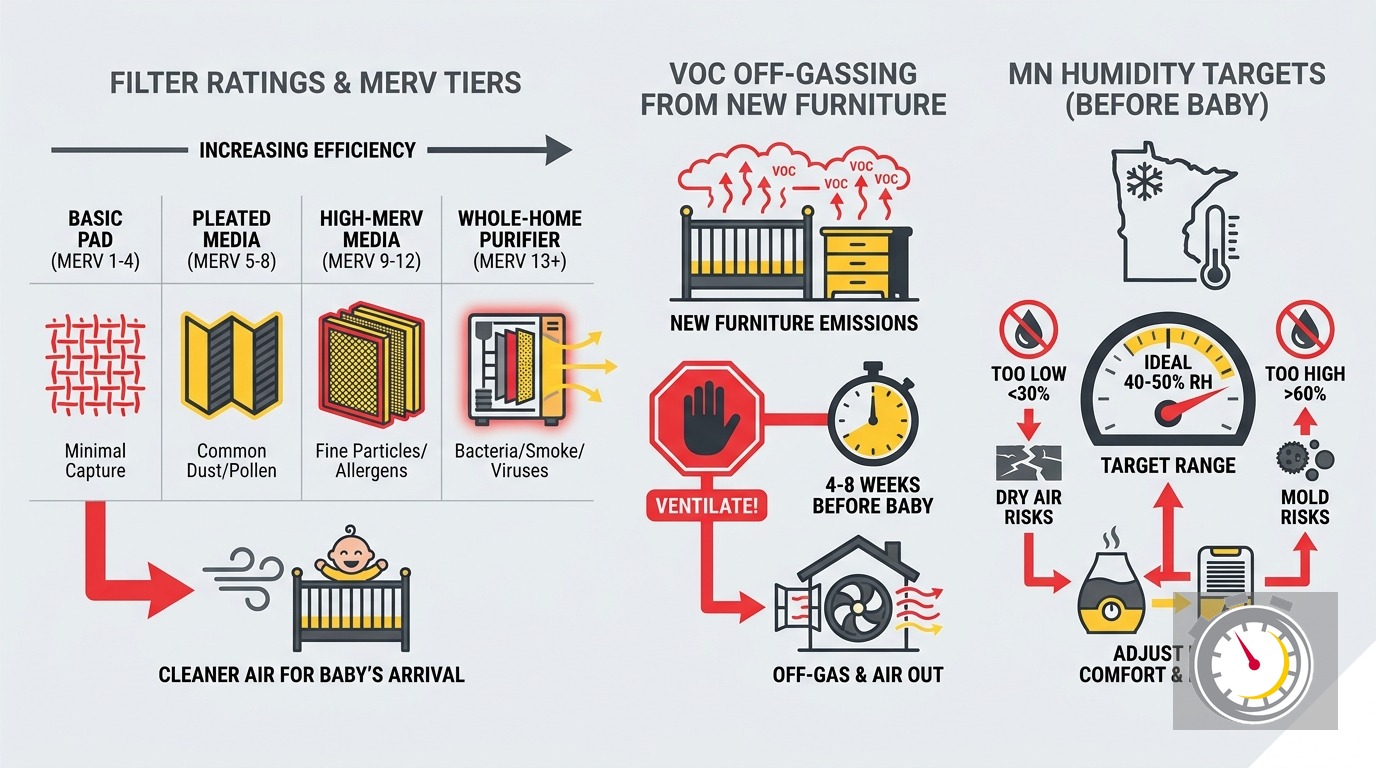
- New nursery furniture - cribs, dressers, carpet, gliders - off-gasses VOCs into your home for months after delivery. In a Minnesota winter, that air has nowhere to go.
- The EPA recommends a minimum MERV 13 filter for homes where improved air quality is a priority. Confirm your blower can handle it before upgrading - not every furnace can.
- Indoor humidity should stay 30-50% year-round. In Minnesota, that means a whole-home humidifier in winter and your AC (or a dehumidifier) holding it below 60% in summer.
- Most forced-air furnaces do not bring in fresh outdoor air. An HRV (heat recovery ventilator) is the only HVAC solution for fresh-air dilution during a sealed Minnesota winter.
- Northern One Hour can install or upgrade all three: filtration, whole-home humidification, and an HRV.
Why Is Indoor Air Quality Different in a Minnesota Nursery?
Generic nursery IAQ guides miss one critical variable: Minnesota winters. Your home seals tight from November through March. New nursery furniture off-gasses VOCs into that sealed envelope for months. A forced-air furnace brings in no fresh outdoor air on its own. The result is prolonged chemical exposure with no dilution path.
Here is what the national parenting sites and generic HVAC guides skip entirely.
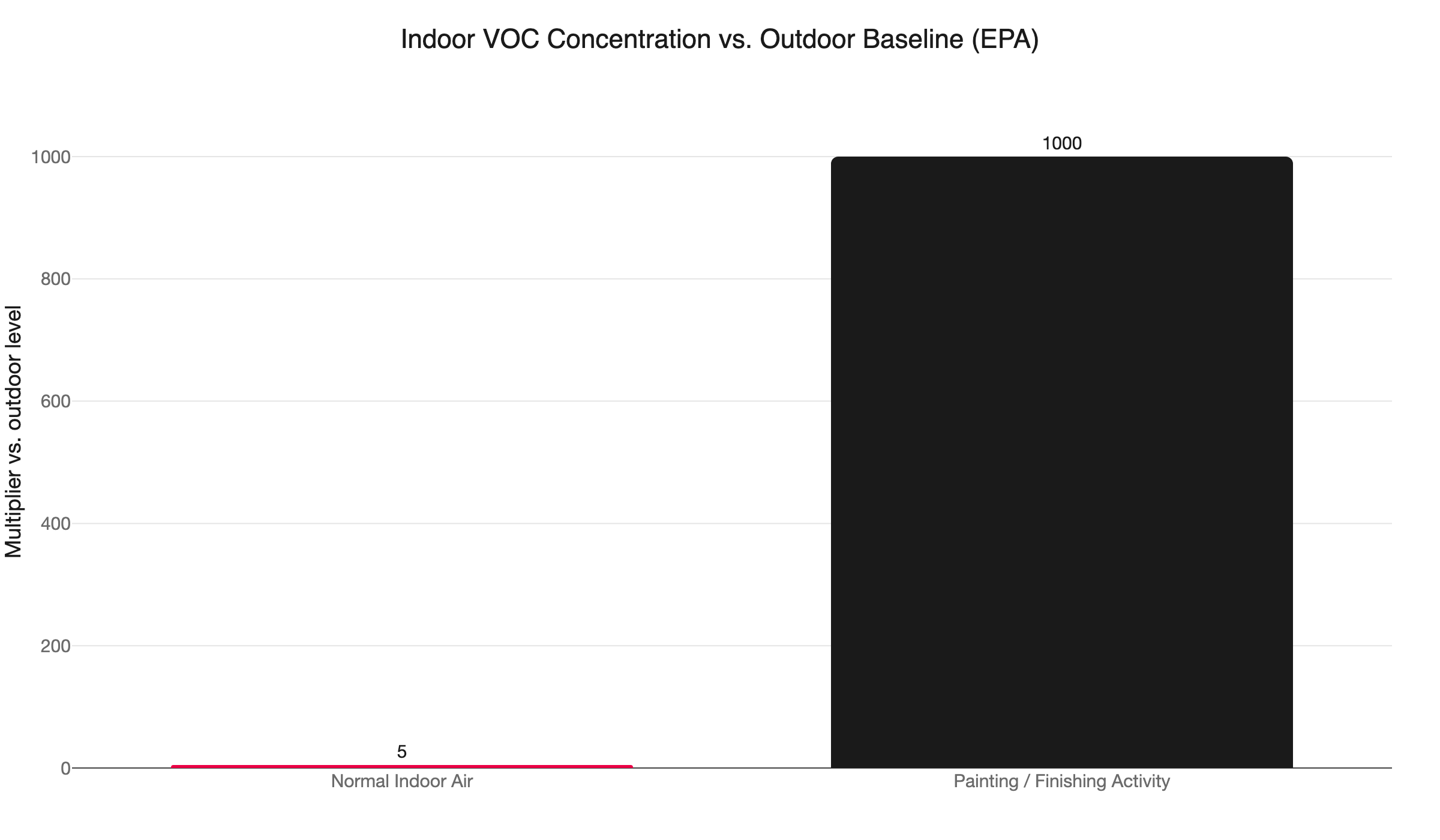
When you set up a new nursery, every piece of furniture in that room is releasing volatile organic compounds. According to the EPA, indoor VOC concentrations run 2-5x higher than outdoor levels under normal conditions. During painting or stripping activities, that gap can reach 1,000 times outdoor background levels. Elevated concentrations persist long after the activity ends.
The problem is timing. Most families finish the nursery in fall, ahead of a late-autumn or winter due date. That puts peak off-gassing directly inside the window when your home is fully sealed. Twin Cities average January lows hover between 5 and 13°F. Opening a window for ventilation is not realistic from late November through early March.
A newborn sleeps 16 to 18 hours a day. The nursery is where they spend most of their time. In a sealed Minnesota winter, that room is breathing the same recirculated air as every piece of new furniture you just brought inside.
The generic advice - buy an air purifier, use low-VOC paint, run a humidifier - is not wrong. It is just incomplete without addressing the sealed-envelope problem. That is the angle this post covers.
What VOCs Come Off New Nursery Furniture?
The short answer: Pressed-wood cribs and dressers, new carpet, foam mattresses, adhesives, and fresh paint all release VOCs including formaldehyde and benzene. Concentrations are highest in the first weeks but can persist for months. In a sealed Minnesota winter, there is no natural dilution unless you take active steps.
The EPA identifies newly installed flooring, carpet, upholstery, and pressed-wood cabinetry as primary indoor air pollution sources. That list covers nearly every item in a newly assembled nursery.
Common off-gassing sources and what they release:
- Pressed-wood crib or dresser (MDF, particleboard): formaldehyde from the urea-formaldehyde resins used in the adhesive layers - the most common VOC in new furniture
- New carpet and pad: benzene, toluene, and styrene from synthetic fibers and backing adhesives, plus residual chemicals from the manufacturing process
- Polyurethane foam mattress or glider cushion: VOCs from the foam itself and flame retardant coatings applied to meet safety standards
- Fresh paint: a range of VOCs during application and for weeks after drying; low-VOC products reduce but do not eliminate them
- Varnishes, caulk, and trim adhesives: additional sources from any finish work done in the room before baby arrives
No federally enforceable VOC limits exist for residential indoor spaces. There is no legal ceiling on what the air in your nursery is allowed to contain. Your newborn’s developing respiratory system is operating in an environment with no regulated maximum unless you take active steps to lower it.
Source control is the most effective strategy. The EPA is explicit: reducing what off-gasses into the air is more effective than filtering or ventilating it away after the fact. Practical steps before baby arrives:
- Assemble nursery furniture 4 to 6 weeks before the due date, or earlier. Off-gassing peaks in the first 30 days.
- Choose low-VOC or no-VOC paint for the walls. The reduction in off-gassing is real and significant.
- Air out furniture in a garage or separate space during a shoulder season - fall or early spring - when opening windows is practical. This is not possible in January.
- Choose solid-wood furniture over pressed wood when the budget allows. Solid wood off-gasses significantly less formaldehyde.
Source control reduces the problem. It does not eliminate it. You still need filtration, humidity management, and mechanical ventilation.
Why Can’t I Just Open a Window?
The short answer: In Minnesota, opening a window is not a winter ventilation strategy. The EPA acknowledges that ventilation through windows is impractical during extreme outdoor temperatures. Most forced-air furnaces bring no fresh outdoor air inside on their own. For a sealed Minnesota home, an HRV is the only HVAC-grade solution.
Most home forced-air heating systems do not mechanically bring fresh outdoor air indoors. Opening windows or running window fans is the standard dilution method. The same source notes you should avoid opening windows when outdoor air quality is poor or during extreme temperatures, and recommends checking AirNow.gov for current conditions before ventilating.
That recommendation lands in a specific way in Minnesota: “extreme temperatures” describes four to six months of our year. The EPA’s default ventilation advice is practically unusable here from roughly late November through early March.
What makes this worse for a nursery is that a forced-air furnace recirculates indoor air. It heats the same air, over and over, through the same ducts. VOCs from new furniture have no exit. They accumulate in that recirculated supply until they degrade on their own or until something removes them. Filtration captures particles - it does not remove gas-phase VOC molecules. The only way to dilute gas-phase VOCs is with fresh air.
What you can do before installing mechanical ventilation:
- Assemble early and in a separate space - a garage or a spare room with the door closed - so peak off-gassing happens before the baby arrives.
- Run bath and kitchen exhaust fans more often during and after nursery assembly. They create slight negative pressure and exhaust some indoor air. Not a substitute, but better than nothing.
- Open windows during mild shoulder-season days before the due date when temperatures allow. Early October or mid-April gives you a window.
- Install an HRV - the durable mechanical solution covered below.
What MERV Rating Does a Nursery Need?
The short answer: The EPA recommends a minimum MERV 13 filter, or as high as your system can accommodate, for homes where improved indoor air quality is the goal. MERV 13 captures particles down to 0.3 microns, including PM2.5 and mold spores. Always confirm compatibility with an HVAC technician before you upgrade - not every blower can handle the added restriction.
MERV (Minimum Efficiency Reporting Value) measures a filter’s ability to capture particles between 0.3 and 10 microns in size. Higher MERV ratings capture smaller particles more effectively. The EPA’s explicit guidance: “If you decide to upgrade to a higher efficiency filter, choose a filter with at least a MERV 13 rating, or as high a rating as your system fan and filter slot can accommodate.” Consult an HVAC technician to confirm compatibility.
What to know before you upgrade:
- Not every furnace can handle MERV 13. Higher MERV ratings increase airflow resistance across the filter. On an older furnace with a standard PSC blower motor, a dense MERV 13 filter can starve the system, overheat the heat exchanger, and accelerate component wear. An HVAC technician can identify the highest MERV your blower supports.
- Central filters cover the whole house. That is a meaningful advantage over portable air cleaners, which protect one room. The EPA recommends combining both: a MERV 13 central filter plus a quality portable unit with a true HEPA filter in the nursery itself. The central filter handles the whole house; the portable covers the room where the baby sleeps.
- Filter replacement schedule matters more with a newborn in the house. A clogged MERV 13 filter restricts airflow and holds everything it captured. Check the filter monthly. Change it on schedule.
Fine particulate matter - PM2.5, particles under 2.5 microns - is a specific concern for newborns. A 2024 consensus study by the National Academies of Sciences, Engineering, and Medicine, sponsored by the EPA, established the scientific basis for health risks from indoor PM2.5 in residential settings. Children face greater risk from PM2.5 exposure than healthy adults. That is exactly the person in the nursery.
For a deeper comparison of central filtration versus portable air cleaners, see air purifiers vs. filters and MERV ratings explained.
One important clarification: a MERV 13 filter captures particles. It does not remove gas-phase VOC molecules. Formaldehyde, benzene, and toluene pass through a filter unchanged. Filtration and mechanical fresh-air ventilation solve different problems. A nursery in a sealed Minnesota winter needs both.
What Humidity Level Is Safe for a Newborn in Minnesota?
The short answer: The EPA target is 30-50% relative humidity year-round. Minnesota forces you to fight both extremes: furnace heat drives indoor RH below 30% without a humidifier in winter, and summer humidity can push above 60% without your AC removing moisture as it cools. A whole-home humidifier and a properly sized air conditioner are the two tools that keep you in range.
The EPA recommends keeping indoor relative humidity below 60% - ideally 30-50% - to prevent mold growth and biological contamination. Mold and dust mites are established asthma and allergy triggers. Children, pregnant women, and older adults are more vulnerable to biological contaminants than healthy adults. That population description maps directly onto a nursery.
The winter problem: indoor RH below 30%
Cold outdoor air holds almost no moisture. When your furnace heats that air to 68-70°F, relative humidity drops sharply. During a Minnesota cold snap - single digits or below zero - untreated indoor air can fall to 15-20% RH. At those levels:
- Nasal passages and airways dry out, reducing their effectiveness at trapping particles and pathogens
- Mucous membranes crack and irritate, creating entry points for infection
- The nursery air carries suspended particles more easily without moisture to weigh them down
A whole-home bypass or flow-through humidifier mounted to your furnace adds moisture to every cubic foot of conditioned air - not just one room. Set the humidistat to 35-45% as your winter target. On the coldest nights, you may need to dial back slightly to prevent condensation on windows. Condensation creates its own mold risk.
The summer problem: indoor RH above 60%
Minnesota summers push indoor humidity high during humid stretches, especially in older homes without tight building envelopes. Mold can begin growing on surfaces within 24 to 48 hours of moisture accumulation. Mold spores trigger asthma in sensitive individuals - and children are in the sensitive category.
A running central air conditioner dehumidifies as it cools - but only if it is correctly sized and running long enough each cycle. An undersized or short-cycling AC can drop the temperature without removing enough moisture. If your AC cannot hold summer humidity below 60%, a whole-home dehumidifier added to the duct system is more reliable than running portable units room to room.
What Is an HRV, and Does My Home Need One for the Nursery?
The short answer: An HRV (heat recovery ventilator) mechanically exchanges stale indoor air for fresh outdoor air while recovering most of the heat from the exhaust stream. It is the HVAC solution for fresh-air dilution in a sealed Minnesota winter. New MN construction requires HRVs under current mechanical code. Most older Twin Cities homes were not built with one.
Advanced home designs use heat recovery ventilators - also called air-to-air heat exchangers - to bring outdoor air in efficiently without the energy loss of simply opening a window. HRVs are now standard in new Minnesota construction per ASHRAE 62.2 ventilation standards, which the Minnesota Mechanical Code references. Homes built before roughly 2000 typically were not built to those ventilation standards.
Without an HRV in a pre-2000 home, your sealed winter envelope has no mechanical fresh-air path. A MERV 13 filter captures particles. It does not touch gas-phase VOCs. An HRV addresses the dilution problem that filtration alone cannot solve.
How an HRV works:
- Draws stale indoor air out through one duct path
- Simultaneously draws fresh outdoor air in through a separate path
- Passes both airstreams through a heat-exchange core, where the outgoing warm air heats the incoming cold air
- Delivers fresh, tempered air to the living spaces - recovering 70-80% of the heat that would otherwise be vented outside
An energy recovery ventilator (ERV) works on the same principle but also transfers moisture between the two airstreams. In a heating-dominated climate where you are fighting dry winter air, an ERV can help hold onto indoor humidity while still diluting VOCs with fresh air. For a detailed side-by-side, see ERV vs. HRV: which ventilation system is right for Minnesota.
HRV installation on an existing home integrates with your current ductwork. Our team assesses your layout, confirms compatibility, and quotes the installation. It is not a small job, but it is the permanent solution to the sealed-envelope problem that every other guide sidesteps.
The Three-Part HVAC Solution for a Minnesota Nursery
Most nursery IAQ guides recommend a portable purifier and low-VOC paint. That is a reasonable start - and it is not the complete answer for a home sealed for five months of winter. The full HVAC solution has three components that work together.
Part 1: MERV 13 central filter plus a portable HEPA unit in the nursery
Upgrade your central furnace filter to MERV 13 if your system supports it. Add a standalone HEPA air cleaner in the nursery itself. The combination gives you whole-house particulate capture plus room-level fine particle removal where the baby sleeps. Change the central filter on a 30-day schedule with a newborn in the house. Have a technician confirm your blower is rated for the higher-restriction filter before you install it.
Part 2: Whole-home humidifier at 35-45% RH
Install a whole-home humidifier before the heating season begins. Set the humidistat to 35-45%. Adjust downward on the coldest nights to prevent window condensation. If you are unsure whether a bypass or steam humidifier fits your system better, see bypass vs. steam humidifiers: which type for Minnesota. The right choice depends on your furnace type and existing setup.
Part 3: HRV for fresh-air dilution
This is the piece no generic nursery guide covers. If your home does not have an HRV, gas-phase VOCs from new nursery furniture circulate in sealed air all winter with no dilution. Filtration captures particles; it does not remove VOC gases. An HRV connected to your existing ductwork provides controlled fresh-air exchange without significant heating losses.
Together, these three upgrades address the complete picture: particulate filtration across the whole house, humidity management in both seasonal directions, and VOC dilution through fresh-air exchange during a sealed Minnesota winter.
What About Utility Rebates?
Xcel Energy and CenterPoint Energy both offer rebates on qualifying whole-home IAQ equipment. Rebate values and program eligibility change seasonally - verify current programs before you schedule work. Xcel posts savings programs at xcelenergy.com/savings; CenterPoint lists rebates at centerpointenergy.com/rebates.
For a complete picture of how to stack utility rebates with available federal tax credits on HVAC upgrades, see stacking HVAC rebates and tax credits in Minnesota.
Call Northern One Hour Before Baby Arrives
We are locally owned and operated in Ramsey, MN, serving homeowners across the Twin Cities: Minneapolis, St. Paul, Blaine, Maple Grove, Plymouth, Brooklyn Park, Woodbury, Bloomington, and the surrounding communities.
Our team can assess your current filter setup, install or service a whole-home humidifier, and evaluate whether your home is a good candidate for an HRV. We show up when we say we will - that is our promise: “Always On Time… Or You Don’t Pay a Dime!(R)”
Call us at (763) 260-6662 or book online. Do not wait until the baby is home to find out your air needs work.
Frequently Asked Questions
What MERV filter rating do I need for a nursery? +
What humidity level is safe for a newborn's room in Minnesota? +
Do new nursery furniture and cribs off-gas VOCs? +
What is an HRV, and does my Minnesota home need one for a nursery? +
Need a technician now?