
HRV ERV Filter Cleaning Maintenance Schedule: Minnesota Guide
Key Takeaways
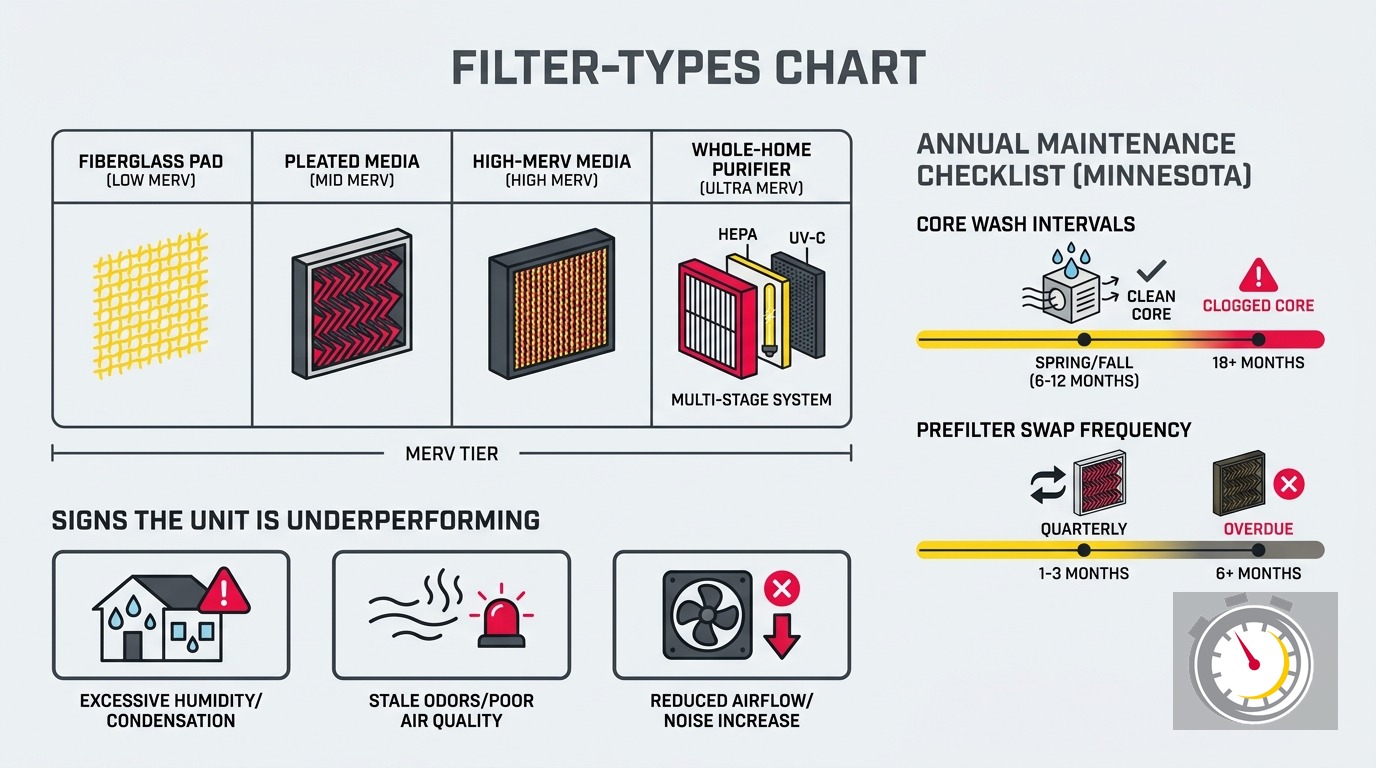
- Inspect HRV and ERV prefilters every one to three months; clean or replace them every three to six months.
- Clean the recovery core at least twice per year: once in fall before heating season, once in spring.
- ERV cores use moisture-permeable membranes. Vacuum gently, rinse with lukewarm water only, no soap.
- HRV cores (aluminum or polypropylene plates) tolerate mild soap and water.
- At -15F, a clogged prefilter can trigger your HRV’s protection mode and stop fresh air delivery entirely.
- Watch for window condensation, stale odors, and extra dust on supply grilles as early warning signs.
- Xcel Energy offers approximately $400 on qualifying units that hit at least 65% Sensible Heat Recovery Efficiency (SRE).
- Annual professional service covers what DIY maintenance cannot: airflow balance, fan inspection, and drain integrity.
What Is an HRV or ERV - and Why Does Your Minnesota Home Have One?
The short answer: Minnesota building code has required mechanical ventilation in new construction since the early 2000s. Both units exhaust stale air and bring in fresh air while recovering heat. An ERV also transfers some humidity back indoors, which makes it the more common choice for dry Twin Cities winters.
Most homes built after 2000 in the Twin Cities have one installed, often tucked in a utility room or attached to the furnace air handler. If you have never thought about yours, you are not alone. These units run quietly in the background, and most homeowners only notice them when something goes wrong.
The distinction matters for maintenance: an HRV (Heat Recovery Ventilator) transfers heat only. An ERV (Energy Recovery Ventilator) transfers both heat and moisture. That difference changes how you clean the recovery core, which is the most important maintenance step and the one most homeowners skip or handle incorrectly.
If your home smells stale after cooking, shows condensation on window corners in January, or seems dustier than it should, your ventilation unit may be the source. A consistent HRV ERV filter cleaning maintenance schedule is the most direct fix.
What Does the Full HRV ERV Filter Cleaning Maintenance Schedule Look Like?
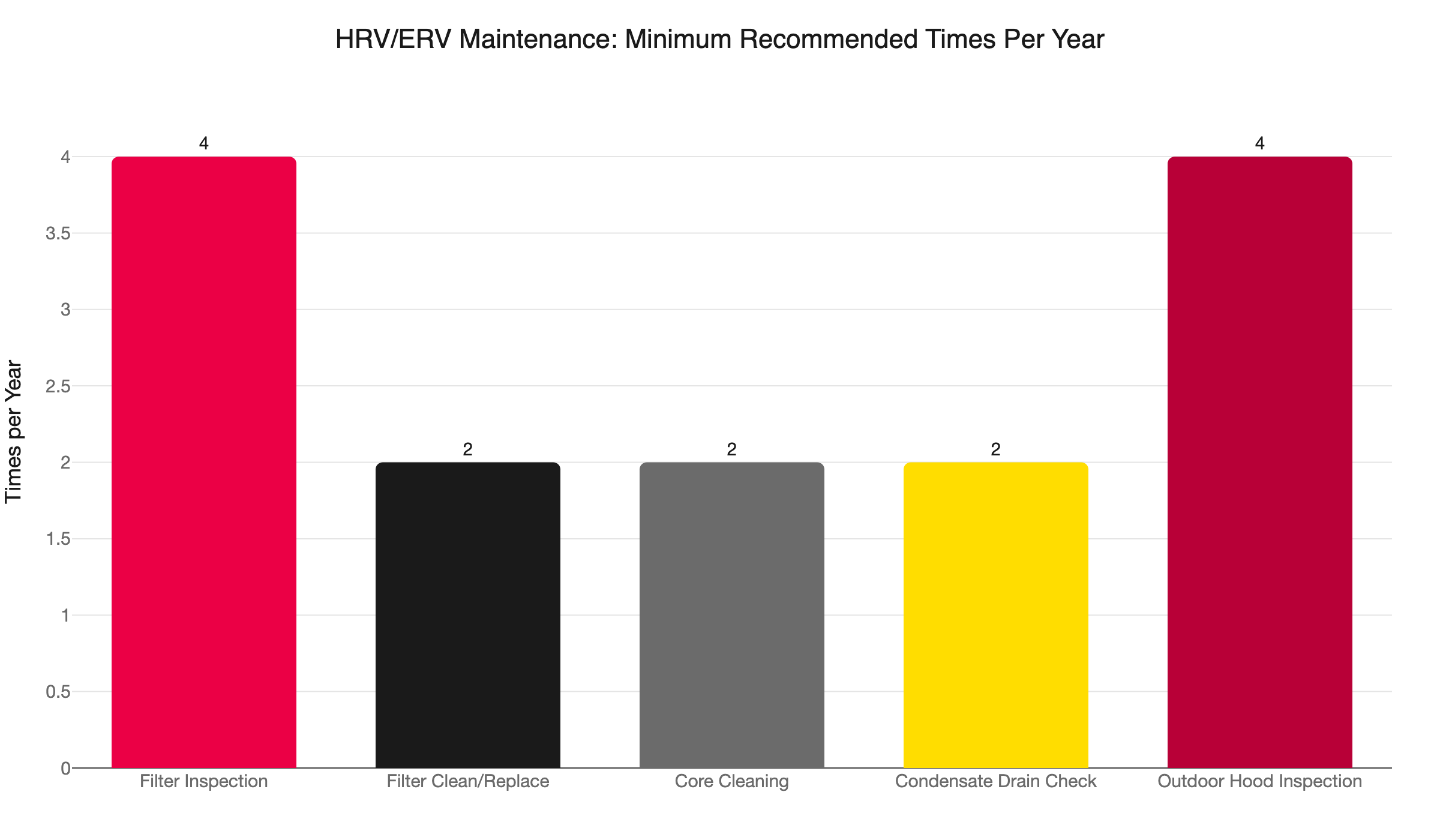
The short answer: Six tasks, ranging from monthly visual checks to every three-to-five year airflow balance inspections. Filter work is the most frequent. Core cleaning and drain checks happen twice per year. Airflow balance is a professional step done at installation and every few years after.
Here is the full schedule before we go deeper on each task.
| Task | Interval |
|---|---|
| Prefilter inspection | Every 1-3 months |
| Prefilter clean or replace | Every 3-6 months |
| Outdoor hood visual check | Monthly; deep clean each season |
| Core cleaning | 1-2 times per year (fall and spring) |
| Condensate drain inspection | Every season (minimum 2x per year) |
| Airflow balance check | At installation, then every 3-5 years |
Homes with pets, heavy dust, or near a busy road should move to the shorter end of every interval. Most Minnesota homes qualify as tight construction, and tighter homes need closer attention at seasonal transitions.
How Often Should You Clean or Replace HRV and ERV Filters?
The short answer: Inspect prefilters every one to three months. Clean or replace them every three to six months under normal conditions, more often with pets or dusty conditions. A loaded filter in a Minnesota winter is not just an air quality issue; it sets up the conditions for more serious failures.
Prefilters are the first line of defense. They catch dust, pet hair, and pollen before that debris reaches the recovery core. When filters load up, airflow drops. Reduced airflow forces the unit to work harder and, in cold weather, sets the stage for icing problems covered below.
According to Rise’s HRV/ERV maintenance guide, filters should be inspected every one to three months and cleaned or replaced every three to six months. Delta Air Systems puts it more simply: check filters every 60 days as a manufacturer rule of thumb.
Most residential HRVs and ERVs use washable mesh prefilters. Pull them out, tap off loose debris over a trash can, rinse with cool water, and let them dry completely before reinstalling. Wet filters restrict airflow just as badly as clogged ones. Check your manual for whether your specific unit uses disposable filters instead; some do, and those get replaced, not washed.
How Do You Clean an HRV or ERV Core - and Does It Matter Which Type You Have?
The short answer: Yes, it matters. ERV cores use moisture-permeable membranes that can tear or delaminate if scrubbed. HRV cores (metal or polypropylene plates) tolerate mild soap and water. Clean both once in fall and once in spring for a Minnesota home running year-round.
The core is where heat (and in an ERV, moisture) transfers between the outgoing and incoming airstreams. Debris on the core plates cuts efficiency directly. In a high-efficiency unit, that loss shows up on your energy bill before you notice any air quality change.
For HRV cores: Remove the core per your manual, rinse with mild soap and lukewarm water, and let it drain and dry fully before reinstalling. A brief soak is fine if plates are heavily fouled.
For ERV cores: Do not soak, do not scrub, and do not use soap. Rise’s ERV/HRV guide is direct: vacuum gently with a soft brush attachment, then rinse with lukewarm water only if your manufacturer permits it. The moisture-permeable membranes that give an ERV its humidity-transfer function are fragile. One round of scrubbing can permanently damage them and no amount of cleaning will restore the performance. Replacement is the only fix.
If you are not sure which type you have, check the brand label or unit manual. Common residential brands include Lifebreath, Fantech, RenewAire, and Venmar. The unit will say HRV or ERV on the label or in the model name.
What Happens to Your HRV During a Minnesota Winter?
The short answer: HRV cores begin icing in the low 20s (F). At -15F, the unit may spend more time in defrost mode than in ventilation mode. A dirty filter at those temperatures can trigger a protection mode that halts fresh air delivery entirely, leaving you with no ventilation until temps moderate.
This is where Minnesota’s climate creates a maintenance wrinkle that no climate-agnostic guide addresses.
HRVs work by transferring heat from warm outgoing air to cold incoming air. When outdoor temps drop far enough, moisture in the outgoing airstream freezes on the core plates. Most residential HRVs manage this with a defrost cycle: the unit temporarily recirculates indoor air or shuts down the fresh air intake to let the core warm up.
Energy Vanguard notes that defrost typically engages around 27F in most residential HRVs. When outdoor temps are at -15F in Ramsey or Blaine in January, that unit may be defrosting more than it is ventilating. That is a real limitation of the technology in our climate, not a sign the unit is broken.
ERVs handle cold weather better. RenewAire’s frost whitepaper shows that ERV cores with latent effectiveness up to 51% require no frost control down to -15F at 30% indoor relative humidity. The moisture-transfer characteristic that defines an ERV also helps it resist frost formation at extreme temps.
What turns a clogged filter into a cold-weather emergency: restricted airflow through a dirty filter reduces the heat the outgoing air delivers to the core. The core runs colder. Defrost cycles become more frequent and longer. At the extreme, the unit triggers its protection mode and halts fresh air delivery completely. You are not getting stale air in that scenario; you are getting none.
The fix is preventive. Keep filters clean, especially going into the first sustained cold snap. A filter you planned to change “sometime this fall” should be changed before temps drop below 25F and stay there.
Indoor humidity plays into this too. During extreme cold, keep indoor RH at or below 30% if you have double-glazed windows at a 70F interior. Running humidity too high when it is -15F outside means more moisture in the outgoing airstream and faster core icing. If you are already seeing condensation on your windows in winter, that is a signal your ventilation rate or humidifier output needs adjustment before the problem gets worse.
What Are the Signs Your HRV or ERV Is Underperforming?
The short answer: Window condensation in winter, stale or musty odors, extra dust on supply grilles, squealing or grinding from the unit, noticeable drafts near exterior doors, and a sudden energy bill spike in a tight home. Any two of these at once warrants a service call, not just a filter swap.
Rise’s maintenance guide catalogs the full symptom list:
- Window condensation in winter. The ventilation unit is not removing enough indoor humidity. In a tight Minnesota home, this is often the first visible sign.
- Stale or musty odors. Cooking smells, pet odors, or bathroom humidity that lingers. The unit is not turning the air over fast enough.
- Extra dust on surfaces or supply grilles. Overloaded or missing filters that are letting debris pass through.
- Squealing, grinding, or rattling. Fan bearing wear or debris caught in the blower wheel. These sounds tend to get worse before a failure.
- Drafts near exterior doors or fireplaces. A pressure imbalance between supply and exhaust. The unit is moving more air one direction than the other.
- Sudden energy bill spike. A tight home with a failing ventilation unit is losing the heat recovery that justifies running the unit. You are paying to heat air you are immediately exhausting without recovery.
Any one of these is worth a closer look. More than one at the same time means the unit needs service, not just a filter swap.
Your Seasonal Maintenance Checklist
Breaking the HRV ERV filter cleaning maintenance schedule into three seasonal passes makes it easier to stay consistent.
Fall: Before Heating Season (September to October)
This is the most important service window for Minnesota homeowners. The unit is about to run hard for five to six months.
- Clean or replace prefilters. Do not carry a loaded filter into winter.
- Clean the recovery core. HRV: mild soap and water, fully dry before reinstalling. ERV: gentle vacuum, lukewarm water rinse only if the manual permits, no soap.
- Inspect and clear the condensate drain. Cold-weather operation generates condensate as warm indoor air meets the cooler core. A blocked drain causes water to back up into the unit.
- Inspect outdoor hoods and grilles. Clear bird nests, debris, or vegetation that accumulated over summer.
- Confirm the defrost setting is active and correctly configured for your unit model.
- If it has been more than three to five years since your last airflow balance check, schedule one. The DOE Building America Solution Center recommends measuring airflow with a flow hood, flow grid, or anemometer to confirm the unit is meeting its minimum required ventilation rate. Duct modifications and home settling throw off the supply-exhaust balance over time.
Mid-Winter: January Check
A quick mid-season inspection during the coldest stretch.
- Inspect prefilters. A filter that looked acceptable in October may be clogged by January in a home with pets or a recent renovation project.
- Check the condensate drain for ice or blockage. Cold snaps can freeze partial obstructions solid.
- Listen for new rattling, squealing, or grinding. Fan bearings are under the most stress during sustained cold-weather operation.
- Check indoor RH. If it is running above 30% during the coldest days, reduce humidifier output or raise the ventilation rate.
Spring Transition: April to May
The unit shifts from heating-season to cooling-season operation. Spring is also when you catch what winter damaged.
- Clean or replace prefilters again. Winter pulled a lot of dust and debris through.
- Clean the recovery core for the second time this year.
- Inspect outdoor hoods after the thaw. Frost cycles can dislodge debris and deposit it near the intake.
- Check the condensate drain before summer humidity starts adding cooling-mode condensation.
- If you have an ERV, inspect the membrane for tears, soft spots, or obvious deformation. A damaged membrane cannot transfer humidity correctly and needs replacement.
Does Minnesota Offer Rebates for HRV or ERV Equipment?
The short answer: Xcel Energy offers approximately $400 on qualifying units that achieve at least 65% Sensible Heat Recovery Efficiency. CenterPoint Energy Home Service Plus offers installation and service plans for the Twin Cities metro. Rebates apply to equipment purchase, not maintenance visits.
If you are replacing an older unit or installing a new one, check the SRE rating before you buy. The 65% SRE threshold is Xcel’s bar. Not every unit hits it. Choosing one that does puts several hundred dollars back into your pocket.
For the full picture of what Xcel, CenterPoint, Minnesota Energy Resources, and other utilities are offering this year, our Minnesota HVAC rebates guide covers current amounts and eligibility details in one place.
When Should You Call a Professional?
DIY maintenance covers most of what a ventilation unit needs year to year. But some situations call for a trained technician.
Call us if:
- You hear grinding, squealing, or rattling you cannot trace to a loose access panel.
- Airflow from supply registers feels weak even with clean filters.
- You have not had an airflow balance check in more than five years.
- The condensate drain has backed up or shows repeated icing.
- Your ERV core looks physically damaged or humidity recovery seems noticeably reduced.
- The unit is more than 15 years old and you are seeing more than one performance symptom.
Our team serves Ramsey, Blaine, Maple Grove, Plymouth, Brooklyn Park, Minneapolis, St. Paul, Woodbury, Bloomington, and the surrounding Twin Cities area. We are locally owned and operated, and we back every visit with a 100% satisfaction guarantee. Every service call starts and ends the way you expect: on time.
That is the commitment behind “Always On Time… Or You Don’t Pay a Dime!(R).”
Call us at (763) 260-6662 or schedule service online before heating season starts.
Frequently Asked Questions
How often should I clean my HRV or ERV filters? +
Can I use soap to clean my ERV core? +
What happens to my HRV at -15F in a Minnesota winter? +
Does Xcel Energy offer rebates for HRV or ERV units in Minnesota? +
Need a technician now?