
Whole Home Humidifier Not Producing Humidity? Three Reasons Why
Key Takeaways
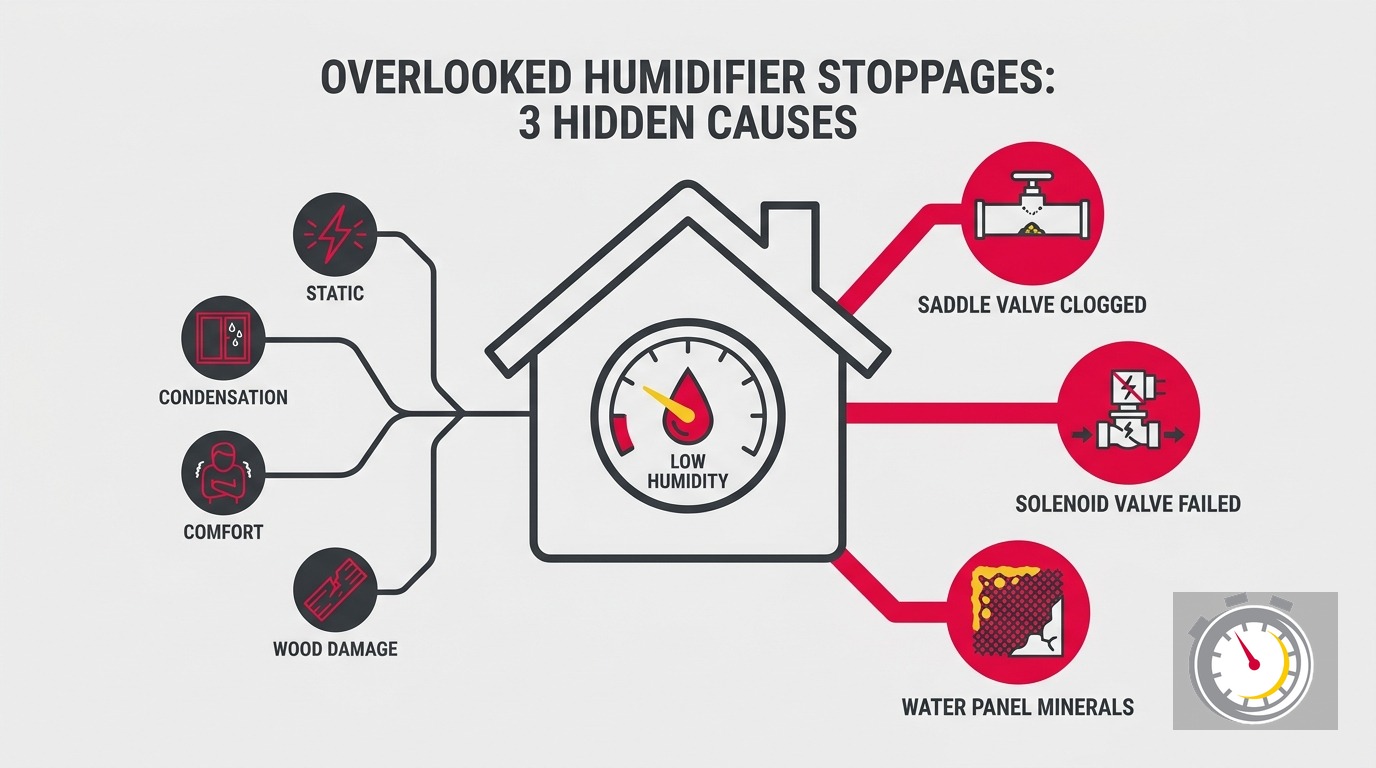
- A whole-home humidifier moves water through three components in order: saddle valve, solenoid valve, and water panel. Block any one link and the unit runs without adding moisture.
- Minneapolis city water averages roughly 5.5 grains per gallon of hardness. That is enough to scale over a small-bore orifice across a full Minnesota heating season. Suburban homes on untreated groundwater can see significantly higher levels.
- The EPA recommends keeping indoor relative humidity at 30-50%, with 60% as the upper ceiling to minimize biological contaminants. Below that range, wood trim gaps, static increases, and your home feels colder than the thermostat reads.
- Saddle valves have no approved standard under the Minnesota State Plumbing Code. Many homes have them anyway. The correct fix is a proper ball valve tee.
- Water panels are the most commonly skipped maintenance item on whole-home humidifiers. AprilAire recommends replacing models 10, 12, and 35 once per heating season, and model 45 twice per season.
- If your humidifier worked fine in October but the air has grown progressively drier since, the failure is almost always in the water delivery chain, not the humidistat.
Why Is My Air Still Dry Even Though I Have a Humidifier?
A whole-home humidifier needs a steady water supply to do its job. If the saddle valve is scaled over, the solenoid valve is clogged, or the water panel is calcified, no moisture reaches the airstream. The unit runs, the fan moves air, but the humidity reading does not climb. The fix depends on which link in the chain has failed.
Most homeowners raise the humidistat when the air feels dry. That is a reasonable first move. But if raising the setting has not helped after a few days, the problem is not the setpoint. Water is not reaching the evaporator panel at all.
Humidity loss is relentless in a Minnesota winter. A furnace running eight to ten hours a day continuously dries indoor air. When the humidifier fails silently, the change is gradual. Wood trim starts to gap, static electricity increases, and throats feel dry overnight. By the time the discomfort is obvious, the unit may have been effectively offline for weeks.
The three most likely causes share the same outward symptom but require different repairs. Working through them in order is the fastest path to a diagnosis.
The Water Chain: Three Components, Three Ways It Can Break
A bypass or flow-through whole-home humidifier draws water from your copper supply line and moves it across an evaporator water panel. Warm air from the furnace passes over that panel, picks up moisture, and distributes it through your duct system.
Water moves through this sequence on every heating cycle:
- Through the saddle valve, which taps directly into the copper supply line.
- Through the solenoid valve, an electrically controlled valve that opens when the humidistat calls for humidity.
- Across the water panel, where evaporation happens.
When a whole-home humidifier stops producing humidity, the cause is almost always at one of these three points. The frustrating part is that each failure looks identical from the outside. The unit runs. The fan moves air. The humidistat reads a call for humidity. Nothing obvious is wrong. But no moisture is entering the duct system.
Diagnosing which link failed determines whether the fix is a $15 water panel or a plumbing repair on the supply line. Our technicians see all three failure modes across Twin Cities homes every winter. Skipping the diagnosis step is the most common reason homeowners replace parts that did not need replacing.
What Does the Saddle Valve Do, and Why Does It Fail?
A saddle valve clamps onto your copper supply line and pierces it with a small needle to draw water to the humidifier. Mineral deposits from hard water build on that tiny needle hole over time and reduce flow to a trickle, or stop it completely. The valve shows no external sign of failure until flow has dropped to near zero.
Minneapolis city water averages about 5.5 grains per gallon (gpg) of hardness, which is below the “very hard” threshold. But that level is still enough to deposit scale inside a small bore over a six-month heating season. In areas where homes draw from untreated groundwater, hardness can run considerably higher before any softening reduces it.
The needle hole in a saddle valve is roughly the diameter of a straight pin. Scale does not need to fill the valve body to stop flow. It only needs to coat that small bore. A partial blockage reduces flow to the water panel, which keeps the panel drier than it should be and lowers evaporation. The humidifier appears to run normally. Output drops quietly and progressively.
There is a second problem beyond scale. Saddle valves carry no approved listing under the Minnesota State Plumbing Code, which amounts to barring them from permitted work. Many homes have them anyway, usually because the humidifier was installed without a permit. The correct fix is not a new saddle valve. It is a properly installed ball valve tee that eliminates the scale-prone needle hole and brings the supply connection up to code.
One practical caution: every time you operate a saddle valve, you increase the potential for a leak. If yours has not been adjusted in years, leave it alone until a technician can handle the replacement. Repeatedly opening and closing it to test flow is not worth the risk.
What Can Clog or Block the Solenoid Valve?
The solenoid valve has an in-line strainer on its inlet side and a small calibration orifice on the outlet side. Either one can plug with mineral scale and reduce flow to zero without triggering any alert. A clogged solenoid produces the same symptom as a stuck-closed solenoid: no water at the panel.
The solenoid opens when the humidistat signals a call for humidity. When the furnace runs and indoor humidity drops below your setpoint, 24 volts energizes the solenoid and water flows. When the setpoint is reached, it closes again.
Inside the valve body, water passes through a mesh strainer on the inlet side before reaching the small outlet orifice. That outlet orifice and the inlet strainer are both common choke points for mineral-scale buildup, particularly in hard-water homes. A partially clogged strainer restricts flow without stopping it, so the humidifier still runs but cannot keep pace with what the furnace is drying out. A fully scaled orifice produces no flow at all.
Testing the solenoid is straightforward. With the humidistat calling for humidity, disconnect the outlet hose and watch for flow. A steady trickle means the valve is open and the orifice is clear. No flow with voltage present means the valve or orifice has failed. Weak flow points to partial scaling. Solenoid valves are not expensive to replace, but you need to confirm whether the issue is the solenoid or the saddle valve upstream before ordering any parts.
Why Is My Humidifier Running But Not Adding Moisture to the Air?
When a humidifier runs but the humidity reading does not rise, water is usually not reaching the panel. That can mean a scaled saddle valve, a clogged solenoid valve, or a water panel so calcified it can no longer wick moisture. All three produce the same outward symptom.
One more thing to check first: the bypass damper. On a bypass-style humidifier, the damper must be in the open (winter) position for warm air to flow across the water panel. If it was left in the closed (summer) position after the cooling season, air skips the humidifier entirely. Check the damper label before anything else. If it is in the correct position and the problem persists, work through the water chain from the saddle valve forward.
If you have already replaced the water panel and confirmed the damper is open and the air is still dry, test the solenoid valve with a multimeter while the humidistat calls for humidity. No voltage at the solenoid terminals means the humidistat wiring or the humidistat itself needs attention. Voltage with no flow points to the solenoid valve or the supply line upstream.
How Do You Troubleshoot a Whole-Home Humidifier?
Start with the humidistat setting and bypass damper position, then check for water flow at the panel, then inspect the water panel condition, and finally test the solenoid valve. Work from the simplest fix outward. Most homeowners can complete the first three steps themselves.
Step 1: Verify the humidistat setting. Set the humidistat to 35-40% relative humidity during a Minnesota winter. If indoor humidity is already at or above the setpoint, the solenoid will not open by design. Turn it up slightly, wait 20 minutes, and confirm the unit activates.
Step 2: Check the bypass damper. On a bypass humidifier, the damper is labeled for summer and winter. It should be in the winter (open) position from roughly October through April. This is the fastest fix if it applies.
Step 3: Confirm water flow at the panel. Remove the humidifier cover while the humidistat calls for humidity. You should see a steady trickle of water running down the panel from the distribution tray above. No water at all means the supply is blocked, either at the saddle valve or at the solenoid.
Step 4: Inspect the water panel. Pull the panel out and hold it to the light. A new panel is white and porous. A spent panel is tan or brown, with the pores sealed over by mineral scale. Replace it if it looks like a rigid, discolored wafer. AprilAire recommends checking the water panel every three months in hard-water homes because scale seals the pores and stops evaporation.
Step 5: Test the solenoid valve. Disconnect the outlet line from the solenoid while the humidistat calls for humidity. Observe whether water flows. No flow with voltage present means the valve body or orifice has failed.
Step 6: Inspect the saddle valve. Trace the small supply tube back to where it connects to the copper supply line. If a saddle valve is present, do not operate it repeatedly to test flow - each cycle increases the risk of a leak at the needle hole. Check for mineral buildup or corrosion around the connection, and have a technician replace it with a proper ball valve tee.
For a broader look at keeping humidity steady all season, the guide on staying comfortable through a Minnesota dry-heating season covers the humidifier maintenance side alongside insulation and air sealing.
How Do You Clean and Maintain Your Whole-Home Humidifier?
Replace the water panel once per heating season, or every three months in a hard-water home. Clean the water distribution tray with white vinegar to dissolve scale. Inspect the solenoid inlet strainer each fall. Confirm the bypass damper is in the winter position before the first heating day.
Water panel replacement. The panel is the engine of the humidifier. It wicks water from the distribution tray and exposes it to the warm airstream for evaporation. When scale seals the pores, evaporation stops. A replacement panel costs $15-30 and takes ten minutes to swap. Installing one at the start of each heating season, before problems develop, is cheaper than diagnosing a no-humidity complaint in January.
Distribution tray cleaning. Scale builds in the plastic tray just like it builds in a coffee maker. Soak the tray in undiluted white vinegar for an hour and scrub with a soft brush. Rinse thoroughly before reinstalling. This removes residue that would otherwise transfer to the new panel and shorten its life.
Solenoid inlet strainer. On most models, you can unscrew the inlet fitting and expose the mesh strainer inside the valve body. Rinse it under running water or soak briefly in vinegar. If it looks heavily scaled, replace the solenoid valve rather than risk reduced flow for another full season.
Drain line on flow-through models. Flow-through humidifiers drain continuously to a floor drain or utility sink. Confirm the drain line is clear and slopes toward the drain. Scale can clog the drain orifice and back water up into the unit, which damages the cabinet and the panel.
Fall startup checklist (each October):
- Flip the bypass damper to the winter (open) position.
- Install a fresh water panel.
- Check humidistat wiring connections for corrosion.
- Confirm water flow at the distribution tray before the first full heating run.
Minnesota Water and the Mid-Season Slide
This is the failure pattern that most troubleshooting articles miss. The humidifier works fine in October and then quietly underperforms through the rest of the season while the homeowner raises the humidistat higher and wonders why the air is still dry.
Here is the sequence. In October, the saddle valve needle hole or solenoid orifice is only partially scaled. Flow is reduced but not blocked. The humidifier adds some moisture - just not enough to offset what the furnace burns off on a full winter day. You raise the humidistat. The reading inches up slightly. You assume it is working.
By January, the scale has thickened further and the water panel has hardened. Output has dropped to near zero, but the change was so gradual it does not register as a failure. It registers as a drier-than-normal winter.
This pattern is more common in homes on well water. Suburban groundwater in the Twin Cities can reach 24 grains per gallon or higher before municipal softening reduces it, which is several times harder than Minneapolis city water. In those homes, checking the water panel every three months rather than once per season makes a real difference. The solenoid inlet strainer also deserves an annual cleaning rather than being left to chance.
If your humidifier is several years old and has never had the supply valve or solenoid serviced, this progressive failure is likely what happened. The solution is not a new humidifier. It is clearing or replacing the valves, swapping the water panel, and upgrading a saddle valve supply connection to a proper ball valve tee. For a sense of what that work costs compared to full replacement, our breakdown of whole-house humidifier costs for Minnesota homeowners covers installation and service ranges across the Twin Cities.
When Should You Call a Professional for Humidifier Repair?
Call a technician when the saddle valve shows any sign of leaking, when the solenoid tests live but produces no flow, or when the supply line needs re-plumbing to replace a saddle valve with a proper ball valve connection. These repairs involve a pressurized water line and low-voltage wiring that should not be approached without the right tools.
Replacing the water panel and cleaning the distribution tray are tasks most homeowners can handle. Everything upstream of the solenoid valve involves either a pressurized water line or 24-volt wiring connected to the furnace control board. A small error at a saddle valve connection can mean a dripping joint inside a wall cavity or above a finished ceiling - damage that far exceeds the cost of a service call.
We are locally owned and operated in Ramsey and serve the full Twin Cities area. Our technicians carry common solenoid valves and water panels on the truck, so most humidifier service calls resolve in a single visit. We schedule with a time window you select. If our technician does not arrive within that window, you do not pay for the service. That is what “Always On Time… Or You Don’t Pay a Dime!(R)” means to us.
To schedule, call (763) 260-6662 or book a visit online. If you are weighing whether to repair the existing unit or replace it entirely, our guide to what humidifier installations and service calls cost in Minnesota walks through the typical ranges before you pick up the phone.
Frequently Asked Questions
Can the bypass damper position cause my whole-home humidifier to stop working? +
What is the difference between a bypass humidifier and a flow-through humidifier? +
Need a technician now?