
How to Use a Gas Fireplace to Reduce Your Heating Bill
Key Takeaways
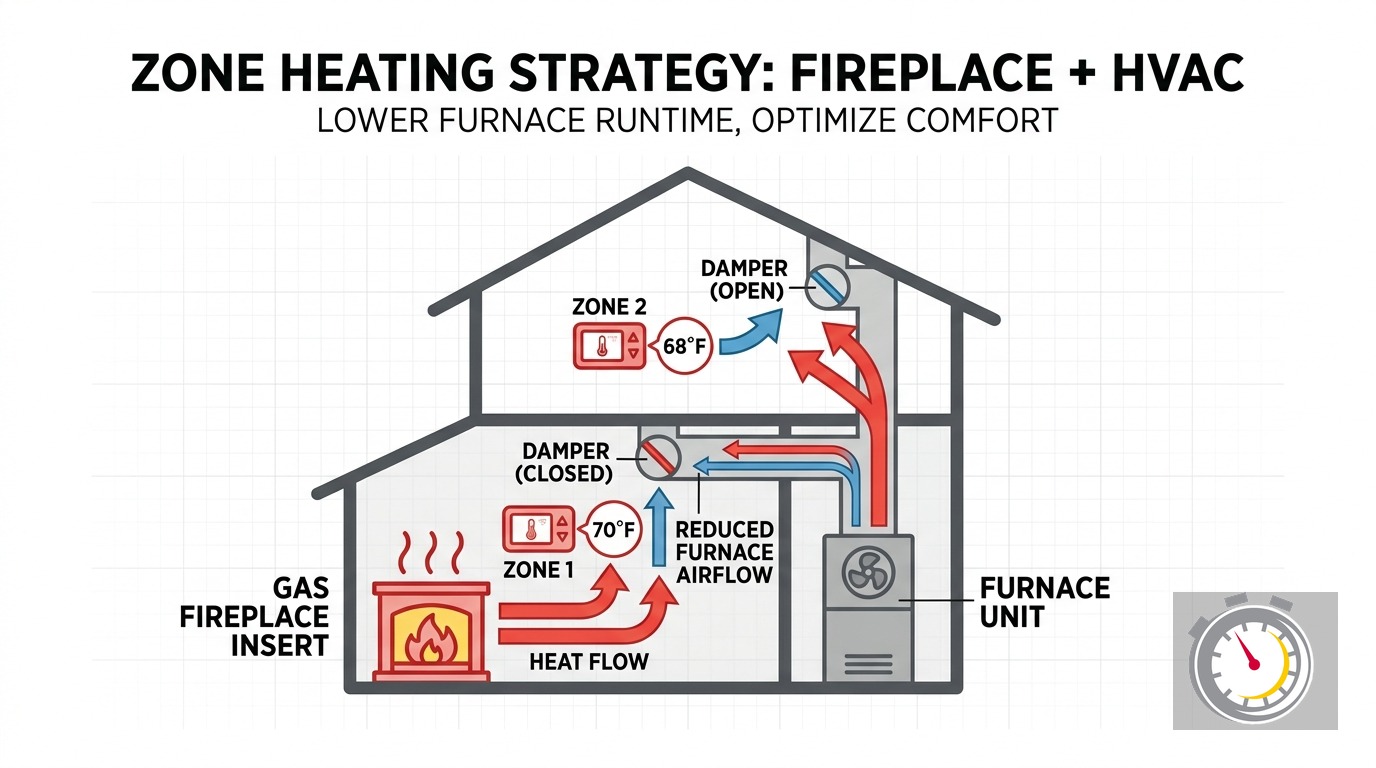
- Lowering your thermostat 4-6 degrees when the fireplace runs is what actually saves money. The fireplace alone changes nothing - the setback is the mechanism.
- A 30,000-40,000 BTU insert can heat 600-1,200 square feet of open-plan living space on a moderate winter day (20-40°F outdoors). It does not replace your furnace.
- On Minnesota nights below -10°F, run both appliances normally. The insert reduces runtime on most winter days but cannot carry the whole house during polar vortex events.
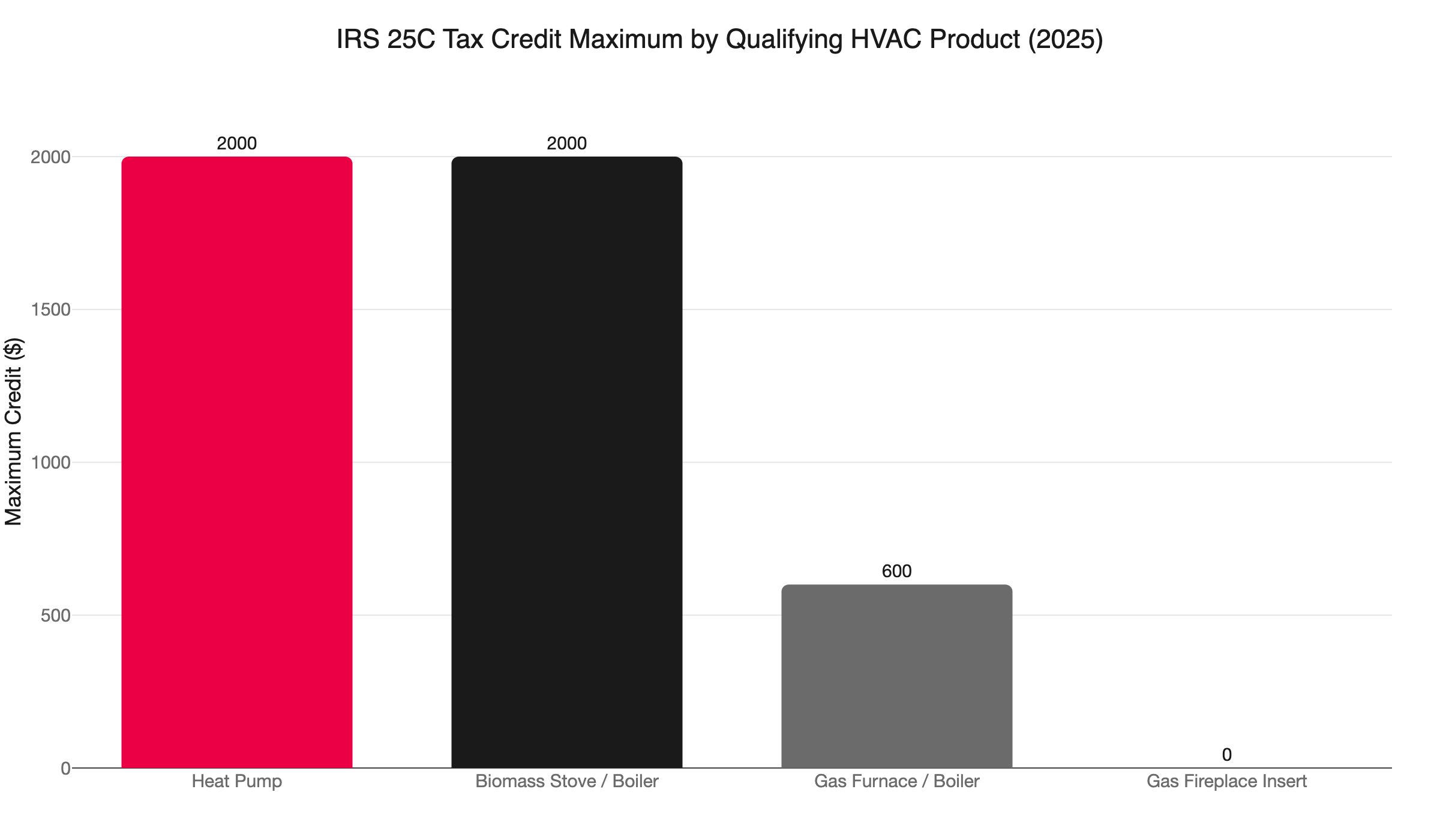
- Gas fireplace inserts do not qualify for the IRS 25C federal tax credit. Standard inserts are not on the qualifying-products list.
- A smart thermostat automates the setback schedule so you capture savings without remembering to adjust the dial every evening.
- Sealed direct-vent inserts (75-90% efficiency) outperform B-vent units (50-70%) and do not pull conditioned indoor air for combustion.
Is Using a Gas Fireplace to Reduce Your Heating Bill Actually Worth It?
Yes, with one condition: you have to lower the thermostat. Without a setback, running the insert alongside a normally set furnace just burns gas in two appliances at once. The savings come from reduced furnace runtime, and that only happens when you deliberately drop the setpoint.
Minnesota makes this strategy more valuable than almost anywhere else in the country. The state sits in the West North Central Census Division, which has the highest heating degree day totals of any U.S. census division. Minneapolis averages roughly 8,082 heating degree days per year - nearly double the national average of around 4,600. That means a furnace here runs far longer each season than one in Nashville or Denver. Every hour of reduced runtime adds up.
Midwest households consume more energy for space heating than any other U.S. region, and natural gas is used in the majority of those homes. A gas insert and a gas furnace run on the same fuel. The question is which appliance delivers heat to the space you are occupying most efficiently at a given moment.
For the zone you are sitting in - the main living area - a properly sized insert wins during moderate cold. It heats that room directly, without pushing conditioned air through ductwork running through unconditioned attic or basement spaces. Your furnace, by contrast, serves the whole house.
The strategy is straightforward: when you light the fireplace in the evening, drop the thermostat. Let the insert carry the room you are in. Let the furnace rest. The savings are real, but they only materialize if you make that thermostat adjustment every time - which is exactly why a programmable or smart thermostat changes the math so significantly.
What Thermostat Setting Works Best When the Fireplace Is Running?
Drop to 62-65°F. That range keeps your pipes safe, prevents unoccupied rooms from dropping uncomfortably low, and gives your furnace a genuine rest between cycles.
Your furnace is least efficient during its startup cycle. The inducer fan runs, the igniter heats up, the gas valve opens, and the heat exchanger has to reach operating temperature before conditioned air moves through the ducts. Very short runtimes waste gas without heating the house evenly. The furnace fires, the thermostat reads “close enough” because the insert has already warmed the main floor, and the system shuts off after three or four minutes.
A 4-6 degree setback creates enough distance between the current room temperature and the setpoint that the furnace stays off for a meaningful stretch. It fires eventually - bedrooms, the basement, rooms away from the fireplace all lose heat steadily - but the intervals between cycles grow longer. That longer interval is where the savings come from.
A few guardrails worth knowing before you set your schedule:
- Do not drop below 62°F when outdoor temperatures are below 10°F. Heat loss through exterior walls is rapid in extreme cold, and a 62°F whole-house setpoint can cause localized cold spots in poorly insulated areas.
- In older Twin Cities homes with single-pane windows or limited wall insulation, 65°F is a more conservative and appropriate floor.
- Know where your pipes run. A setback to 62°F in a 1960s home with pipes in exterior walls carries more risk than the same setback in a newer, well-insulated build.
For a deeper look at how your furnace responds to setpoint changes over a Minnesota heating season, our post on keeping your furnace efficient through a Twin Cities winter walks through the cycling dynamics in detail.
What Can a Gas Fireplace Insert Actually Heat?
A 30,000-40,000 BTU insert heats roughly 600-1,200 square feet of open-plan living space on a moderate winter day. It is a zone heater. It is not a whole-home system.
A common industry starting point is 25-35 BTU per square foot in a well-insulated Minnesota home at mild-to-moderate outdoor temperatures. The actual number depends on your ceiling height, insulation quality, how open the floor plan is, and outdoor conditions.
Work the math for common insert sizes:
- 20,000 BTU insert: effective zone coverage of roughly 570-800 sq. ft. in an open layout
- 30,000 BTU insert: roughly 860-1,200 sq. ft.
- 40,000 BTU insert: roughly 1,140-1,600 sq. ft.
These numbers assume the insert and the space it is heating share the same open area. Rooms with closed doors - bedrooms, a home office, bathrooms - receive no meaningful benefit from the insert. In a typical Twin Cities two-story or split-level home, the insert warms the main-floor great room and possibly an adjacent dining area. The upper level and the basement stay on the furnace.
That is the right mental model: the insert is a zone. Size it for the zone you are heating and run it like one. If you have been thinking of the insert as a furnace substitute, the bills will disappoint. If you think of it as a zone heater that lets the furnace rest during occupied evening hours, the numbers work.
What Happens on a -20°F Night?
Your furnace does the work. A gas insert helps on most Minnesota winter days, but when temperatures drop below -10°F to -20°F, heat loss through your building envelope exceeds what any single insert can offset for the whole house.
During polar vortex events, keep your thermostat at a normal comfort setpoint - 68-70°F - and let your furnace run as designed. The insert still adds warmth to the main living area and reduces some cycling, but a deep setback at -15°F means cold bedrooms, uncomfortable sleeping conditions, and potential risk to pipes in exterior walls.
The calculation shifts at the extremes. On a 0°F night, a 62°F setback can result in the bedrooms dropping to 58°F by 2 a.m. in a home that leaks heat at a normal rate for its age. That is uncomfortable at best.
Plan for this reality: roughly 30-40 nights per Minnesota heating season will be cold enough that the insert plays a supporting role only. On the other 90-110 nights when temperatures range from the teens to the upper 30s, the strategy works well and delivers genuine savings. The insert is a mild-to-moderate cold weather tool, not a polar vortex solution.
If you notice your furnace struggling to reach your setpoint on extreme cold nights, our post on furnace performance when it cannot reach setpoint in extreme cold covers what to check.
Does a Gas Fireplace Insert Qualify for a Federal Tax Credit?
No. Standard gas inserts are not on the IRS Section 25C qualifying-products list.
This is one of the most persistent misconceptions in articles about gas fireplaces and heating savings. Many pieces written before 2023 still claim inserts qualify. They do not.
Under IRS Section 25C (Energy Efficient Home Improvement Credit), the qualifying heating products are:
- Natural gas furnaces and boilers meeting the CEE highest efficiency tier: up to $600 credit
- Heat pumps: up to $2,000 credit
- Biomass stoves and boilers at 75%+ thermal efficiency: up to $2,000 credit
A gas fireplace insert - even a high-efficiency sealed direct-vent model - is not on that list. It is classified as a hearth appliance, not a heating system, under the credit rules. Its efficiency rating does not change that.
The 25C credit offered 30% of cost, up to $3,200 per year, through December 31, 2025. Its status for 2026 was not confirmed on official government pages at the time this was written. If you are considering a high-efficiency furnace replacement, boiler upgrade, or heat pump installation alongside or instead of relying on the insert, those systems may qualify. Talk to our team and your tax advisor about what documentation you will need - starting in 2025, IRS requires a manufacturer QM code on returns for all qualifying equipment.
Which Gas Insert Type Is More Efficient?
Sealed direct-vent. A sealed direct-vent insert draws combustion air from outside through a coaxial vent pipe and exhausts combustion gases back outside through the same assembly. It operates in a fully closed combustion loop. Your indoor conditioned air is never used for combustion.
A B-vent (natural-vent) insert draws combustion air from the room. Every cubic foot of indoor air it uses for combustion exits the house as exhaust, and cold outdoor air infiltrates to replace it. That infiltration adds a hidden load to your furnace. You are paying to heat air just to burn it.
Efficiency ratings reflect this difference directly:
- Sealed direct-vent inserts: typically 75-90% thermal efficiency
- B-vent inserts: typically 50-70%
For a homeowner using the insert specifically to reduce furnace runtime and fuel consumption, only a sealed direct-vent unit delivers meaningful net savings without the infiltration penalty. If you already have a B-vent insert, the thermostat setback strategy still works - you just capture less of the potential benefit.
If you are in the market for a new insert for this purpose, ask for a sealed direct-vent model and verify the thermal efficiency rating on the manufacturer’s spec sheet before purchase.
Combustion Air and Backdraft: What to Know
Running a gas insert and your furnace at the same time in a tightly sealed home raises a combustion air question worth understanding. Both appliances need air to burn. If your home is well-sealed and both are running simultaneously, negative pressure can develop - and that pressure imbalance can cause either appliance to pull combustion gases back into the living space rather than venting them outside.
This is not a reason to avoid using the insert. It is a reason to understand your home’s combustion air setup before you lean on the strategy every evening.
Older Twin Cities homes with natural infiltration typically have enough air movement to support both appliances without issue. Newer or recently air-sealed homes are more likely to have inadequate combustion air for both running at once.
Our post on gas fireplace and furnace combustion air backdraft in Minnesota homes covers the specifics of how these systems interact and what a technician checks during an inspection. If your home was built after 2000 or has had significant air sealing work done, have a qualified technician verify adequate combustion air before you make simultaneous dual-appliance operation a regular habit.
Can a Smart Thermostat Automate the Setback Strategy?
Yes, and it is the most reliable way to run this strategy consistently. Manual adjustment gets skipped. A programmed schedule does not.
On a Nest or ecobee, set a schedule tied to your fireplace habits: when you typically light the fire on winter evenings, the thermostat automatically drops to 63°F. When your usual bedtime arrives and the fire is winding down, it returns to 68°F. You never have to remember. The furnace gets its rest on every applicable evening.
Both platforms also support remote temperature sensors - a feature that pairs particularly well with this setup. Place a sensor in the main living area near the fireplace. The thermostat reads that space rather than a hallway sensor, giving the furnace accurate data about whether the zone actually needs heat. If the insert has the room at 70°F, the furnace stays off even if the hallway reads 65°F.
Our Nest vs. ecobee comparison for Minnesota homes breaks down the specific features that matter in our climate. For this particular use case - an evening setback tied to fireplace operation - both platforms handle it cleanly. Smart thermostat installation with programming typically runs in the low hundreds. The payback through fuel savings in a Minnesota home is usually well under two heating seasons.
Is a Gas Fireplace Safer for Indoor Air Than a Wood Fireplace?
Yes, significantly. The EPA’s Burn Wise program was created specifically because wood combustion produces fine particulate matter (PM2.5) that affects indoor and outdoor air quality. Wood-burning fireplaces and stoves are its focus.
Gas fireplaces fall outside that concern entirely. A properly installed and maintained sealed direct-vent gas insert exhausts all combustion byproducts outside and produces no particulate matter in the living space. For households with asthma, allergies, or members sensitive to smoke and airborne particles, gas is meaningfully cleaner supplemental heat than any wood-burning alternative.
This matters for the using-gas-fireplace-to-reduce-heating-bill strategy because it means you can run the insert more frequently, for more hours, without an indoor air quality tradeoff. More runtime with a consistent setback means more savings and no downside from a health standpoint.
How Do You Know If the Strategy Is Working?
Track your gas usage month over month and compare with the same month in prior years. Most Twin Cities homeowners on CenterPoint Energy can pull monthly therm usage history from their online account. Because natural gas prices fluctuate, compare therms used rather than dollar amounts for a clean, accurate measurement.
Benchmarks worth watching:
- If you run the insert 4-6 hours per evening with a consistent 4-6 degree setback on 60-80 nights per season, you should see a measurable reduction in therms used during those billing periods.
- If your therm usage is flat despite consistent fireplace use, check whether the thermostat setback is actually happening. A scheduled program is more reliable than manual adjustment.
- Watch for very short furnace run cycles during fireplace hours - two to three minutes per cycle. Short cycling at this scale means the thermostat setpoint is too close to current room temperature. The furnace fires, barely heats the space, and shuts off before completing an efficient cycle. Drop the setback one more degree and monitor.
Current Minnesota residential natural gas rates are published monthly by the EIA. That page lets you convert your therms-saved number into a real dollar figure for the season.
What About Your Furnace?
The setback strategy is only as effective as the furnace behind it. If your system is 15-18 years old and already running at declining efficiency, reducing its runtime helps - but every cycle it does run costs more than it should.
An 80% AFUE furnace wastes 20 cents of every dollar of gas. A 97-98% AFUE unit installed by our team starts at around $9,100 in the Twin Cities. The operating cost difference over a 15-20 year equipment life is substantial, and those high-efficiency gas furnaces may qualify for the 25C federal tax credit (up to $600) - a credit the insert does not.
If you have noticed rising heating bills over the past two to three winters, even in years with average temperatures, that trend usually points to declining furnace efficiency rather than weather. Combining a new high-efficiency furnace with a deliberate insert setback strategy is the full picture for minimizing gas heating costs in a Minnesota winter.
We also offer financing on larger system work, including furnace replacements. Ask our team for details when you call.
Call Northern One Hour
We are locally owned and operated in Ramsey, MN, and we serve the entire Twin Cities metro - Minneapolis, St. Paul, Blaine, Maple Grove, Plymouth, Brooklyn Park, Woodbury, Bloomington, and the surrounding suburbs.
Whether you want a smart thermostat installed and programmed for your evening fireplace schedule, a furnace tune-up to verify your system is running efficiently before you lean on the setback strategy, or a full replacement consultation on an aging system, our team is ready to help.
We show up when we say we will. That is the promise behind “Always On Time… Or You Don’t Pay a Dime!(R).”
Call (763) 260-6662 or book online to schedule. Same-day service is available for heating emergencies, and financing options are available for system replacements.
Frequently Asked Questions
Does a gas fireplace insert actually lower your heating bill? +
What thermostat temperature should I set when using the gas fireplace? +
Does a gas fireplace insert qualify for the 25C federal tax credit? +
How many square feet can a gas fireplace insert heat? +
Need a technician now?