
How to Relight a Gas Fireplace Pilot Light This Fall
Key Takeaways
- Shut off the gas and wait five full minutes before any ignition attempt.
- Cap retries at three. More than three attempts stacks unburned gas in the firebox.
- Pilot dies on release: thermocouple suspect. Pilot holds but main burner will not fire: thermopile suspect.
- IPI (electronic ignition) fireplaces have no standing pilot. The standard relighting steps do not apply to them.
- Test your CO detector before the first fire. Replace the battery if it is more than a year old.
- If you smell gas after 10 minutes of ventilation, leave immediately and call 911.
October in the Twin Cities is fireplace season. Most homeowners want to know how to relight gas fireplace pilot light safely the first time they reach for the remote. This guide covers the full fall startup: vent check, ignition system identification, the standard relighting steps, and the two failure scenarios that send most people to YouTube with no useful answer.
How to Relight Gas Fireplace Pilot Light: Why October Is the Right Time
NWS 30-year normals show that the Twin Cities reliably sees freezing temperatures each fall. That first hard freeze is when most homeowners reach for the fireplace remote for the first time since spring.
Most gas fireplace pilots get shut off in May. Shutting down the standing pilot saves money on gas during the months you do not need heat. Now it is October, the pilot is cold, and the fireplace has been sitting dark for five months.
Knowing how to relight the pilot correctly saves you a service call. Knowing when to stop saves you from a gas hazard. Both matter.
Should You Check the Vent Before Relighting?
Yes, always. Before you touch the control knob, go outside and look at the vent termination or chimney cap. A blocked flue routes combustion gases back into your living room. Minnesota summers are warm enough for birds, wasps, and squirrels to find a flue cap appealing. A five-minute check outside prevents a serious safety problem inside.
What to look for:
- Nesting material or debris packed at or inside the cap
- A damaged, crushed, or missing cap screen
- Any visible obstruction at the vent opening
Animals nesting in vent pipes are a more common fall problem than most homeowners expect. The same hazard affects furnace flues and fireplace exhausts alike. If the termination looks clear, move on. If you see a blockage, do not light anything until a qualified technician clears and inspects the flue.
What Kind of Ignition System Does Your Fireplace Have?
This determines whether you can relight it yourself at all. A standing-pilot system has a continuously burning pilot flame visible through the access panel. An IPI (Intermittent Pilot Ignition) system has no continuous pilot: it sparks and lights automatically when you call for heat. Manual relighting steps only apply to standing-pilot systems. If you have IPI and the fireplace is not firing, that is a service call, not a knob turn.
Most fireplaces installed before 2010 use a standing pilot. Newer units often use IPI to reduce standby gas consumption.
To identify your system: open the access panel at the base of the fireplace and look for a small blue flame, or a pilot assembly with a tube leading toward a burner tip. If either is present, you have a standing pilot. If the firebox looks completely dark with no pilot assembly visible, you likely have IPI.
A standing-pilot system does not use household electricity. The thermopile inside generates the only power the controls need. This is why millivolt fireplaces work during a power outage. The thermopile is the sole power source for the wall switch, remote, and thermostat.
If you are unsure which type you have, search your model number online before proceeding.
How to Relight Gas Fireplace Pilot Light: The Standard Sequence
What are the steps? Turn the knob to Off, wait five minutes, switch to Pilot, press and hold while igniting, keep holding for 30 full seconds after the pilot lights, release slowly, then turn to On. Cap retries at three: more than that releases unburned gas into the firebox. The whole process takes under three minutes once gas has cleared.
Here is the full sequence:
1. Turn the control knob to Off. The knob sits behind the access panel at the base of the fireplace. Turn it fully to Off.
2. Wait five full minutes. This clears unburned gas from the firebox. Open a window if possible. If you still smell gas after five minutes, do not proceed. Ventilate and call your gas utility.
3. Switch the knob to Pilot. Some units have a separate red or black igniter button. Others combine the Pilot position and igniter into one knob. Read the labels on your control before pressing anything.
4. Press and hold the knob (or the pilot button). Pressing the knob manually opens the bypass on the safety valve, sending gas to the pilot tube.
5. While holding, ignite the pilot. If your fireplace has a built-in piezo igniter, press it once. No spark? Press again. On older units without a built-in igniter, use a long-reach lighter at the pilot tube opening. Keep the knob pressed continuously throughout.
6. Hold for a full 30 seconds after the pilot lights. The thermocouple generates 20-30 millivolts to signal the safety valve to stay open. It must heat up before it can produce that signal. Count slowly. Rushing this step is the most common reason the pilot dies on release.
7. Slowly release the knob. If the pilot holds, you are past the hardest part.
8. Turn the knob to On. Test the main burner using the wall switch or remote. It should fire within a few seconds.
9. Replace the access panel. Do not run the fireplace with the panel removed.
Three-attempt limit. If the pilot does not hold after three complete attempts, stop. Wait at least 15 minutes for any gas to dissipate. Then try once more or call a technician.
Why Won’t the Pilot Stay Lit After Relighting?
A failing thermocouple is the most likely cause. It generates the voltage signal that holds the safety valve open. When it weakens, the valve closes the moment you stop manually holding it. The pilot dies within seconds of release. This is the single most common standing-pilot failure, and almost no online guide tells you what to do next.
There is a clear diagnostic fork between the two internal components that confuse homeowners. Most guides treat them as interchangeable. They are not.
Thermocouple. Generates 20-30 millivolts. Its only job is to hold the pilot safety valve open. Failure symptom: Pilot lights while you hold the knob. Pilot dies when you release.
Thermopile. Generates 300-900 millivolts. It powers the gas valve and all controls: wall switch, remote, and thermostat. It is the entire power source on a millivolt system. Failure symptom: Pilot stays lit. Wall switch or remote does nothing. Main burner never fires.
Both diagnoses mean a service call, not a YouTube repair session. A technician tests output with a multimeter. If thermocouple output reads below 20 millivolts, or thermopile output reads below 300, replacement is the answer. Bending or scrubbing these components can mask a failing part and leave you with an unreliable fireplace heading into a Minnesota winter.
The gas valve itself can also fail. But a weak upstream component is the more common and less expensive diagnosis. A technician confirms which is at fault before recommending anything.
Is Your CO Detector Ready for Fireplace Season?
Yes, a working detector is required near any gas appliance. The CPSC reports more than 200 Americans die annually from CO produced by non-automotive consumer products. CO is odorless and colorless. You cannot detect it without a working alarm. The detector is not optional equipment.
Before the first fire of the season, run through this checklist:
- Press the test button on every CO detector in your home.
- Replace the battery if you have not done so in the past year.
- Confirm placement: CO detectors belong on every level of the home and outside each sleeping area.
- Check the manufacture date on the back of each unit. Most CO detectors last 5-7 years. An expired sensor may pass the button test but fail to alarm when it matters.
- Look for the UL 2034 certification mark. That is the standard the CPSC recommends.
The CDC reports that accidental CO poisoning causes deaths and emergency room visits across the country every year. Most deaths happen December through February. That is exactly the window when a neglected fireplace gets its first use of the season.
A correctly venting gas fireplace will not produce dangerous CO levels. But a blocked or cracked flue can redirect combustion gases directly into the living space. The CO detector is the safety net for that scenario.
For detailed guidance on where to place detectors throughout a Minnesota home, see our guide to carbon monoxide detector placement near furnaces and boilers.
What Does a Yellow or Orange Pilot Flame Mean?
It means something is wrong. Do not run the fireplace. A healthy pilot flame is mostly blue, sometimes with a small yellow tip at the very top. A predominantly yellow or orange flame indicates incomplete combustion: the gas is not mixing with enough air. Possible causes include a dirty pilot orifice, low gas pressure, or a venting problem. Schedule an inspection before lighting the fireplace again.
A flame that burns unusually high is also a warning sign. CenterPoint Energy advises calling immediately if a pilot flame suddenly burns much higher than normal, which may indicate a gas pressure surge. CenterPoint’s emergency line is 800-296-9815. If you are a CenterPoint customer and the pilot looks abnormally high, call that number rather than adjusting anything yourself.
Why Did the Pilot Go Out Over the Summer?
The most common reason in a Minnesota home is an intentional seasonal shutdown. Most HVAC technicians and utilities recommend shutting off a standing pilot from May through September to cut gas costs. If someone in the household did that, the pilot is simply off, not broken. This is the scenario most Twin Cities homeowners face in October.
Other causes:
Wind downdraft. Minnesota winters generate powerful chimney drafts. A tall chimney or a high-wind day can extinguish a standing pilot. If the pilot went out once during the heating season and re-lit cleanly afterward, downdraft is a reasonable suspect.
A weakening thermocouple. A thermocouple that is losing output will eventually let the pilot extinguish on its own. If the pilot went out repeatedly during last heating season, expect the relighting to fail and call a technician.
A brief gas supply interruption. A short utility interruption can extinguish a pilot. If the pilot went out during a severe cold snap, check whether neighbors experienced similar interruptions. Demand surges and pressure drops are more common in Minnesota than most homeowners realize.
When Should You Stop and Call a Pro?
Stop and call if: the pilot will not hold after three complete 30-second attempts, you smell gas after 10 minutes of ventilation, the pilot flame is yellow or orange, the pilot burns unusually high, or the main burner will not fire even though the pilot holds steady. Any one of these conditions ends the DIY attempt.
The full stop list:
- Pilot will not hold after three complete attempts, each with a full 30-second hold.
- Gas odor does not clear after 10 minutes of ventilation with windows open. Leave the home immediately, without operating switches or appliances on the way out. Call your gas utility from outside.
- Pilot flame is yellow, orange, or flickering instead of predominantly blue.
- Pilot burns noticeably higher than normal.
- Pilot holds steady but the main burner will not fire (thermopile suspect).
- Soot or black marks appear around the firebox opening.
For a step-by-step guide on what to do when you smell gas anywhere in the home, our walkthrough covers each step from discovery to resolution.
NFPA standards require annual inspection and cleaning of chimney systems. A cracked flue tile, a separated liner joint, or animal nesting material can block venting and direct combustion gases into the living space. If your fireplace has not been inspected in the past 12 months, schedule that before the first fire of the season.
Is Gas Fireplace Glass as Hot as It Looks?
Hotter. Gas fireplaces produced after January 1, 2015 include a mandatory barrier screen because the glass surface reaches temperatures that cause serious burns on contact. Do not remove the screen. Keep children and pets away from the glass during and after operation. The glass retains heat for a significant time after the burner shuts off.
Do not run the fireplace while sleeping or while everyone is out of the home.
What Does the Standing Pilot Cost to Run All Winter?
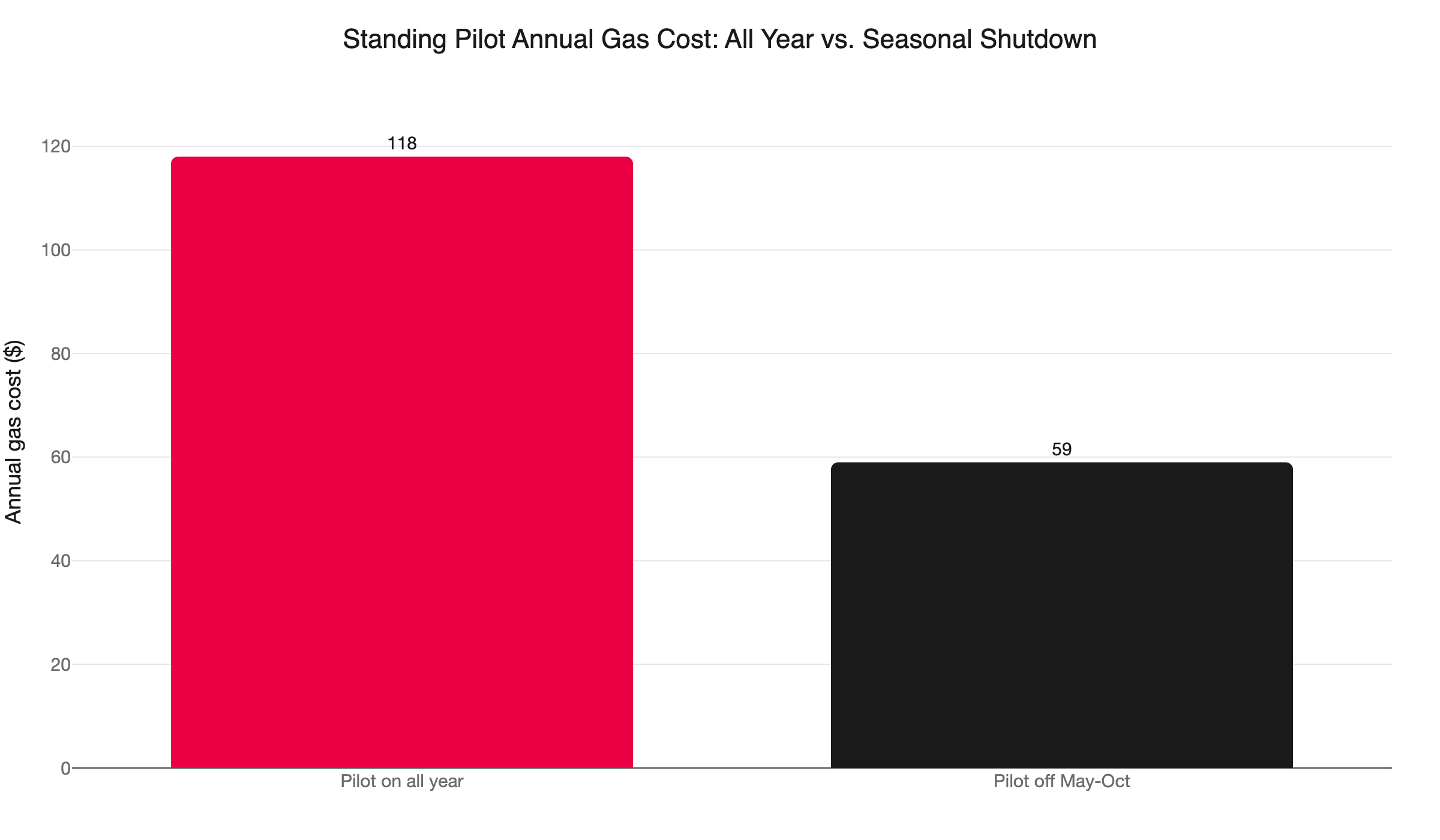
A standing pilot burns approximately 1,000 BTU per hour continuously. Over a full year with no seasonal shutdown, that totals roughly 87.6 therms, which runs around $118 per year in gas just to keep the pilot lit.
Xcel Energy raised Minnesota residential gas rates 6.8% in January 2026. The average residential customer pays about $70 more per year than in 2025. Shutting the pilot off from May through October cuts the standby cost roughly in half.
The fireplace itself, used strategically, more than offsets that standby cost. Running it in the main living area during peak evening hours lets you drop the whole-home thermostat a few degrees. Our guide to using a gas fireplace insert as a zone-heating tool breaks down how that math works for Twin Cities homeowners.
Ready for Fall Heating Season?
Gas fireplace startup and furnace startup both belong on your October list. If your pilot will not hold, the main burner will not fire, or you want a licensed technician to inspect the fireplace before the season starts, call (763) 260-6662 or book online. We are locally owned and operated in Ramsey, serving the Twin Cities metro from Minneapolis to Woodbury. We show up in the window you select. “Always On Time… Or You Don’t Pay a Dime!(R)“
Key Takeaways
- Check the vent termination for nesting or debris before any ignition attempt. A blocked flue is the hazard you cannot smell from inside.
- Confirm your ignition type: standing pilot or IPI. The manual relighting steps only apply to standing-pilot systems.
- Standard sequence: Off, wait 5 minutes, Pilot plus hold plus ignite, hold 30 seconds, release slowly, turn to On.
- Three-attempt maximum. More than three attempts stacks unburned gas in the firebox.
- Pilot dies on release: thermocouple failing. Pilot holds but burner will not fire: thermopile failing. Both need a technician.
- Test your CO detector and replace the battery before the first fire. Detectors belong on every level of the home and outside each sleeping area.
- Stop and call if: the pilot will not hold after three attempts, gas odor does not clear, the flame is yellow or orange, or the pilot burns unusually high.
Frequently Asked Questions
How long do you hold the pilot button when relighting a gas fireplace? +
Why does my gas fireplace pilot light go out when I release the knob? +
Can I relight a gas fireplace pilot light myself? +
What is the difference between a thermocouple and a thermopile in a gas fireplace? +
Need a technician now?