
Furnace Power Outage Minnesota: Why Your Heat Stops
Key Takeaways
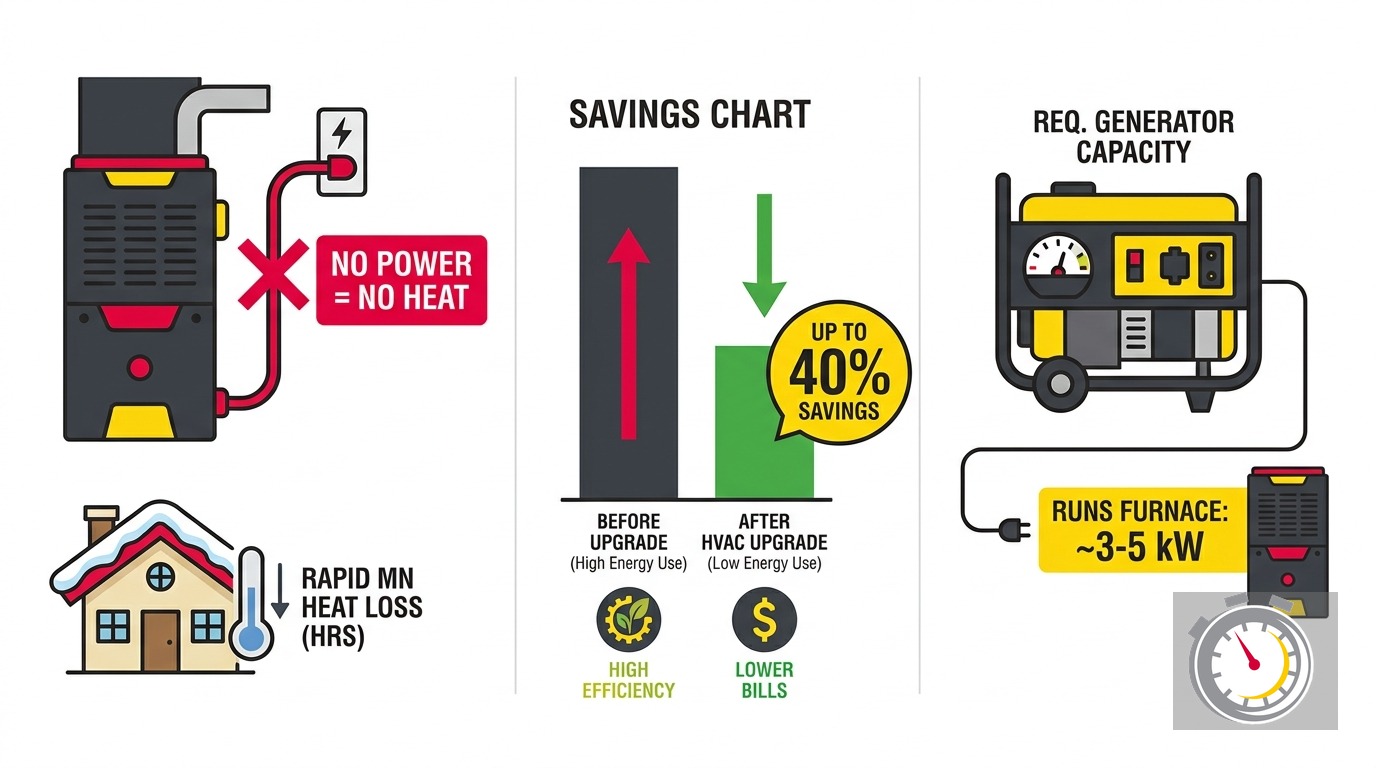
- Your gas furnace needs electricity to run. Even with natural gas flowing normally, a 90%+ AFUE furnace requires 300-1,400W of power to fire.
- A modern high-efficiency furnace has five sequential electrical components. Any power interruption breaks the chain and the furnace locks out.
- At Minneapolis’s design temperature of -16°F, a typical home loses 1-2°F of indoor temperature per hour. Older, less-insulated homes cool faster.
- Underground natural gas lines from CenterPoint and Xcel are unaffected by ice storms. The gas is available. Only the electrical controls are missing.
- Generator sizing depends on blower motor type. ECM motors are efficient at steady state but can surge to 3,500W on startup. Size for starting watts, not running watts.
- Keep indoor temperatures at or above 55°F during an outage. Below that, pipes in unheated spaces enter freeze territory.
Why Does a Gas Furnace Need Electricity?
A gas furnace is not a simple flame you can light with a match. It is a sequence of electrical events that must happen in the correct order before any heat moves through your home. Remove power and the sequence stops.
The U.S. Department of Energy puts it plainly: “most equipment uses electricity to drive controls and other auxiliary functions. This means that if an electrical outage occurs, even though a furnace is mainly gas powered, it will not be able to function and provide heating.”
That applies to every gas furnace made in the last 30 years. It is not a design flaw. It is how controlled, safe combustion works.
CenterPoint Energy’s underground distribution network stays operational when surface power lines go down. The fuel is there. The furnace simply cannot use it without electricity.
What Happens Inside Your Furnace When the Power Cuts?
Every time your furnace calls for heat, it runs through five electrical steps in sequence. Power loss at any point breaks the chain. The furnace locks out on safety and will not try again until power returns and the lockout resets.
Here is each component and what it does.
Inducer motor. The furnace starts by energizing the draft inducer motor. This fan clears combustion gases from the flue before ignition begins. A failed or unpowered inducer means no draft. No draft means the pressure switch stays open. Everything stops here.
Pressure switch. The pressure switch confirms that the inducer is moving enough air through the combustion chamber. It closes only when a specific negative pressure is established. Without power, there is no pressure and the switch stays open.
Hot surface igniter. The igniter is a silicon carbide or silicon nitride element that heats to glowing red-orange on 120V AC. It typically draws 80-120W on its own. Without power, it cannot produce heat. The gas valve will not open without a confirmed ignition source.
Control board. The control board is the furnace’s central computer. It sequences all other components, monitors safety inputs, and is the only component authorized to open the gas valve. Without power, it does nothing.
ECM blower motor. Once the burner lights and the heat exchanger reaches temperature, the variable-speed blower distributes warm air through your ductwork. Modern ECM motors require consistent, clean power to operate correctly. Generator type matters here, and that distinction is covered below.
All five components together draw varying amounts of power depending on furnace model and blower type. That is the only barrier between your gas supply and warm air in your home.
Are Newer High-Efficiency Furnaces More Vulnerable?
Yes, in practice. The 96% AFUE furnace has more electrical dependencies than the 80% furnace it replaced. More efficiency requires more complexity, and more complexity requires more power.
An older furnace often used a standing pilot light, a simple fan relay, and a basic control board. The newer furnace uses a sealed combustion system, a secondary heat exchanger, a variable-speed inducer motor, an ECM blower, and a more capable control board monitoring additional sensors.
None of that is a bad trade. The efficiency gains reduce your heating bills meaningfully over a Minnesota winter. But homeowners should understand the full picture: every point of AFUE comes with additional electrical complexity. A furnace power outage in Minnesota hits a modern furnace in five places instead of two or three.
How Fast Does a Minnesota Home Lose Heat?
Typical Minnesota homes drop roughly 1-2°F of indoor temperature per hour during ordinary freezing conditions. Older homes, homes with poor insulation, and homes exposed to wind infiltration lose heat faster.
That is the temperature a properly sized heating system is engineered to handle at maximum load. During a polar vortex, you are at or near that design extreme.
At -16°F outside and 68°F inside, the temperature gap is 84 degrees. That differential pushes heat out through every wall, window, and door. The actual rate of heat loss depends on insulation quality, window ratings, and home size, but the direction is always the same.
Northern Minnesota near International Falls sees design temperatures below -30°F. At those conditions, the same home cools considerably faster.
Factors that accelerate indoor cooling:
- Attic insulation below current code, common in homes built before 1980
- Single-pane windows or older double-pane units with failed seals
- Uninsulated crawl spaces or rim joists
- Wind infiltration around doors, windows, and utility penetrations
Six hours without heat on a -10°F morning can mean 6-12°F of indoor temperature lost in a typical home. That is enough to push the unheated zones of your house into dangerous territory.
When Do Pipes Enter the Danger Zone?
Pipe freeze risk rises sharply when outdoor temperatures drop far enough below freezing for several hours, especially for pipes in unheated attics, crawl spaces, and exterior walls. Your main living space may still feel livable. The unheated spaces behind your walls may already be at the freeze threshold.
Keep indoor temperatures at or above 55°F to protect plumbing in those unheated zones. Below 50°F, the buffer between your conditioned living space and your unheated cavities disappears quickly.
The damage from frozen pipes is usually not the freeze itself. It is the burst when the ice thaws and expands. Water pressure has to go somewhere.
Steps that buy time during an outage:
- Open cabinet doors under sinks on exterior walls to let interior air reach the pipes.
- Allow a cold-water faucet to drip slowly on the side of the home most exposed to cold.
- Know where your main water shutoff is before you need it.
- If you must leave the home, shut off the water main and drain the plumbing.
None of these replace heat. They slow the clock.
What Generator Capacity Actually Runs a Furnace?
The right generator size depends on your blower motor type, not a one-size-fits-all wattage recommendation. Older PSC motor furnaces need at least 2,000W of starting capacity. Modern ECM motor furnaces can run on an inverter at steady state, but their startup surge can spike considerably higher. Always size for starting watts, not running watts.
Generic articles recommend “5,000-7,500W portable or 14-16kW standby” without explaining why the range spans so wide. The blower motor type explains it. The next section breaks down the difference.
ECM vs. PSC: Why Motor Type Changes the Sizing Answer
Older furnaces use PSC (permanent split capacitor) blower motors. PSC motors draw significant power when running and surge to two to four times that on startup. A PSC furnace needs a generator that can handle at least 2,000W of starting load, even if its steady-state draw is lower.
Modern furnaces use ECM (electronically commutated motor) blowers. The Department of Energy required ECM motors in all new residential furnaces as of 2019. ECM motors use far less power and soft-start, which reduces startup surge compared to PSC motors. In theory, a 2,000W inverter generator can keep a modern ECM furnace running.
The catch: the control board and ECM motor still produce an inrush current spike when the furnace fires. That spike can reach 3,500W. A generator rated for 2,000W running and 2,200W starting may trip its own overload protection the moment your furnace tries to start.
Two things to check before buying:
Read the furnace nameplate. Every furnace has a data label near the blower compartment. It lists minimum circuit ampacity and maximum overcurrent protection. Those numbers reflect the electrical load the system was designed to handle.
Buy for starting watts, not running watts. A portable inverter generator rated for 2,000W running and 3,500W starting covers most modern ECM furnaces. A generator rated for 2,000W running and 2,200W starting likely will not.
One more detail: ECM motors are sensitive to power quality. A conventional open-frame generator produces modified sine-wave power. That can cause control board faults or rough motor operation on a modern furnace. Inverter generators produce clean true sine-wave power and are the correct choice for furnace-only portable backup.
Portable vs. Standby: Which Generator Fits Your Situation?
For most Twin Cities homeowners, the practical question is which generator type fits the situation. A portable unit covers furnace-only loads at lower upfront cost. A whole-home standby unit covers the entire house automatically but costs significantly more to install.
Portable generators (2,000-7,500W):
- Lower upfront cost, generally $500-$2,000 for a quality inverter unit
- Require manual setup, outdoor placement, and fuel management
- Run on gasoline or dual-fuel configurations (gasoline plus propane)
- Adequate for furnace-only or furnace-plus-essentials loads
- Key limitation: you need fuel stored safely in advance and you must be home to deploy
Whole-home standby generators (14-16kW for a typical Twin Cities home):
- Automatically cover furnace, sump pump, refrigerator, and selected circuits without any manual action
- Connect to the same underground natural gas supply line your furnace uses
- Sense an outage and start within seconds, no action required from you
- Higher upfront investment, generally $5,200-$13,000 or more installed
If you travel frequently during Minnesota winters, if anyone in your household depends on powered medical equipment, or if you experienced a multi-day outage in a prior winter, a standby unit is worth pricing. If you want furnace-only protection at manageable upfront cost, a quality inverter-type portable generator is a practical starting point.
One note on natural gas standby generators: they connect to the same underground supply that powers your furnace. The outage that stopped your grid power does not stop that supply line. Your generator keeps running as long as the gas flows.
What to Do Before the Next Outage
A furnace power outage in Minnesota is not a hypothetical planning exercise. A single Xcel Energy winter storm left widespread customer outages across Minnesota and Wisconsin. More than 4,400 Twin Cities customers were still without power the following morning.
The preparation steps are practical, and most cost nothing:
-
Identify your blower motor type. Check your furnace manual or the data label near the blower compartment. “ECM” or “variable speed” means a modern motor. If you do not see either term, assume PSC and size your generator accordingly.
-
Size for starting watts. Get the starting wattage rating for any generator you consider. Compare it against your furnace nameplate ampacity. A unit that cannot handle the startup surge will fail at the worst possible moment.
-
Keep a battery-backup carbon monoxide detector. Gas combustion produces CO. Running a furnace on generator power does not change that. Make sure your detector is functional and has fresh batteries before winter.
-
Know the 55°F rule. If indoor temperature approaches 55°F during a hard freeze, you are in pipe-protection territory. Have a plan before that situation arrives.
-
Schedule a furnace tune-up before winter. A furnace struggling before an outage will not improve during one. A clean igniter, a tested pressure switch, and a properly functioning inducer motor all matter when the system is running hard.
We are locally owned and operated in Ramsey, and our team serves the entire Twin Cities metro. If your furnace is overdue for service, or if it behaved strangely after a recent power event, call us at (763) 260-6662 or book your appointment online. We show up when we say we will. That is the promise behind “Always On Time… Or You Don’t Pay a Dime!(R).”
Frequently Asked Questions
Will my gas furnace run during a power outage? +
How fast do pipes freeze during a Minnesota power outage? +
What generator size do I need to run my furnace? +
Need a technician now?