
Heat Pump Aux Heat Strips Cost Minnesota: Monthly Math
Key Takeaways
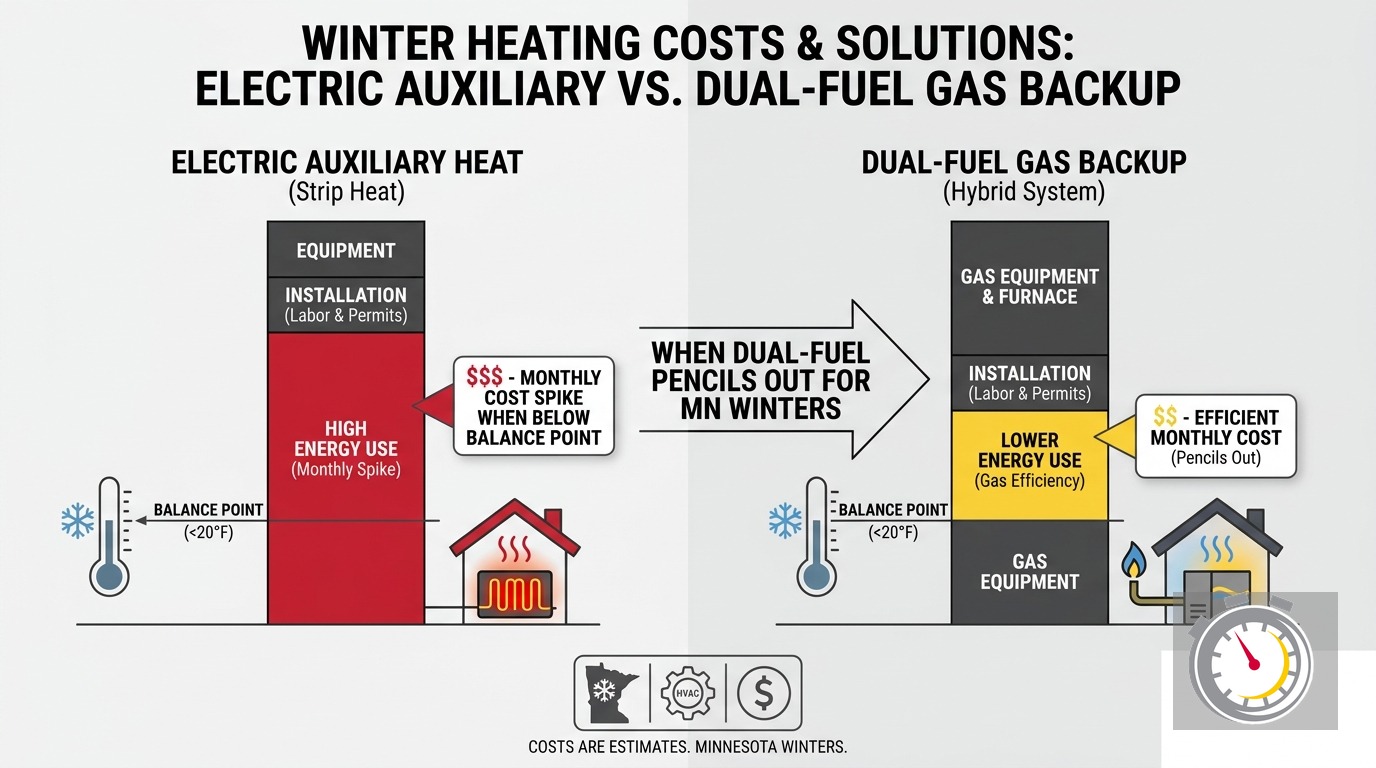
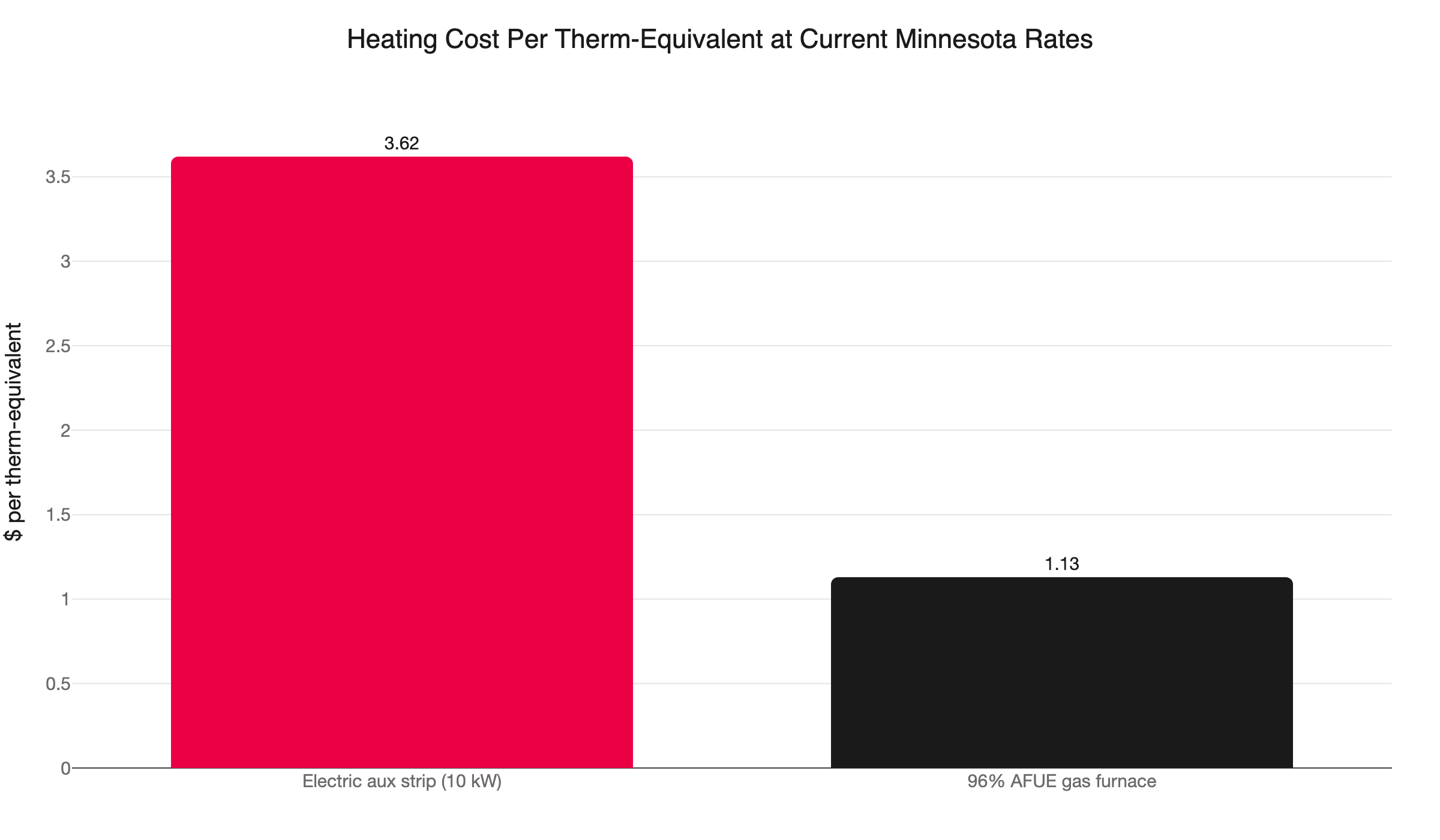
- Electric auxiliary heat strips in Minnesota cost roughly $3.62 per therm-equivalent of heat - about 3.2 times more than a 96% AFUE gas furnace at current MN energy prices.
- A 10 kW aux strip running 8 hours a day for 10 cold January days adds about $99 to your electric bill for that stretch alone, stacked on top of base heat pump operation.
- The economic balance point - the outdoor temperature where gas becomes cheaper per BTU than the heat pump - falls around 15-25°F for most systems in Minnesota.
- Modern cold-climate heat pumps rated to -13°F can push aux heat activation well below 0°F, cutting monthly strip costs substantially versus standard equipment.
- The IRS 25C tax credit (up to $2,000) expired December 31, 2025 and is not available for 2026 installations unless Congress acts.
- For most Twin Cities homes, a dual-fuel system - heat pump during mild temps, gas furnace below the balance point - is the lowest-cost-to-operate setup for a Minnesota winter.
When temperatures drop into the single digits across the Twin Cities, your heat pump calls for backup. Those electric auxiliary heat strips kick in to fill the gap. Heat pump aux heat strips cost Minnesota homeowners significantly more per BTU than most people expect - and the articles that rank for this topic almost never publish the actual Minnesota numbers. This post runs the real calculation and explains when a dual-fuel gas backup is the smarter call.
What Are Heat Pump Aux Heat Strips and How Do They Work?
Electric resistance coils inside your air handler activate when the heat pump cannot produce enough BTUs to meet the heating load alone. The strips convert 100% of electrical energy to heat, with no refrigeration cycle needed. Most residential systems carry 5 to 15 kW of strip capacity, often staged so the second bank only fires when the first bank is not enough.
The system activates auxiliary heat automatically when outdoor temperatures fall below a threshold set in the thermostat or the equipment’s own controls. “Auxiliary” is the key word. Aux heat is designed to supplement the heat pump during cold stretches, not replace it entirely.
Emergency heat is different. It bypasses the compressor and runs the strips alone. Emergency heat mode should only be active if the compressor is damaged or the refrigerant circuit has a known fault. Running emergency heat as a default winter setting costs far more than letting the heat pump run with aux support when needed. Many homeowners flip to emergency mode during a polar vortex without realizing the cost difference.
Most residential aux strips are configured in stages. A 10 kW total capacity might be split into two 5 kW stages. The second stage only fires when the first cannot maintain setpoint. This staging limits electric draw and operating cost. A system that throws all its strip capacity at the problem on every heating call bypasses the efficiency benefit of staging entirely.
How Much Do Heat Pump Aux Heat Strips Cost to Run in Minnesota?
At Minnesota’s average residential electricity rate of 12.35 cents per kWh (EIA data), a 10 kW aux strip draws 10 kWh per hour of operation, costing $1.24 per hour. That same output from a 96% AFUE gas furnace runs about $1.13 per delivered therm - roughly $0.28 per hour equivalent. Running aux strips costs about 3.2 times more per BTU than gas at current Minnesota prices.
Hourly aux strip operating cost at 12.35¢/kWh:
- 5 kW strip: $0.62/hour
- 7.5 kW strip: $0.93/hour
- 10 kW strip: $1.24/hour
- 15 kW strip: $1.85/hour
Those hourly figures add up quickly during a sustained cold stretch. A 10 kW strip running 8 hours a day for 10 days costs $99 in aux heat alone. Homes with 15 kW strips - common in larger Twin Cities houses with higher heating loads - face $1.85 per hour of aux run time. A cold January with sustained subzero stretches can mean $220 to $400 in aux heat costs for those homes.
Minnesota’s electricity rate is below the US national average. That softens the aux heat penalty compared to states paying 18-20 cents per kWh. Even so, the 3x gap between electric resistance heat and gas is wide enough to drive real bill spikes when temperatures stay low for weeks. If your heating costs climbed faster than expected last winter, see our post on heat pump electric bill spikes in Minnesota winters for the full list of causes beyond aux strips.
What Is the Balance Point, and Why Does It Drive Your Electric Bill?
The balance point is the outdoor temperature below which your heat pump needs backup heat to maintain indoor comfort. Most standard heat pumps reach that threshold around 30-35°F. In a Twin Cities winter, temperatures fall below 30°F for months at a stretch, creating sustained aux heat operation for a standard all-electric system.
Two balance points exist, and confusing them causes real problems in how these systems are designed and explained.
The capacity balance point is the temperature at which the heat pump can no longer produce enough BTUs to meet the home’s heating load. Below this temperature, the strips fire regardless of cost. The heat pump physically cannot handle the demand alone.
The economic balance point is lower. It is the outdoor temperature at which the heat pump’s efficiency (COP - coefficient of performance) drops to the point where gas heat costs the same per BTU. Above this temperature, the heat pump wins on cost. Below it, gas is cheaper - even if the heat pump could still physically produce enough heat.
These two thresholds are typically 10 to 20 degrees apart. A homeowner whose system switches to gas at 35°F may be doing so at a temperature where the heat pump is still the more economical choice. Getting both numbers right, and setting the thermostat’s switchover point accordingly, is one of the most valuable things a technician can do during a dual-fuel commissioning.
For a detailed look at how backup heat staging interacts with heat pump operation in the Twin Cities, see our post on heat pump balance point and backup heat in Minnesota.
Heat Pump Aux Heat Strips Cost: The Monthly Math for a Twin Cities Home
Minneapolis averages around 8,000-8,400 heating degree days per year at a 65°F base. That is one of the highest HDD figures for any major US metro. January lows average around 3-4°F. January highs average around 20°F. The city sees approximately 200-400 hours per year when temperatures fall below 0°F. During those hours, even cold-climate heat pumps lean on backup heat.
Here is what aux heat costs for a 2,000 sq ft Twin Cities home with a 10 kW strip, at 12.35¢/kWh:
| Scenario | Hours/day | Days | kWh used | Aux heat cost |
|---|---|---|---|---|
| Moderate cold snap (15-25°F) | 4 hrs | 10 days | 400 kWh | $49 |
| Severe cold snap (0 to -10°F) | 8 hrs | 10 days | 800 kWh | $99 |
| Extended polar vortex | 12 hrs | 14 days | 1,680 kWh | $207 |
These are the aux heat costs alone, layered on top of your base heat pump operation. During the severe scenario - 10 days of sustained near-zero temperatures - the strips add $99 to your bill for that window. Add base electricity use and you can see how January electric bills reach $300 to $500 for some Twin Cities heat pump homes.
Scale the math to a 15 kW strip and the severe cold-snap scenario jumps from $99 to $148 for the same 10-day period. Homes that were spec’d with oversized strip packages to meet code minimums - without optimizing for operating cost - pay that premium every January.
Minneapolis uses approximately -16°F as the ACCA Manual J heating design temperature. Your backup heat has to cover the full load at that temperature. That is why most systems carry substantial strip capacity. It was sized for coverage. The economic question is when to hand that load off to gas instead.
What Is the Difference Between the Capacity Balance Point and the Economic Balance Point?
The capacity balance point is where the heat pump runs out of heating ability and aux strips must fire regardless of cost. The economic balance point is lower: the outdoor temperature at which gas heat costs less per BTU than running the heat pump. At current MN rates, the crossover falls at a heat pump COP of approximately 3.2, which most systems hit somewhere between 15 and 25°F.
Here is the math behind that crossover number.
EIA data shows Minnesota residential natural gas averaged $11.17 per MCF in January 2026. Dividing by 10.37 therms per MCF gives $1.08 per therm. One delivered therm from a 96% AFUE furnace: $1.08 divided by 0.96 = $1.13.
One therm-equivalent of heat from a 10 kW electric strip: 29.3 kWh at 12.35¢ = $3.62.
Crossover COP: $3.62 divided by $1.13 = COP 3.2.
When your heat pump is operating above COP 3.2, it costs less per BTU than gas at current MN prices. When it drops below COP 3.2, gas wins. Most cold-climate units fall below COP 3.2 somewhere in the 15-25°F range, depending on the model and the system’s sizing relative to the home’s actual load.
The practical implication: on a 25°F day, your heat pump may still be both capable and cheaper than gas. On a 5°F day, it may still technically run, but gas is now cheaper per BTU. Installer-set switchover temperatures on dual-fuel systems default to 25-35°F, calibrated to national-average energy prices. For a Twin Cities home on Minnesota’s below-average electricity rate, the optimal switchover may sit closer to 20-25°F. Ask your technician whether the switchover point reflects MN-specific rates or a national default they left in place.
When Does a Dual-Fuel Gas Backup Pencil Out Better?
At current Minnesota rates (12.35¢/kWh electricity, $1.08/therm gas), a dual-fuel system running gas backup below the economic balance point delivers heat at roughly one-third the cost of electric aux strips for the same BTUs. For a Twin Cities home spending weeks below 20°F each winter, that adds up to meaningful seasonal savings over an all-electric setup.
A dual-fuel setup makes the most sense when:
- Your home already has a gas line and a forced-air system with a furnace that has remaining service life.
- You want the efficiency advantage of a heat pump during fall and spring shoulder seasons without paying the aux strip penalty in deep winter.
- You are adding central cooling to a gas-heat home at the same time you need a new furnace, and the combined project economics favor adding a heat pump alongside the furnace.
- Your home’s heating load is large enough that aux strip run hours in a cold January add up to $150 to $200 or more.
- You want to reduce peak electric demand in your household without committing fully to an all-electric system.
The dual-fuel case weakens under two conditions. First, if natural gas prices rise significantly relative to electricity, the economic balance point shifts toward favoring electric heat at lower outdoor temperatures. Second, if you install a modern cold-climate heat pump that maintains a high COP well below 20°F, aux strips run far fewer annual hours and the operating cost gap between electric and gas narrows enough that adding a gas furnace may not pencil out.
For a full breakdown of dual-fuel system design and installed costs in the Twin Cities, read our post on dual-fuel heat pump and gas furnace hybrid systems in Minnesota.
How Cold-Climate Heat Pumps Shrink the Aux Heat Bill
Modern cold-climate units rated to -13°F maintain a useful COP at temperatures well below the 30-35°F threshold where standard equipment loses efficiency. Aux strips engage far less often, and monthly aux heat costs drop accordingly.
The difference in annual aux strip hours between a standard and a cold-climate unit is substantial for a Twin Cities home:
- Standard heat pump with a capacity balance point around 30°F: aux heat fires for most of November through February. That is roughly 1,200 to 1,800 hours per heating season in a typical Minneapolis climate.
- Cold-climate heat pump with a capacity balance point near 0°F: aux heat fires primarily during the 200-400 hours per year when temperatures fall below 0°F in Minneapolis.
At $1.24 per hour for a 10 kW strip, the difference between 1,500 and 300 annual aux heat hours is approximately $1,488 per year in operating cost savings. Over 10 years, that gap covers a significant portion of the cold-climate unit’s price premium.
The tradeoff is upfront cost. Cold-climate units carry higher equipment prices, and the installed system cost reflects that. With the 25C federal tax credit no longer available for 2026 installs, the payback timeline deserves a careful look before committing. For a homeowner planning to stay in the home long-term in a high-HDD market like Minneapolis, the annual operating savings typically justify the premium within a few heating seasons. Ask about financing options when you call - larger system replacements often qualify.
If you already own a cold-climate heat pump and your electric bill still spiked last winter, the most likely explanation is that the thermostat’s aux heat staging threshold was never adjusted from the factory default. A unit rated to -13°F that activates aux heat at 35°F gives up its cold-weather efficiency advantage entirely. Our technicians check this calibration on every heat pump service call. It is a quick fix that can pay for the service visit in its first winter.
What Rebates and Credits Are Available for 2026?
The federal 25C Energy Efficient Home Improvement Credit expired December 31, 2025. Homeowners installing heat pumps in 2026 cannot claim the previous 30%-up-to-$2,000 annual credit unless Congress passes an extension. No extension has been enacted as of this writing (IRS source).
That changes the payback math for any project that straddled the 2025-2026 line. A $15,000 cold-climate system that would have netted a $2,000 federal credit in 2025 carries the full cost in 2026. Factor that gap into any dual-fuel or heat pump replacement calculation you are running today.
Utility rebates remain available, though amounts and eligibility change regularly. The most reliable current tool for confirming what your specific utility offers is the ENERGY STAR Rebate Finder. Xcel Energy has historically offered heat pump incentives for Minnesota residential customers. CenterPoint Energy, primarily a gas distribution utility, focuses most of its efficiency incentives on gas furnace upgrades rather than heat pumps. Call your utility directly or use the ENERGY STAR tool before committing to a purchase - rebate amounts shift and the finder reflects current program status.
For strategies on stacking utility rebates with any remaining state or local programs, read our post on Minnesota heat pump rebates and tax credits.
Get a Dual-Fuel Assessment Before the Cold Arrives
The numbers in this post come from real Minnesota energy data: 12.35¢/kWh electricity and a January 2026 gas rate of $1.08/therm, not national averages that consistently run low for what the work actually costs in this market.
The right system configuration for your home still depends on your specific Manual J heating load, your current equipment’s condition, and whether your gas line can support a dual-fuel install. Those variables require an in-home assessment, not an online calculator.
Our team is locally owned and operated in Ramsey, MN. We serve the full Twin Cities metro: Minneapolis, St. Paul, Blaine, Maple Grove, Plymouth, Brooklyn Park, Woodbury, Bloomington, and the surrounding area. When you call us, we show up when we said we would. That is not just our preference - it is our standing promise: “Always On Time… Or You Don’t Pay a Dime!(R)”
If your electric bill spiked last winter or you want to know whether a dual-fuel system pencils out for your specific home and equipment, call us at (763) 260-6662 or book online. We will run the balance point math against your actual equipment and current MN energy prices - not a national average - so you can make the decision with real numbers in front of you.
Frequently Asked Questions
How much does it cost to run aux heat strips on a heat pump in Minnesota? +
What temperature does aux heat kick in on a heat pump? +
Is a dual-fuel heat pump system cheaper to operate than all-electric in Minnesota? +
Does the 25C federal tax credit still apply to heat pump installs in 2026? +
Need a technician now?