
First Winter With a Heat Pump: What to Expect in Minnesota
Key Takeaways
- Steam, dripping water, and a stopped outdoor fan during winter are defrost cycle symptoms. They are normal and last 3-10 minutes.
- “AUX” on your thermostat means supplemental backup heat is running. Brief AUX activity during defrost and sub-zero stretches is expected behavior.
- Cold-climate heat pumps are engineered for Minnesota winters. Minneapolis-St. Paul’s 99% design temperature is -12°F, and modern cold-climate units have been tested and operated at -15°F.
- A higher electric bill in January reflects three things at once: harder work in extreme cold, backup resistance heat, and a statewide rate increase.
- If your system’s lockout temperature is set too high, backup heat runs when the heat pump could handle the load alone. One service call fixes it.
- Xcel Energy customers using a heat pump as their primary heat source may qualify for a reduced Electric Space Heating Rate. Most new owners never enroll.
Your First Minnesota Winter With a Heat Pump
Your first winter with a heat pump in Minnesota brings a set of surprises no one warned you about. The outdoor unit is steaming. The thermostat reads “AUX.” The electric bill looks nothing like last year’s gas bill.
Before you pick up the phone, keep reading. Most of what you are seeing is the system working exactly as it was designed to work.
This post covers the three things that confuse new heat pump owners most: the defrost cycle, auxiliary heat, and the winter electric bill. We also cover the one Xcel Energy rate enrollment that most owners miss - and that reduces your operating cost starting the first full billing cycle after you sign up.
Is That Steam Cloud Outside Normal?
The outdoor unit is covered in frost, the fan has stopped, steam is rising, and water is dripping. Is this a failure?
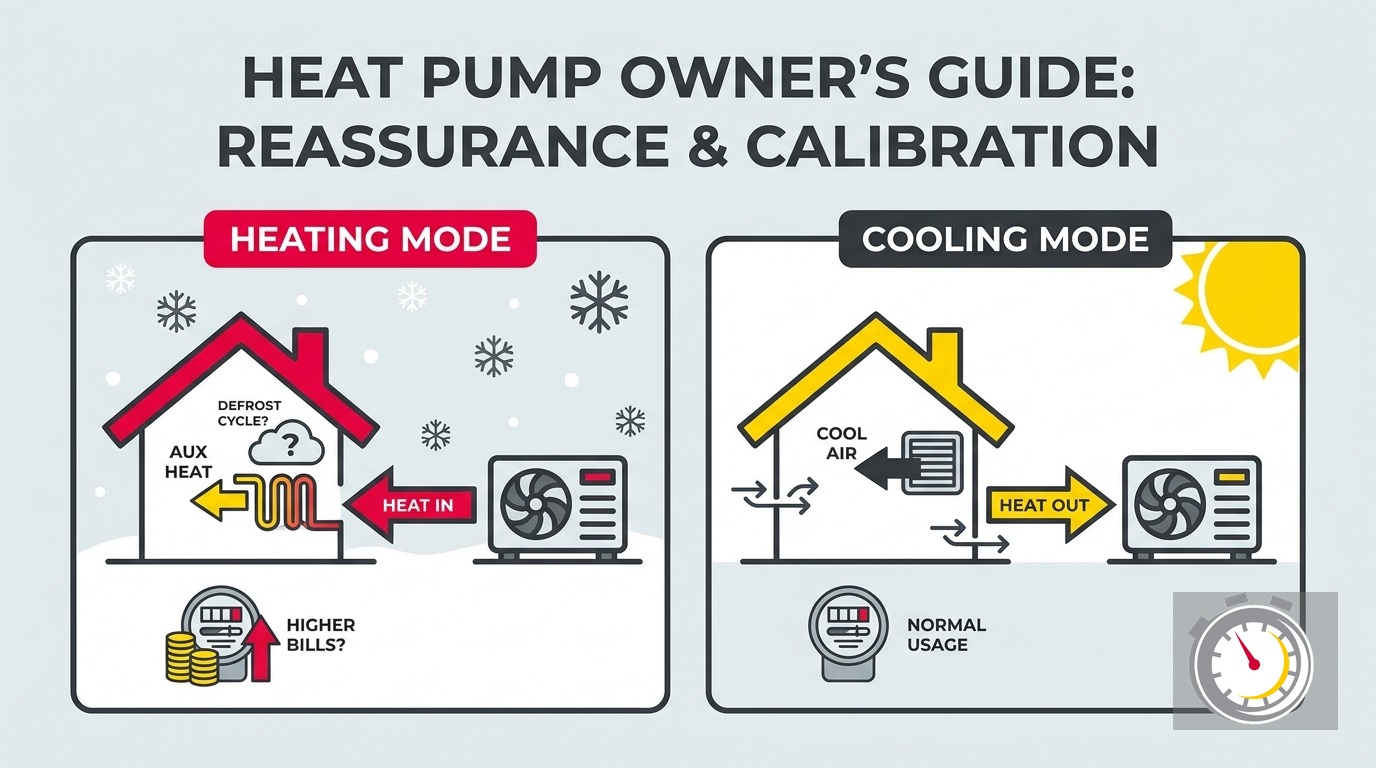
No. This is the defrost cycle doing exactly what it was built to do. Your heat pump reversed direction briefly to melt frost off the outdoor coil. Steam, dripping, and a stopped fan are all part of it. The cycle lasts 3-10 minutes and then heating resumes. You do not need to take any action.
Here is the physics. Your heat pump pulls heat from outdoor air even when temperatures drop well below freezing. Air at 0°F contains more than 75 percent of the energy found in 140°F air. That is how the system keeps working when it seems impossible outside. The catch is that the outdoor coil runs roughly 10 to 20°F colder than the surrounding air temperature. When moisture is present, it freezes onto the coil. Too much frost and the system loses efficiency - so it clears it.
To defrost, the reversing valve switches the heat pump into a brief cooling mode. Hot refrigerant flows to the outdoor coil. The fan stops. Frost melts. Steam rises, water drips, and you may hear a low metallic drone or hum. When the coil clears, the valve reverses and the system resumes heating.
Frost buildup is most likely when outdoor temperatures are between 25°F and 45°F. Below 20°F, the air is typically too dry to deposit much frost. Above 45°F, the coil stays warm enough that frost rarely forms. This means you will see the most defrost activity on moderate-cold days - the 28-35°F range that is common in a Twin Cities November or March - not during the deep-freeze stretches.
Modern demand-defrost systems trigger only when sensors detect actual buildup. Those cycles typically last 3-5 minutes. Older timed systems may cycle every 30, 60, or 90 minutes regardless of whether frost has built up. One or two defrost cycles per hour on a 30°F day is normal for most systems. Constant cycling - or ice that never clears - is worth a service call.
For a visual guide to what normal frost looks like versus what does not clear on its own, see our full post on heat pump ice and defrost cycles in Minnesota.
Why Does My Thermostat Say “AUX”?
The thermostat shows “AUX” and you are not sure whether it is an alert.
It is not an alert. AUX means your supplemental electric resistance strips turned on. This happens in two situations: during the defrost cycle to keep your home warm while the heat pump is temporarily reversed, and when outdoor temperatures fall below your system’s balance point. Both are expected behavior. Backup heat is installed precisely for these moments.
Here is what each scenario looks like.
During defrost: When your heat pump reverses into a defrost cycle, it is briefly moving heat away from your house, not into it. The heat pump’s coefficient of performance approaches zero during defrost because nearly all the heat output is directed to the outdoor coil. The backup strips carry your home’s heat load for those few minutes. When defrost ends, the strips shut off automatically.
During extreme cold: Every heat pump has a balance point - the outdoor temperature below which the heat pump alone cannot match your home’s rate of heat loss. Below that point, backup heat fills the gap. A well-sized cold-climate heat pump in a well-insulated Twin Cities home may not need sustained backup support until temperatures drop below zero. An older, leakier home has a higher balance point and leans on backup more.
The most common configuration error is a lockout temperature that is set too high. This setting tells the system to stop running the heat pump entirely and switch to backup heat only. Xcel Energy’s dual-fuel rate allows switchover at or below 35°F. But if your lockout is set at 35°F and the heat pump can still run efficiently at 15°F or 20°F, your backup strips are doing work the heat pump could handle more cheaply. Most homeowners never know this setting exists. A technician can check it in a single visit and lower it if it is misconfigured.
For a breakdown of what backup strip operation costs per hour and how to minimize it, see heat pump auxiliary heat strips and operating cost.
Should I Be Worried When AUX Heat Runs a Lot?
AUX has been on for hours and it is not that cold out. Is something wrong?
Brief AUX during defrost and during sustained sub-zero weather is expected. Prolonged AUX at temperatures above 20°F - especially on a 30°F afternoon - usually points to a misconfigured lockout temperature. That is a settings problem, not a hardware failure. One technician visit resolves it.
One distinction matters here: “AUX” and “EMRG” are not the same mode.
AUX means the backup strips are assisting the heat pump. The heat pump is still running. EMRG (emergency heat) disables the heat pump entirely and runs only the resistance strips. Emergency heat has a coefficient of performance of exactly 1.0 - one unit of electricity in, one unit of heat out. Compare that to a cold-climate heat pump at COP 1.75 at 5°F. Emergency mode is there for when the heat pump itself has failed and you need to stay warm until a technician arrives. It is not a backup heating mode for ordinary cold weather.
If your thermostat shows EMRG and you did not manually switch it there, call us. If it shows AUX during a cold day or during defrost, watch it for a few hours before calling. Sustained AUX on a moderate day is worth a service call to check the lockout setting.
Why Is My Electric Bill Higher This Winter?
Your electric bill is much higher than last year’s gas heating bill. Does the heat pump have a problem?
Probably not. Three factors combine in a cold Minnesota January: the system works harder as temperatures fall, backup resistance heat draws significant power when it runs, and statewide electricity rates have increased substantially. All three land at once on your bill.
The system works harder in extreme cold. A heat pump’s efficiency falls as outdoor temperatures drop. At 30-40°F, many cold-climate heat pumps achieve a coefficient of performance of 2 to 3 - meaning 2-3 units of heat out for every unit of electricity in. At 5°F, the qualifying threshold drops to COP 1.75. You are still getting more heat than electricity, but the margin narrows in the coldest weeks of the year.
Backup heat is expensive by comparison. Resistance strips operate at a flat 1:1 ratio. Every hour they run costs more than an equivalent hour of heat pump operation at COP 2+. If your lockout temperature is set too high and backup runs on days the heat pump could handle alone, that shows up directly in the monthly total.
Utility rates have risen. Minnesota households using electric heat could see bills rise nearly 20 percent this winter compared to prior years, according to the Citizens Utility Board of Minnesota. The increases are attributed to large data center construction, rising natural gas costs, and grid maintenance spending. This affects every household heating electrically. It is not a signal that your system is malfunctioning.
The most immediate lever available to Xcel customers is the Electric Space Heating Rate, which we cover below. The second-best lever is confirming your lockout temperature is not set higher than necessary.
For a deeper breakdown and specific questions to ask a technician, see heat pump electric bill spikes in winter.
Can a Cold-Climate Heat Pump Handle a Minnesota Winter?
You keep hearing that heat pumps struggle in extreme cold. Should January worry you?
No. Modern cold-climate heat pumps are designed and tested for this climate. Minneapolis-St. Paul’s 99% design temperature is -12°F. That is the temperature threshold used in building science to size heating systems. Modern units have cleared it.
Testing conducted by the Department of Energy with eight manufacturers - including Bosch, Carrier, Daikin, Lennox, Rheem, and Trane - showed cold-climate units continuing to operate at -15°F. These are not lab curiosities. They are units available from licensed HVAC contractors today.
The NEEP standard that Xcel Energy uses to qualify equipment for rebates requires a cold-climate heat pump to achieve COP at least 1.75 at 5°F and maintain at least 70% of its 47°F rated capacity when outdoor temperature is 5°F. Equipment that clears this bar has been screened specifically for northern climates.
Three caveats apply regardless of equipment quality. An older home with minimal insulation has a higher heat loss rate, which pushes the balance point up and increases backup heat usage. A system that was never sized with a Manual J load calculation may be undersized for your specific home. And a dual-fuel configuration (heat pump plus gas furnace) is designed to let the furnace handle the deepest cold days while the heat pump handles everything above the switchover point - if yours is set up this way, that is intentional and works well in Minnesota.
What Outdoor Maintenance Does Your Heat Pump Need in Winter?
Is there anything you should be doing for the outdoor unit during a Minnesota winter?
Less than you might expect. The unit is designed to operate outdoors year-round. A few straightforward steps help it do that without restriction.
- Clear snow after heavy storms. Brush accumulated snow off the top and sides of the unit. Do not let drifts pack against the base and block airflow into the coil.
- Maintain clearance from the discharge side. Keep solid objects - fencing, decking, firewood, stored items - at least five feet from the direction the unit exhausts air. Restricted discharge lowers efficiency.
- Trim vegetation back a couple feet. Plants that grow into the coil fins trap debris, ice, and leaves. Keep them clear.
- Use a garden hose, not a pressure washer. If debris has collected in the fins and you want to rinse it out, a standard hose at low pressure is safe. A pressure washer bends the aluminum fins and permanently reduces airflow.
One thing not to do: cover the unit. Heat pumps run all winter, including during mild stretches and shoulder-season days when you least expect them to. A cover traps moisture and blocks the unit when it needs to start.
Ice is different from frost. A light coating of frost or a thin layer of ice is normal between defrost cycles. A solid block of ice that does not clear after several hours is not normal and warrants a call.
One Rebate Most New Owners Miss
The Xcel Electric Space Heating Rate is a reduced per-kWh rate for Xcel customers whose heat pump serves as their primary heat source. This is not an installation rebate. It is a rate class change that applies to every heating bill going forward, month after month. Most new heat pump owners never know it exists.
If you qualify, enroll directly with Xcel Energy. The enrollment costs nothing and applies to your next billing cycle.
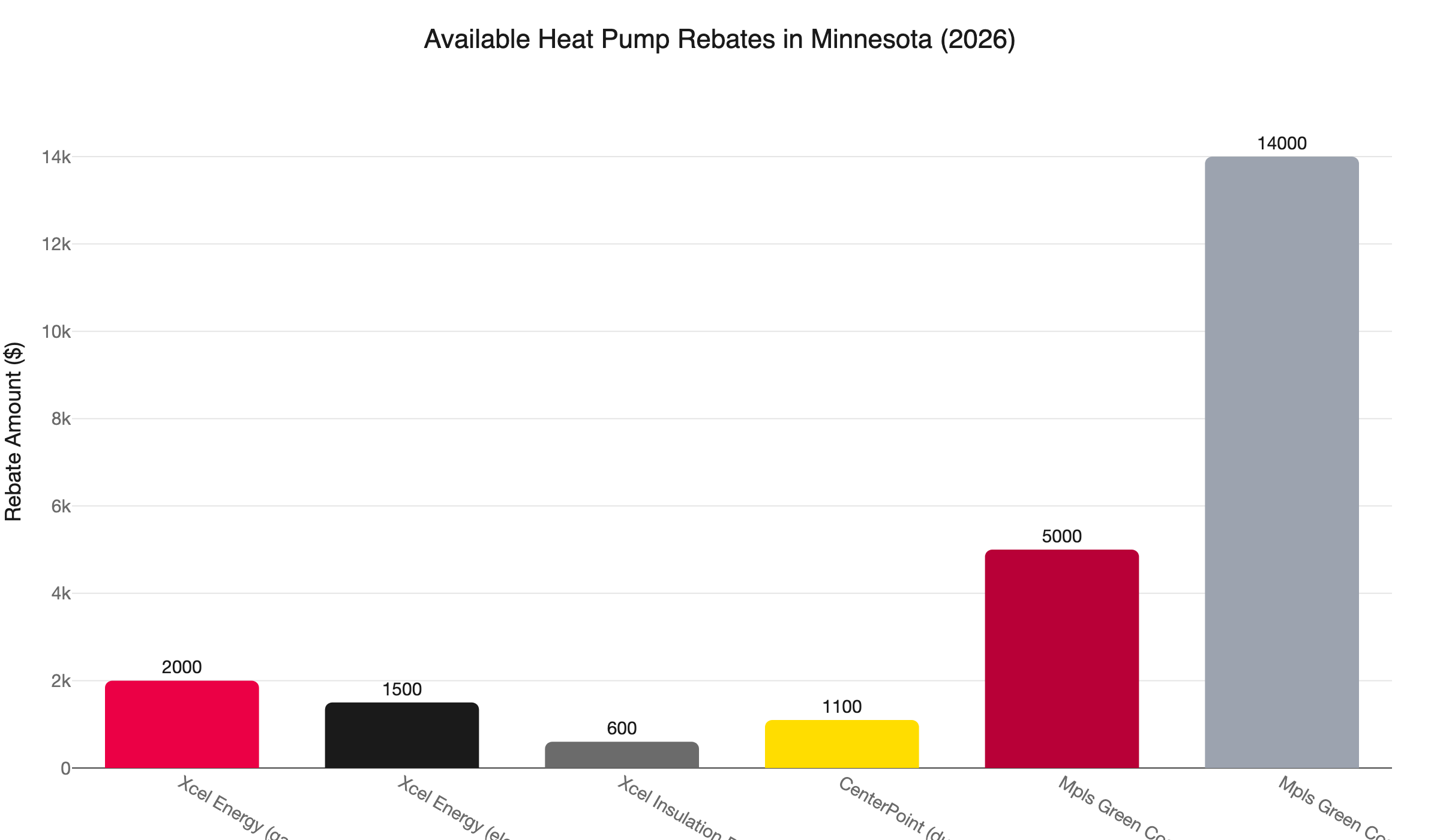
On the installation rebate side, programs active as of October 2026:
- Xcel Energy: $2,000 rebate for combo or gas customers, $1,500 for electric-only customers, plus a $600 insulation bonus if you upgrade insulation alongside the install
- CenterPoint Energy: $1,100 for a ducted heat pump paired with a gas furnace in a dual-fuel configuration; requires HSPF2 at least 7.8 and switchover at 40°F or lower
- Minneapolis Green Cost Share (administered by CEE): Up to $5,000 in non-Green Zone areas, up to $14,000 in the Green Zone; stacks with utility rebates; applies to 1-4 unit residential properties only
One important note: the federal 25C heat pump tax credit expired December 31, 2025. The state Save Energy MN program (the HOMES/HEAR framework funded by the Inflation Reduction Act) had not launched as of October 2026, and installations made before its launch will not qualify retroactively. Do not factor it into a purchase decision until the program is live and you can confirm the terms.
For a full picture of what stacks, what is gone, and how to claim what remains, see Minnesota heat pump rebates and tax credits.
When Should You Actually Call for Service?
Your heat pump is doing something unfamiliar. How do you decide whether to wait or call?
Most unfamiliar winter behavior is the system working correctly. The list below draws the line clearly.
Normal. No call needed:
- Steam or vapor rising from the outdoor unit
- Dripping water around the base of the outdoor unit
- The outdoor fan stopping for several minutes
- The AUX indicator lit on the thermostat
- A louder metallic hum or drone during a defrost cycle
- A brief blast of cool air from vents while defrost runs
Call us:
- Your home is not reaching setpoint even with AUX running
- The outdoor unit is encased in solid ice and has not cleared after several hours
- You hear grinding, clanking, or persistent loud rattling from the outdoor unit
- The system is blowing cool air in heat mode for more than a few minutes outside a defrost window
- Your thermostat shows “EMRG” and you did not switch it there manually
When you do need service, Northern One Hour is locally owned and operated out of Ramsey, MN. We serve Minneapolis, St. Paul, Blaine, Maple Grove, Plymouth, Brooklyn Park, Woodbury, Bloomington, and the surrounding Twin Cities area. Every visit is backed by our commitment: “Always On Time… Or You Don’t Pay a Dime!(R).”
Call us at (763) 260-6662 or book your service appointment online. We are here when the system is not.
Frequently Asked Questions
Is it normal for my heat pump's outdoor unit to steam and drip in winter? +
Why does my thermostat say AUX and should I be worried? +
Should I switch my heat pump to emergency heat in winter? +
What heat pump rebates are still available in Minnesota in 2026? +
Need a technician now?