
Mini Split Maintenance Minnesota: Annual Service Guide
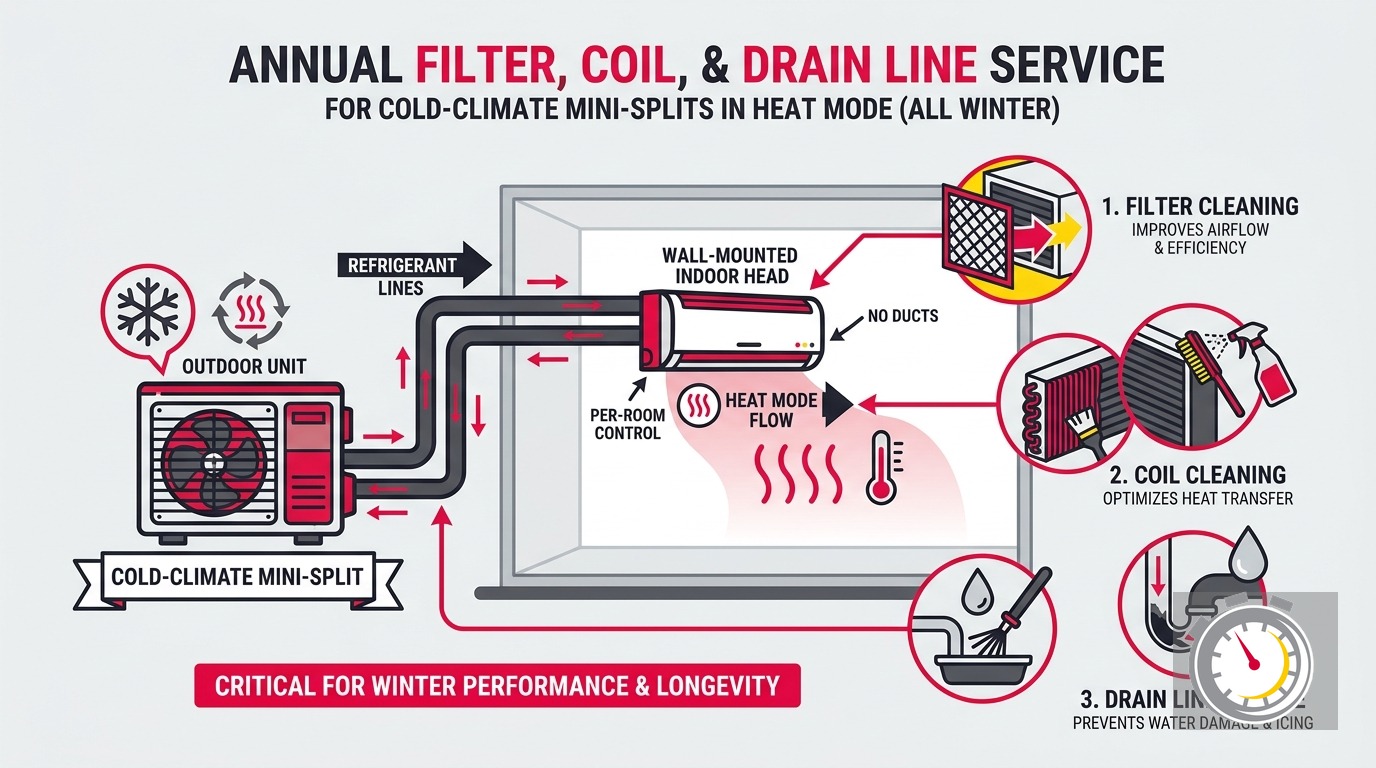
Key Takeaways
- Clean your indoor air filter every 4 to 6 weeks during heating season, not just once in the fall.
- The spring service window - late April to early May - is the most important annual appointment for Minnesota mini splits, not a fall tuneup.
- In heat mode, the indoor coil runs warm and dry all winter. Dust bakes on without condensate to rinse it away.
- The indoor drain line sits completely dry and stagnant from November through April. When cooling starts, a biofilm-lined drain is a water damage risk.
- The outdoor unit needs snow-stand mounting 12 to 24 inches off the ground with at least 2 feet of clearance on all sides.
- A drain pan heater prevents defrost melt water from refreezing and damaging the fan or cracking the coil.
- Xcel Energy offers up to $2,000 in rebates for qualifying cold-climate heat pumps. Federal tax credits ended December 31, 2025.
- Northern One Hour is locally owned and operated in Ramsey, MN. Call (763) 260-6662 or book online to get on the spring schedule.
Why Mini Split Maintenance Minnesota Requires a Different Approach
Most mini split maintenance advice is written for mild climates. Clean the filters twice a year, rinse the outdoor fins, schedule a checkup in fall. In the Twin Cities, that advice misses the most important thing a Minnesota winter does to these systems.
If your ductless mini split is a primary heat source, it has been running in heat mode continuously since October. That is six months of all-day operation with internal conditions that look nothing like summer cooling. The indoor coil stays warm and dry. The drain line carries no water from November through April. Dust bakes onto the coil with nothing to rinse it off.
When you flip to cooling in May, you are asking a caked coil and a stagnant drain to handle moisture immediately. That is where problems develop. Good mini split maintenance minnesota homeowners need addresses both sides of the system with that winter-to-summer transition in mind.
How Often Should You Clean Your Mini Split Filter in Minnesota?
Short answer: Every 4 to 6 weeks during peak heating season. Homes with pets or heavy dust should clean every 2 weeks. A dirty filter is the single fastest way to damage a mini split.
ENERGY STAR lists filter inspection as a core maintenance step and notes that a dirty filter increases energy use and can lead to early equipment failure. That guideline applies year-round. In Minnesota, where a mini split may run almost continuously from October through April, waiting for a seasonal reminder is not enough.
Midland Heating and Cooling, an MN HVAC contractor, recommends cleaning the filter every 4 to 6 weeks during a Twin Cities winter, with every 2 weeks for pet owners or dusty homes. That frequency reflects six months of nearly constant operation, not a system that cycles on and off occasionally.
Most mini split filters are washable. Slide them out of the indoor head unit, rinse gently with cool water, let them dry completely in the air, and slide them back in. Never run the system with a wet filter.
Here is what a clogged filter actually does. It restricts the airflow the blower wheel pulls through the unit. With less airflow, the coil gets dirtier faster. The system runs longer to hit the set temperature, pulling more electricity. In heating mode, reduced airflow can also cause the outdoor unit to work harder to extract heat from cold air - exactly the situation you do not want on a January night.
If you clean the filter and airflow is still weak, the problem is likely the blower wheel. The blower wheel is behind the filter and accumulates its own layer of dust and greasy buildup. That is not a DIY fix. It requires disassembling part of the indoor head to brush or ultrasonically clean the wheel. Midland’s guidance is clear: persistent weak airflow after filter cleaning is a flag that the blower wheel needs professional attention.
What Happens to the Indoor Coil After a Full Minnesota Winter?
Short answer: The coil runs warm and dry for six months, baking on dust with no condensate to carry it away. By spring, heavy buildup on the fins chokes airflow and forces the system to work harder to cool.
This is the indoor-unit physics that most mini split maintenance guides miss.
In cooling mode, the indoor evaporator coil runs cold and wet. Condensate forms on the fins and drips continuously into the drain pan. That steady drip actually carries light dust and particles away from the coil surface. It is not a complete cleaning, but it prevents serious buildup through a typical summer.
Heat mode is the opposite. The indoor coil runs warm - warm enough to let particles adhere and bake on, not wet enough to wash them off. Over a six-month Minnesota heating season, that means six months of accumulation with no self-cleaning mechanism at all.
By April, the indoor coil on a mini split that has been the primary heat source since October may be significantly fouled. That fouling reduces heat transfer efficiency in both heating and cooling, strains the compressor, and shortens the equipment’s life. A professional coil cleaning at the spring service restores the coil to a condition where it can do its job.
If your home runs an air purifier or uses high-MERV filtration elsewhere in the system, expect the mini split filter to load up faster. Those devices capture particles that would otherwise circulate freely, which means more of the fine dust that makes it past the filter lands on the coil.
Why the Indoor Drain Line Is a Spring Problem, Not a Summer One
The condensate drain line is easy to think of as a summer concern. Water forms in cooling mode, the drain carries it out, and if it clogs you get a drip or a backup. That framing is not wrong, but it misses what sets up the problem in Minnesota.
From November through April, the indoor drain line of a mini split running in heat mode carries no water. It sits completely still in a dark pipe. Biofilm - bacteria, algae, and mold - begins to develop inside the line even without active moisture, because organic material from the air settles in the pipe walls over time.
ENERGY STAR’s checklist specifically identifies a plugged condensate drain as a source of water damage and indoor humidity problems. The risk in Minnesota is that the drain does not become blocked during a warm, active cooling season when you would notice a drip right away. It becomes ready to block in May, right when the system produces condensate for the first time in six months and pushes it through a line that has been sitting stagnant since fall.
The right time to flush and inspect the drain is before you switch to cooling, not after water appears on the floor or ceiling below the indoor unit. A proper spring service includes a drain flush as a standard step, along with an inspection of the drain pan for scale or debris.
For a closer look at how condensate drain problems develop and what fixing them involves, see our guide to clogged AC drain lines.
What Should a Professional Mini Split Tune-Up Include?
Short answer: Filter cleaning, indoor coil cleaning, blower wheel inspection, drain line flush, outdoor unit inspection, refrigerant charge verification by measurement, and electrical connection check. Refrigerant must be verified by gauges, not by feel.
The DOE’s EnergySaver guidance on heat pump maintenance requires refrigerant charge verification by measurement, electrical terminal inspection, motor lubrication, and blower and coil inspection for dirt and obstructions. Those are the federal baseline. A proper Minnesota spring service goes further.
Here is what a complete mini split tune-up covers:
Indoor unit:
- Wash or replace air filters
- Inspect and clean the evaporator coil
- Inspect the blower wheel and flag for deep cleaning if needed
- Flush the condensate drain line and inspect the drain pan
- Check all electrical connections and control board
Outdoor unit:
- Clear debris from fins and coil
- Inspect for physical damage from winter
- Verify mounting height and clearances
- Check refrigerant line insulation for cracks or gaps
- Verify refrigerant charge by measurement
- Test defrost cycle operation
System-level:
- Review error code history from the winter
- Test heating and cooling operation
- Check all refrigerant line connections at the wall penetrations
A thorough tune-up takes time. If a technician is in and out in 20 minutes, something is being skipped. Book the spring appointment early - April slots fill faster than most homeowners expect, and companies that do good work fill first.
If a technician finds a problem beyond normal maintenance - a failing capacitor, a slow refrigerant leak, a damaged coil - our heat pump repair service covers mini splits and central heat pump systems throughout the Twin Cities metro.
Does the Outdoor Unit Need Special Setup for Minnesota Winters?
Short answer: Yes. Mount the outdoor unit on snow stands 12 to 24 inches off the ground with at least 2 feet of clearance on all sides. That clearance prevents snow from blocking defrost drainage and airflow.
The Twin Cities averages around 54 inches of snow per winter and sees multiple nights below -10°F in most years. The outdoor condenser unit runs all winter in those conditions, pulling heat from outside air through a refrigerant cycle. It is built to handle cold. It is not built to be buried.
Midland Heating and Cooling recommends mounting on snow stands 12 to 24 inches high with 2 feet of open clearance on all sides. That clearance keeps drifting snow from cutting off airflow, lets defrost melt water drain away freely, and gives the defrost cycle room to operate without ice building up at the base.
If your outdoor unit is mounted directly on a pad that puts it at ground level, or if it sits within a few inches of a fence or exterior wall on any side, that installation creates risk. Rethinking the mount is worth doing before next winter, not after ice damage.
During your spring service, the technician should verify clearances and note anything that needs adjustment. If the unit came through the winter with significant ice accumulation around the base, that is a sign the mounting or drainage setup needs attention.
Should You Add a Drain Pan Heater?
Short answer: For Minnesota, yes. A drain pan heater plugs into the condenser control board and prevents defrost melt water from refreezing in the pan - which can lock fan blades or crack the outdoor coil.
Cold-climate mini splits run a defrost cycle to remove ice from the outdoor coil. During the cycle, refrigerant flow briefly reverses to warm the coil and melt the ice. That melt water collects in the drain pan below the outdoor unit and drains out.
On nights below 20°F - which happen regularly in December, January, and February in the Twin Cities - that water can refreeze before it exits the pan. Pharo Heating describes what that refreezing can do: it can lock fan blades in place, and in worse cases the ice can wedge between coil fins and crack the coil. Either outcome means a repair, not just a service call.
A drain pan heater is a low-cost accessory. It plugs into the condenser’s control board and activates automatically when temperatures approach freezing. Not every mini split installation includes one. If your outdoor unit does not have a drain pan heater, ask about adding one at your next service visit.
ENERGY STAR-rated cold-climate heat pumps are tested at 5°F to verify full heating capacity. Even those certified systems benefit from drain pan heaters in Minnesota, since the certification floor is 5°F and many Twin Cities winters see multiple nights below that threshold.
What Are the Current Minnesota Rebates for Mini Splits?
Maintenance protects the investment you already have. If you are also thinking about upgrading an older unit or adding a zone, current incentives make the timing worth considering.
Xcel Energy offers up to $2,000 for a qualifying cold-climate heat pump that meets NEEP standards with a coefficient of performance of at least 1.75 at 5°F. A $600 bonus applies if qualifying insulation or air sealing is done at the same time. Xcel also offers an Electric Space Heating Rate discount on all electricity from October through May for customers with a heat pump - free to enroll, no new equipment required.
The Minnesota Air Source Heat Pump Collaborative lists all current utility rebates, which range from $50 to $2,200 depending on system type and utility. If you are on Xcel, the rebate program is active. If you are on CenterPoint Energy, note that CenterPoint does not rebate mini splits or full-electric heat pump replacements. Their $1,100 rebate applies only to ducted heat pumps paired with a gas furnace in a dual-fuel setup.
The federal 25C and 25D residential energy tax credits ended December 31, 2025. The state HEAR program, which offered up to $8,000 for households under 80% of area median income, has not launched as of mid-2026 while the state awaits federal approval.
For a full breakdown of current Minnesota rebates, see our post on Minnesota heat pump rebates and tax credits.
When Should You Schedule Your Annual Mini Split Service?
The best window for mini split maintenance minnesota homeowners should target is late April to early May. Three things align in that window.
First, the heating season is winding down. Any wear from winter is still fresh and visible to a technician rather than having two months of summer running added on top.
Second, the system has not switched to cooling yet. A technician can inspect the indoor coil and drain line in their end-of-winter condition, flush the drain before it first handles condensate, and catch any refrigerant loss that happened over the winter before it turns into a no-cool call in June.
Third, summer demand has not spiked. Late April appointments are available. June and July appointments fill fast once the heat arrives.
If you missed the spring window and your mini split is showing symptoms now, do not wait another season. Signs that need a service call:
- Musty or moldy smell from the indoor head unit
- Water dripping from the indoor unit
- Weak airflow even after cleaning the filter
- Ice on the indoor unit
- The system running but not keeping up with the temperature setting
- Error codes on the display panel
Any of those symptoms indicate something beyond a filter cleaning. Running a system through a clogged drain or a fouled coil puts real stress on the compressor. A repair that could have cost a few hundred dollars in spring can become a compressor replacement in fall.
Is DIY Maintenance Enough?
Homeowners can and should handle filter cleaning. That is the right call to make on your own schedule, every 4 to 6 weeks, without waiting for a professional visit.
Beyond filters, the answer is no for most of what matters.
Coil cleaning requires specific coil-safe cleaners and tools to avoid bending the aluminum fins. Using the wrong product or the wrong pressure damages the coil surface. Blower wheel cleaning requires partial disassembly of the indoor head. Drain line flushing should include an inspection of the pan, the exit point, and the pipe slope. Refrigerant charge verification requires gauges and EPA 608 certification.
There is also the diagnostic layer. A technician reviewing the unit’s error code history from the winter can catch a slow refrigerant leak, a failing capacitor, or a control board glitch before it becomes a no-heat or no-cool emergency. None of those show up on a filter check.
For brand-specific filter cleaning steps, check your unit’s owner’s manual. Most manufacturers publish clear step-by-step guides. The cleaning frequency guidance in this post applies regardless of brand - it is driven by how Minnesota winters load these systems, not by the brand name on the unit.
Schedule Your Spring Service With Northern One Hour
Northern One Hour Heating and Air Conditioning is locally owned and operated in Ramsey, MN. We serve the Twin Cities metro: Minneapolis, St. Paul, Blaine, Maple Grove, Plymouth, Brooklyn Park, Woodbury, Bloomington, and the surrounding area.
Every visit is backed by our on-time promise: “Always On Time… Or You Don’t Pay a Dime!(R)”. That is not a marketing line. It is how we run every call.
Spring mini split maintenance books quickly once the weather shifts. Call us now at (763) 260-6662 or schedule online to get on the calendar before summer demand takes over.
Frequently Asked Questions
How often should I clean my mini split filter in Minnesota? +
When is the best time to schedule mini split maintenance in Minnesota? +
Does a mini split need different service after running in heat mode all winter? +
What rebates are available for a mini split in Minnesota? +
Need a technician now?