
Home Energy Audit HVAC Upgrades Minnesota: Do This First
Key Takeaways
- Get a blower door test before you bid any HVAC equipment. Air sealing first can shrink your load enough to step down one equipment size.
- An estimated 75% of HVAC systems are oversized when contractors skip proper load calculations. Short-cycling wastes 15-30% more energy annually.
- If air sealing pushes your home to 5 ACH50 or tighter, Minnesota code requires mechanical ventilation. Budget $1,500-$3,500 for an HRV or ERV.
- CenterPoint Energy requires a qualifying audit completed before installation to unlock insulation and air sealing rebates. Sequencing is written into their rules.
- Xcel Energy pays a $600 stacking bonus when you install qualifying insulation or air sealing first and then a qualifying heat pump within two years.
- The Home Energy Squad through CEE costs $100 for most Twin Cities homes and is the logical first step before any contractor bids.
What Does Your Blower Door Number Actually Mean?
ACH50 measures how many times your home’s total air volume leaks through gaps and cracks per hour under test pressure. Lower is tighter. Minnesota’s new construction code requires 3 ACH50 or better. Most older Twin Cities homes test between 6 and 12 ACH50.
The tester depressurizes your home to 50 pascals. Then they measure how fast air flows back in through every unsealed gap, penetration, and crack in the building shell. A high number means a leaky house. A low number means a tight one.
Minnesota’s residential energy code sets 3 ACH50 as the new construction standard. That threshold is stricter than most states, driven by Minnesota’s six-plus month heating season. An older Minneapolis bungalow might test at 8, 10, or even 12 ACH50.
The number matters for your HVAC decision because it directly sets your heating and cooling load. A leaky house needs more capacity than a tight one of the same square footage. Replace equipment before you tighten the shell and you size for the wrong building. The furnace or heat pump will be oversized the moment you finish the air sealing.
Think of it this way: fixing a car’s fuel leak before you rebuild the engine makes more sense than doing it in reverse. The blower door number is your fuel leak reading.
Why Envelope Work Comes Before HVAC Equipment
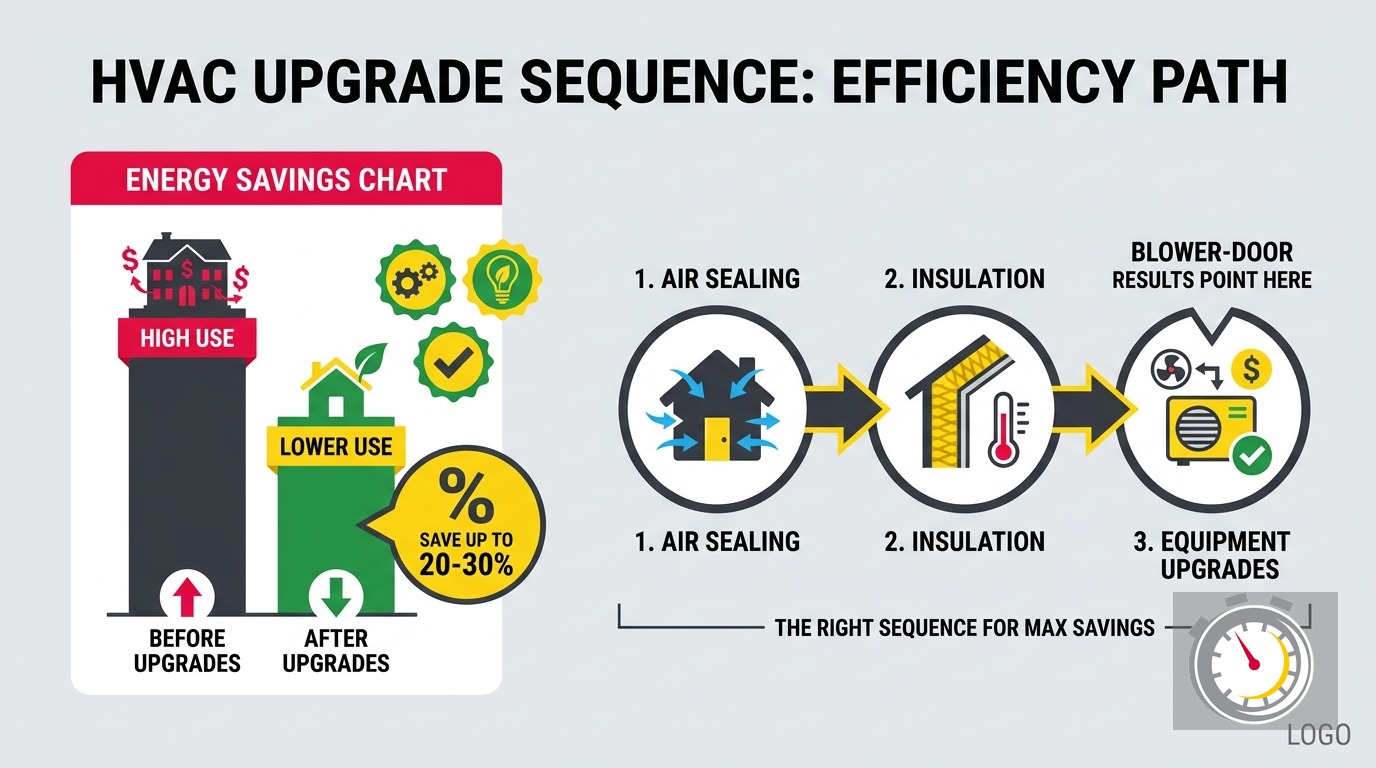
BPI, ENERGY STAR Home Performance, and ACCA Quality Installation all specify the same sequence: air seal, insulate, re-run the Manual J load calculation on the tightened house, then select equipment. This is not an opinion. It is the methodology every certified contractor is trained to follow.
The consequences of skipping it are well-documented. An estimated 75% of HVAC systems are oversized when contractors skip proper load calculations. An oversized furnace or AC short-cycles. It heats or cools the space quickly, then shuts off before it has run long enough to dehumidify the air, distribute heat evenly, or reach peak efficiency. The result is humidity problems in summer, cold spots in winter, and 15-30% more energy waste year-round.
ENERGY STAR estimates homeowners save an average of 15% on heating and cooling costs by air sealing and insulating before any equipment change. Nine out of 10 U.S. homes are under-insulated. Air leakage in a typical home is equivalent to leaving a window open every day of the year.
The savings from the right sequence are documented and real. A retrofit that drops infiltration from 0.50 ACH to 0.25 ACH can cut 15% off the heating and cooling load. That is often enough to step down one full ton of capacity. One real-world case found that envelope work cut a home’s cooling load in half. The right-sized equipment came in at $14,500. The pre-envelope quote had been $22,000. A $300 load calculation saved $7,500 on installed equipment.
For a deeper look at why this step matters, see our post on air sealing before an HVAC upgrade in Minnesota.
What Happens If Your House Tests at 5 ACH50 or Below?
When air sealing pushes your home to 5 ACH50 or tighter, Minnesota code requires mechanical ventilation. Natural infiltration no longer covers the ASHRAE 62.2 fresh-air requirement below that threshold. An HRV or ERV is not optional. Budget $1,500-$3,500 and add it to the HVAC scope before you sign any contract.
When your home is leaky, fresh air seeps in through all those cracks. That is not a good system, but it functions as one. When you air seal below 5 ACH50, you remove that accidental fresh air supply. The house becomes too tight to ventilate on natural infiltration alone.
IECC 2021, which Minnesota residential code tracks, requires whole-house mechanical ventilation when a home tests at 5 ACH50 or tighter. Minnesota mechanical code goes further: it requires a balanced ventilation system for all low-rise dwellings. Exhaust-only ventilation, like a bath fan running continuously, does not satisfy the requirement. You need an HRV or ERV that both exhausts stale indoor air and brings in conditioned fresh air.
For a 2,000-square-foot, 3-bedroom home, ASHRAE 62.2 requires approximately 90 CFM of continuous fresh air. An HRV or ERV that meets this spec adds $1,500-$3,500 to the project cost.
If your auditor projects that sealing will push your home below 5 ACH50, add ventilation to the HVAC scope before any contractor bids. The contractor who surprises you with it on install day is the one who did not read the blower door report.
Our post on ERV vs. HRV: which ventilation system for Minnesota explains the difference and helps you decide which type fits a Twin Cities climate.
How the Right Sequence Changes What You Pay for Equipment
Doing the envelope work first changes the Manual J output. That output changes the equipment recommendation. The recommendation changes the price.
A house that needed a 100,000 BTU furnace before tightening might need only an 80,000 BTU unit after. On a heat pump project, that load reduction might shift you from a 4-ton system to a 3-ton system. The installed price difference between those two tiers can be $2,000-$4,000 on equipment alone. Smaller electrical service requirements and shorter line sets add more savings on top.
The same logic applies to central AC. Right-sizing after envelope work is one of the most reliable ways to keep the installed cost in range. Our post on HVAC sizing and the Manual J load calculation covers what a proper calculation involves and what to ask your contractor.
An oversized unit also carries a comfort penalty that lasts for the life of the equipment. Short-cycling means the blower runs in short bursts at full capacity. A right-sized or modulating system runs longer cycles at lower output. The result is more even temperatures, better humidity control in summer, and less mechanical noise throughout the year. That comfort difference is something you notice every day - not just on your utility bill.
If you are planning to replace both a furnace and AC at the same time, the load reduction from air sealing can affect both systems. A lower heating load may let you step down furnace size. A lower cooling load may let you step down AC tonnage. Both savings land on the same project.
How Much Can You Save by Getting the Order Right?
Documented cases show the right sequence can cut equipment costs by $5,000-$7,500 on a single project, on top of 15-30% lower annual energy bills. The audit itself costs $100-$500. That is a strong return on the first step.
The $22,000 vs. $14,500 case is not an outlier. It is what happens when a contractor runs a real Manual J on a post-sealing load instead of sizing by square footage rules of thumb. The $300 load calculation cost is recovered in the first year of lower utility bills alone.
Add the rebate stacking math and the gap widens further. Xcel Energy’s $600 stacking bonus rewards the correct sequence with real dollars. CenterPoint’s audit-first requirement for insulation rebates builds the sequence into the rules. The programs exist because utilities have the billing data to confirm what happens when you do it right.
The per-project saving from right-sizing typically dwarfs the cost of the audit and the load calculation. The audit is where you start.
Which Rebates Stack for Home Energy Audit HVAC Upgrades in Minnesota?
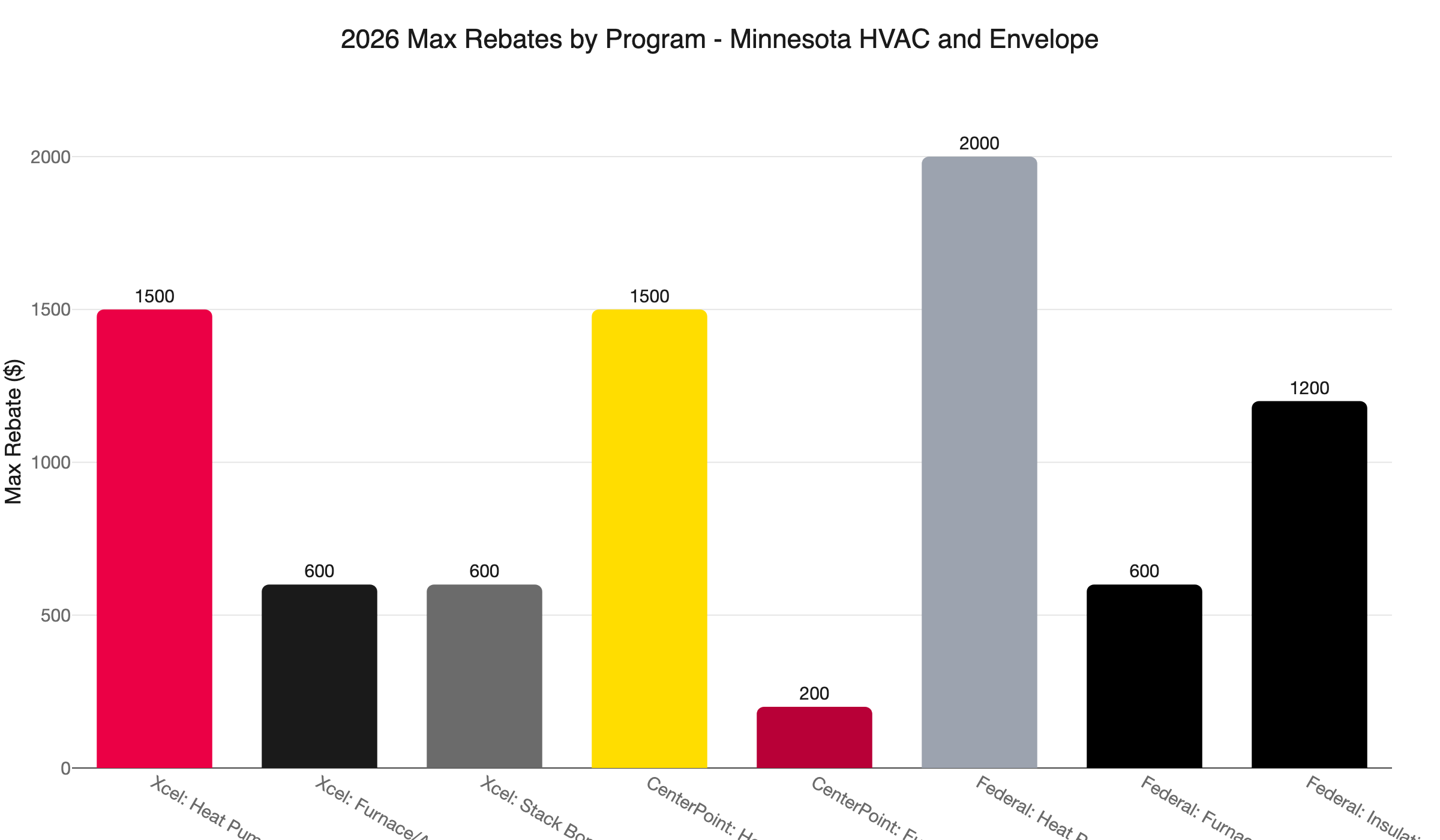
In 2026, a homeowner who follows the correct sequence can stack Xcel or CenterPoint utility rebates with the federal 25C tax credit. Combined value on a heat pump project can reach $4,000-$5,800. CenterPoint requires the audit completed before installation; the sequencing is written into their rules.
Here is how the programs line up:
Xcel Energy offers up to $1,500 on cold-climate heat pumps, up to $2,000 on mini-splits, and $200-$600 on high-efficiency furnaces and AC. The $600 stacking bonus applies when you install qualifying insulation or air sealing first and then a qualifying heat pump within two years. Apply at xcelenergy.com; deadline is September 30 of the following year.
CenterPoint Energy offers up to $1,500 for ducted air-source heat pumps and $50-$200 for qualifying high-efficiency gas furnaces. To unlock insulation and air sealing rebates, CenterPoint requires a qualifying energy audit completed before installation. This is written into their rebate rules on form CNP-1153, not just suggested practice. Deadline is December 31, 2026.
Federal 25C tax credits pay 30% of project cost: up to $2,000 for qualifying heat pumps, up to $600 for high-efficiency furnaces, and up to $1,200 combined for insulation and air sealing. Utility rebates and federal credits are not mutually exclusive. You can claim both.
One note: the MN HOMES and HEAR rebate programs are not yet launched. As of June 2026, Minnesota is still waiting for formal DOE approval with no estimated launch date. Do not hold your project waiting for them.
For a full breakdown of how to combine these programs, see our post on stacking HVAC rebates and tax credits in Minnesota. Financing is also available for larger projects. Call (763) 260-6662 and ask about options for furnace replacements, AC installs, and heat pump projects.
Does Minnesota Require a Permit for HVAC Work?
Yes. A mechanical permit is required for every furnace and HVAC replacement in Minnesota with no exceptions. Twin Cities suburb fees typically run $50-$450 depending on the municipality. Unpermitted work shows up as a defect at closing.
Minnesota requires a mechanical permit for every HVAC installation. The installing contractor must hold a current license from the Minnesota Department of Labor and Industry. You can verify a contractor’s license at dli.mn.gov before you sign a contract.
The permit process protects you. An inspection confirms that combustion venting is correct, refrigerant lines meet code, and electrical connections are safe. A permitted installation also documents that the work was done to code - which matters when you sell.
When you collect bids, ask each contractor to confirm they will pull the permit and schedule the inspection. That is standard practice for a properly licensed contractor. A bid that does not include permit costs deserves a follow-up question.
How Northern One Hour Handles Home Energy Audit HVAC Upgrades in Minnesota
We are locally owned and operated in Ramsey, MN. We serve Minneapolis, St. Paul, Blaine, Maple Grove, Plymouth, Brooklyn Park, Woodbury, Bloomington, and the surrounding Twin Cities area.
When a homeowner calls us after a blower door test, we ask for the results before we size anything. If you have a post-tightening ACH50 projection from your auditor, we use the tightened number for the Manual J calculation. If you have not yet done the air sealing, we talk through sequencing before we schedule the estimate. The equipment we recommend depends on the house you will have after shell work is done - not the house you have right now.
We run the load calculation after the envelope work is complete. We pull the permit. We schedule the inspection. We show up when we say we will. That is the commitment behind “Always On Time… Or You Don’t Pay a Dime!(R).”
If your project crosses the 5 ACH50 line, we scope the HRV or ERV as part of the HVAC project. The ventilation requirement is a technical fact. It goes in the proposal upfront, not as a surprise addition on install day.
On pricing: furnace replacements in the Twin Cities start at $3,900-$7,800 installed, depending on efficiency tier and home size. High-efficiency 95-96% AFUE units start around $6,500; top-tier 97-98% AFUE units start around $9,100. Central AC replacement starts at $7,500-$10,400 for mid-tier equipment; high-efficiency 18-20+ SEER2 systems run $11,000-$15,600. Cold-climate heat pump projects vary based on your post-sealing load calculation - call for a quote specific to your home. All pricing includes equipment, labor, and permit.
What Should You Do Right After Your Energy Audit?
Get a copy of the blower door report. Note your ACH50 number. Share it with every HVAC contractor who gives you a bid. If your number is above 5 ACH50, prioritize envelope work before equipment. If you are already at or below 5 ACH50, add an HRV or ERV to the project scope.
Here is a clear action sequence:
- Get the blower door report. Ask your auditor for the ACH50 result and any recommendations for air sealing and insulation.
- Handle the envelope first. If your home tests above 5 ACH50, focus on air sealing and insulation before you bid equipment. The Home Energy Squad through CEE is the lowest-friction audit entry point in the Twin Cities at $100 for pre-2000 homes.
- Get a post-sealing blower door test. Confirm your new ACH50 number before you size any equipment.
- Require a Manual J on the tightened house. Do not accept sizing based on square footage rules of thumb.
- Check the 5 ACH50 threshold. If your post-sealing number is at or below 5 ACH50, add an HRV or ERV to the HVAC scope.
- Stack your rebates. Apply for utility rebates before installation. CenterPoint requires the audit already completed; do not skip that step. Claim federal tax credits on your return.
- Verify permits. Confirm your contractor will pull a mechanical permit and schedule an inspection.
Call our team at (763) 260-6662 or schedule online. Share your blower door results when you call. We will tell you whether the numbers point to envelope-first or equipment-first, and give you a written scope that includes everything the project actually requires.
Frequently Asked Questions
What does ACH50 mean on a blower door test? +
Should I replace my furnace before or after air sealing? +
Does CenterPoint Energy require an energy audit before HVAC rebates? +
What happens if air sealing makes my house too tight in Minnesota? +
Need a technician now?