
Furnace Humming but Not Starting? Cold-Weather Checks
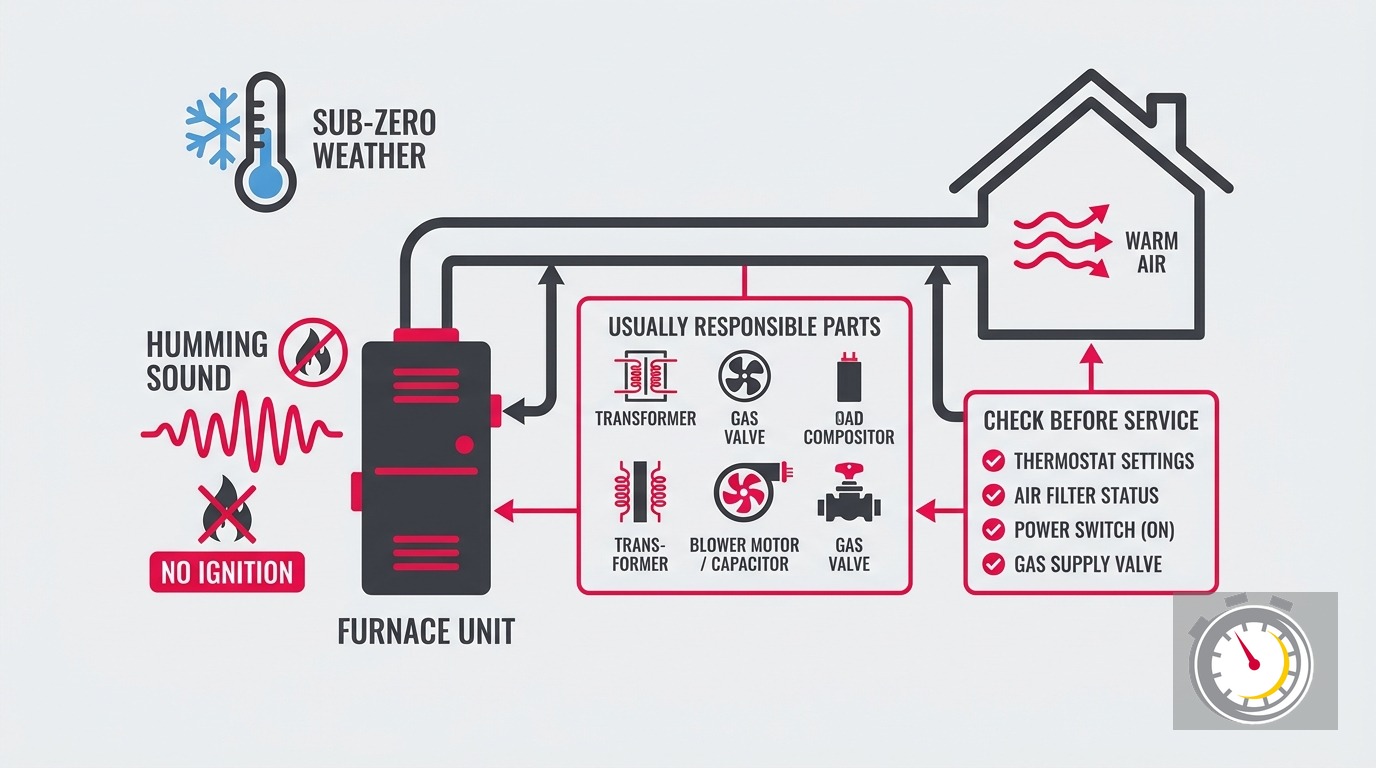
Key Takeaways
- A hum with no heat means a part is powered but not completing the startup sequence.
- Do only the safe checks: thermostat, power switch, breaker, filter, panel door, outdoor pipes, and CO alarm.
- In sub-zero weather, check the outdoor intake and exhaust pipes for snow and ice.
- Never open the electrical compartment or try to test a capacitor yourself.
- Stop and call right away for a gas smell, a burning smell, a CO alarm, or repeated failed restarts.
- Capacitors, motors, inducers, and pressure switches are the usual suspects. A technician confirms which one.
- Annual inspection by a qualified contractor catches many of these problems before the first freeze.
Furnace Humming but Not Starting: The Short Answer
A furnace humming but not starting means something is getting power but not finishing its job. A motor may be trying to turn and failing. Or the startup sequence may be stalling before the burners light.
In a Minnesota cold snap, the cause is often not the blower at all. On a high-efficiency furnace, frost in the vent pipes or a frozen condensate line can stop the sequence cold. The furnace hums, clicks, and then gives up.
We are locally owned and operated, and we know what our winters do to furnaces. Below you’ll find which checks are safe for you to try and when to stop and call us.
What does it mean when your furnace is humming?
A humming furnace has power reaching a motor or transformer, but the part is not doing its full job. A motor may be stuck or weak. A control may be waiting on a safety signal. The hum is a clue, not a diagnosis.
Some humming is normal. Many furnaces hum softly when the blower or inducer runs. That sound is fine if heat follows.
The trouble is a hum that never leads anywhere. You hear the sound, then silence, then maybe a click. The burners never light, and the house keeps cooling.
Here is how to read what you hear:
- A steady hum, no fan movement: a motor is getting power but cannot turn. This points to a start part or the motor itself.
- A hum, a short whir, then quiet: the furnace starts its sequence and then shuts down. A safety control is often the reason.
- A hum with clicking, but no flame: the sequence may be moving forward but stalling at ignition.
- A loud buzz or grinding: a mechanical part may be failing. Shut the furnace off and call.
If your furnace sounds different from a hum, we cover other noises in our guide to furnace banging, popping, and squealing sounds.
How does a furnace start up, step by step?
A modern gas furnace follows a set order: thermostat call, inducer motor, pressure check, igniter, gas valve, flame proof, and then the blower. If any step fails, the furnace stops. A hum with no heat means it failed at one of those steps.
Knowing the order shows you why the hum matters. Here is the plain-language version.
- The thermostat calls for heat. It sends a low-voltage signal to the control board.
- The inducer motor starts. This small fan pulls air through the furnace and pushes exhaust outside.
- A pressure switch confirms airflow. It proves the exhaust path is open. If the path is blocked, the switch stays open and the furnace waits.
- The igniter heats up. It gets hot enough to light the gas.
- The gas valve opens. The burners light.
- A flame sensor confirms fire. If it cannot sense flame, it shuts the gas off.
- The blower starts. After the heat exchanger warms up, the main fan pushes warm air through your ducts.
The hum usually comes from step 2 or step 7. In step 2, the inducer runs but the sequence stalls at the pressure switch. In step 7, the blower motor hums but cannot spin.
From your couch, those two cases sound alike. Their causes are very different.
What safe checks can you try first?
Start with the simple, safe checks: thermostat settings, the furnace power switch, the breaker, the filter, the blower panel door, the outdoor pipes, and your CO alarm. Stop there. Anything that involves opening electrical parts belongs to a technician.
Work through these in order. Each takes a minute or two.
1. Check the thermostat
Make sure the thermostat is set to Heat. Raise the setpoint a few degrees above the room temperature. If the screen is blank, replace the batteries. Our thermostat troubleshooting guide covers more.
2. Check the furnace power switch
Most furnaces have a switch that looks like a light switch, often on or near the unit. Make sure it is on. It is easy to bump during storage or a filter change.
3. Check the breaker
Find the furnace breaker in your electrical panel. If it tripped, flip it fully off and then back on. Do this once. If it trips again, leave it off and call us.
4. Check the filter
A very dirty filter can choke airflow and trigger a safety shutdown. Minnesota’s Department of Commerce says to check your filter every month, especially during heavy use months. The same bulletin says that at a minimum, you should change it every three months.
Slide the filter out and hold it to the light. If you cannot see light through it, replace it. Check that the new one is the right size and faces the right way.
5. Check that the panel door is seated
Most furnaces have a door switch. If the blower door is loose or not fully latched, the furnace will not run. Remove the door, then set it back firmly until it clicks into place.
Do not remove anything else. Do not reach into the cabinet.
6. Check the outdoor pipes
Most guides skip this check, and it matters most in sub-zero weather. The next section covers it.
7. Check your CO alarm
Look at your carbon monoxide alarm. Make sure it is working and not alarming. We explain why below.
If all seven checks pass and the furnace still hums without heat, stop. Do not keep cycling the power. Call us.
If your furnace shows no signs of life at all, our no-heat walkthrough for Minnesota homes covers that case.
Why does sub-zero weather cause a hum with no ignition?
Sub-zero weather can block the outdoor intake and exhaust pipes of a high-efficiency furnace. It can also freeze the condensate line. Either problem can stall the startup sequence. The furnace hums, waits for a safety signal that never comes, and shuts down.
High-efficiency furnaces suit Minnesota homes well. They pull more heat from the exhaust. That leaves the exhaust cooler and wetter, and it exits through plastic pipe, often out the side of the house.
In deep cold, that moisture can freeze into frost or ice at the pipe opening. Snow can also drift over the pipes. Then the inducer cannot move air properly, the pressure switch never closes, and the furnace will not light.
Based on our technicians’ field experience, this is a common reason for a hum with no ignition during a cold snap. Many guides focus on capacitors and blower motors instead.
Check the outdoor intake and exhaust pipes
Walk outside and find the two pipes on the side of your house, or the vent on the roof. Look for:
- Snow drifted against or over the openings
- Frost or ice built up at the tip
- Leaves, nests, or debris from earlier in the season
- A pipe that looks bent, loose, or separated
The Minnesota Department of Commerce advises you to keep snow and ice clear of furnace exhaust vents, air intake hoods, and chimneys. For side-vented high-efficiency furnaces, Minnesota Energy Resources gives the same advice: keep the vent pipe clear of ice and snow.
Gently clear loose snow with your hands or a soft broom. Do not chip at ice with a sharp tool. Do not pour hot water on the pipe, because you can crack plastic. If the ice is thick or packed in, call us.
For more on this problem, see our post on frost buildup on sidewall furnace vents.
Why the condensate line matters
A high-efficiency furnace makes water as it runs. That water drains out through a small line. If the line freezes or clogs, a safety switch can shut the furnace down.
In our experience, a frozen or clogged condensate line is a real cause of no-start calls in cold snaps. This is especially true when the line runs through a cold basement, garage, or crawl space. We do not recommend that you thaw it yourself. Call us instead.
When should you stop and call right away?
Stop and call right away if you smell gas, smell burning, hear your CO alarm, or see the furnace fail after repeated restarts. Do not keep trying. These signs point to safety problems that a reset will not fix.
Treat these as red flags:
- A gas smell. Leave the building immediately. Do not use switches, phones, or lighters inside. Call 911 or your gas utility’s emergency line from outside. Know which utility serves your home and keep that number handy. Minnesota Energy Resources says to get out of the building immediately if you smell gas.
- A CO alarm. Get everyone out of the house. Minnesota Energy Resources says that if you suspect CO poisoning, get everyone out of the house and call 911 or emergency medical help immediately.
- A burning smell. Shut the furnace off at the switch and call us.
- Repeated restarts. If the furnace hums, tries, and fails more than once, stop. Each failed attempt can stress parts.
- Scorch marks, soot, or water pooling. Leave the furnace off.
For more, see our guides on what to do if you smell gas near your furnace and carbon monoxide safety in furnace season.
Why the CO alarm check matters
A furnace that struggles to vent can also be a furnace that leaks exhaust. Blocked vents are one possible cause of CO trouble.
Minnesota requires at least one operational CO alarm within 10 feet of every room used for sleeping. The same Commerce tip lists causes of appliance failure, including a cracked heat exchanger, blocked chimneys, damaged or separated vents, and too little combustion air.
Minnesota Energy Resources also advises you to replace CO alarms older than five years. Test yours now, before you need it.
Which parts are usually responsible?
The usual suspects are the run capacitor, the blower motor, the draft inducer motor, the pressure switch, the igniter, the flame sensor, and the control board. You can’t tell which one from the couch. A technician confirms it with proper testing.
Here is how each one tends to show up, based on technician experience. None of this comes from a government page, so treat it as general guidance.
Run capacitor
A capacitor gives a motor the jolt it needs to start and keep spinning. When it weakens, the motor hums but cannot turn. This is a common cause of a steady hum with no fan movement.
Capacitor repair, parts and labor, typically runs $195 to $500 in the Twin Cities. A capacitor can hold a charge even with the power off. Do not test it or discharge it yourself.
Blower motor
If the blower motor is worn or seized, the hum may continue with no airflow. Bearings wear out. Windings fail. A failed blower motor often costs more than a capacitor. Replacement starts near $1,100 for a standard motor and about $2,200 for a variable-speed one.
We explain the signs and costs in our post on furnace blower motor failure signs and replacement costs.
Draft inducer motor
The inducer is the small fan that starts the sequence. If it is weak, noisy, or failing, the furnace may hum and then lock out. A draft inducer motor typically costs $375 to $900 to replace. Some brand-specific motors run $500 to $1,650.
See our guide to draft inducer motor failure for more.
Pressure switch
The pressure switch proves that the exhaust path is open. If the pipes are blocked or the switch is stuck, the furnace will not move on. Sometimes the switch is fine and the real problem is a frozen vent. A technician sorts that out.
Our post on pressure switch failure symptoms explains the difference.
Igniter and flame sensor
If the igniter is cracked or weak, the burners never light. If the flame sensor is dirty, the furnace lights and then shuts off in seconds. A flame sensor or igniter service typically runs $95 to $325.
Control board
The control board runs the whole sequence. A failing board can cause odd behavior, including hums, clicks, and no start. Control board replacement, installed, averages about $750. We rule out the simpler parts first.
What could be the reasons your furnace blower motor isn’t turning on?
A blower motor may not turn because of a failed capacitor, a worn motor, a tripped door switch, a dead control board, or a safety lockout upstream. Sometimes the blower is fine and the furnace never reaches the blower step.
Here is the list, in the order we usually check:
- No power reaching the motor. A tripped breaker, off switch, or loose panel door can cause this.
- A weak or failed capacitor. The motor hums and cannot start.
- A worn motor. Bearings seize, or windings fail.
- A dirty or jammed blower wheel. Heavy dust buildup can drag the motor down. See our post on dirty blower wheel symptoms.
- A control board problem. The board never sends the signal to start.
- A safety lockout. The furnace stopped earlier in the sequence, so the blower never gets its turn.
The last item is easy to miss. On a gas furnace, the blower often starts only after the burners light and the heat exchanger warms up. If ignition fails, the blower may never start. A silent blower does not always mean a bad blower.
Why will a blower run on “On” but not on “Auto”?
If the blower runs with the thermostat fan set to On but not Auto, the motor likely works. The problem is probably upstream, such as a failed ignition, a safety lockout, or a control issue that blocks the heat call.
The On setting tells the fan to run all the time. It bypasses the furnace’s heating sequence. The Auto setting lets the furnace decide when to run the fan, usually after heat is ready.
So if the fan runs on On but stays quiet on Auto, the furnace is not producing heat. The blower motor is probably fine. Look at ignition, the pressure switch, and the vent path.
Treat this test as a clue only. Setting the fan to On pushes cold air through your house, and that is not a fix. Switch it back to Auto after you test, and call us.
We explain these settings in more detail in our guide to thermostat fan Auto versus On.
Why does the first hard freeze matter for your furnace?
The first hard freeze is when weak parts finally fail. Your furnace may sit idle for months, then run hard on the coldest night. Worn capacitors, dirty sensors, and clogged lines show up at the worst time.
Think about what your furnace did in the last year. It sat unused through summer. Dust settled. Parts aged. Then it had to run for hours straight at sub-zero temperatures.
That is a lot to ask of a part that has been marginal for a while. A capacitor that barely worked in October may fail in January. A condensate line that drained fine in fall may freeze when the wind chill drops.
A routine inspection catches many of these failures. The Minnesota Department of Commerce says to inspect heating systems annually. Another Commerce bulletin says furnaces and boilers should be inspected and adjusted every year.
A pre-season visit costs much less than an emergency visit. After-hours and emergency calls often add $180 to $270 per hour on top of standard rates. Our annual maintenance plan runs $195 to $390, and a single tune-up visit runs $95 to $250. See our post on whether a maintenance plan is worth it for the full picture.
What to Expect When We Arrive
When you call us, we ask what you hear, what you smell, and what you already checked. That helps us arrive prepared. Then a technician inspects the full startup sequence, finds the failed step, and explains your options before any work begins.
Here is what that looks like in practice:
- We confirm safety first. We check for gas, CO, and venting problems before anything else.
- We watch the startup sequence. We see where it stalls, so we repair the cause and not a guess.
- We test the likely parts. Capacitor, motors, switches, igniter, sensor, and board are tested with proper tools.
- We check the vent and condensate path. In cold weather, this is a regular part of the visit.
- We explain your options. You get a clear price and a plain-language explanation before we start.
We keep our pricing honest and transparent. If the furnace is old and repairs are piling up, we will tell you. Our guide on when to repair or replace can help you think it through. If replacement makes sense, we offer financing for larger jobs.
Our on-time promise
When your furnace is down in January, waiting is the worst part. That is why we stand behind our promise: “Always On Time… Or You Don’t Pay a Dime!(R)”
In practice, we arrive within the time window you select. If our technician does not show up on time, you do not pay for the service.
We are a locally owned and operated Twin Cities company, backed by the national One Hour Heating & Air Conditioning name. We serve Ramsey, Blaine, Maple Grove, Plymouth, Brooklyn Park, Woodbury, Bloomington, Minneapolis, St. Paul, and nearby communities. We also back our work with a 100% satisfaction guarantee.
A Quick Cold-Weather Checklist You Can Save
Keep this list near your thermostat for the next time your furnace hums and does not start.
Safe for you:
- Confirm the thermostat is on Heat with a higher setpoint
- Confirm the furnace power switch is on
- Reset the breaker once if it tripped
- Replace a dirty filter
- Seat the blower door firmly
- Gently clear snow from the outdoor intake and exhaust pipes
- Check that your CO alarm works and is not older than five years
Call us:
- Any gas smell, burning smell, or CO alarm (leave the house first)
- A furnace that fails again after one reset
- Ice packed into the vent pipes
- A frozen or leaking condensate line
- Any hum paired with a seized or silent blower
- Anything that requires opening the electrical compartment
Your Furnace Is Humming and the House Is Getting Cold
A trained technician rarely finds a humming furnace that won’t start to be a mystery. It is also rarely a good DIY project. The safe checks above take a few minutes. If they do not solve it, the next step is a professional diagnosis.
Do not wait until the house drops to a risky temperature. Call Northern One Hour at (763) 260-6662, or book online to schedule fast. Pick your time window, and we will be there. If our technician is late, you do not pay for the service.
If cost is a concern, the Minnesota Department of Commerce lists an energy assistance line at 800-657-3710. We also offer financing for larger repairs and replacements.
Frequently Asked Questions
Is it safe to keep resetting a furnace that hums but will not start? +
Can a humming furnace be dangerous? +
How much does it cost to fix a furnace that hums and will not start? +
Should I try to test or discharge the capacitor myself? +
Need a technician now?