
Furnace Keeps Tripping Breaker? Causes and Safe Next Steps
Key Takeaways
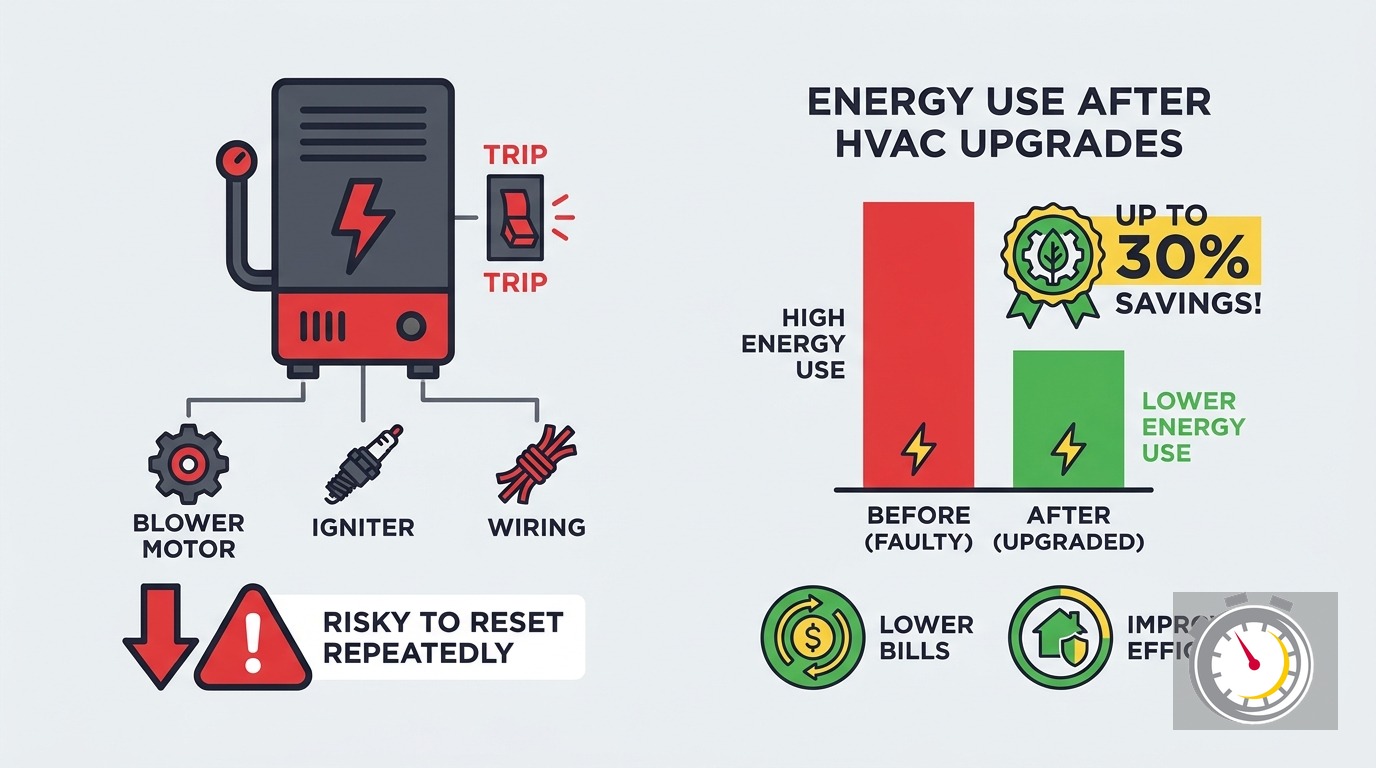
- A furnace that keeps tripping its breaker has a real electrical or mechanical fault. Do not keep resetting it.
- One reset after a brief surge can be fine. A second trip means stop and call.
- When the breaker trips tells you a lot: right away, when the blower starts, or when the igniter glows.
- The usual suspects are a failing blower motor, a shorted igniter or inducer, a bad capacitor, pinched wiring, or a control board fault.
- Never swap in a larger breaker. It hides the problem and puts the wiring at risk.
- In Minnesota, changes to the circuit itself fall under electrical licensing rules. Furnace repair falls to us.
- Call Northern One Hour at (763) 260-6662 or book online. We are locally owned and operated, and we protect your time with our on-time promise.
Why does a furnace keep tripping the breaker?
A furnace keeps tripping its breaker because something in the system is drawing too much current or leaking it. The usual causes are a failing blower motor, a shorted igniter or inducer motor, a bad capacitor, damaged wiring, or a worn control board. The breaker is doing its job.
Think of the breaker as a smoke alarm for your wiring. It does not cause the problem. It tells you one exists.
We get this call often in the Twin Cities, especially when the first hard cold arrives. The furnace sits idle for months, then runs for days without a break. Weak parts fail under that load.
Below, each trip pattern is matched to its likely cause, along with what you can safely check. We are an HVAC company, so we cover the furnace side and point out where an electrician is the right call.
What does resetting the breaker over and over actually do?
Each reset sends power back into a circuit that just failed. If the cause is a short, a seized motor, or a damaged wire, that power flows into the fault again. The trip is a warning, and repeated resets ignore it. This is why safety groups tell you to stop.
A breaker trips when current climbs past a safe level. That current heats the wire and the failing part. Reset the breaker and you restart the heating.
One reset may be harmless. One equipment maker’s troubleshooting guide says a single reset after a one-off surge may be fine. It also says that if the breaker trips again, you should not keep resetting it, because the trip signals an underlying problem.
Federal safety guidance agrees. The Consumer Product Safety Commission’s home electrical checklist warns that if one appliance keeps tripping the breaker, it may have a fault that is a fire or shock hazard. A furnace has a motor, a heating system, and a control board. That is a lot of places for a fault to hide.
Here is the risk in everyday terms:
- A damaged wire can heat up inside a wall where you cannot see it.
- A seized motor can overheat and burn its windings.
- A shorted part can fail further each time it gets power.
- A tripped furnace in winter pushes you to try “just one more” reset.
That last one matters most. Cold weather makes the temptation stronger. Resist it.
How do you reset a furnace circuit breaker safely?
Turn the furnace power switch off first. Find the furnace breaker in your panel and push it fully to off, then back to on. Wait about 30 seconds before you reset it. Turn the furnace switch on and watch the first cycle. If it trips again, stop and call.
Follow these steps once, and only once:
- Set the thermostat to off.
- Flip the switch on or near the furnace to off. It often looks like a light switch.
- Open your electrical panel. Look for the furnace breaker. It sits in the tripped or middle position.
- Push the breaker all the way to off. Then push it to on.
- Turn the furnace switch back on.
- Set the thermostat to heat and watch the furnace through one full start-up.
Stay near the panel and the furnace. Listen for a hum, a buzz, or a click. Smell the air near the furnace for hot or burning odors. If you notice any of these, turn the furnace off at the switch right away.
If the breaker holds and the furnace runs normally, note the date and time. A one-time trip may have come from a power surge. If it happens again within days, treat it as a real fault. Our guide to furnaces that will not start after a storm or power surge covers that situation.
If the breaker trips a second time, leave it off. Do not try for a third.
How does the timing of the trip point to the cause?
Timing is the best clue you have. A breaker that trips the moment you reset it points to a short or ground fault. A breaker that trips when the blower starts points to the motor circuit. A breaker that trips when the igniter glows points to the igniter or its wiring. A breaker that trips after a while points to overload.
Most articles skip this part, and you do not need a meter for it. Just watch what the furnace was doing when the breaker let go.
Use this simple decision tree:
- Trips the instant you reset it. The fault is likely a dead short or a ground fault. Something is touching metal or another wire. Do not reset again.
- Trips when the blower starts. Suspect the blower motor, its capacitor, or its wiring.
- Trips when the igniter glows. Suspect the hot surface igniter, the inducer, or the wires feeding them.
- Trips after running for several minutes. Suspect overload or overheating. A motor that works too hard can draw more current as it warms up.
- Trips when the thermostat calls for heat. Suspect low-voltage wiring or a control board problem.
These patterns come from how electrical faults generally behave. We offer them as practical field guidance, not a law of nature. A technician still has to test the parts to be sure.
Write down what you saw. A clear description saves diagnosis time when we arrive.
Can a failing blower motor trip the breaker?
Yes. The blower motor is one of the biggest electrical loads in your furnace. When its bearings wear or it seizes, it pulls extra current. That surge can trip the breaker the moment the blower tries to start.
A wearing motor often gives warnings first:
- A humming sound, but no spinning
- A grinding or squealing noise
- Air that feels weak at the vents
- A burning smell from the furnace cabinet
- Cycles that start, stall, and stop
A failed run capacitor causes a similar story. The capacitor helps the motor start and keep running. When it fails, the motor strains and draws too much current. Read about furnaces that hum but do not start for more.
Motor type matters too. Older furnaces use a permanent split capacitor motor. Newer ones often use a variable-speed motor with its own electronic module. Both can fail, and the repair differs. Our post on blower motor failure signs and costs walks through both types.
Dirt plays a role as well. A caked blower wheel makes the motor work harder. See our guide to a dirty blower wheel and its symptoms if your furnace is older.
Do not try to free a stuck blower while power is on. Do not spin it by hand to “test” it with the breaker on. Leave motor work to a technician.
Can a bad igniter or inducer motor trip the breaker?
Yes. A hot surface igniter glows white-hot to light the gas, and it draws real current. If the element cracks or its wiring shorts, the breaker may trip as the igniter powers up. The inducer motor, which pulls exhaust out of the furnace, can short the same way.
The sources we reviewed describe these as common causes, but they give no single furnace-specific standard. We say it because we see it on the job.
Watch for these signs:
- The breaker trips just as you hear the inducer start, or just as the igniter begins to glow.
- The furnace clicks, then goes quiet.
- You smell something hot or scorched near the furnace.
- The control board shows an error code.
Our guides to igniter failure signs and draft inducer motor failure explain what these parts do. A furnace that will not ignite on a cold morning may have a different issue, such as a dirty sensor. A technician can sort out which.
Igniters are fragile. Do not touch the element with your fingers, because skin oil shortens its life. The part also sits behind a panel with live wiring.
Can thermostat wiring or the control board cause a trip?
Yes. A pinched thermostat wire can create a short on the low-voltage side. A failing control board can send power where it should not go. Either can cause repeat trips, or a furnace that acts strangely before the breaker lets go.
Thermostat wire is thin, but it is part of the same system. It runs behind the furnace, through walls, and past metal edges. Over time, vibration can rub the insulation through. A new furnace install or a tight panel can pinch a wire too.
The control board is the furnace’s brain. It tells the blower, inducer, igniter, and gas valve when to run. Boards fail from age, heat, moisture, and power surges. Symptoms include odd error codes, a furnace that never starts, or a furnace that cycles without logic.
Learn more in our guides to control board failure symptoms and furnace blinking-light error codes. If your thermostat screen is also dead, see our thermostat blank screen troubleshooting page.
Do not strip, tape, or splice wires on your own. A bad splice on a furnace can cause bigger trouble than the one you started with.
Should my furnace be on a 15 or 20 amp breaker?
Your furnace should be on the breaker size printed on its nameplate. Look for the maximum overcurrent protection and minimum circuit ampacity ratings. Many furnaces use a 15 amp circuit, and some need 20 amps. We cannot name one size for every home. Match the nameplate and the wire gauge, and never upsize.
The nameplate is a metal label on the furnace, often inside the blower door. It lists the maximum breaker size and the minimum wire capacity the furnace needs. Those two numbers tell a licensed professional what the circuit must be.
Never solve the problem with a larger breaker. The CPSC checklist says not to install a higher-amp breaker or fuse to stop trips. The wire inside your wall has a safe limit. A bigger breaker lets more current flow before it trips, so the wire can overheat first.
Here is what a mismatch can look like:
- A furnace wired to a breaker that is too small trips under normal load.
- A breaker that is too large lets a fault run too long.
- A shared circuit, with lights or outlets on it, may trip from the combined load.
Many furnaces should sit on their own dedicated circuit. If yours shares a circuit with other loads, ask a licensed electrician. We cover who handles what further down.
How do you check a furnace circuit breaker step by step?
Look at the panel first. A tripped breaker sits in the middle or off position, and it may feel loose. Push it fully off, then on. Check the furnace switch, the door switch, and the filter. Never open the furnace cabinet, and never touch the panel wires. If you are unsure, stop.
Here is a safe checklist any homeowner can follow:
- Check the furnace switch. Make sure it is on. An off switch can look like a dead furnace.
- Check the blower door. Furnaces have a door switch. If the panel is loose, the furnace will not run.
- Look at the panel. Find the breaker for the furnace. Note whether it is tripped, off, or on.
- Check the label. Make sure the breaker is marked for the furnace, not another room.
- Reset once. Follow the steps above. Do not repeat.
- Check the filter. A clogged filter strains the system. The Department of Energy’s guidance says to check forced-air furnace filters and generally replace them about once every month or two, and more often in heavy use.
- Look for signs. Note any burning smell, buzzing, or scorch marks. Mention them when you call.
What not to do matters as much:
- Do not remove the panel cover on your electrical panel.
- Do not use a meter on live wires unless you are trained.
- Do not touch scorched or melted wiring.
- Do not bypass a safety switch on the furnace.
A warm or buzzing breaker is a warning sign. If it smells hot, shut off the main breaker if you can do so safely, and call for help. If you smell gas, leave the home and call your gas utility. See our gas smell guide for steps.
Why does a tripping furnace matter more in a Minnesota cold snap?
A furnace that stays off in subzero weather puts your home at risk of freezing pipes and a fast drop in indoor temperature. The cold also tempts people to keep resetting a bad breaker. That is the worst moment to ignore a warning. Heat the home another safe way and call us.
We have no official number to offer here. This is general guidance from years of Twin Cities winters. When the temperature drops, you feel pressure to get heat back at any cost. The breaker is telling you the cost may be a fire.
If your furnace is down on a cold night, do this:
- Leave the tripped breaker off.
- Close doors to unused rooms and keep warm air in your main living space.
- Open cabinet doors under sinks on exterior walls to let warmer air reach the pipes.
- Use extra blankets and layers.
- Never use a gas oven, grill, or generator indoors for heat.
- Call us.
Read our steps for a furnace that is out tonight and our guide to frozen pipes and HVAC failure risk for more.
Carbon monoxide matters too. A struggling furnace can vent poorly, so check that your detectors work. Our carbon monoxide safety guide explains where to place them.
When you call us, our on-time promise applies. Northern One Hour backs it with “Always On Time… Or You Don’t Pay a Dime!(R)” In plain terms, we arrive within the time window you select. If the technician does not show up on time, you do not pay for the service.
Who can fix furnace wiring and breaker problems in Minnesota?
Minnesota separates HVAC work from electrical work. An HVAC technician can diagnose and repair furnace parts like the motor, igniter, and control board. Work that changes the electrical circuit itself, such as a new dedicated circuit, calls for a licensed electrical contractor and often a permit.
Northern One Hour is HVAC only. We repair furnaces, air conditioners, heat pumps, thermostats, and indoor air quality equipment. We do not do electrical or plumbing work. If your panel or house wiring needs work, we will tell you so plainly.
State guidance draws a line worth knowing. A Minnesota Department of Labor and Industry HVAC bulletin has said an HVAC contractor may replace a furnace without a licensed electrician only if they disconnect and reconnect the existing branch circuit without modifying it. Any circuit modification requires a licensed electrical contractor. That bulletin may have been updated since, so confirm the current rules with the state before relying on it.
Permits are part of this too. The state’s homeowners page says homeowners can request electrical permits through the Department of Labor and Industry’s website for work on their own property.
Local rules vary. The state handles many permits and inspections, while St. Paul runs its own electrical permitting. We cannot give one rule for the whole metro, so check with your city. Our post on when an HVAC permit is required covers the HVAC side.
The safety groups agree on the main step. The National Fire Protection Association’s electrical safety checklist says to call a qualified electrician if you have frequent problems with blowing fuses or tripping circuit breakers. We agree. If we test the furnace and find it healthy, the problem may sit in the circuit, and an electrician takes over.
What will a technician check when your furnace keeps tripping?
A technician starts with safety, then works through the electrical path. We check the breaker, the wiring, the blower motor and capacitor, the igniter, the inducer, and the control board. We measure current draw and look for shorts. Then we explain what we found before any repair.
A typical visit looks like this:
- Listen to your story. What you saw and heard narrows the search quickly.
- Inspect the panel and wiring. We look for loose lugs, scorch marks, and damaged insulation at the furnace.
- Test the blower motor. We check the motor, the capacitor, and the wheel for drag.
- Test the igniter and inducer. We check their wiring and their draw.
- Check low-voltage wiring. We look for pinches, frays, and shorts at the thermostat run.
- Inspect the control board. We look for burn marks and error codes.
- Confirm the breaker size. We compare it to the nameplate and tell you if it looks wrong.
Then we give you the options. Some fixes are quick, like a capacitor or an igniter. Others, like a seized blower motor or a failed board, cost more. For a rough sense of what repairs run, see our furnace repair cost guide. You can also read about our furnace repair service.
Sometimes the answer is bigger than a part. If your furnace is old and keeps failing, replacement may make more sense. Our guide on repair or replace decisions can help you weigh it. If you replace, we offer financing options for larger jobs. See our financing overview.
Why does my furnace run for a few seconds and then shut off?
People often confuse this with a trip, but it is a separate problem. A short run followed by a shutdown usually means a safety control stopped the cycle. If the breaker is not involved, the cause is often a dirty flame sensor, a blocked filter, or a pressure switch fault. See our FAQ below for the quick answer.
Our guides to the flame sensor and short cycling go deeper. If the breaker also trips, return to the steps above and stop resetting.
How can you prevent breaker trips before they start?
Regular maintenance catches weak parts early. A tune-up checks motors, tightens electrical connections, and cleans out dust that makes parts run hot. Change your filter on schedule. Keep the area around the furnace clear. Consider surge protection for your HVAC equipment.
The equipment maker we cited earlier notes that its tune-up includes cleaning and lubricating the motor and tightening electrical connections. That matches what we do. Loose connections create heat. Heat wears out insulation. Worn insulation leads to shorts.
The Department of Energy also advises having a professional service the equipment once a year. We suggest scheduling before the heating season starts, when we have more room in the calendar. Read what a furnace tune-up includes and whether a maintenance plan is worth it.
Add these habits:
- Replace your filter on a regular schedule. Our guide to how often to change your HVAC filter helps you pick one.
- Keep storage away from the furnace. See our clearance guide.
- Learn what a surge protector can do for your HVAC system.
- Do not ignore small signs. A new buzz or a bit of burning smell deserves a call.
Air conditioners trip breakers too. If your summer system does the same thing, read why an AC keeps tripping the breaker. Many of the same rules apply.
If the blower will not stop instead, our post on a furnace blower that runs constantly covers that opposite problem.
Why call Northern One Hour for a tripping furnace?
We are a locally owned and operated Twin Cities HVAC company, backed by the national One Hour Heating & Air Conditioning name. We know Minnesota winters and the homes they test. We show up when we say we will, and we explain what we find in plain language.
Here is what you get:
- Technicians who treat a repeat trip as the safety issue it is
- Clear options before work begins
- Honest, transparent pricing
- A 100% satisfaction guarantee
- Our on-time promise: “Always On Time… Or You Don’t Pay a Dime!(R)” means we arrive within the window you choose, or you do not pay for the service
We serve homeowners across the Twin Cities, including Minneapolis, St. Paul, Ramsey, Blaine, Maple Grove, Plymouth, Brooklyn Park, Woodbury, and Bloomington. Learn more about why on-time service matters.
What should you do right now?
If your furnace has tripped the breaker once, reset it one time and watch it. If it trips again, leave it off. Note when it tripped. Keep the home as warm as you safely can. Then call us.
Do not keep resetting, do not upsize the breaker, and do not open the cabinet.
Call Northern One Hour at (763) 260-6662 or book online. We will find the cause, explain it clearly, and get your heat back on safely.
Frequently Asked Questions
Why does my furnace run for a few seconds and then shut off? +
Is it safe to keep resetting a furnace breaker? +
Can a dirty furnace filter trip the breaker? +
Can I put in a bigger breaker to stop the trips? +
Need a technician now?