
Furnace Won't Turn On After Power Surge? Check This First
Key Takeaways
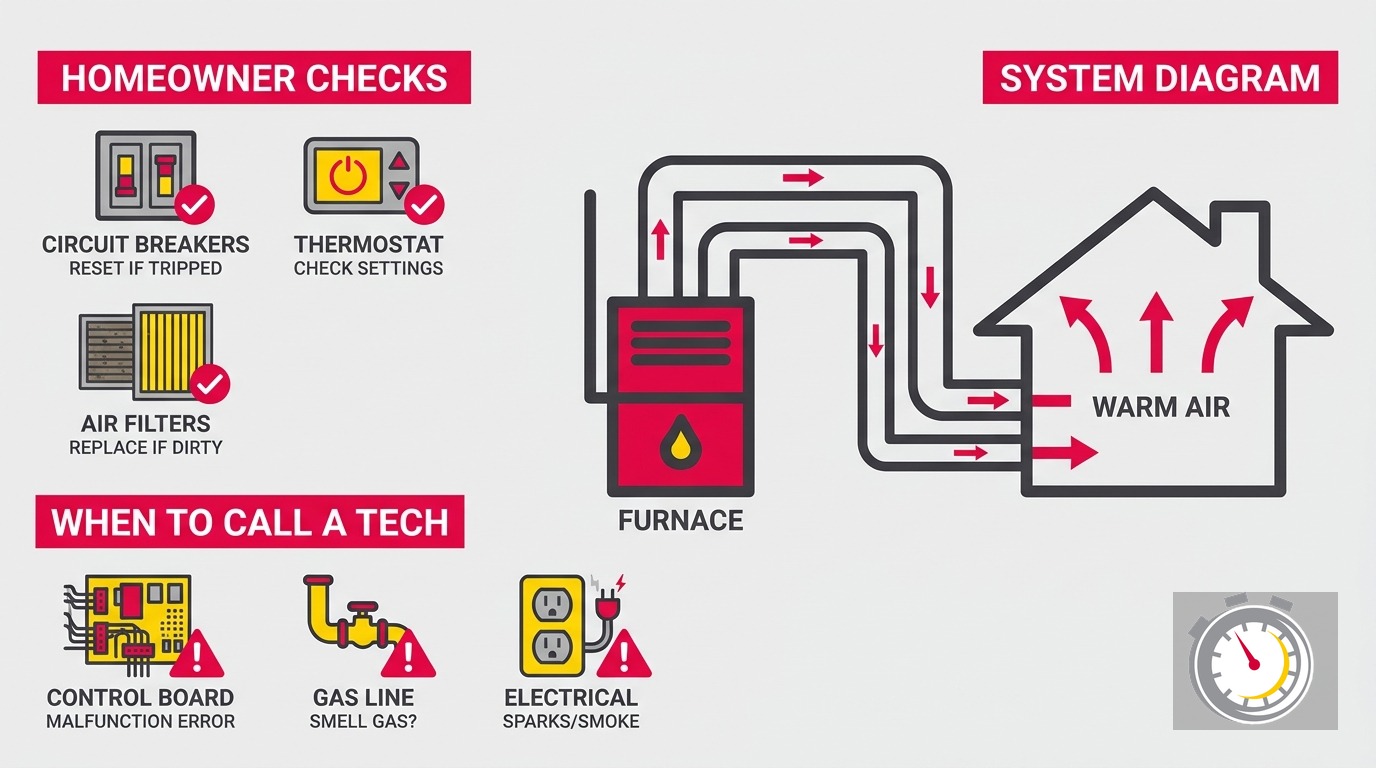
- Work from the outside in: panel, power switch, thermostat, door switch, then the diagnostic light.
- Try one reset only. A second failure means a part may be damaged.
- Never open the control board, handle wiring, or touch the gas valve.
- Stop and call if a breaker trips again, you smell burning, or the light stays dark with power confirmed.
- Surges often hit when power returns, not when it fails. Switch the furnace off before the grid comes back.
- Check your carbon monoxide alarms any time a furnace acts up after a storm.
- Whole-house plus point-of-use surge protection lowers the odds of a repeat.
Why Your Furnace Won’t Start After a Surge
Start outside the furnace and work inward. Check the breaker, the furnace power switch, the thermostat, and the blower door switch. Then look at the small diagnostic light. One careful reset is fine. After that, stop and call a pro.
Summer storms are a common surge source in the Twin Cities. Lightning, downed lines, and utility switching can all send a spike through your home’s wiring. Your furnace sits idle all summer, so you may not find the damage until the first cold morning in October.
Why Is My Furnace Not Working After a Power Surge?
Short answer: A surge can trip a breaker, blow a small fuse, or confuse the control board. Sometimes the furnace just needs power restored. Other times a part took a hit. The checks below separate the simple fixes from real damage.
Most online guides treat this as a plain outage, but a surge is different. An outage cuts power. A surge pushes too much power through your wiring for a split second.
Your furnace is full of sensitive electronics. The control board is the brain. It tells the blower, the inducer fan, the igniter, and the gas valve when to run.
A surge can stress that board, a fuse on it, or a motor. We cannot see inside your furnace from here, so treat this as general technical guidance, not a diagnosis.
Here are the common outcomes after a surge:
- Nothing happened. The breaker tripped or a switch flipped. A reset fixes it.
- A small fuse blew. The board lost power. The fix is quick for a technician.
- The board is damaged. The furnace may show no light or an error code.
- A motor or sensor took a hit. The furnace tries to start, then stops.
- The thermostat lost power. The screen is blank and the furnace never gets a call for heat.
At home, your job is to rule out the easy items safely. Repairing anything inside the cabinet is not your job.
Will the Furnace Come Back On After a Power Outage?
Short answer: Usually, yes. Most modern furnaces restart on their own once power returns. If yours does not, the cause is often a tripped breaker, an off switch, a dead thermostat, or a safety lockout. A surge may also have damaged a part.
A plain outage should not harm your furnace. The system shuts down and waits. When power returns, the board runs a startup check. Then it calls for heat when the thermostat asks.
That is why timing matters. The risky moment is often when power comes back, not when it leaves. Utilities sometimes restore power in surges and flickers, and a string of on-and-off blinks is hard on electronics.
Our guide to what happens to your heat during a Minnesota power outage goes into more depth. It also explains how to stay warm while you wait.
If the furnace does not restart within a few minutes of steady power, move to the ladder below.
Before You Touch Anything: Safety First
A few rules keep you safe.
- Smell gas? Leave the house. Call your gas utility from outside. Do not flip switches.
- See smoke or scorching? Leave and call 911.
- Standing water near the furnace or panel? Do not touch anything. Call a pro.
- Dizzy, nauseated, or headachy? Get everyone outside and read the carbon monoxide section below.
If none of that applies, you can go on. Keep a flashlight handy. Do not use a candle or open flame near the furnace.
How Do I Reset My Furnace After a Power Outage?
Short answer: Check the breaker, flip the furnace power switch off and on once, confirm the thermostat is on and calling for heat, and wait five minutes. Do this one time. If the furnace fails again, stop and call a technician.
Think of this as a storm-surge triage ladder. You start at the panel and move toward the furnace. Each step is cheap and safe. Stop the moment something does not match.
Step 1: Check the electrical panel
Find your main panel. Look for a breaker in the middle or off position. The furnace breaker may be labeled “furnace,” “heat,” or “boiler.”
To reset a tripped breaker, push it fully to off. Then push it firmly to on. If it clicks back to the middle right away, stop. Do not try again.
A breaker that trips twice points to a short or a damaged part. Resetting it over and over can make things worse.
Also check for a tripped GFCI outlet nearby. Some furnaces share a circuit with one.
Step 2: Check the furnace power switch
Most furnaces have a switch that looks like a normal light switch. It sits on or near the furnace, often on a wall or the side of the cabinet. People bump it more than you would think.
Make sure it is on. If it was on, flip it off, count to ten, and flip it on again. That gives the board a clean restart.
Step 3: Check the thermostat
A dead thermostat can look like a dead furnace. Look at the screen. If it is blank, the thermostat may have lost power or batteries.
Replace the batteries if your model uses them. Then set the mode to heat and the temperature a few degrees above the room temperature.
If the screen stays blank with fresh batteries, the surge may have hit the thermostat or its wiring. Our guide on fixing a blank or dead thermostat walks through what to check.
Step 4: Check the blower door switch
Furnaces have a safety switch that cuts power when the front panel is off. If the panel is slightly loose, the furnace will not start.
Make sure the lower panel is seated fully and snug. You may hear or feel a small click. This check is safe because you are not reaching inside.
Step 5: Look at the diagnostic light
Most furnaces have a small light behind a viewing window in the door. It blinks in patterns, and each pattern is a code. The next section explains how to read it.
Step 6: Wait, then stop
After steps one through five, wait about five minutes. Furnaces run a startup sequence. You may hear the inducer fan first, then a click, then the burners.
If the furnace starts, watch it for one full cycle. If it does not start or shuts off again, stop. Do not repeat the ladder.
How Do I Read the Furnace Light After a Surge?
Short answer: Look through the small window on the furnace door. A steady light usually means normal operation. A blinking pattern is an error code. No light at all, with power confirmed, points to a blown fuse or a failed control board.
Most guides skip this step. The light is your furnace talking to you, and you need no tools to read it.
Here is how to use it:
- Find the small window or opening in the front panel. The light sits behind it.
- Note the pattern. Count the blinks and the pauses between groups.
- Write it down, or take a photo with your phone.
- Check the sticker on the inside of the door for the code chart. Do not remove the door if it is not designed to open easily.
Patterns differ by brand. A steady green light often means normal. Rapid flashing or a repeating count usually means a fault. Our furnace error codes and blinking light guide covers common patterns in plain English.
Give the code to the technician when you call. It saves diagnostic time.
What “no light” can mean
If the furnace switch is on, the breaker is on, and the door switch is closed, you should see a light. A dark window suggests the board is not getting power. That may be a blown fuse or a damaged board.
Do not poke around to find out. This is a stop-and-call moment.
What a lockout looks like
A lockout means the furnace tried to start several times and gave up. A safety feature shuts it down. A surge can trigger one by disrupting a sensor reading mid-cycle.
Some lockouts clear with a single power reset. If it comes back, there is a real cause. We explain more in our post on furnace ignition lockouts that won’t reset.
What Should You Never Touch on a Surge-Hit Furnace?
Short answer: Never open or touch the control board, never handle wiring, and never touch the gas valve. These parts carry live voltage or control fuel. A mistake can cause shock, fire, or a gas leak. Leave all three to a licensed technician.
Homeowners can do a lot, but some parts are off limits. Here is the short list.
- The control board. It holds live circuits and static-sensitive parts. Touching it can finish off what the surge started.
- Wiring and connectors. Loose or burned wires may look minor. They are not. Do not tape, twist, or swap them.
- The gas valve. It controls fuel to the burners. Only a licensed tech should test or replace it.
- The burner area and flue pipe. Do not remove parts to look inside.
- Fuses on the board. A blown fuse is a symptom, and something caused it. A fresh fuse can blow again, or hide a bigger problem.
Online videos make this look easy and skip the risks. A tech has meters, training, and the right tools to test safely.
To learn more about the board itself, read our guide to furnace control board failure symptoms and costs.
When Should You Stop and Call a Technician?
Short answer: Call right away if a breaker trips again, you smell burning or gas, the furnace locks out repeatedly, or the diagnostic light stays dark with power confirmed. Also call if the furnace short cycles, makes new noises, or leaves you unsure.
If any item below fits, put down the flashlight.
- A breaker trips a second time. Do not keep resetting it.
- A burning or hot-electrical smell. Shut the furnace off at the switch. Call us.
- A gas smell. Leave the house first. Call your gas utility, then us.
- Repeated lockouts. The furnace tries, fails, and shuts down again.
- No light on the board with power confirmed. Breaker, switch, and door switch are all fine.
- A blank thermostat after new batteries. The thermostat or its wiring may be damaged.
- Strange noises on startup. Humming, clicking, or banging after a surge needs a look.
- Other electronics also died. If the surge hit your TV or router, assume the furnace was exposed too.
In winter, a dead furnace is more than an inconvenience. If it is cold and you have no heat, see our steps for what to do when your furnace is out tonight.
When you call, we ask a few simple questions: what you saw, what the light is doing, and what you already tried. Having that ready speeds things up.
How Do You Reset HVAC After a Power Surge?
Short answer: Turn the thermostat to off, reset any tripped breaker, and wait about five minutes. Turn the system back on at the thermostat. Air conditioners need that wait to protect the compressor. If the system fails again, stop and call a technician.
Many Twin Cities homes have one thermostat for heat and cooling. A surge that hits the furnace may hit the AC, too. They share the blower, the control board, and the thermostat wiring.
Here is a safe reset for the whole system:
- Set the thermostat to off.
- Check the furnace power switch and the breakers for both furnace and outdoor AC unit.
- Reset any tripped breaker once.
- Wait about five minutes. This delay protects the AC compressor from starting under pressure.
- Set the thermostat to heat or cool and watch the result.
Do not cycle the system on and off several times in a row. Short, repeated starts are hard on motors. They also stress parts that a surge may already have weakened.
If your AC is also acting up, our post on an AC that keeps tripping the breaker explains what that can mean.
Carbon Monoxide: Why It Matters After a Storm
A furnace that acts up after a storm can also be a carbon monoxide risk. Storm season brings generators, blocked vents, and rushed repairs. Carbon monoxide is an odorless, colorless gas that can cause sudden illness and death if inhaled.
You cannot smell it, so you need working alarms.
Minnesota law requires them. State statute calls for an approved and operational carbon monoxide alarm installed within ten feet of each room lawfully used for sleeping purposes in a single-family dwelling. Test yours after any storm.
If you run a generator during an outage, follow these rules from the CDC:
- Never run it inside a home, basement, or garage.
- Keep it more than 20 feet away. The CDC warns against placing it less than 20 feet from any window, door, or vent.
- Use a battery-powered or battery backup CO detector while it runs.
If anyone shows signs of CO poisoning, get them outside. Then call 911 or Poison Control at 1-800-222-1222.
For more on generator risks and your home’s air supply, read our guide on portable generator CO risk and combustion air.
What Surge Repairs Can Cost
Prices vary with the part, the brand, and the time of day. These ranges are typical Twin Cities starting points for installed work. Your technician will give you an exact quote before any work begins.
| Repair | Typical range |
|---|---|
| Flame sensor or igniter service | $95-$325 |
| Capacitor repair | $195-$500 |
| Draft inducer motor | $375-$900 |
| Control board, installed | Around $750 |
| Blower motor (PSC or ECM) | $1,100 or $2,200 |
After-hours calls can add an hourly premium on top of standard rates. If the damage is widespread, replacement may make more sense than repair. Furnace replacement in the Twin Cities typically runs $3,900-$7,800 installed.
Ask whether your homeowners insurance covers surge damage. Our overview of homeowners insurance and HVAC coverage explains what to ask your agent. Keep photos and the technician’s written findings.
If you do need a new furnace, we offer financing options so a surprise does not become a hardship. Our furnace replacement cost guide breaks down what drives the price.
How Can You Protect Your Furnace From the Next Surge?
Short answer: Combine whole-house surge protection at the panel with point-of-use protectors on sensitive equipment. Also switch the furnace off before power returns after an outage. Surges often arrive during restoration, so a few seconds of caution protects expensive parts.
You cannot stop lightning. You can lower the odds that a spike reaches your furnace board. Treat this as general guidance, and have a licensed professional review your setup.
Switch off before the grid returns
This step is free. If you know an outage is underway, turn the furnace power switch off. Leave it off until the lights have been steady for several minutes.
Utilities often restore power in stages. That can create flickers and spikes. Waiting spares your board the roughest moments.
Whole-house surge protection
A whole-house protector installs at or near your main electrical panel. It helps absorb big spikes before they travel through the wiring. A licensed electrician installs it. Northern One Hour does not do electrical work, so ask a qualified electrician.
Point-of-use protection
A point-of-use device protects a single piece of equipment. Some are made for furnaces and air conditioners. They add a second layer closer to the equipment.
Ask your HVAC technician which type fits your furnace and AC. Using both layers gives you the best coverage. Our post on HVAC surge protectors and lightning protection goes deeper.
Keep up with maintenance
A clean, tuned furnace puts less stress on its parts. A yearly tune-up also lets a tech spot weak components before a storm finds them. Learn what is covered in our furnace tune-up cost and inclusions guide.
Test in September, not January
Run your furnace for a short cycle in early fall, on a mild day. If a summer storm damaged anything, you find out before the deep cold arrives. Our fall HVAC shutdown and startup checklist shows how.
A Quick Local Note on Utilities
During a widespread outage, your utility is the right contact for line and meter problems. Your furnace is on your side of the meter. That is where we come in.
If you see downed lines, stay away and call 911. If your meter or service equipment looks damaged, you will need your utility and a licensed electrician before we can safely work on your system.
We have not verified specific utility phone numbers for this article, so check your latest bill or your utility’s website for the right outage line.
Why Call Northern One Hour
We are a locally owned and operated Twin Cities HVAC company. We know how our storms, our winters, and our homes treat equipment. Our team serves Minneapolis, St. Paul, Ramsey, Blaine, Maple Grove, Plymouth, Brooklyn Park, Woodbury, and Bloomington.
We also stand behind our timing. Our promise is “Always On Time… Or You Don’t Pay a Dime!(R)” That means we arrive within the time window you select. If the technician does not show up on time, you do not pay for the service.
We also back our work with a 100% satisfaction guarantee and honest, transparent pricing.
For a furnace that will not start after a surge, our furnace repair team can:
- Read the diagnostic light and error history.
- Test the control board, fuses, and safety switches.
- Check motors, sensors, and the igniter.
- Confirm the furnace is safe to run.
- Walk you through repair and replacement options, with financing if you need it.
Do not wait if you are cold or unsure. A furnace that limps along after a surge can fail at the worst moment.
Call (763) 260-6662 or book online to schedule fast.
Final Checklist
Keep this list handy for the next storm.
- Check the breaker. Reset it once.
- Flip the furnace power switch off, then on.
- Check the thermostat and its batteries.
- Make sure the front panel is seated.
- Read the diagnostic light and write down the code.
- Wait five minutes, then stop.
- Do not touch the board, wiring, or gas valve.
- Test your CO alarms.
- Call a technician if anything on the stop-and-call list applies.
A furnace that won’t turn on after a power surge is stressful. Checking in the right order keeps you safe and saves time.
Frequently Asked Questions
Can a power surge permanently damage a furnace? +
Should I turn off my furnace during a summer storm? +
Is it safe to keep resetting a furnace that will not stay on? +
Does Northern One Hour fix furnaces after storm surges? +
Need a technician now?